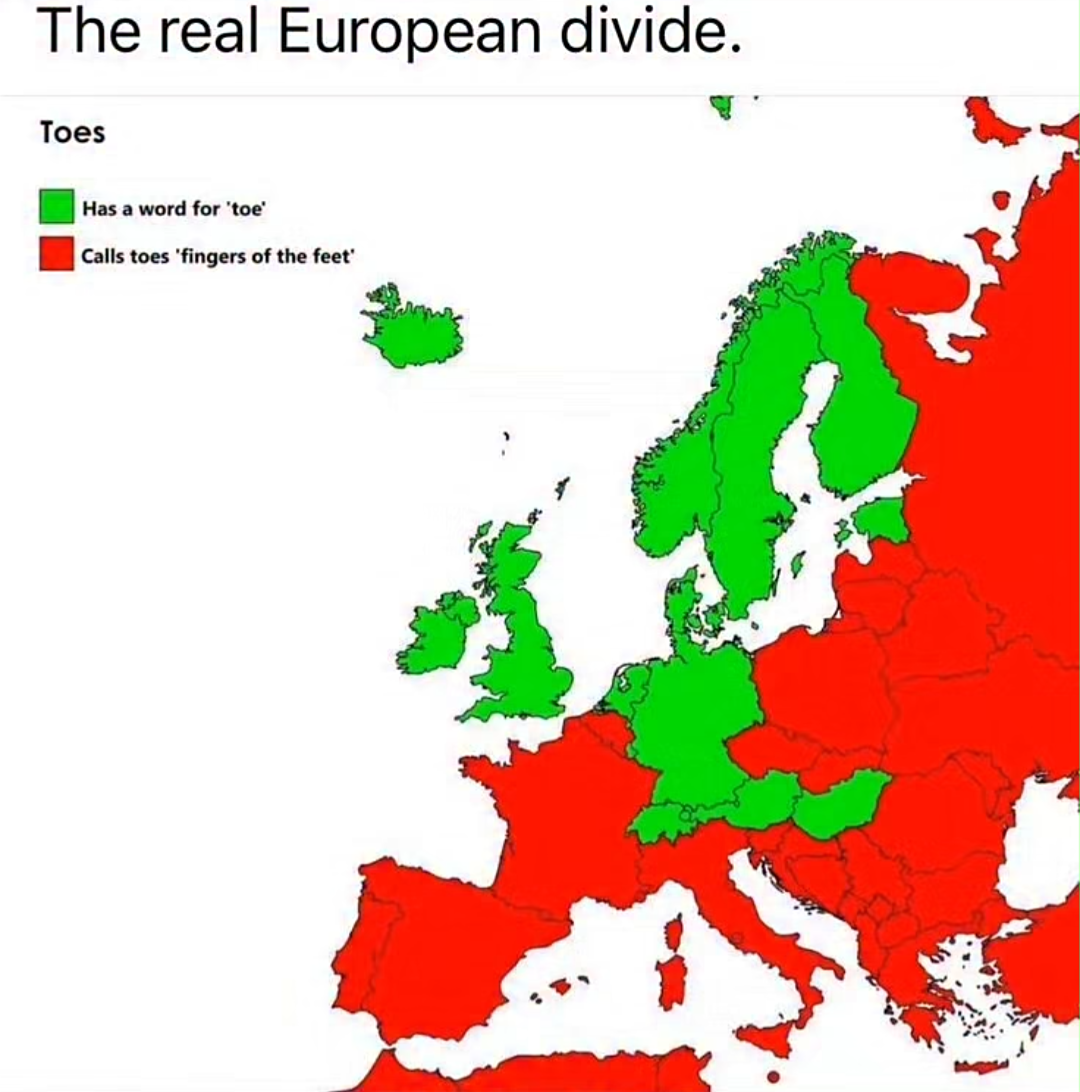
So the Flemish part of Belgium has "tenen", which is not toefinger. The french have "orteils", which is also not fingers of the foot( finger is doigt ).
So the map is at least wrong for those two countries.
So the Flemish part of Belgium has "tenen", which is not toefinger. The french have "orteils", which is also not fingers of the foot( finger is doigt ).
So the map is at least wrong for those two countries.
I'm wondering if they got France and Germany mixed up. I don't remember all the French I was taught growing up, but it didn't sound right. So I googled it and got "droigts" and "orteils" for "fingers" and "toes".
German has "Finger" and "Zehen"
Yes, but why do we say "Fußzeh" there aren't any other "Zehen" on the body, right?
I don't think I have ever heared anyone say "Fußzeh". Maybe it's regional?
Both "orteils" and "doigts de pied" are used in French, the former sounding less childish than the latter.
The same language where ninety-two is "four twenties and a twelve"?
Just four twenty twelve, that's enough. We're not savages.
Ninety two is nine ten two anyway, it's not that far off. In fact french and Basque at least do have a word for twenty, english doesn't.
Twenty is rebranded two ten.
Thirty is third ten.
And so on.
It's fucking far off. I can't stress how bonkers your number naming is. I speak two romance languages and two Germanic ones, and I'll not try French because this and many other bullshittery.
I think you're allowing this to make you angrier than you should.
You clearly speak English, which I think of as the mongrel child of two or three Germanic languages and a Romance one, and not in a good way, so I also think it's the most fucked up and inconsistent one of the lot. The only thing it's got going for it as a language is genderless nouns.
Not angry at all, thank you for the concern.
And yeah, English is terrible, the absolute divorce between writing and speaking being the most salient point for me. But it's the lingua franca, you can't not speak it if you want to interact in the world stage. But, for all its faults, I'm glad it replaced French in this role.
The invention of the printing press and of the dictionary at a time of great language change has been problematic for English spelling.
Why do you feel English is better than French? I think English has most of the problems of French and then a whole bunch of its own, but I'm interested in your perspective.
I wouldn't say better, just easier to learn the basics.
For instance, it is a mostly incomplete language from a conjugation standpoint. While I love the communication power romance languages have in verbal conjugation, they do present an obstacle for learning.
Plural is also quite easy in English, as are basic adverbs.
If only English had consistent pronunciation rules like German, it would be a near prefect lingua franca.
In confused by you saying that french verb conjugation is all three of: mostly incomplete, powerful and hard to learn. Did you mean inconsistent rather than incomplete?
Would German make a better lingua franca?
I'm told sanskrit is pretty logical.
Oh, is was taking about English. Sorry it wasn't clear.
German is quite hard grammatically, with its dative case and inconsistent use of genders for non gendered things. It's got some phonemes that are quite hard for adult learners too. The one thing it's got going for a lingua franca is the consistent pronunciation rules.
Don't know anything about Sanskrit. Sounds interesting.
French took it's number system from Basque, which is at least more consistent since iirc in French 70 is 60+10 while the consistent logic should be 3*20+10.
Anyway, you say that twenty is far from twenty ->twen ten->second ten. 70 in Basque is hirurogeitahamar->hirur hogei ta hamar->hirugarren (third) hogei(twenty) eta(and) hamar(ten). It's the same logic.
The only reason you say it's bonkers is because you don't understand. Different = wrong. Lmao.
Also, don't fucking say that french is my language, I'm Basque Spaniard.
Also, as the other commenter said, we are speaking English, do you understand how insane of a language it is? It's a Frankenstein of several languages where words were imported while keeping the pronunciation, so there's no fucking logic as to how you are to say things.
How do you said "read"? No that's wrong, I meant the past tense. Oh, it needs context?
How do you say entrepreneur? Why are you saying it in French? Fuck logic.
In Spanish you are able to pronounce correctly any word you read for the first time because the rules it has define strict pronunciation. Same for Basque, the only thing you might do wrong is intonation but most of the time it's the second syllable. It's fucking crazy that you both need to learn a word and how it's pronounced in english, for every word.
Oh, extra edit. If the Basque/French counting system makes the language too hard don't touch spoken Chinese lmao, intonation changes completely words way more frequently than Papa/papá.
The other word for twenty in English is score. Pretty rarely used, however.
Congratulations. You've just discovered how base 10 counting works.
Not really. We are talking about how numbers are called in different languages. Other languages have actual names for twenty that aren't a combination of digit+ten.
Basque is hogei, ten is hamar, two is bi, there is no phonetic similarity. The way language is created then informs how counting and numbers work.
Spanish has a proper distinct name for 20, but then is like english for 30 and above.
No need to be so passive aggressive while not understanding what I was trying to explain.
I'm not being passive at all.
First off, the remark about French and 92 is a jab at French in particular. No other romance language for some reason stalls out at 70 and cobbles together the 80s and 90s. There is a modern word, IIRC "neufant" or something that's closer to "nine tens."
To your point, base 10 counting, which we use because of how many fingers our species has. Whether we use base 8, 10, 12, etc. counting, the fact remains that all counting uses incremental increases like base 10.
9 rolls over to 1 unit in the 10s column. 19 rolls over to 2 units in the 10s column.
So if we say "4 x 20" instead of 80, were suddenly creating a second, nested, base 20 counting system (confusingly, using base 10 numbers!) within our usual base 10 system. So it's the same in the sense that we are using numbers in general, but different in that it anchors the counting base in a weird way.
Let's say I run a restaraunt and make omlettes. I can make a 2 egg, 3 egg, or 4 egg omlette for you. But the 4 egg omlette is tiny. Why? Because for the 4 egg omlette I use quail eggs. But only for the 4 and 5 egg omlettes. Order a 6 egg omlette and you're getting a half dozen chicken eggs in some 100 square meter omlette. Multiples of 4 and 5, always quail eggs. It's sort of like that.
in French, les orteils but also plenty of slang: les nougats, les arpions, les radis, les haricots...
Language maps shouldn't be country maps, as language boundaries rarely overlap country borders. And it's also wrong, in Hungarian toe is "lábujj" literally means "footfinger"
Sociocultural boundaries are almost entirely grounded in language. Nation states are almost entirely grounded in imagination.
By that logic, it should be both green and red, because it looks like "lábujj" is both a word, and like you said it means "footfinger".
I suspected it was rage bait, starting with the British isles being coloured green, despite the existence of the word 'toe' there.
hungary is the wrong colour too: "lábujj" lit. "footfinger". more confusingly, the middle is "lábfej", which is "foothead"
So, Germanic and Uralic languages vs. Latin and Slavic languages.
Ok, so Albanian and Greek are the outliers here. Albanian is its own language group.
Though, to be fair to Greek, the word is for toe and finger is δάχτυλο. Dachtylo. Which is kind of like "digit." Even in Koine Greek. Also, arm and hand are the same word, and leg and foot are the same word.
My Greek isn't good enough to say for sure, but a pre-Google language manuals call both finger and toe dachtylo. Then specify hand or foot. Or...specify arm or leg? Arm digit? Leg digit?
Greece should be a grey "N/A"
For some reason I always get really annoyed when Lithuanian gets grouped into slavic even when it makes sense.
Hungarian here, we're in the "fingers of the feet" group!
Nope. In portuguese we do not call the toes "fingers of the feet". In fact we do not have a word for fingers. Or toes.
What we have instead is a word for those little appendages that one can find at the end of one's arms or legs. We call them "dedos". Most of the time we do not feel the need to specify if we are talking about fingers or toes. Context is usually enough to distinguish between the two. But when do have to be specific, we call the fingers "dedos of the hands" and the toes "dedos of the feet".
Now, that may seem weird to some, but to me what is really surprising is that some languages found it necessary to use two words to describe what is essentially the same fucking shit.
"Digits" would be the English equivalent of "dedos", and the words are indeed related.
Now, that may seem weird to some, but to me what is really surprising is that some languages found it necessary to use two words to describe what is essentially the same fucking shit.
Sucking on fingers is an entirely different kink from sucking on toes. So somewhat different I suppose.
to me what is really surprising is that some languages found it necessary to use two words to describe what is essentially the same fucking shit.
I mean, you can start calling all sorts of body parts the same shit, and some of them even have words already. Like we say arms and legs, but we could also say upper and lower limbs. We've got knees and elbows and shoulders, but they're all just joints.
Now I'm wondering what languages have the fewest words that could describe the entire body, as in once you break down the word "body" into any number of parts (without using the word "body", like upper and lower body), how many other words are needed? I think in English you couldn't get away with anything less than head, neck, torso, and extremities (although one might argue that the latter refers only to hands and feet so you'd have to put limbs back in as well).
what is essentially the same fucking shit.
?
You stubbed your finger?
As someone who only speaks English, the cognitive map made by that language is kind of disgusted to think of toes and fingers interchangably.
Fingers are (or should be) clean, and are allowed to touch many things. I am perfectly comfortable touching many things with my fingers that other people's fingers have touched.
But toes? Toes are gross. They are not interchangeable with fingers. Unless I'm in the shower cleaning my toes, if my fingers touch my toes I probably need to wash my hands after. And other people's toes?...
No - toes and fingers are not the same thing. My toes are great, I'm glad to have them for balance while walking or running. But they are not fingers, or vis versa
Huh what? Dedos are fingers. And we say "dedos dos pés".
You said "nope" then wrote a paragraph of text to confirm what you just tried to deny.
But we also say "dedos das mãos", don't we? A lot, in fact. You are not seriously trying to convince me that you are portuguese but you do not know this, are you?
"Dedos" can be used for hands and feet. Fingers are exclusively used to describe the digits of the hands. That's my point.
Also, I wrote 3 paragraphs. Learn to count and learn to read.
But we also say "dedos das mãos", don't we? A lot, in fact.
Absolutely not. If I come running saying "ah meu deus, quebrei o dedo" you'd immediately assume fingers, not toes, if I meant toes I would specify, otherwise fingers are the default. I don't think I can even recall a scenario of specifying "dedos das mãos" except for some kind of medical talk or children's play or something like that.
that you are portuguese
I'm brazilian.
"Dedos" can be used for hands and feet.
Sure, which means just like the map implied we use "fingers of the feet" to say "dedos dos pés" and we don't have a specific word for it. Thanks for confirming my (and OP's) point you tried to deny.
Also, I wrote 3 paragraphs. Learn to count and learn to read.
You're very angry for somebody disproving their own argument one comment later.
If you are brazillian, then why are you replying to my post about european portuguese? You are just wasting my time with your irrevelant rant.
This is a silly and pointless discussion. A lot of things that are true for brazilian-portuguese are false for portuguese. And vice-versa. Apparently, dedos means fingers in brazillian. I did not know that. But that does not change the fact that in portuguese dedos means either fingers or toes.
Merry christmas. Please stop bothering me.
i always use this as an example of how deeply the languages we use shape how we understand the world
even the answer to the question "how many fingers do you have?" changes depending on the language, and that's a physical fact that seems to not have any degree of subjectivity to it
Eight. A thumb is not a finger.
In certain Austroasiatic languages, your wrists and ankles are your hand-necks and foot-necks.
This unites the Germanic and Uralic languages in by far the most important cultural way.
False, italian has a word for toe that is separate from the fingers of the feet (alluce)
That is specifically the name for the big toe though, and while there are names for the various other toes (they're quite uncommon, I don't remember them), they're not generic like "toe"
No, only alluce is a real word. The other names seems to be made up just to make a funny story.
Source: https://accademiadellacrusca.it/it/consulenza/i-nomi-delle-dita-dei-piedi/1119
I don't know much about it, but I suspect this is not far off from being just a map of the 'Germanic" language family.
Not quite. Green countries are germanic or uralic (finnish, estonian, hungarian). I assume each country is only represented by a single language on the map, and Ireland is probably assumed to be speaking English according to this map.
Ah excellent, thank you.
I think the numbers speaking Irish Gaelic are incredibly small, whereas Welsh is still a commonly spoken first language away from south Wales.
I looked up the welsh for toes and found toesau which is a Welsh pluralised borrow from English, but also bysedd traed, which is indeed fingers of the foot, so I think Wales should be added to the stripey red and green part of the map as per other comments.
I just can't get over how in Japanese, 足 means from like thigh, all the way down to tippy toes. Drives me nuts.
At least they usually use 脚 for leg and 足 for foot, even if they're homophones.
I have a proposal:

Slovakia and czechia is in wrong color too. In slovak language we have toe is palec and prst is finger
That's not what a toe is. Toes are the digits on feet. Palec is either "thumb" if on hand or "big toe" in on a foot.
I'm pretty sure the English don't even consider the things on your feet to be fingers at all, though they can say "digits" to cover both fingers and toes (so "digit" would be the most exact translation of "prst", rather than finger... though in most contexts "finger" is good enough).
As a polish person: What the fuck.
We use palec for both fingers and toes.
It's a Google Translate issue. It says some version of prst nogi/noši for every Slavic language.
Any languages have both? Like Japanese has ashi(no)yubi [foot('s)finger], and although yubi is technically digit it's much more common to use it for finger. Then there's also tsumasaki, literally meaning nailtip (or point, end, head, etc).
top 94 comments