top 66 comments

sorted by: hot top controversial new old
[+] 77 points 1 year ago (18 children)
  • [–] 27 points 1 year ago (17 children)

    Maybe English should just get rid of the stupid "the first consonant is silent when two consonants form the beginning of a word" rule tbf.

    It's a skill issue to mispronounce loan words (like gnome, pterodactyl or psychology).

  • source
  • parent
  • hideshow 17 child comments
  • [–] 11 points 1 year ago (4 children)

    If you don’t pronounce the p in pterodactyl or psychiatrist then lose my number

  • source
  • parent
  • hideshow 4 child comments
  • [–] 17 points 1 year ago (3 children)

    If I start pronouncing them, can I get your number?

  • source
  • parent
  • hideshow 3 child comments
  • [–] 8 points 1 year ago (1 child)

    Snail, small, three, press, change. I could keep going.

    I've never heard of that rule. There are a few combos that are basically always that way though: pt, gn, and kn come to mind.

  • source
  • parent
  • hideshow 1 child comment
  • [+] 30 points 1 year ago (8 children)
  • [–] 38 points 1 year ago* (4 children)

    I was already an adult when I learned that "salmon" is supposed to be pronounced as "sammon".

  • source
  • parent
  • hideshow 4 child comments
  • [–] 2 points 1 year ago (2 children)

    Wait wait wait... How are baked and naked supposed to be pronounced?

  • source
  • parent
  • hideshow 2 child comments
  • [–] 1 point 1 year ago* (2 children)

    out of curiosity, do you speak another language than English?

  • source
  • parent
  • hideshow 2 child comments
  • [+] 2 points 1 year ago (1 child)
  • [–] 2 points 1 year ago*

    ah, I was wondering because, in comparison to my native tongue (French), I've found English significantly more intuitive. I may be biased though, or French may just be another mongrel of a language πŸ˜…

    My uneducated feeling so far is that most languages weren't developed with particularly logical rules, and rules were added retroactively, and as such, most languages are ugly amalgamations, but English gets some of the worst rep because of its dominance on the internet.

  • source
  • parent
  • [–] 55 points 1 year ago* (1 child)
  • [–] 39 points 1 year ago (5 children)

    Making a fork of GNOME called GGNOME fr

  • source
  • hideshow 5 child comments
  • [–] 37 points 1 year ago (19 children)

    I use KDE because I never want to have to worry about how to pronounce it. There is no ambiguity with KDE, it's just K D E

  • source
  • hideshow 19 child comments
  • [–] 23 points 1 year ago (5 children)

    It's pronounced kiddy.

    Just KDEing..

  • source
  • parent
  • hideshow 5 child comments
  • [–] 13 points 1 year ago (2 children)

    My wife works at a bakery that uses an ordering system called FreshKDS (kitchen display system in case you’re wondering). She always calls it fresh kids.

  • source
  • parent
  • hideshow 2 child comments
  • [–] 7 points 1 year ago (3 children)

    I am still thoroughly confused whether I should call it KDE or Plasma or Plasma Desktop. Like, what is the difference?

  • source
  • parent
  • hideshow 3 child comments
  • [–] 9 points 1 year ago (2 children)

    KDE is the author, Plasma is the application. There is ambiguity since they don't make more than one desktop environment - so all are good.

  • source
  • parent
  • hideshow 2 child comments
  • [–] 28 points 1 year ago* (3 children)

    If it makes anyone feel better, I watched a coworker write β€œsequel” in her notes while I was talking about SQL.

  • source
  • hideshow 3 child comments
  • load more comments (1 reply)
    [–] 28 points 1 year ago (6 children)

    Meanwhile, me, a non-native English speaker:

  • source
  • hideshow 6 child comments
  • [–] 5 points 1 year ago (1 child)

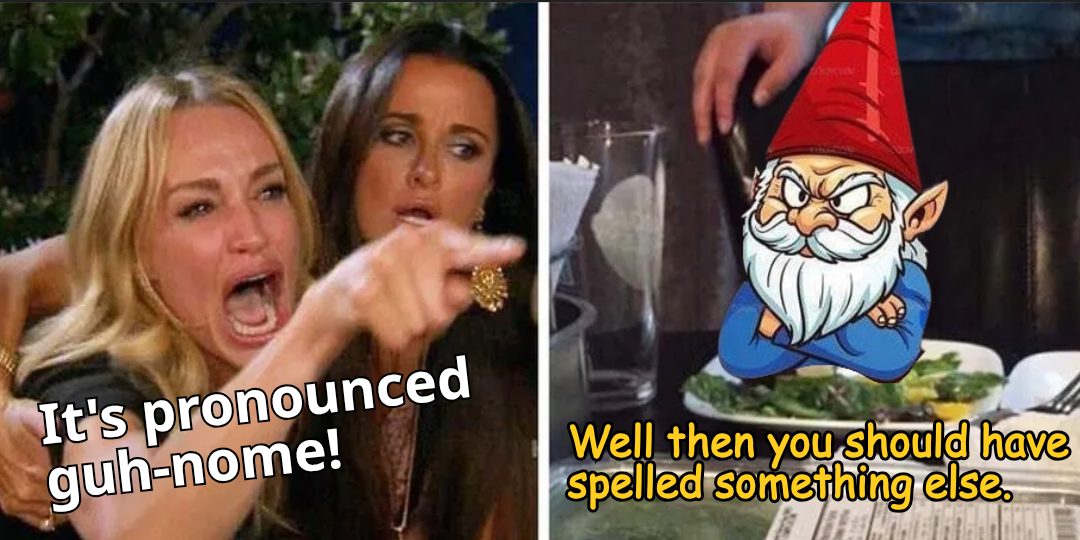
    The G is silent in English words starting with gn. Gnarly gnats is pronounced narly nats.

    There's not a lot of those words anyway

    Gnu and gnome are exceptions only when used to describe the software. The gnu animal and the mythical gnome creature are pronounced with silent gs.

  • source
  • parent
  • hideshow 1 child comment
  • [–] 3 points 1 year ago (2 children)

    The only way to learn what something sounds like as a non-native speaker is to look it up or listen to someone pronounce it. There are no rules -- or at least no useful rules, because any rule will have many exceptions. Even different English dialects differ in how to pronounce words. There's simply no making sense of it.

    For example, in many British English dialects, the "a" in "can" and the one in "can't" are pronounced completely differently, despite "can't" being a contraction of "can not". It's literally the same word, just with a different word afterwords, and yet the two get different pronunciations. There's no way to guess at that being the case, or come up with a logical reason why. You just have to accept it.

  • source
  • parent
  • hideshow 2 child comments
  • [–] 20 points 1 year ago (1 child)

    We native speakers of German intuitively pronounce an audible "g" followed by an audible "n" when reading "GNOME" and find it weird that the ordinary word "gnome" is pronounced with a silent "g" in English. The cognate in our first language is "Gnom", pronounced with two consonants in the beginning, like the desktop environment.

  • source
  • hideshow 1 child comment
  • [–] 3 points 1 year ago

    It wasn't silent for me in UK, it was G as in the ng sound in the word sing so ngnome. The back of tongue at back top of throat rather than just starting with Nome that has N with tongue at front of mouth.

  • source
  • parent
  • [+] 19 points 1 year ago* (last edited 1 year ago) (5 children)
  • [–] 11 points 1 year ago (4 children)

    In Italian "gn" sounds like a brief "nyuh" or "ny" like in gnocchi.

    So "nyome".

  • source
  • parent
  • hideshow 4 child comments
  • [–] 18 points 1 year ago

    Yohohoho!

    I'm not a KDE, I'm not XFCE, I'm not LTQt, I'm not a Hyprland, I'm not a Cinnamon, I'm a Guh-Nome! And you have been Guh-Nomed!

    borks your Linux

  • source
  • load more comments
    view more: next β€Ί