top 11 comments

sorted by: hot top controversial new old
[–] 23 points 1 year ago* (last edited 1 year ago) (3 children)

I wonder if history will repeat with PCs, and especially handheld PCs, a market which the Steam Deck effectively sparked into life, while Nintendo, PS, and Xbox crash and burn should there be a second Video Game Crash any time soon.

Because all three of the current console vendors aren't doing great at all, in fact Xbox is basically already dead and even the Switch 2 seems DOA as far as exclusives go and it's very much maligned by the press atm, while PC seems to be doing fine comparatively especially considering the success of the Steam Deck and the other PC handhelds which followed it.
  • source
  • hideshow 3 child comments
  • [–] 16 points 1 year ago

    Nintendo will not change, maybe they will get out of the US.

    Sony may sack their console departments and stick to everything else.

    Microsoft is already getting over with Xbox.

    Steam Deck and clones will become the new handhelds, along with (possibly) Android gaming phones with controllers.

    PC architectures will displace console ones.

  • source
  • parent
  • [–] 7 points 1 year ago

    In a world where you have a choice other than a walled garden, are you surprised people pick an open platform? Exclusives are never a good thing for the consumer, it is a way to control the user and deprive them of choice. About time people started wising up.

  • source
  • parent
  • [–] 18 points 1 year ago* (last edited 1 year ago) (5 children)

    Oh my beloved C64! I made my first "real" games with it, my buddies were artistic and made the music, sprites, animations, etc. I programmed the tools to make them!

    The worst aspect of the C64 was that the hardware was a mostly undocumented mystery zone. As an early teen, I had the C64 programmer's reference manual checked out of our library for 2 years!!! Doing any kind of advanced graphics meat PEEKing and POKEing random addresses and registers and interrupts to see what would happen. A nightmare! My hat's off to all the demo scene folks that did ludicrous stuff

    edit: My first released game was "Studmaster" replete with every horrible thing your mind is currently imaging lmao. I'm not proud of this now but it was pretty wild for two 14 year old kids in the 80's to make a small-scale text/graphic adventure game and publish it

  • source
  • hideshow 5 child comments
  • [–] 7 points 1 year ago* (last edited 1 year ago) (4 children)

    The worst aspect of the C64 was that the hardware was a mostly undocumented mystery zone.

    This is simply false. The C64 was a completely open platform, everything was open, including how you programmed the special hardware directly. Even the included documentation was pretty good to get started, and included examples on how to program audio, graphics and sprites directly to the hardware.

    For more advanced programming (assembly) you obviously needed to purchase the tools and documentation. The included book was only meant to get you started with the included BASIC. But the tools were cheap and documentation were extremely cheap compared to other computers, because it was a completely open platform.
    The ability to have an assembler on a capsule in shadow ROM was extremely powerful.

    The philosophy of Jack Tramiel was to put the hardware in the hands of users, and let them do whatever they wished without limitations. No closed garden at all.
    Exactly because of that Jack Tramiel was a fucking hero IMO. And no other computer had more hacks and programming examples available at the time. And I bet it was a huge reason for why C64 was by far the best selling home computer for years.

    Atari and Texas Instruments however at the time were closed, and therefore IMO useless.

    Included book for C64:
    https://www.commodore.ca/commodore-manuals/commodore-64-users-guide/

  • source
  • parent
  • hideshow 4 child comments
  • [–] 1 point 1 year ago (1 child)

    I don't ever remember seeing a list of PEEKs and POKEs. Guess it never occured to me that there was better documentation to be had. Every pin in the machine was clearly documented though.

  • source
  • parent
  • hideshow 1 child comment
  • [–] 1 point 1 year ago*

    No computer I know of ever came with an actual hardware reference.

    However the concept is shown for instance on page 60, that shows peek and poke address for border and background color.
    The C64 had a lot to get you started, way more than most, but it is still just to get you started.
    If you want to get serious on a C64 you don't peek and poke much, but program in assembly.

  • source
  • parent
  • [–] 1 point 1 year ago* (1 child)

    You are talking a lot of philosophical stuff, but the reality was when you wanted to get the low level hardware, there was very little documentation. Even banks of the technical documents had giant blanks saying these are a bunch of video registers and interrupts, basically good luck lol

    I don't sense that you have any actual experience programming on that platform, because if you did you'd know what I'm saying

  • source
  • parent
  • hideshow 1 child comment
  • [–] 1 point 1 year ago* (last edited 1 year ago)

    but the reality was when you wanted to get the low level hardware, there was very little documentation.

    The low level of what? Graphics sprites sound and IO were ALL documented!
    Maybe horizontal and vertical smooth scrolling wasn't in the included book, which is essentially just an introduction for beginners, but such things were absolutely released info by Commodore, and it was dead easy to do for that reason, such info was everywhere!

    I don’t sense that you have any actual experience programming on that platform,

    I absolutely did, and I programmed sprites in assembly, and made a program we called sprite design, where you could design and animate sprites, which we never released, because we were under the false assumption that you didn't release software until it was perfect.
    Later when i didn't use the C64 anymore, a friend of mine borrowed all my software, and came back absolutely ecstatic about how professional Sprite Design was, and was very puzzled he had never heard about it.
    We made a build in help function using our own 90% efficient compression, we used self modifying code, and utilized the 6510 ability to switch off the ROM to have access to the RAM at that address space, and swapped where the character set was located and used our own 6 pixel wide character set, with an interrupt to give a tiny beep sound with key presses. The main structure was made with the Petspeed compiler, but everything surrounding the sprite animations was assembly. ( fuck 8 bit programming 😜 ) I made pretty sophisticated algorithms to make the weird 8x8 or 4x8 graphics format in color easier and faster to work with.
    The C64 was amazing for its time for its speed and hardware capabilities. Despite being a machine that ran slightly below 1 MHz it was quite fast for its time.

    You just probably isn't aware that all that was openly available on the C64 wasn't on most other computers of the time.

    A collection on C64 books: https://archive.org/details/commodore_c64_books

    An example of a book describing assembly and hardware registers:
    https://archive.org/details/Assembly_Language_Programming_With_the_Commodore_64_1984_Brady_Communications_Company/mode/2up

    But also there was a ton of info released in magazines like RUN etc.

    I'm not sure what info exactly you think was lacking? Except of course there were a few things that were possible that even the creators of the chips were unaware of, But was figured out by hackers. Such things can obviously not be part of the official documentation.

  • source
  • parent
  • [–] 11 points 1 year ago* (last edited 1 year ago)

    I do think software piracy also was a large success factor. When I was 13 there was one major spot in my city where consoles and computers were sold (within a department store!), and people where "swapping" games even before they bought the hardware. I remember at least one of the store clerks having a small side business providing access to disks and tapes you could copy - right on the machines that were shown in store.

    And I learned how to copy the C64's basic rom to ram and mod small things even before I had the machine myself.

    All the kids were gathering round the computers, the consoles were less attractive.

    When I got my own C64 in 1983, my first game was Fort Apocalypse. It was not an original. You needed a boom box with dual tape decks to copy these.

  • source
  • 31 comments in c/technology@lemmy.world view that post
    [–] 33 points 10 months ago (22 children)

    I kinda want a modern computer that comes with a book similar to how Commodore included one that had simple instructions on how to do pretty much everything, like making simple music all the way to programming it

  • source
  • hideshow 22 child comments
  • [–] [S] 17 points 10 months ago (2 children)

    you're right. nowadays a beginner would have to sift through a bunch of websites to figure out how to do it.

  • source
  • parent
  • hideshow 2 child comments
  • [–] 12 points 10 months ago (1 child)

    I wish it was just a website. You can't even download Android Studio or any other starter package without being forced into some kind of AI bloated IDE just to write "hello world".

  • source
  • parent
  • hideshow 1 child comment
  • [–] 7 points 10 months ago*

    I mean.... You can still technically use Eclipse if you're a masochist.... Android studio is head and shoulders above it despite all of the Jetbrains nonsense though

    If you want to make a website, you still only need a text editor

    If you want to make a C++/rust/go/python/Haskell/brainfuck application for something that isn't a phone? You still only need a text editor and a compiler

  • source
  • parent
  • [–] 15 points 10 months ago (7 children)

    Literally, the new Commodore 64. Comes with a book that teaches you Basic.

  • source
  • parent
  • hideshow 7 child comments
  • [–] 6 points 10 months ago (2 children)

    And on that note, the Commodore X16 from The 8 Bit Guy is built from the ashes of what would have been a C64 successor, post 128. Documentation available is extensive. Of course, it doesn't ship with a spiral bound manual, so I guess it doesn't even apply, but, ya know. It's a cool little thing to tinker with.

  • source
  • parent
  • hideshow 2 child comments
  • [–] 3 points 10 months ago* (1 child)

    The 8-bit guy is controversial. From VICE's article ( https://www.vice.com/en/article/8-bit-guy-ibm-7496-executive-workstation-computer-reset/ ) "[...] touting open carry in Texas, antagonizing the anti-gun Moms Demand Action nonprofit, and statements about gun control that have made many fans question whether they can keep watching his computer content."

  • source
  • parent
  • hideshow 1 child comment
  • [–] 4 points 10 months ago

    Only thing is he is very aware of this and has since stopped posting content like that, nearly a decade ago, and has removed any of it from his channel, and never talks about it.

    He went overboard, seemingly realized his screw up, and stopped with the gun crap. I wouldn't be following him if he was still posting the gun stuff, but that was even before I found him in 2017.

    Unlike a lot of those kind of gun people, he at least seems self aware. Again, this is only since I've started watching his content in 2017. No idea how had it was prior to that.

  • source
  • parent
  • [–] 5 points 10 months ago* (3 children)

    Yes, this would be awesome, but for the love of all that is holy can it please not be BASIC?

  • source
  • parent
  • hideshow 3 child comments
  • [–] 6 points 10 months ago (2 children)

    Why wouldn’t it be? It’s meant to run all the software written for C64.

  • source
  • parent
  • hideshow 2 child comments
  • [–] 7 points 10 months ago

    The book that came with the C-64 was a good primer for first-time computer users, but I ended up needing more and bought the "Commodore 64 Programmer's Reference Guide," which was far more useful, and then "Mapping the Commodore 64" and "Machine Language for Beginners."

    Yes, I still have them. You never know... :D

  • source
  • parent
  • [–] 6 points 10 months ago (2 children)

    Not a console, but PICO-8 can be installed on lots of stuff and uses lua.

  • source
  • parent
  • hideshow 2 child comments
  • [–] 6 points 10 months ago (2 children)
  • [–] 1 point 10 months ago

    I don't know about supplies in rest of the world, but typically the rpi "kits" that include the book seem to be very limited and rarely in stock.

    I think the book, at least older versions, can be found on ebay though. I think its just a basic into to python and GPIO so the earlier editions are probably fine.

  • source
  • parent
  • [–] 4 points 10 months ago

    Terry Davis tried to do for the PC with TempleOS what the C64's BASIC and KERNAL did for its hardware.

    Terry was all the more a mad lad because he didn't get to create the hardware spec he was working with.

    Could you imagine someone doing the same as Commodore did but starting with 64-bit era hardware?

    Taking it another direction, there are free and paid "easy programming" platforms that provide a sandbox not unlike a modern version of what it was like to program a C64.

    At a pinch, DOSBox and a copy of QBASIC might suffice.

  • source
  • parent
  • [–] 2 points 10 months ago

    I believe a company that tried that... would be a pile of flames, rubble and pitchforks in minutes.

    You want to get some computer experts to agree on the best language, and IDE to start with, or do we need to include every one... then deciding the order.

  • source
  • parent
  • [–] 2 points 10 months ago (1 child)

    Unfortunately, that is not really possible.

    The UEFI standard, a pdf that describes in detail the unified system that all motherbpards use during the boot process, is 1200+ pages long. And that's only one of the many subsystems in a modern system (that gigantic pdf tells you nothinf about PCI, about ACPI and usb, nor any other hardware peripheral). Also, since you are talking about a modern system, you also would need kernel, drivers and operating system calls documentation. All of these exist (for an open source OS like linux, and if you follow the aforementioned standards), but bundling them in a book, and keeping them uodated, would be just impossible.

  • source
  • parent
  • hideshow 1 child comment
  • [–] [S] 2 points 10 months ago

    I beg to differ. They just asked for a book that explains "how to do pretty much anything" (admittedly pretty vague). i'm assuming they mean things like browsing the internet, composing simple music, editing photos etc. You can do that without knowing any of the things you mentioned - they are part of most operating systems today, so the book would just need to go to that level.And when it comes to programming, the book could just explain how to code simple stuff for example in JavaScript in the browser's "developers tools" (or equivalent).

  • source
  • parent
  • [–] 26 points 10 months ago (4 children)

    I've said this for years... There was no "gaming crash", people just started playing games on the C-64.

  • source
  • hideshow 4 child comments
  • [–] [S] 15 points 10 months ago (3 children)

    ...and a high percentage of those were copied illegally. I'm not judging, just stating a fact

  • source
  • parent
  • hideshow 3 child comments
  • [–] 11 points 10 months ago (2 children)

    We literally had hundreds of games and had bought maybe ten of them.

  • source
  • parent
  • hideshow 2 child comments
  • [–] [S] 6 points 10 months ago (1 child)

    Your percentage of legal games was probably still higher than average 😉

  • source
  • parent
  • hideshow 1 child comment
  • [–] 8 points 10 months ago

    Here there was no sensible way to buy C64 games till the early 90's. Late 80's you could find few games "under the counter" in shops specialised in electronics, if you asked. They were usually expensive garbage and picked by someone, because of the cover art. There was always the one obscure flight sim for adults that was also shit.

    So 100% illegal copies.

    If somebody found a good game it was quickly bartered and copied to everyone else.

  • source
  • parent
  • [–] 7 points 10 months ago* (last edited 10 months ago)

    A C64 is one of the only retro machines I’ve never encountered before in-person. Presume they were less popular in the UK because of the Spectrum.

    But I have a default appreciation of it because of my childhood Amiga adoration.

    I actually installed Virtual64 on the Mac the other day and was trying to learn some ways to mess around in BASIC. Hoping to get to know the C64 (and Spectrum) better, mainly just for the fun of it.

  • source
  • [–] 7 points 10 months ago (1 child)

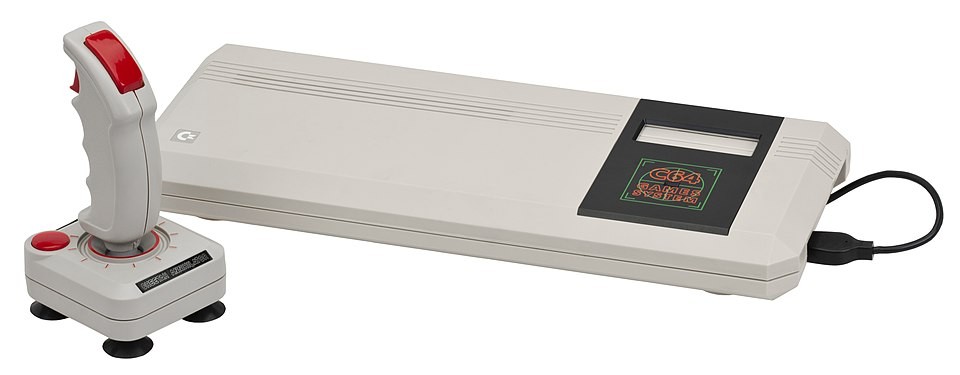
    "The Console That Wasn't"
    The 64GS enters the chat
    A Commodore 64GS console based on the C64 with a white Cheetah Annihilator joystick

  • source
  • hideshow 1 child comment
  • [–] 6 points 10 months ago

    The 64GS was one of Commodore's last gasps at trying to make some money using the 8-bit parts they still had left in stock. The whole thing was a disaster.

    It wasn't based on the C64. It was a C64. Without a keyboard and some of the other ports missing. A fact that came to bite anyone who tried a C64 cartridge game that needed keyboard input.

    And IIRC one of the games that came bundled with it was a game like that.

    They were at least smart enough to have the BASIC startup pointer (the one that otherwise caused READY. to appear) in the ROM patched to go to a neat little graphic telling people to turn it off, plug in a game and turn it back on again.

    What Commodore saved by releasing the GS, the customer ultimately paid by needing to buy games in a format more expensive than disk or tape that would run on a regular C64.

    ... and given the time period, lots of people were buying PCs and offloading their regular C64 hardware and a ton of games for the price of the GS and its handful of games. And that C64 would run any GS game that was likely to come out.

  • source
  • parent
  • 1 comment in c/retronet@lemmy.sdf.org view that post
    [–] 11 points 1 year ago

    I love everything about the c64 and still have my vintage one from childhood. The article skips one absolutely vital component of c64's success over consoles: software piracy

    An Atari 2600 cartridge or even later a NES cartridge would set you back $20-$50. On the other hand, a box of 5.25" single density diskettes you could buy for under $10 and fit 5 to 30 games on by copying them with your friends. That was impossible with cartridges.

  • source