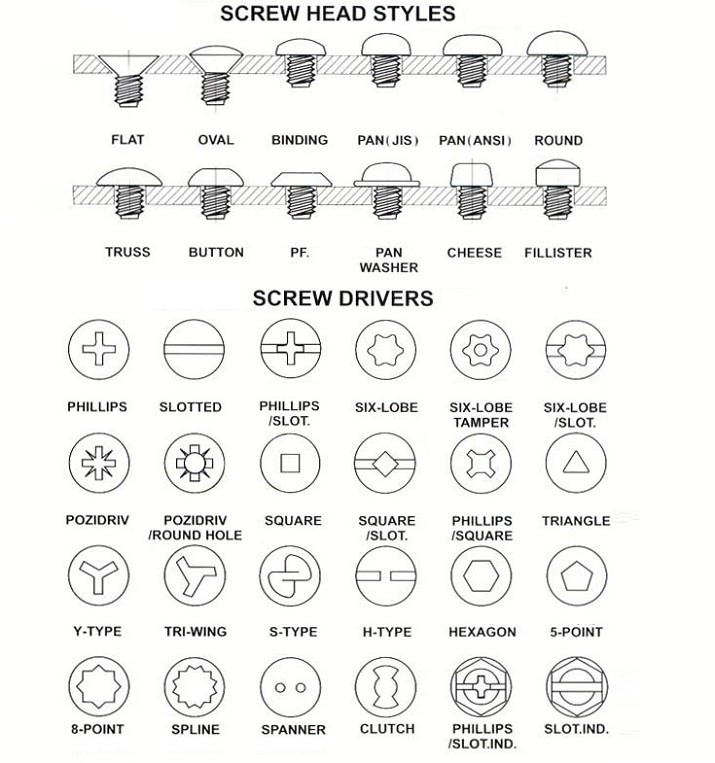
Phillips/square? You mean pre-half-stripped and here I come with a too small screwdriver to finish the job.
post
Never heard of Phillips the screw before. We call it Kreuzschlitzschraube and the tool for it is a Kreuzschlitzschraubendreher, and I think that's beautiful.
But it's absolutely fascinating that torx on the other hand is here with its generic name.
Although in my opinion there are three slots only: torx, hex and wrong.
Not pictured here is also 'JIS' or Japanese Industry Standard screws.
They are very similar to Philips, but they're slightly deeper with sharper corners. They have less tendency to 'cam-out' and strip the screw head.
Supposedly the camming out thing is actually intentional design in Philips screws, to prevent screw guns from over torquing screws in early automotive/aircraft assembly lines; but there's not actually evidence to support that according to Wikipedia.
Not pictured here is also 'JIS' or Japanese Industry Standard screws.
Yeah I thought it was funny they got the JIS head shape but not the drive.
They are very similar to Philips, but they're slightly deeper with sharper corners. They have less tendency to 'cam-out' and strip the screw head.
Until you try to drive one with a Philips because who the fuck outside of Japan has a JIS driver lying around, then they strip real easy. Ask me how I know.
Why, why, are there so many different cross-shaped screw drives?
who the fuck outside of Japan has a JIS driver lying around, then they strip real easy. Ask me how I know.
Funnily enough, I only know about these because I've got one of I Fix-It's screwdriver sets with 70 driver bits.
I was wondering why there were two sets of what looked like Philips and went looking for info.
Funnily enough, I only know about these because I’ve got one of I Fix-It’s screwdriver sets with 70 driver bits.
I got one of these too, and holy shit is it worth it. Great purchase. I love not having to wonder if I'm going to have the right screwdriver head (generally. Obviously, this thread has taught me that there's like infinite more types)
If I could just wave a magic wand and make it happen I would change all screw-type fasteners into Torx and just be done with these problems forever.
Because there was a lot of money to be made if you could create a new standard type of screw back in the day.
Screw drive arguments are my absolute favorite, thank you OP for posting such divisive content!
Star bit.
That isn't a thing ~~~~
That's what I've always called them
I'm just keeping with the adversity of the discussion, so your opinion is inferior to my superior choice of drive and terminology
Same - this will easily be my favorite post of the day, and it's still early.
also relevant Bonus xkcd
I worked as a supervisor where my predecessor thought square/Robertson were superior without listening to the others who were used to torx. I very quickly changed back to using torx.
Would you have let an employee continue to use Roberson if that was their preference?
No. It was a scenic construction shop. Letting one person use a different standard would slow the process during break down or repairs. Having to remind the others to swap bits for one scenic piece or even on the same piece when it's controlled chaos at best is not worth it.
Whats the advantage of 1 over the other?
Square/Robertson claims to have less slippage and less prone to rounding out. That's never held up in my experience. Torx has the same claims and outside of some user error, it's held up for me.
Square/Robertson bits hold the fastener tightly so they don’t fall off when starting to drive them. Star/Torx doesn’t hold as well.
It also doesn't let the bit torque out when your driving into something hard like walnut or oak. In my furniture making days we exclusively used Robertson because the ability to stick a screw on the driver, and to know absolutely that you won't slip out and gouge the workpiece.
Torx torx torx torx!
I use exclusively torx or tamper-proof torx for my projects and I love it so much.
What is this square?
It is called a Robertson not a square.
Technically Robertson has a taper to it, while square drive doesn't. Though nobody really differentiates it in common usage.
At least with star drive, while they are the same, pretty much everyone calls them Torx.
It's called Robertson by proud Canadians, in the US, at least, "square" is common. A square drive also wasn't invented by Robertson, he just made the tooling for manufacturing the screws to be economical.
If you're looking at a guide like this, it's pretty likely that it's because you need to know what to put into a search engine to buy the right screwdriver, so it's absolutely got value to know the name other people are using for a thing and selling it as.
The perimeter of the hole is square. The hole and driver are a trapezoidal prism.
SQUARE
You mean Robby
Calling it a square not a Robinson makes me doubt everything else on this including the ones I know are right.
Same with 6 lobe instead of torx
Torx is a trademarked name, 6 lobe is generic Torx.
Like how everybody calls a tissue a Kleenex.
Or 6 lobe tamper: security torx. Or hexagon: Allan key. Seriously.
in america everything must be named after a company
also isn't it Robertson?
What is labelled "flat" here I've only ever heard of as "countersunk" and what's labelled as "slotted" I've only ever heard of as "flat head". Also wtf is "PF"?
"square" aka Robertson
I thought, for some reason, that Robertson was ostracized from the screw world.
Best drive going hands down. I don't need a deliberate tourqe out to save my driver, I'm a big boy. Plus it usually just breaks the screw
In the USA maybe.
Everywhere else it's pretty common.
Fun fact, Henry Ford wanted to use them on his cars, but tried to screw Robertson in the deal. His petulance is the reason that Americans can't benefit from this perfect design.
I had the same thought! Also I’ve only ever heard “torx” instead of “six lobe” although I’m guessing torx is a brand name.
PF = Plastic thread Forming. They are basically a self-tapping screw meant for plastics.
Yeah, in the US I've only heard "Philips" or occasionally "four way". We say star here also though, but I think for the "six lobe" iirc
A "cross head" generally refers to the JIS, (Japanese Industrial Standard), version of the philips screw. Because evidently they were too lazy to design something original. They require their own special set of screwdrivers to fit correctly, (the philips drivers are close, but no cigar).
damn your area uses dumb names for things then lol
calling a drive type by the head shape, that's wild
I hate phillips head screws with every fiber of my being. All they are good at is becoming stripped.
Just wait until you have to remove some old slotted screws! Phillips are great compared to them. My house was build in 1925, I think slotted was the only option back in those days...
Found this on Wikipedia "The credited inventor of the Phillips screw was John P. Thompson who, in 1932, patented (#1,908,080) a recessed cruciform screw and in 1933, a screwdriver for it."
They are better than slotted. The driver always slips and you always stab yourself in the arm, they are impossible to work with. Why were they even invented, what purpose do they solve, it is literally the worst possible way to design a screw.
They are the easiest to machine, so they were invented first. Being first and being cheap leads to abundance. Ubiquity means every toolbox needs a flathead screwdriver, and most of those also prove useful as prybars.
Slotted is still useful today, but as a bolt instead of a screw. They are fantastic for applications where you can't assume someone has a screwdriver.
They work OK as machine screws these days. But I still far prefer socket hexhead screws.
O the other hand, I have dabbled in the gunsmithing repair of old antique firearms. I have a taste for fine old British SxS shotguns. And they often needed repairs to put them back in service. They use nothing but slotted screws to this day.
And honestly, there is something in my toolmaker's brain that feels so good when I gaze upon a fine old shotgun and see every screw slot is timed to be in perfect alignment and every screw meticulously hand fitted to make it so. The extra time and effort to do that speaks to the care and craftsmanship of the 'smith that built that gun. It's a level of craftsmanship we no longer see in the day to day world anymore.
I should specify that they work better when all you have is a knife, coin, or cartridge. to unscrew things. My avalanche beacon has a slotted screw for the battery for example, but guns are another one.
Your beacon maybe has a coin slot that's a more universal type for real emergency things like your beacon or a small child's battery operated toy.
Flatheads are typically used in situations where you want to discourage using a driver because it may over torque the screw and cause damage such as in an outlet cover.
The problem you have with slotted screw heads is twofold.
-
You buy the cheapest and crappiest set of straight bladed drivers the dollar store sells. Manufactured by some poor Pakistani dude squatting in the dirt and wearing his safety squints and safety sandals as he bashes each one out with a hammer and scrap steel anvil.
-
You have no idea that those drivers are actually meant to be fitted to the slotted screw you are working with. Not that it matters, you won't take the time and effort to do so anyway.
A good set of straight blade screw drivers cost real money. They a forged and then the tips are hollow ground to get purchase in the slot to prevent cam out. Check the cost of a set of gunsmithing screwdrivers. And no one that actually has a set or two of those is afraid to modify the tips to correctly make the screwdriver, (or as the British so elegantly put it-- turnscrews back in the day), fit the slot.
While we have far better designs these days, they are complicated to make and require special tooling to manufacture. And a big advantage to the slotted screw is if you strip out one of those much fancier types, you can often just take a small flat file and pretty quickly cut a slot to try again. (looking at you Philips head).
Pozidrive for the win.
You would be correct. Except philip head screws were never really meant to be removed. They were originally designed to be a simple torque limiting fastener for use on an assembly line to speed up the work. I think the screw type was developed for Ford Motor's use on assembly lines in the 1920s. The installation tool is meant to cam out of the slots when the screw hits the proper limit. So one and done. The issue is today designers are often too stupid/lazy to not distinguish between assemblies that need to be taken apart to repair and those that won't be.
And THEN the Japanese walk into this mess by introducing their JIS spec cross-head screws and special drivers. It's very close to the original philips in looks, but it's not. It's designed to not cam out as easily as a philips head screw and be reusable. And It requires a special set of JIS screwdrivers to install or remove. They are commonly found on Japanese motorcycles. Though they have spread and can be found in the weirdest places these days.
So if you have a "philips head" screw you just can't remove, it just might be JIS. So buy a set of JIS drivers, and look very closely, and "try before you pry" to be sure you are getting the correct fit between the driver and the screw head.
I'd like to go on record as saying six-lobe tamper can die in a fire.
Slotted screws should have gone away after the 1800s. God, I hate them so much.
Okay, now I'm really confused. I was going to comment that the six-lobe shape is known to me as star bits, and then I did a search to see if anyone else uses the name, but these sites say they're 5-point bits, but they're star-shaped, not pentagons. The star bits in my security bit set all have six points, and I've not come across a five-pointed star screw because I'd surely remember being pissed off about them not working. Where/when are five-pointed stars used?
6-lobe, star, and Torx are all names for the same somewhat common screw type. Torx is a trademarked brand name however.
Separately there's a 5-lobe screw called 'pentalobe' that's looks just like the 6-lobe but with, well..., 5 lobes. It was developed by Apple iirc, to keep people out of their products and make repair harder.
My previous house had security screens on the windows with screws that I could never find a driver for - it was a few years ago, but I think they were pentalobe with the security nub in the middle. I didn't look too hard though - it was a good excuse to not wash the windows.
The common hack makes it easier to remember: the common star, or brand name Torx, is the same as a hexagon. If you have a full set of both SAE and Metric star drivers, there is a star that will fit tightly into nearly all hexagon cap screws. If you strip a hexagon screw cap, using a star driver will often work to remove it. This only works because it is the same number of points.
There are many other types, but the common star is the 6 point.

top 100 comments