top 74 comments

sorted by: hot top controversial new old
[–] 98 points 1 year ago (12 children)

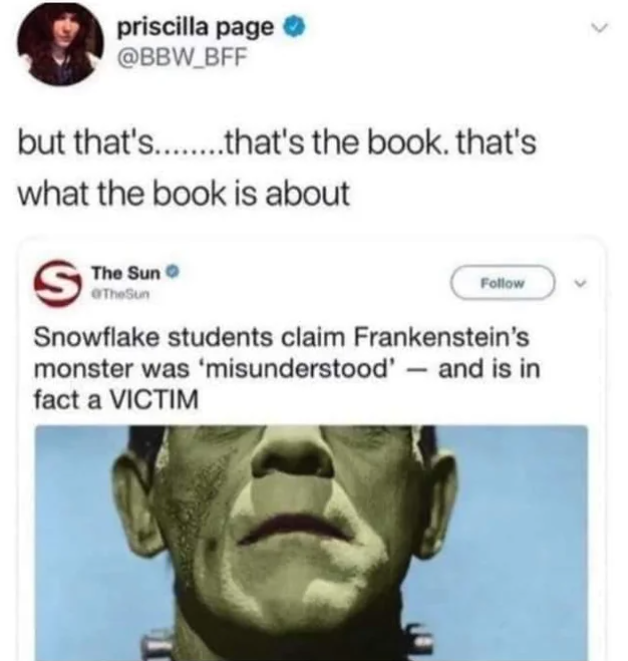
Breaking news: in act of gross defiance, student reads book

  • source
  • hideshow 12 child comments
  • [–] 25 points 1 year ago (11 children)

    I think the problem is the students are giving too much credence to the monster's monologues, but "He is eloquent and persuasive, and once his words had even power over my [Frankenstein's] heart; but trust him not."

    All that aside, you can't look past strangling a 4-year-old boy. It's reasonable to call anything that strangles a 4-year-old boy a monster, even if it felt lonely/abandoned.

    And even the monster has the self-insight to know that he's fundamentally evil: "I had cast off all feeling, subdued all anguish, to riot in the excess of my despair. Evil thenceforth became my good."

  • source
  • parent
  • hideshow 11 child comments
  • [–] 37 points 1 year ago (9 children)

    I think too many are equating being a victim with being innocent.

  • source
  • parent
  • hideshow 9 child comments
  • [–] 3 points 1 year ago (7 children)

    What's the worst thing done to the monster, in your opinion?

  • source
  • parent
  • hideshow 7 child comments
  • [–] 25 points 1 year ago (6 children)

    If you really want an answer, I think we need to start early...

    The monster is naive, curious, and good natured at the beginning. Delighted by fire, choosing to touch it - and then feeling pain. No one there to teach right and wrong, or even safe and dangerous. Just a naive child in a grown up body.

    He finds a small hovel, and lives there observing. Taking food from them to keep himself fed, later discovering - because no one taught otherwise - that taking from others hurts those people. He doesnt want them to be hurt by him though, so he eats berries and nuts. I think this shows he is good natured, not wanting to hurt others.

    Then we have his first interaction with the village. Some run, but others attacked him with stones and other weapons. He even commented not only that he was physically hurt, but seriously hurt by them (I think "grievously bruised" is the right quote).

    He hid in a place so far removed from the village that the cottages seemed like palaces in comparison. He understands he looks different than others, but didnt understand how his looks would make him not just shunned, but hated. The villagers based everything on how he looked, and now this naive and good natured being had a direct look at just absolute cruelty.

    Skipping ahead, the final part that makes him turn to being cruel himself is being told he will be alone, always.

    At this point he hasn't experienced kindness from others, just cruelty. The neglect, the hopelessness, the physical pain from being attacked - this is the only expression towards others he experienced himself.

    So the abused becomes an abuser. He takes out the pain and anger on others, showing them the pain he felt. He knew only pain and being alone, and his rage at his creator made him want his creator to feel the same.

    I'd say its a pretty obvious tale of victim becoming the perpetrator.

  • source
  • parent
  • hideshow 6 child comments
  • [–] 3 points 1 year ago (5 children)

    The worst people in real life have both an abused background and an organic brain/genetic problem.

    The monster's abnormal reaction to rejection (becoming a serial killer), I read that as he's probably got a bad brain/nature too. And why wouldn't he, given how he was made?

  • source
  • parent
  • hideshow 5 child comments
  • [–] 6 points 1 year ago (4 children)

    Generically speaking, nurture is the common thread. In this book, and in my experience.

    I can't get behind blaming genetics/nature for people being good/bad. All that reminds me of is phrenology.

  • source
  • parent
  • hideshow 4 child comments
  • [–] 1 point 1 year ago (3 children)

    Right, and that fits with what the profs are saying here: that modern sensibilities view monsters (even serial killers) as victims.

  • source
  • parent
  • hideshow 3 child comments
  • [–] 3 points 1 year ago (2 children)

    Yes, because its accurate.

    Dahmer was a horrifying killer. He also had a functionally absentee father, and his mother was self-medicating to deal with her mental health issues and developed a substance abuse issue. He was left alone at home for long periods of time, making him both physically and socially isolated. His biggest connection with his dad was being interested in the anatomy of dead animals, and his dad showed him.how to bleach bones and overall encouraged it - but not really engaging further. In school his behavior was considered bizarre, heavily attentions seeking, began drinking in high school, etc...

    Everyone around him failed him in some way, and he became an absolute monster.

    It doesnt change the fact that he did horrible things. It doesnt mean he didnt become a monster.

    Recognizing that trauma led to that, though, is a good thing. It means we can better identify, understand, and address earlier.

    If we reworked the monsters experience, Frankensteins engagement with him, how he was presented to the townspeople and how they reacted to him, would he have turned out differently? I would say yes. And I think its important for us to recognize that.

  • source
  • parent
  • hideshow 2 child comments
  • [–] 1 point 1 year ago (1 child)

    Yes, Dahner is probably a good example of what I'm talking about: the conjunction of mistreatment and organic brain disorders. His parents denied scientists at Fresno permission to examine his brain before cremation, so we can't be sure exactly what was wrong with him, but we know he was an alcoholic and the son of a mentally ill mother.

    Charles Whitman is another: beaten by his father, lost his brother to murder, plus a tumour on his amygdala.


    The point the English professors are making is that the new generation of students see monsters entirely as victims of circumstances. It's an ideological belief.

  • source
  • parent
  • hideshow 1 child comment
  • [–] 1 point 1 year ago

    The point the English professors are making is that the new generation of students see monsters entirely as victims of circumstances.

    No, thats the point the Sun (a shit rag of a paper) was trying to get you to think. The professor who made the comment the Sun abused to make a shitty tweet said that students consider it more a creature than a monster, and how it shaped his teaching, and he himself sees the novel as a question of sentience and medical ethics.

    It's an ideological belief.

    No.

  • source
  • parent
  • [–] 24 points 1 year ago*

    I agree, the creature (monster?) is not innocent, and eventually becomes a monster but Victor himself absolutely is a monster, from the beginning. He gets into an absolute fervor to create life from nothing but cadaver parts, finally succeeds, only to abhor what he created. But then, the creature, seeking guidance and understanding is shunned at every opportunity, treated as an aberration, and vilified by Victor... for simply existing.

    The book was a very difficult read for me, as Victor makes the wrong choice at literally every turn, but somehow still places the blame externally onto his creation. How it ended was for the best, for all parties involved.

  • source
  • parent
  • [–] 39 points 1 year ago (2 children)

    knowledge is knowing Frankenstein is the doctor, wisdom is knowing Frankenstein is the monster

  • source
  • hideshow 2 child comments
  • [–] 11 points 1 year ago

    Folks who have heard about the book know that Frankestein was the monster.

    Folks who have read the book know that Frankestein created the monster.

    Folks who understand the book know that Frankenstein was the real monster.

  • source
  • parent
  • [–] 31 points 1 year ago

    These damn college educated liberals and their basic reading comprehension

  • source
  • [–] 58 points 1 year ago (1 child)
  • [–] 50 points 1 year ago (5 children)

    You can be a victim and still be a monster.

    Was it cruel for Frankenstein to bring this tortured being into life? Yes.

    Is the creature a victim then? Yes.

    Does the creature purposefully harm and kill others (and also try to force Frankenstein into making another tortured being because he wants her to be ugly and face the same torment as him so she’ll have to be with him; showing that he is just as if not more willing to commit the same horror as the Dr. just to feel slightly less alone)? Yes.

    Does that make him a monster? Yes.

    I mean seriously guys he’s still a fucking monster.

    The doctor crossed a line and did something monstrous, but he didn’t know how bad it would be. The creature, however, knows exactly how bad it is, and still wants to do commit the sin again because—by incel-esque logic—this new cursed being will have to love him. If you’re willing to knowingly subject another person to indefinite torture just to feel slightly better yourself, you might be a monster.

    Serial killers often had bad childhoods, but that doesn’t excuse their monstrous actions. Frankenstein’s creature had a rough life, but he’s still a monster.

  • source
  • hideshow 5 child comments
  • [–] 14 points 1 year ago (1 child)

    I think that's a bit unfair. Frankenstein had no sympathy for his creation whatsoever, he ran away after creation and when he first met him he called him monster and wouldn't listen to his story. The creature had to watch humans from afar and to learn to live, being secluded in a hut for at least a year.

    He wanted to bring joy to the family which he called protectors, he helped them when they couldn't see them and was constantly afraid of being discovered. It took him so much courage to confront the family for which he gained affection only to be attacked and they fled quickly after.

    In his final speech of the book, his sentiment is basically that. All his life he wanted to converse with other humans and be included in society, but he was not allowed, because everyone called him a monster and screamed at his appearance.

    Of course murdering other people was the wrong approach to this situation, but he was equipped with weapons and used them when his emotions were too strong for rationale.

  • source
  • parent
  • hideshow 1 child comment
  • It strikes me that Frankenstein, as a work of literature does try to teach a moral lesson.

    To me, it feels wrongheaded to take the lesson "Hey, maybe if you're a being born of ultimate neglect, maybe don't do any vengeful murders" from this work.

    "If you're going to make a person, which is a thing people do all the time, it is your responsibility to not neglect or abuse them" is probably closer to the truth.

  • source
  • parent
  • [–] 22 points 1 year ago* (1 child)

    Shelley was woke as fuck. Daughter of two woke ass motherfuckers and marries Lord Poet Snokeflake.

  • source
  • hideshow 1 child comment
  • [–] 16 points 1 year ago

    In the UK, The Sun newspaper targets those blessed with the gift of not having to worry about having their own thoughts. It is infamously a standout vile paper. They continued having a full page different topless girl on page 3 for decades. Throughout they routinely describe black, brown, Muslim, LGBTQ+ in derogatory ways. Charlie Kirk would have promoted them.

  • source
  • [–] 14 points 1 year ago

    Nick Groom, external, a professor of English literature at the University of Exeter, who has written a new introduction to mark the novel's 200th anniversary since publication.

    “It’s interesting when I teach the book now, students are very sentimental towards the being,” Professor Groom wrote.

    “There’s been a gradual shift... for years Victor Frankenstein’s creation was known as the Monster, then critics seemed to identify him as a victim and called him the Creature. That fits more with students’ sensibilities today.”

  • source
  • [–] 18 points 1 year ago (4 children)

    Bunch of speculation as to the headline being serious. We can read the article instead of guessing.

    https://www.thesun.co.uk/news/5732932/snowflake-students-dub-frakenstein-misunderstood-victim/

  • source
  • hideshow 4 child comments
  • [–] 29 points 1 year ago (2 children)

    Yes. The answer to whether or not they're serious was "Yes".

  • source
  • parent
  • hideshow 2 child comments
  • [–] 18 points 1 year ago (1 child)

    On one hand, Frankenstein's monster was a victim, but on the other, he was also a giant piece of shit.

  • source
  • hideshow 1 child comment
  • [–] 8 points 1 year ago

    Engaging with the slop by making a post about it is also succumbing to the clickbait, unfortunately.

    The sun is just another garbage tabloid that gets plastered on the internet.

  • source
  • [–] 30 points 1 year ago (11 children)

    What's funny about this? He WAS a victim. He was the creation of pride and hubris. Only shallow judgement made him a "monster"

  • source
  • hideshow 11 child comments
  • [–] 6 points 1 year ago (3 children)

    Only shallow judgement made him a “monster”

    You mean the monster's own bad judgement, or Frankenstein, or the humans in the book in general?

  • source
  • parent
  • hideshow 3 child comments
  • [–] 27 points 1 year ago* (last edited 1 year ago) (1 child)

    Frankenstein immediately labels him an abomination as soon as he comes to life, and he never gives him a chance to show that he’s anything but a monster.

    He also hides out trying to help this family for a long time, and as soon as they see him, they assume he’s evil and terrible and run away as well.

    The monster kills a few of Frankensteins family members, and stalks him for the rest of his days though, so he did kinda become the thing he was thought to be.

    Victims turning into monsters because of abuse is kinda the whole point of the book.

  • source
  • parent
  • hideshow 1 child comment
  • [–] 12 points 1 year ago (3 children)

    The murders make him a monster.

  • source
  • parent
  • hideshow 3 child comments
  • [–] 5 points 1 year ago (2 children)

    You could probably call the first one a tragic accident that is ultimately the doctor's fault, but he's killed at a minimum four people by the end.

  • source
  • parent
  • hideshow 2 child comments
  • [–] 5 points 1 year ago* (last edited 1 year ago)

    You could....

    Frankenstein! you belong then to my enemy—to him towards whom I have sworn eternal revenge; you shall be my first victim.’

    The child still struggled and loaded me with epithets which carried despair to my heart; I grasped his throat to silence him, and in a moment he lay dead at my feet.

    I gazed on my victim, and my heart swelled with exultation and hellish triumph; clapping my hands, I exclaimed, ‘I too can create desolation; my enemy is not invulnerable; this death will carry despair to him, and a thousand other miseries shall torment and destroy him

    ...but I didn't read it that as an accident. Imagine using that defense in a courtroom: "I wasn't trying to kill the child, I was trying to kidnap him for revenge. I killed him by accident when choking him to silence him." Especially given the physical mismatch of a huge heavyweight versus a tiny child.

    As I said earlier, "I think the problem is the students are giving too much credence to the monster’s monologues"

  • source
  • parent
  • [–] 6 points 1 year ago

    So far, there have been no comments on the parallels between Frankenstein and his creature and the Christian god and theirs. I think many people also assume the word creature has a negative connotation, but I would not be surprised if that stemmed from the effect this book had on society, and its use was mostly literal.

  • source
  • [–] 5 points 1 year ago

    the sun makes the new york post look good, and that's an insult

  • source
  • [–] 4 points 1 year ago

    And then there's this dude...

    Fucking Eric, man...

  • source
  • [–] 5 points 1 year ago (6 children)

    Remember, those people don't read. If they can read at all.

  • source
  • hideshow 6 child comments
  • [–] 2 points 1 year ago (5 children)
  • [–] 1 point 1 year ago (4 children)

    The "journalists" of The Sun. They are good at inventing stories, but proper journalism and background research is not exactly their strong point, to put it mildly.

  • source
  • parent
  • hideshow 4 child comments
  • [–] 1 point 1 year ago (3 children)

    How do they work as journalists if they're illiterate?

  • source
  • parent
  • hideshow 3 child comments
  • [–] 1 point 1 year ago (2 children)

    That is a good question. I've read The Sun occasionally (actually mostly for school purposes, it is a good example for a low-quality British tabloid when teaching about "The Press"), and always wondered if the people who produce this can walk and breathe at the same time...

  • source
  • parent
  • hideshow 2 child comments
  • [–] 1 point 1 year ago (1 child)

    In this case, the sources were a professor of English at Exeter who wrote an intro to the book, and Mary Shelley expert Professor David Punter, of Bristol University.

    http://archive.is/BEz2F

  • source
  • parent
  • hideshow 1 child comment
  • [–] 2 points 1 year ago

    They have been taught that by their woke teachers around the world for more than a century, imagine that!

  • source
  • [+] -14 points 1 year ago (14 children)
  • [–] [S] 14 points 1 year ago (13 children)

    The title is sarcastic. It's extremely sloppy journalism.

  • source
  • parent
  • hideshow 13 child comments
  • [–] 14 points 1 year ago (12 children)

    I have a feeling the commenter wasn't talking about the title 😬

  • source
  • parent
  • hideshow 12 child comments
  • [–] [S] 7 points 1 year ago (11 children)

    Oh.

    I mean, I haven't read frankenstein myself, but when I was like 9 I read one of the condensed children's version, and the vibe I got was that he was misunderstood.

  • source
  • parent
  • hideshow 11 child comments
  • [–] 11 points 1 year ago (2 children)

    It's a really good book. If all you know is pop culture references you're honestly missing most of the story. Def worth a read

  • source
  • parent
  • hideshow 2 child comments
  • [+] -6 points 1 year ago (3 children)
  • [+] -13 points 1 year ago (3 children)