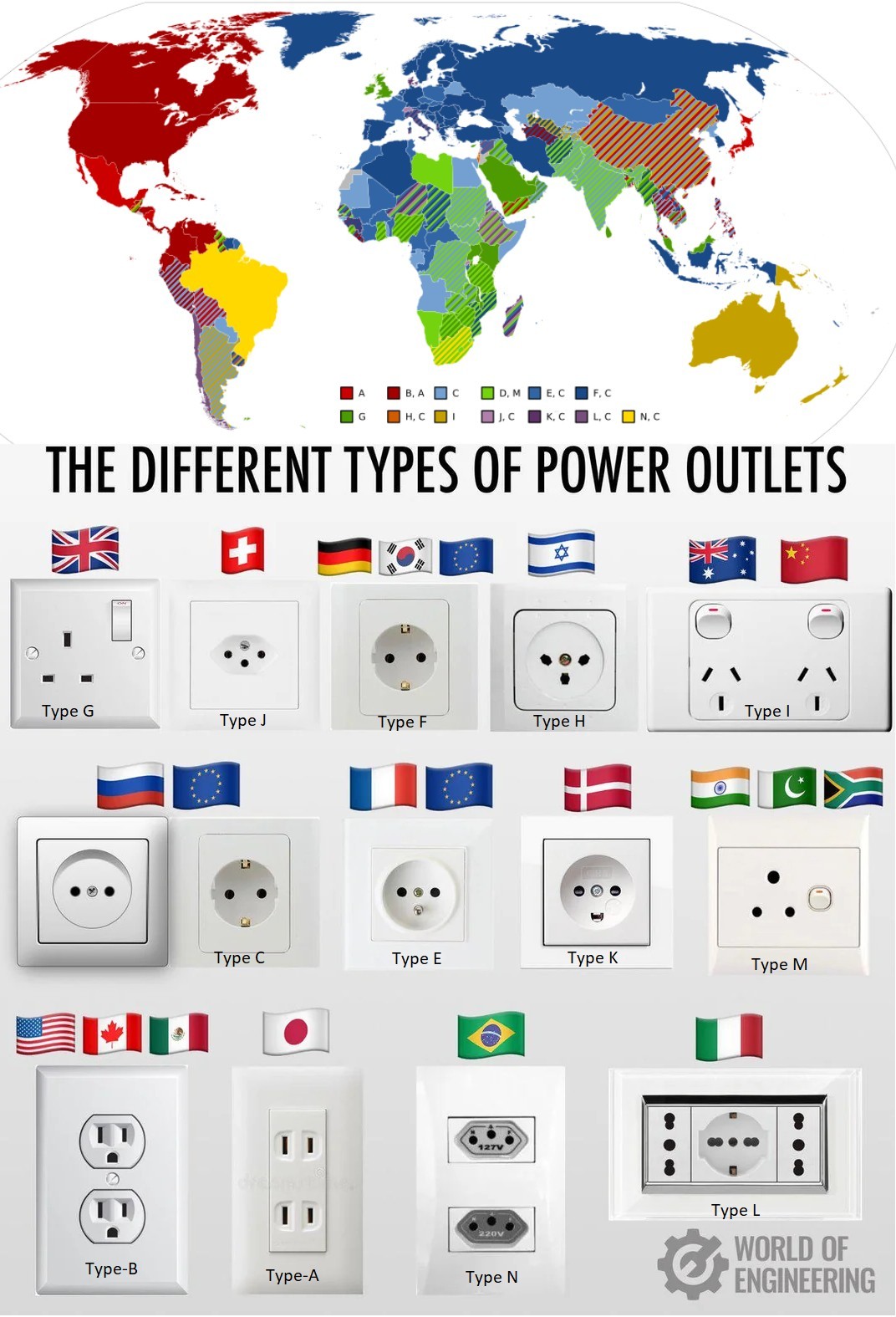
A useful source:
https://worldofsockets.com

What is the best Power Outlet?

top 100 comments

sorted by: hot top controversial new old
[–] 1 point 1 year ago

Italy shakin'

  • source
  • [–] 1 point 1 year ago

    Glancing over the images... Hmm, okay... Israel being a bit weird... Recessed is definitely better... what the type L is that?

  • source
  • [–] 1 point 1 year ago* (1 child)

    As far as I know you can push 240V device to any of those holes. Not saying it will work but ex. charger will charge, just slower.

  • source
  • hideshow 1 child comment
  • [–] 1 point 1 year ago

    Japan and Taiwan are the same plug but they use 100V and we are 110V.

  • source
  • [–] 106 points 1 year ago (2 children)

    Type K. I mean how can you say no to that face?

    IMG

  • source
  • hideshow 2 child comments
  • [–] 487 points 1 year ago (15 children)

    The British one. It has a switch and a fuse, and later versions have age-verification so your kids can no longer plug in your adult toys.

  • source
  • hideshow 15 child comments
  • [–] 57 points 1 year ago* (3 children)

    And your adult toys must be licensed, of course. To protect the kids.

  • source
  • parent
  • hideshow 3 child comments
  • [–] 7 points 1 year ago (2 children)

    Its important you don't allow them access so you need to keep them on your person in a place thats very hard to access. So hard.

  • source
  • parent
  • hideshow 2 child comments
  • [–] 8 points 1 year ago (6 children)
  • [–] 1 point 1 year ago (2 children)
  • [–] 51 points 1 year ago (1 child)

    Oh, a list of things each identified by a different letter, better put them in a completely random order.

  • source
  • hideshow 1 child comment
  • [–] [S] 147 points 1 year ago* (last edited 1 year ago) (49 children)

    In my opinion it's Type-F

    Because:

    • It's bi-directional
    • It's grounded and ungrounded plugs use the same socket
    • It's already widespread (50+ countries) source
    • Your fingers can't touch the live wire as you're plugging in a wire
    • It's recessed
    • Low footprint
    • Accepts Type-C
  • source
  • hideshow 49 child comments
  • [–] 36 points 1 year ago (7 children)

    What's the difference of C and F type?

  • source
  • parent
  • hideshow 7 child comments
  • [–] [S] 49 points 1 year ago* (last edited 1 year ago) (5 children)

    C is mostly for low power devices

    F is basically a heavy duty upgrade of C, it's got grounding on the side and can handle 16A (ovens, heaters etc.)

  • source
  • parent
  • hideshow 5 child comments
  • [–] 14 points 1 year ago (4 children)

    Don't you get numpties plugging F appliances into C sockets then complaining to customer service that the induction stovetop doesn't boil water for tea fast enough?

  • source
  • parent
  • hideshow 4 child comments
  • [–] 3 points 1 year ago* (last edited 1 year ago)

    The type-C shown in the picture is also not the only form it has and maybe partly misleading, the plug usually is significantly smaller and flat, and power strips can feature multiple of those in less space.

  • source
  • parent
  • [–] 7 points 1 year ago (3 children)

    I see a lot of your comments about F being objectively same or better compared to G. The only thing I'd throw into the mix is the socket switch feels so logical, I'm really surprised it's not more standard.

    High frequency use case: I don't need my microwave on all the time showing me the time, so I switch it off at the socket unless I'm using it

    Low frequency use case: before going on holiday I switch all the electrics off at the sockets

  • source
  • parent
  • hideshow 3 child comments
  • [–] 5 points 1 year ago

    Furthermore, appliances compatible with Type F are almost always compatible with Type E as well, it's just a matter of including both grounding mechanisms which they all do to avoid designing multiple cords.

    I haven't yet visited the UK so the only time I've had trouble plugging in something in Europe is in shudders Italy.

  • source
  • parent
  • [–] 3 points 1 year ago

    Bi-directional is a double-edged feature.

    It means that there is no reliable way of identifying line and neutral wire, which requires more complex double switches downstream.

    Also, F is unnecessarily clunky and big and hard to make a weather-proof version of because of the complex shape.

  • source
  • parent
  • [–] 2 points 1 year ago

    Hear me out, type L, the one in the middle, is the best socket, as it has all the things you talked about, but also accepts Italian plugs.

    Type L bipasso (the one on the side) instead is the most space efficient, while retaining type C compatibility and grounding. Type L plugs also have plastic bits at the end to avoid contact with live wire (like UK one).

  • source
  • parent
  • [–] 2 points 1 year ago

    And type-E. Most EU plugs are F-E compatible, because countries go about alternating them. Spain F, France E, Germany F, Poland E. You build a plug with a hole for the E ground bolt and a cutout for the F side contacts.

  • source
  • parent
  • [+] -10 points 1 year ago (29 children)

    It's bi-directional

    That's bad.

  • source
  • parent
  • hideshow 29 child comments
  • [–] 13 points 1 year ago (21 children)

    Why? It doesn't make any difference with AC

  • source
  • parent
  • hideshow 21 child comments
  • [–] 7 points 1 year ago (14 children)

    The actual electrical device can be designed such that it depends on exactly which direction is live and which is neutral.

    Imagine a circuit loop that, as you follow along the circuit, has an AC power source, then a switch, and then the electrical appliance, leading back to the AC source it started from.

    If you design the circuit so that you know for sure that the live wire goes to the switch first before the actual load, then your design ensures that if there is a fault or a short somewhere in the appliance, it won't let the live power leak anywhere (because the whole device is only connected to the neutral line, not the hot live voltage that alternates between positive and negative voltage). It's safer, and is less likely to damage the internals of a device. Especially if someone is going to reach inside and forgets to unplug it or cut power at the circuit breaker.

  • source
  • parent
  • hideshow 14 child comments
  • [–] 12 points 1 year ago

    In practice tons of outlets are wired the wrong way around.
    F actually has a convention for the socket, which is probably ignored even more often, but I would never trust live and neutral not to have been swapped somewhere regardless of outlet.

    Just forcing plug designers to consider live/neutral being randomized in a very obvious manner might be safer in the long run than working on a partially broken system where someone manufacturer might be fooled into trusting it.

  • source
  • parent
  • [–] 2 points 1 year ago (6 children)

    Could you give an example of such a device? Seems like a bad design

  • source
  • parent
  • hideshow 6 child comments
  • [–] 2 points 1 year ago (5 children)

    A simple lamp can demonstrate.

    You have both live and neutral lines in the cable, coming up to a switch, which can either open the circuit on the live line or the neutral line. Then, the lamp itself has a single light bulb as the load.

    If you place the switch on the live line, then the energy of the live line stops at the switch, with only whatever lower voltage is in the neutral line to actually be connected to the light bulb and lamp assembly.

    But if you place the switch on the neutral line, you're leaving the entire lamp on the voltage of the live line, which gives the voltage more places to potentially short circuit. If you were to take a non-contact voltage detector, you'd be able to detect a live voltage in the line leading up to the bulb, even when it's not turned on.

    You generally do this with the in-wall wiring and switches, too, and make the wall switches break open the circuit on the live line, not the neutral line. It's just a better practice overall.

    And no, the neutral line is not totally grounded, so it can still pose a danger, too. But safety is exercised in layers, and putting the switch on the live line is the better practice.

  • source
  • parent
  • hideshow 5 child comments
  • [–] 2 points 1 year ago

    This is an entirely theoretical problem that just doesn't exist in practice. Just to be clear, for it to short circuit, it's needs to find a path to ground. It can't just "go somewhere". Just because the line is longer didn't make it more dangerous for it to "just exist". There are regulations for wires, which include frankly absurd safety margins, regulations for the electrical devices that are not optional either (CE compliance for example). It just complicates this for basically no reason to have keyd outlets.

  • source
  • parent
  • [–] 1 point 1 year ago (1 child)

    If there's electricity reaching the bulb it would be lit no? So if I place the contact upside down, I wouldn't be able to turn off my light?

  • source
  • parent
  • hideshow 1 child comment
  • [–] 2 points 1 year ago

    It's not electricity, exactly, but it is a higher voltage that is different from the average of everything around it. Electricity needs a closed loop to flow, and breaking open the loop with a switch means that no electricity flows, but the voltage of the live line goes up and down, creating an electric potential with anything that might be at a different voltage, if a conductor touches both.

  • source
  • parent
  • [–] 0 points 1 year ago* (last edited 1 year ago) (5 children)

    it's a bad practice to design appliance in such a way to assume that neutral will have low voltage, because in case of neutral failure in three-phase circuit you can get full voltage there, and there can be a couple of volts difference (sometimes more) between neutral and ground even in normal circumstances

    it's better to cut off both live and neutral at the same time anyway, especially if there's no standard which is which. also, as device designer you don't know if it'll be used on a circuit that has neutral and phase where you think it'll go or not. (ie british appliance used on unpolarized circuit, like type F. adapters exist)

  • source
  • parent
  • hideshow 5 child comments
  • [–] 4 points 1 year ago (4 children)

    it's a bad practice to design appliance in such a way to assume that neutral will have low voltage, because in case of neutral failure in three-phase circuit you can get full voltage there,

    Who's using three phase in a setting where these types of plugs are used? In the US, at least, three phase circuits use very different receptacles and plugs.

    The fact of the matter is that the switch has to be placed somewhere. And it's safer to place the switch between the load and the live wire, rather than between the load and the neutral wire. Designing a system where the live and neutral can easily be known makes it easier to do the safer thing.

  • source
  • parent
  • hideshow 4 child comments
  • [–] 2 points 1 year ago* (3 children)

    you don't have to have three phase circuit to be affected by floating neutral in three-phase substation upstream. in some places in us there are 208v interphase three-phase circuits, which give 120v phase to neutral, which is distributed as a pair of wires as single-phase circuit. this is also normal way to deliver single-phase power in europe, as it's most efficient use of conductor. (from 400v three-phase circuits) in case more power is needed than single-phase circuit can deliver, three-phase circuit is installed

    if there's switch on device, it's 2p1t meaning both phase and neutral are switched. if it's permanent, non-pluggable circuit, like lightning, it's okay if only phase is switched (neutral is connected permanently)

  • source
  • parent
  • hideshow 3 child comments
  • [–] 2 points 1 year ago (1 child)

    This is entirely an US problem created by the "center tap" nonsense. Nobody else I'm aware of uses that, let alone with that other. The outlet in question (type F) I'm only aware of being in use with one phase of a there phase supply plus the neutral, or just "the" phase and neutral. Note that in the second case, even if a house or apartment only has one phase wired to it, it's still generally part of a three phase supply, but the other phases just aren't wired to that particular place (incredibly rare these days, but might be the case for very old homes/installations).

    Now the real reason for it being safe: The neutral is required to be wired to ground at the main breaker panel. With installations newer than 2000-something, every circuit has to be GFCI protected. With even newer installations having even more granular requirements (not sure on the specifics).

  • source
  • parent
  • hideshow 1 child comment
  • [–] 0 points 1 year ago

    in many flats even recently built you don't get three-phase power, just single phase, but building divides single three-phase supply into three groups of single phase circuits like you say (do you really need 20kW in residential flat? one that doesn't use EV charger, built in 90s-10s?) i guess it depends on country also. separate houses tend to get three phase connection where i live

    floating neutral will also be a problem in american-type two-phase installation, might be even worse (more frequent) on account of large number of lightly maintained transformers used (why on gods green earth there's few-kV medium voltage line going down every street, americans make it make sense)

  • source
  • parent
  • Yeah, you're probably right. I'm in over my head on this discussion.

    I am reminded of my first day in an electrical engineering circuit theory class, when the professor made very, very clear that he was teaching us theory and fundamentals, and that the real world of electricity required a lot more safety built into the procedures and designs, because not everything behaves the way the undergrad textbook describes.

    So I've learned something new. Thanks.

  • source
  • parent
  • [–] 3 points 1 year ago (3 children)

    Some people say it does with certain devices but I've never had anything I've run into. The American outlets have been used as bi-directional in most instances. (With 2 prong). If they had a ground then you can only go in one way. But that said... Obviously a cord without a ground can still plug into an outlet that has the ground set up. If the device wants the current to go in a certain direction they use one with a slightly larger prong on one side, but if you pick up any phone charger in America, you can plug it into any outlet any direction.

  • source
  • parent
  • hideshow 3 child comments
  • [–] 4 points 1 year ago (1 child)

    If the device wants the current to go in a certain direction

    That's not how AC works

    they use one with a slightly larger prong on one side,

    That's not Ground, it's Neutral. Neutral is sometimes bonded to Ground, but they are fundamentally different things

  • source
  • parent
  • hideshow 1 child comment
  • load more comments (1 reply)
  • load more comments (1 reply)
  • [–] 35 points 1 year ago

    It's obviously the one in the country I live in. All the others that I have had zero experience with are from Satan.

  • source
  • [–] 31 points 1 year ago (16 children)

    does type A just have no ground?

  • source
  • hideshow 16 child comments
  • [–] 1 point 1 year ago

    It's the oldest standard on the list, and is still around older homes in the USA. They used to be equally-sized (aka unpolarized), but later on they had a bigger hole for neutral (polarized). They're not up to code anywhere anymore though, you'll only see them in older houses before the grounding pin was required.

  • source
  • parent
  • [–] 17 points 1 year ago (4 children)

    Yup. Japan also has grounded outlets, though, although they are comparatively rarer.

  • source
  • parent
  • hideshow 4 child comments
  • [–] 11 points 1 year ago*

    I recently had a house built, and most of the outlets do support grounding.

    However, it's not very common to actually use them — many appliances don’t have grounded plugs, or the shapes don’t match.

    I’d say only things like washing machines, microwaves, and rice cookers tend to use them.

    線のときはつなぐ

    U字のは繋げない、PC関連に多い

  • source
  • parent
  • [–] 2 points 1 year ago (8 children)

    I see the left side of just slightly bigger than the right, so I expect one of those sides to be the ground

  • source
  • parent
  • hideshow 8 child comments
  • [–] 14 points 1 year ago* (4 children)

    You'd think so, but the ground will either be at the bottom of the outlet, requiring a separate cable, or Type-B.

  • source
  • parent
  • hideshow 4 child comments
  • [–] 8 points 1 year ago (2 children)

    That's only on homes that have updated wiring codes.

    My grandma still has the old aluminum wiring with type A. It's annoying as shit because there are so many grounded plugs and only so many adapters that take the grounded plug.

    And then don't ground it. Fuck safety right

  • source
  • parent
  • hideshow 2 child comments
  • [–] 1 point 1 year ago

    In the USA, there's a ground in that the neutral wire is connected to ground. Devices that take advantage of this have a slightly broader neutral pin that won't fit into the hot pin.

  • source
  • parent
  • [–] 48 points 1 year ago

    Type F.

    SCHUKO PLUG SUPREMACY FOREVER!

  • source
  • [–] 23 points 1 year ago

    The type I grew up with.

  • source
  • [–] 20 points 1 year ago (6 children)
  • [–] 10 points 1 year ago (2 children)

    Because it's a hot mess trying to accept both type F and type L. The traditional type L socket has three pins inline. The pin spacing between Live and Neutral for an earthed device using type L is wider than using type F, so plugging in a Schuko won't work in normal type L sockets. However, some type L sockets have extra, smaller holes at Europlug spacing, to accept ungrounded type C plugs.

    The picture here shows two Type L sockets with Europlug expansions on the sides (C/L combo), and an F/L combo in the middle.

  • source
  • parent
  • hideshow 2 child comments
  • [–] 5 points 1 year ago

    Here in Romania we use Type F but sometimes also install a modular Type L socket alongside regular ones because it's smaller and you can fit 2 of those in place of a full Type F/Schuko one. We don't use Italian plugs and so only use them for europlugs (max 2.5A and double-insulated so no ground needed) (Kind of something like this)

    I do find it kind of sad seeing them getting slowly replaced even in Italy (I know it won't fully happen of course) because they're very space efficient

  • source
  • parent
  • [–] 4 points 1 year ago

    The pictured one is an universal socket that can accept any plug sold in the eu, because if you go to buy any fridge or oven or washer it comes with the German plug

    Otherwise, any other plug (phone chargers, lamps, laptops) comes with the standard which is this:

    It doesn't fit in a German plug as the diameter of the holes and the spacing is slightly different, hence the weirdly shaped wholes

    It has both prongs insulated so you don't get accidentally electrocuted if your finger accidentally touch one during unplugging (especially toddlers)

    In my house I exclusively got pure L sockets without the double holes and I wanted to kill the sadist electrician who decided to install them everywhere. (It's a money issue, universal socket by regulations need 2.5 mm² section copper wires, while the 10A L socket can use cheaper 1.5 mm² section copper wires - but still, how much he saved, 50€ in total? Asshole, I had to spend 3x that to replace all the sockets)

  • source
  • parent
  • load more comments
    view more: next ›