The characters in DS9 went on lots of Treks. Like the time Miles lived out decades in an alien prison only for it to really happen in his head. Or the time Miles was replaced by an alien who didn't realize he was the impostor. Or that time Miles was kidnapped and put on trial by the Cardassians. Or that time...
post
DS9 is probably the best-written Star Trek show, but what worries me is how many of its fans think that Sisko's war crimes are "badass" and that his worldview should be emulated. Many DS9 fans seem to think that the show's shades of grey renders the Roddenberry vision on display in TOS and TNG invalid - dismissing it with "it's easy to be a saint in paradise".
There are a lot of things to criticize with Discovery, but what it absolutely nailed was the Lorca twist. Lorca arguing about how rules are made to be broken, sometimes you gotta commit a war crime or two, and "context is for kings", was a perfect summation of the mindset of these kinds of Trek fans. So when it was revealed that he was actually from the universe where humanity had given in to this mentality and thus failed to create the Federation, that was the perfect "sci-fi twist" that Star Trek excels in.
I enjoy DS9, but not uncritically.
I remain quite annoyed by how the major driver for resolving both the Borg and Dominion conflicts hinged on a very illegal, extremely immoral thing that someone did.
DS9 had the Morphogenic virus that Section 31 unleashed, and Voyager had the neurolytic pathogen.
It being the thing that won the wars in the Federation's favour ends up implying that it would not have succeeded without either of them, and that all their talk of morality was simply pretence.
It defeats the entire point of the Federation existing, as part of them having those moral stances in the first place was that they could succeed without having to stoop to underhanded means like their peers did. It might be a harder road, but ultimately more rewarding.
Going by those two conflicts, if you're in a war with the Federation, and they don't see you as an organic humanoid, they will happily have someone attempt/commit genocide on your populace to win, allow it to happen by inaction, or reward them for it. There's no real difference between the Romulan Star Empire or the Federation, except that the Federation pretends to be moral.
Many DS9 fans seem to think that the show's shades of grey renders the Roddenberry vision on display in TOS and TNG invalid - dismissing it with "it's easy to be a saint in paradise".
It might be easy to be a saint in paradise, but the Federation is proof that it's possible to begin with. It won't be easy, but that hardly means it's impossible.
It's also one of the things about the DS9 mirror universe episode that ticks me off. "Mirror, Mirror" ended on a nice, optimistic, hopeful note, where for the Terran Empire's flaws and atrocities, being ethical was ultimately a more successful strategy, and that with time and much work, they too, could be like the Federation. DS9 throws all that out the window with "Spock's reforms softened the empire, causing its destruction", and the hopeful ending, that anyone, even the worst civilisation seen thus far, could become like the Federation, was ruined.
As it turns out, you can only be the Federation, if you're human, in this universe, with this perfect set of circumstances. Anyone else would be making a fatal mistake.
Its particularly irritating in both those cases, because there's groundwork in both DS9 and Voyager to end the war through other means. DS9's ending of the war could be done through helping/freeing the Jem'hadar, talking with the Vorta, and convincing the Founders solids aren't actually all that bad. Same for the Borg, where Voyager very clearly states many a time that what the Borg seek is perfection, and they believe assimilation to be a manner of achieving it. It would not be a great stretch for Voyager to repeatedly interact with the Borg, and eventually convince them that cooperation is a superior method, gradually pushing toward the end of the war in so doing.
Instead, what we got took the easy route, where the Dominion were forced to the negotiation table in the face of extinction, and Borg civilisation/the Collective was outright destroyed.
Its just a terribly cynical viewing of the Federation, where they can only succeed by being underhanded, or having people "do the dirty work" for them. If that's the case, why does the Federation even exist to begin with? It may as well be an empire like any other.
What war crimes did he commit?
S5E13 “For the Uniform: he hunts down that Marquis spy and poisons the atmosphere of Maquis colonies, forcing evacuations. Deliberately targeting civilian habitats to make them uninhabitable is a straight up war crime.
Eh, we do the same to our own planet.
It wasn't portrayed as "bad assed", it's explicitly a retelling of Javert from Les Mis.
Remember, Eddington was using the same tactic on multiple Cardassian worlds and was planning to do it again. It's not presented as "Whoa Sisko is so awesome for doing that!" but more as a moral dilemma, do you poison one planet to save many more from the same fate? Sisko did poison a planet's atmosphere, but he prevented Eddington from poisoning many more. And of course the fact that Sisko was indeed a bit too obsessed with capturing Eddington makes it all a grey area. If it wasn't a so personal, could Sisko have found another way to prevent Eddington from continuing to do the war crimes he was committing?
So it's very reductive (and missing the point of the episode) to call that a "straight up war crime".
He was accessory to assassinating a romulan diplomat to get them into the dominion war.
How could that be a "war crime" if the Federation wasn't at war with the Romulans?
Also he was an accessory after the fact. Garak did the deed, but nobody complains about everyone gushing over him.
You're technically correct that killing Senator Vreenak wasn't a war crime. It was a crime of aggression, and is still one of the four core crimes under the Rome Statute of the International Criminal Court (Genocide, crimes against humanity, crimes of aggression, and war crimes), so Sisko would still be at the Hague for it.
I don't think courts would see Sisko as an accessory after the fact as he was conspiring to bring the Romulans into the war using false pretenses. Senator Vreenak got killed by one of the conspirators while in commission of the conspiracy. I think this would definitely be an arguable court case.
According to the ICC a crime of aggression is "the use of armed force by a State against the sovereignty, integrity or independence of another State." What Garak did (again it wasn't Sisko that did it) in no way threatened the sovereignty or independence of the Romulan Empire.
I don’t think courts would see Sisko as an accessory after the fact as he was conspiring to bring the Romulans into the war using false pretenses.
I don't think lying is a war crime. If it were, every politician in the world would be on trial.
A crime (but not a war crime) was committed by Garak. Sisko was an accessory after the fact because he didn't report what Garak did. It's just our culture has gone towards being hyperbolic with the use of terms like "war crime" so it's often repeated that Sisko committed war crimes.
He was active in a conspiracy to draw the Romulan empire into a war, which resulted in the death of a Senator. Sisko engaged Garak into the conspiracy. How do you not see Garak blowing up Vreenak's ship as "the use of armed force by a State against the sovereignty, integrity or independence of another State". Garak was engaged in the conspiracy by a federation captain. It was the very definition of a crime of aggression. It doesn't matter if Sisko intended the result, he (and the Federation by extension) orchestrated the conspiracy.
Do you consider Lindsey Graham's death a threat to the sovereignty, integrity or independence of the US? I don't think the death of one Senator quite meets that standard. Though I'm sure if Lindsey Graham were still alive he'd try to argue that it is.
Garak was engaged in the conspiracy by a federation captain.
A conspiracy limited to disinformation, not involving assassination. Garak on his own had a contingency plan which involved assassination. Sisko was not a party to that part of the plan until after the fact.
It doesn’t matter if Sisko intended the result, he (and the Federation by extension) orchestrated the conspiracy.
Why wouldn't it matter? If you post some disinformation on Lemmy in an effort to effect some political change and then someone else on Lemmy assassinates someone in support of that disinformation campaign, are you complicit in that assassination?
DS9 has better character chemistry than the other shows. It also has a solid mix of both serious and humorous episodes.
Plus they also got that polycule thing going on at that space station
Is that polycule situation actually canon or just meme material?
I mean, there is the whole Keiko x O’Brien x Kira x Shakaar Edon situationship.
Bashir x Leeta with their open relationship at the end
DS9 had a lot of changing romantic relationships compared to other shows.
Keiko being more okay with Miles and Nerys potentially becoming a thing than Miles or Nerys were was definitely an interesting way to take that.
DS9 had Garak.
I like ds9 cause Sisko ain't afraid to punch a mother fucker in the face on occasion.
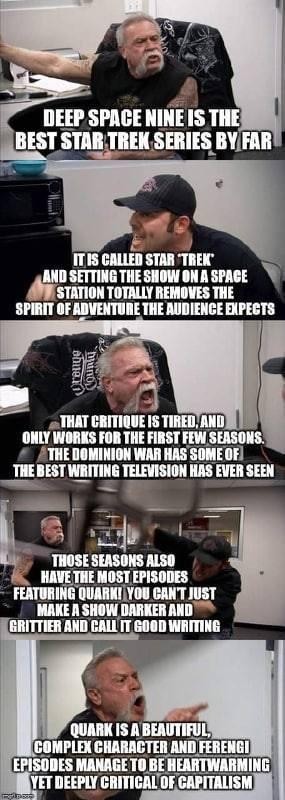
Well, if your biggest point of criticism is that they are not travelling around enough...
Deep Space 9 was peak Star Trek in so many other ways, who cares they're not on trek? By that measure, ENT would probably rank highest. Or even worse, Voyager.
(I didn't make this meme)
I did hear that criticism many times (e.g. they had to add in the Defiant to make the show interesting). But I agree with you.
Yeah I love the show after but ds9 vs any other shows is a depth vs breath. Ds9 had some of the most complex characters in all of star trek. Because of that push and pull between the writers and Berman. Those first few seasons let you do character driven stories and flesh out the world. Then that paid off in dividends in the later seasons when they starting doing plot driven serial stories. Plus they were not to drop a epistolic story right in the middle of a longer story arc. To give the audience a breather/ palette cleanser.
Unlike today where each season is a bloated movie where the plot is find the mcguffin that will save the universe every season. Like a crappy railroaded D&D campaign.
Eh. It's still Star Trek. I think the hangup on traveling is silly. The wormhole serves the same role as a narrative device as the warp drive. The original idea, before the Dominion War came along, was that the station would regularly have the same kind of weekly "planet of the week" encounters as other Star Trek shows. And the series does have many episodes like that, episodes like Meridian. I'm referring to bottle episodes, episodes focused on a single novel planet, culture, or ethical dilemma.
The idea was that because the station is at the mouth of a newly discovered wormhole, that the station would get that story mechanic while the characters stay in the same spot. Instead of the entire crew visiting new planets, new planets would effectively come to them. Delegations from new worlds would pour through the wormhole, providing opportunities to explore new cultures and civilizations. And Federation explorers could go through the wormhole and have their adventures shown on-screen or be discussed back on the station. An example of this can be found in Captive Pursuit.
Narratively, a wormhole functions the same as a warp drive. The story just brings the universe to the crew, rather than the crew to the universe. But narratively it makes little difference. You would think Trek fans more than anyone would appreciate that motion is relative in space.
(I didn't directly addressed you, just the opinion formulated in the meme).
I mean, I get that the show could feel a bit slow and light in the first two seasons sometimes. But on the other hand, the first thing it does is introducing Picard's perfect foil as the new commanding officer by questioning Picard and his role during the Borg crisis.
Most interesting start of any Trek show if you ask me.
Also the themes the show worked with, the character developement, even the continuation and expanding of TNG topics like Klingon and Ferengi culture and society.
BRB, wrote myself into wanting to rewatch.
If you prefer bottle episodes, then DS9 earns its nickname of Deep Sleep 9.
You too, can realize your dreams of running a concentration camp turned space strip-mall! Sign up for the Federation Navy today!
Both points can be right. DS9 WAS a divergence from the existing formula. Yes it mostly worked but they did push more exploration episodes in later seasons specifically to address this point, so the criticism was heard and acknowledged.
Setting the story on a station allowed the "trekking" to be more psychological and philosophical. Has trekking the stars changed us as much as we'd like to imagine? We're more open-minded as a result, but where are the limits of tolerance? Where are there still blind-spots? An excellent inversion of the Star Trek formula that builds out the whole "Western, but set-in-space" by playing off of something like Gunsmoke more than Wagon Train or whatever.
It's the only Star Trek where most of the trekking is done around the main characters rather than by them. But it's still relevant to the stories!
I also thought the Ferengi episodes were the best.
They were the best, but not on the strength of their social commentaries (which were played laughs far more than being a serious critique). The Ferengi episodes were the best because the characters were the best. Nog had by far the best development arc of any Star Trek character, ever.
Certainly not the best series.
I’m just happy “what’s the best Trek” is as debatable as “what’s the worst Trek”
Not every franchise has that.
Agreed.
(It's Academy that's the worst)
Are they? At least in my circles, DS9 and then Voyager are pretty universal as those answers.
I love DS9, but I would rather watch TNG than Voyager.
Early voyager (especially Neelix) hurts to watch. Once they pick up Seven of Nine and they make the doctor more of a crew member it’s really really good, but as a whole, if I had to choose to only watch TNG or Voyager again, TNG would win.
That’s because the EMH rulez. 🤘
Arguably TOS is the best in the plow sense.
(The plow is the greatest invention of all time in that the resulting food surplus enabled all the subsequent inventions).
Which series would you rate the highest? For me, probably TNG, largely on the basis of nostalgia. I haven't really watched any recent Trek, though, so I may lack some basis for comparison.
I like ds9 but any captain who justifies warcrimes is disqualified from best trek.
So... All of them?
I also LOVE star trek but as someone generally for peace and a decentralized, just world, I can't pretend that Starfleet isn't a thinly disguised military.
I absolutely think the heart of the show shines through, but the Liberal influences can often insert our failings as perfectly normal. Things that would not appear just or equitable in a socialist society like The Federation, are placed in as sort of accepted and normal.
I feel TNG and Voyager never outright justified it, but rather found a way to minimize and debate it and try their nest to end up on the most moral objective whereas sisko let the ends justify the means and then said he'd do of again lol.
I hated that episode when I saw it the first time. I felt it betrayed everything I imagined Starfleet to stand for.
Rewatching the show last year...when it came up again, I got it. Something about the Dominion war changed the context.
I hadn't actually seen anything else from that season the first time around. It made a difference.
In The Pale Moonlight is one of the few episodes of Trek I can name by name, and it is probably my favorite episode of all Trek.
It is the point when Sisko is just done with all the bullshit, and played the game to the fullest.
Starfleet command were not in a metal state of war at the time, neither was Sisko at first, but something snapped inside of him, and he turned on war mode.
It is a clear shift in his personality as he realizes the normal Starfleet way isn't working, and he took matters into his own hands.
This topic also brings to mind a book I read a year or two back. The Ministry of Ungentlemanly Warfare which showed a lot of "dishonorable" moves the Allies employed in WW2. Better to fight dirty than lose to the Nazis, they figured.
There's a nice parallel. The noble Federation captain figures it's better to fight dirty than to lose to the Dominion.
Agreed but in part thats because they still needed to ground the story for everyone to relate and . . well . . *gestures to everything*
we only saw like 3 minutes of seven as an official capatain. she wins by technicality here.
Seven is amazing
I can’t pretend that Starfleet isn’t a thinly disguised military
Disguised how? It's literally Federation's military.
True. When it comes to wars it is, however the writers are SOOO adamant that they are a "exploration and science corp" when in peace time.
I think Sisko gets misunderstood on this point. It's not unlike Picard in First Contact, when he starts to take the Borg incursion too personal. Or analogous in some way to the "Corrupt Admiral" trope. It's not to Gene's utopia views for sure, but it shows real fallible characters and the story of them.
DS9 is just a soap opera but in space.
When does it get good?


all 81 comments