Shamelessly stolen from you-know-where.
you are viewing a single comment's thread
view the rest of the comments
[–] [S] 2 points 1 year ago (4 children)

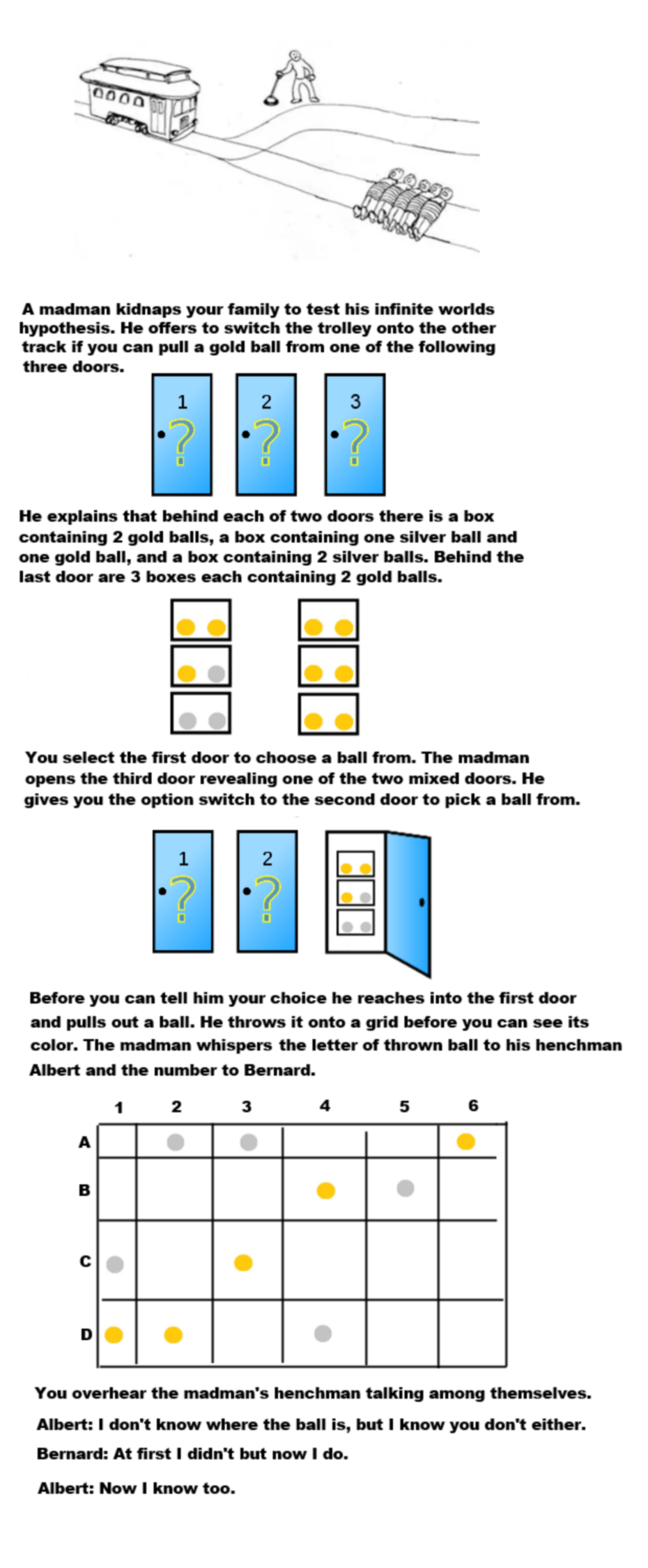
Knowing that the ball was gold gives you Bayesian knowledge about the boxes behind the door, since the prior probability of the host pulling a gold ball from a 6-gold door is different than from the 3/3 door. So you have to multiply Monty Hall probabilities and Bayesian probabilities together.

That assumes the host pulled a ball at random, of course, and not a deliberately gold ball.

  • source
  • parent
  • hideshow 4 child comments
  • [–] 3 points 1 year ago (3 children)

    Hmm, you're quite right. My intuition is that the Bayesian portion would exactly offset the Monty hall portion. I think, at a glance, Bayes would give door 1 a 2/3 probability of having 6 gold, but Monty Hall would give door 2 the same probability, so we can effectively cancel these out and just consider a raw probability

    You either have 5 gold or 2 gold 3 silver behind door 1, and 6 gold or 3 and 3 behind door 2, which gives door 2 a very slight edge. Does that check out?

  • source
  • parent
  • hideshow 3 child comments
  • [–] [S] 3 points 1 year ago (2 children)

    Yes! Cancels out, leaving only a very slight edge on door 2. All that work for only... 2.77% edge over picking at random. What a troll problem, huh?

  • source
  • parent
  • hideshow 2 child comments