the judge ruled that there appeared to be a ‘terrorist connection’ as the activists were attempting to influence the Israeli government by restricting its access to weapons.
This is suuuch a stretch.
the judge ruled that there appeared to be a ‘terrorist connection’ as the activists were attempting to influence the Israeli government by restricting its access to weapons.
This is suuuch a stretch.
The only large mainstream competitor, which would probably benefit from github's troubles: "We saw github breaking itself regularly because of it's own slop coding AND flooded with trash vibe coded projects and thought - that's where we wanna be!"
Maybe they've blocked you.
I don't know, sorry.
Not even close.
"Impressions" is the amount of time a piece of content was viewed. This is a key metric in advertising-based situations because you want to know the ratio of clicks on the thing vs how many impressions it has to judge how effective a bait it is.
If you wire the panels in series then the total voltage will be the sum of all the panels' voltages. The final amps will be the amps of the weakest panel.
If you wire the panels in parallel then the max voltage will be the voltage of the weakest panel but the amps will be the sum of all the panels' amps.
So it depends what your charge controller can handle. High volts or high amps. Also series and parallel react differently to partial shade. I can't remember the details, only that parallel seems to cope much better.
High voltage (24v or higher, ideally 48v) is good for longer distances as transmitting electricity at 12v suffers losses after a few meters unless you have extremely thick wires. If your panels are < 4 meters from your plug/controller then parallel panels (with it's lower voltage) will be ok.
Don't skimp on fuses. If anything goes wrong you want the panels to be cut off, not pumping electrons into the fire.
If they want to click 3000 buttons, yes. These buttons are not new functionality, it's been like that since the beginning.
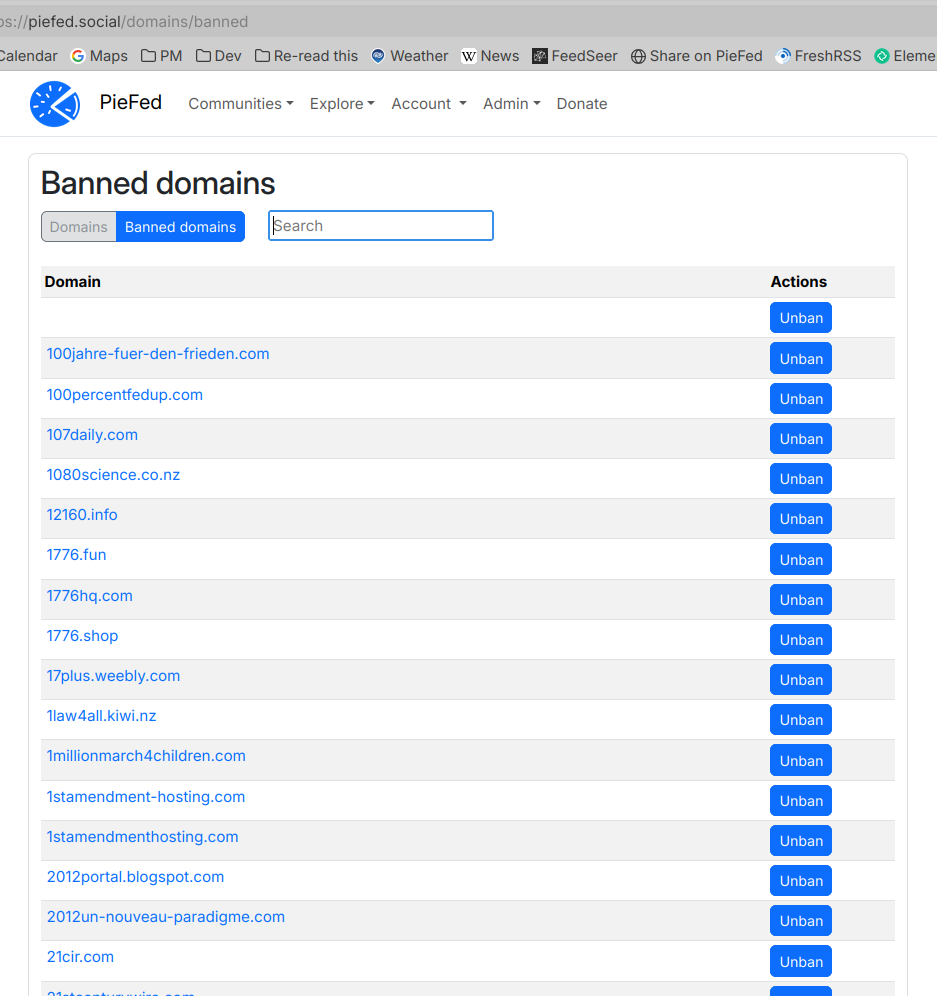
Easier just to empty the relevant database table! It's called 'domain' if anyone in the future finds this.
Here is the user interface for unblocking:
Thank you for that, I'll think about it.
Yes that does sound pretty cool, on a technical level.
I've never built a system that was based around microservices but if it's a way of doing things that you enjoy and have experience in (or want experience with!) then go for it :D
So, microservices architecture? Lots of ink spilled debating the pros and cons of that already, I won't add to it.
With federation with other software and with mobile apps involved via an API it already feels like we have a lot of moving parts spinning at different speeds making it hard to keep it cohesive. Throwing a microservices architecture in there would probably increase the systemic incoherence issues even more? Dunno. Seems risky.
I like your choice of python though 😎
from the mod log:
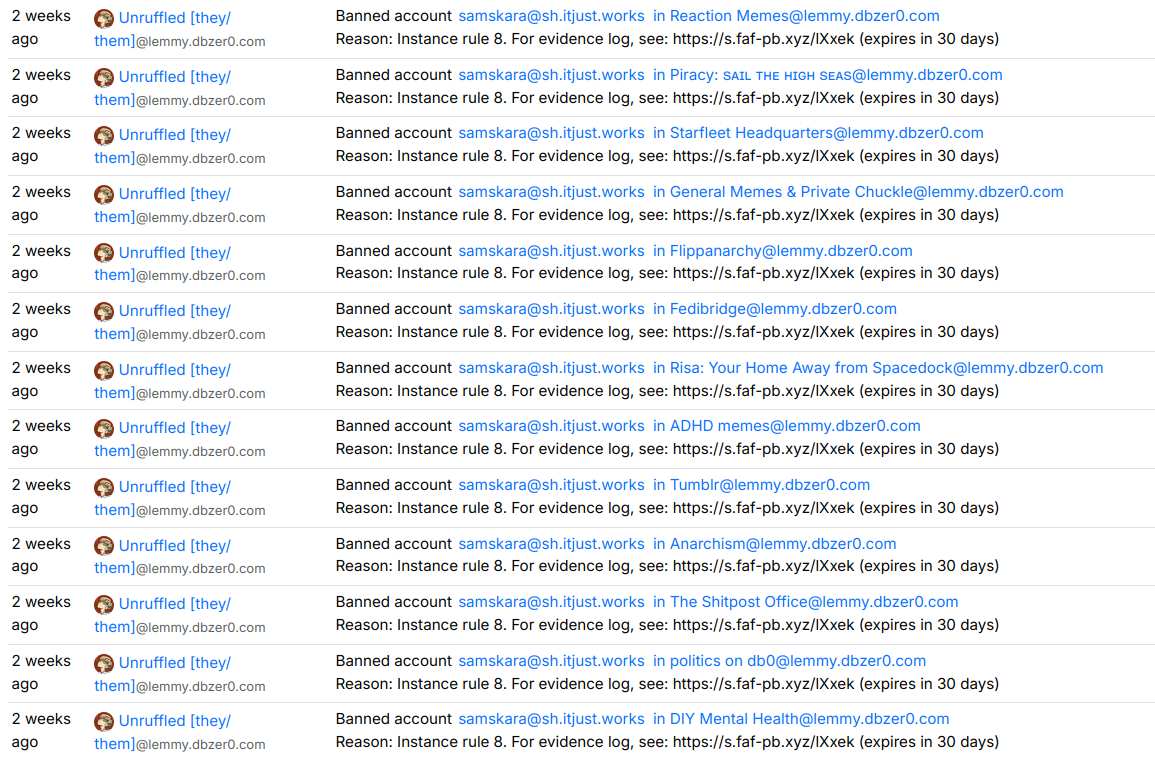
https://s.faf-pb.xyz/lXxek was the old url but they took it down - I have a copy at https://join.piefed.social/wp-content/uploads/2026/05/evidence-llm-used-for-banning.txt
The output from the LLM was provided as proof that someone needed to be banned.
I didn't want to do this but my hand was forced by their dissembling, minimization and bullshit. Note how the output includes a nice big logo with a slogan and ascii graphics - this was not a one-off experiment, this is an app they were proud to call their own.
I recently discovered that some popular federated instances have been using LLM-assisted moderation tooling that evaluates whether someone has said something bannable. They do this by running a script/app that sends the user’s comment history to OpenAI with the question “analyze this content for evidence of specific political ideology sentiment. Also identify any related political ideology tropes“. (The italic bits are where I've redacted the ideology they're seeking).
OpenAI’s LLM (they’re using GPT-5.3-mini) then responds with something like:
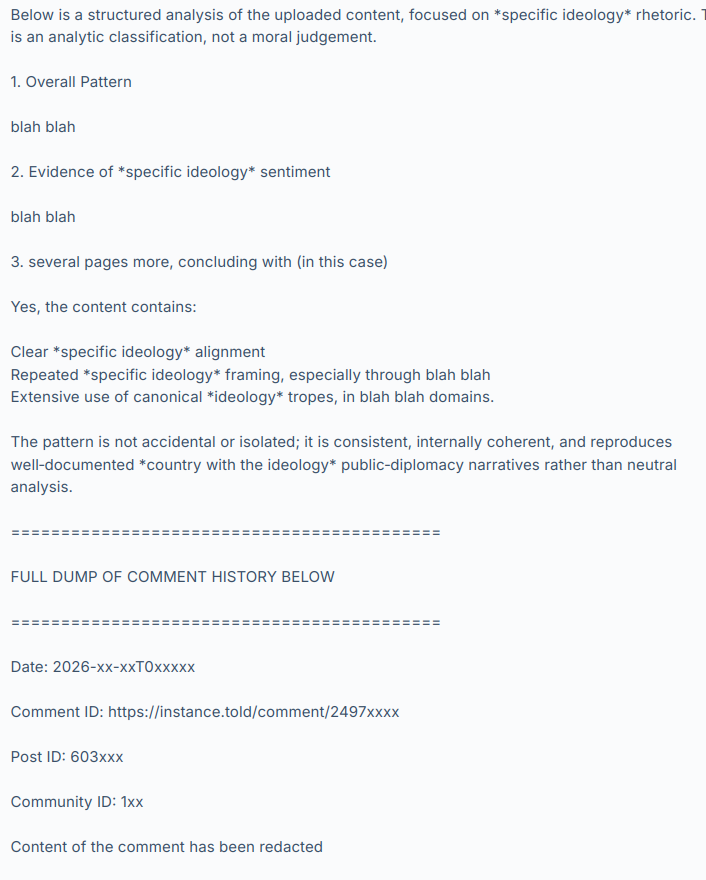
and so on, hundreds of comments.
I have not named the instances or people involved, to give them time to consider the results of this discussion, make any corrective changes they want and disclose their practices at their own pace and in their own way. I have also redacted the evidence to avoid personal attacks and dogpiling. Let’s focus on the system, not the individuals involved. Today these instances and people are using it and maybe we’re ok with that because it’s being used by groups we agree with but what if people we strongly disagree with used it on their instances tomorrow?
The use and existence of this tooling raises a lot of other questions too.
What are the risks? Fedi moderators are often unsupervised, untrained volunteers and these are powerful tools.
What safeguards do we need?
Would asking a LLM “please evaluate this person’s political opinions” give different results than “find evidence we can use to ban them” (as used in the cases I’ve seen)?
What are our transparency expectations?
Is this acceptable and normal?
Should this tooling be disclosed? (it was not – should it have been?)
If you were given a choice, would you have opted out of it?
Can we opt out?
Are there GDPR implications? Privacy implications? Should these tools be described in a privacy policy?
Are private messages being scanned and sent to OpenAI?
How long should these assessments be retained and can we request to see it, or ask for it to be deleted?
Once the user’s comments are sent to OpenAI, is it used to train their models?
What will the effect be on our discourse and culture if people know they are being politically profiled?
Where are the lines between normal moderation assistance tools, political profiling and opaque 3rd-party data processing?
I hope that by chewing over these questions we can begin to establish some norms and expectations around this technology. The fediverse doesn’t have any centralized enforcement so we need discussions like this to develop an awareness of what people want in terms of disclosure, privacy, consent and acceptable use. Then people can make choices about which instances they join and which ones they interact with remotely.
And of course there are the other issues with LLMs relating to environmental sustainability, erosion of worker’s rights, increasing the cost of living and on and on. I can’t see PieFed adding any functionality like this anytime soon. But it’s happening out there anyway so now we need to talk about it.
What do you make of this?
I did some analysis of the modlog and found this:
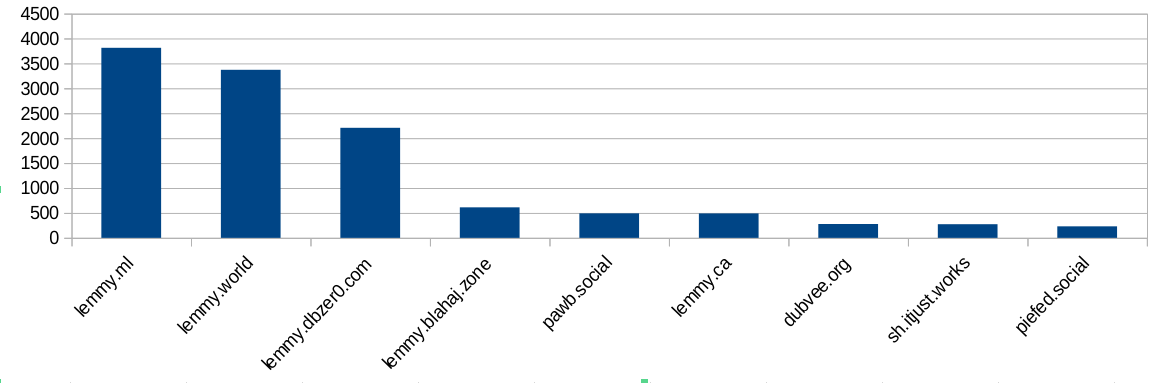
Ok, bigger instances ban more often. Not surprising, because they have more communities and more users and more trouble. But hang on, dbzer0 isn't a very big instance. What happens if we do a ratio of bans vs number of users?
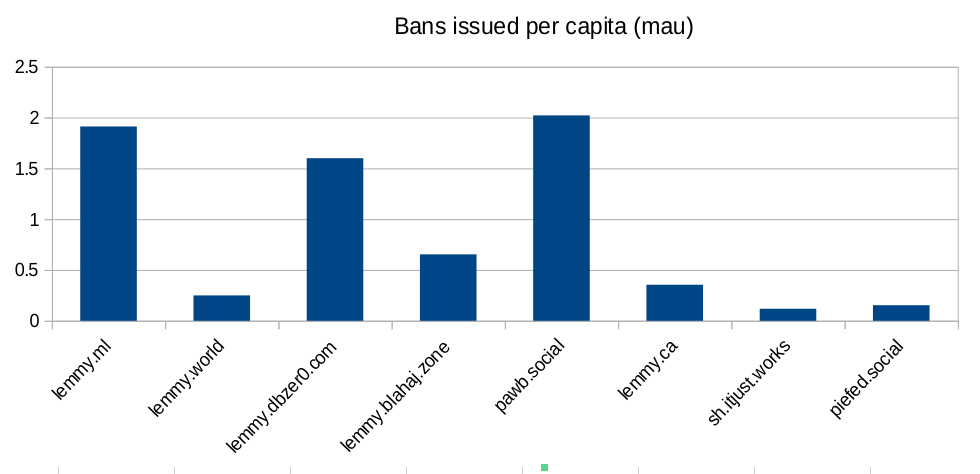
Ok, so lemmy.ml, dbzer0 and pawb are issue an outsized amount of bans for the number of users they have... But surely the number of communities the instance hosts is going to mean they have to ban more? Bans are used to moderate communities, not just to shield their user-base from the outside. Let's look at the number of bans per community hosted:
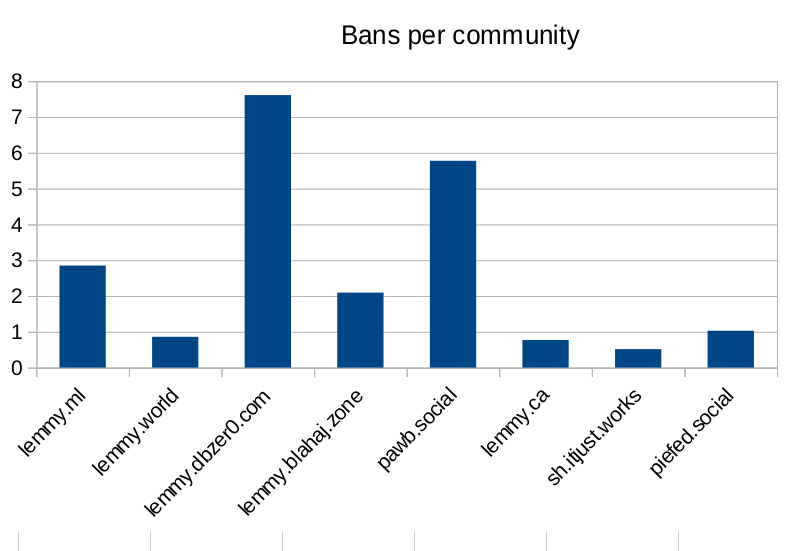
Seems like dbzer0 really loves to ban. Even more than the marxists and the furries! What is it about dbzer0 that makes them such prolific banners?
Raw-ish numbers and calculations are in this spreadsheet if anyone wants to make their own charts.