Does anyone know of any attempts out there of building more ethical AI models for things like text LLM, image or audio processing?

To clarify, I am talking about an AI model which is trained on a dataset of public domain, creative commons, licensed, or more intentionally fair use sampling methods.

Personally, I believe that the way the modern AI industry has built their giant models is incredibly exploitative, unethical, toxic to society and culture, and arguably not even consistent with the letter or spirit of the existing rules by which we have all been asked to play.

As a tool, machine learning may not be fundamentally bad, but who, if anyone, is out there trying to do it in better, more legitimate way?


The past four weeks have been something of a wake-up call for the video game industry. You’ve read the headlines, so you know the deal by now: AI advancements spearheaded by Claude Opus 5.5 have turned the world of coding on its axis. Decompilations that used to take months, or even years, are now being pumped out on a daily basis, and publishers can’t keep up with the deluge of vibe-coded browser ports and “native” PC recompilations. I’ve been covering and researching this over the past month, and there’s one recurring topic that keeps popping up in every comment section I read: karma. For many, this is the video game industry’s “you reap what you sow” moment, proof that the AI tools many publishers have brazenly admitted to using are a double-edged sword.


I have a MIDI controller keyboard that I have cleaned in the past with disinfectant alcohol wipes, which I know is a bad idea because it degrades the rubber over time.

Well, the rubber on the pitch bend and modulation wheels has indeed degraded, and the surfaces texture is awful, uneven and sticky now. My fault... I know.

So does anyone know of any way to fix, or even improve, this kind of nasty rubber surface degradation once it occurs? Sanding? Applying oils? Is there any way I can even slightly restore these controls back to their original soft-touch rubbery glory?


For whatever reason I've never been a huge chatroom person, but the recently renewed conversation over Discord's identity verification system has got me thinking once again about free, open, and community-run alternatives--with Matrix being the one that I think stands out the most.

For those who aren't familiar, for better or worse Matrix isn't a 1:1 clone of Discord (like you mostly see with Stoat or Fluxer), but an open protocol for federated messaging and voice chat. Instead of a centralized service run by any one company or group, Matrix is a lot like email or "the fediverse": a network of different servers, run by different people, communicating with each other using a single protocol and visualized through various apps (like Element or FluffyChat).

But for as much as Matrix feels like the fediverse in spirit, to me it also feels very separate from the fediverse, like it's not a part of the "same conversation", so to speak. The ethos is similar. The background is similar. The mission is similar. But, despite that, I feel like I don't see as much overlap between fediverse communities and matrix communities as I would expect.

Maybe it's purely because of the near-ubiquity of Reddit and Discord in modern net culture, but it seems pretty common to see Reddit communities that advertise links to Discord communities. Whereas it seems a lot more rare for "threadiverse" communities to advertise links to Matrix communities. Which leads me to my question...

What do you all think of Matrix?

Have you been aware of it? Have you tried it?

Are you an active Discord user? Are you an active Matrix user? If so, what do you like/dislike about it? If not, why not?

Broadly speaking, do you think there is value in what Matrix is doing? How do you see it fitting in with the rest of the Fediverse?


Hey there! Are you a fan of classic, intense and borderline overwhelming real-time strategy games like StarCraft or Age of Empires?

If so, then welcome to @rts@fedia.io, a brand new fediverse community for fans of the real-time strategy (RTS) game genre!

I hope this will be a great place on the fediverse to talk about all things RTS games--be it news, strategy, memes, game design, modding, reverse engineering, or what have you.

What's more, in addition to this fediverse community I've also just set up a brand-new Matrix space, #realtime:matrix.org, for real-time discussion and matchmaking for various games (with each game having its own subspace and plenty of room for null

That's !rts@fedia.io and #realtime:matrix.org!

See you there!


Today's SteamVR release makes more Steam features available in VR, adds 32-bit OpenXR support, and improves the streaming experience. If you encounter issues with this update, please post in the SteamVR Bug Report forum. If possible, please include a SteamVR System Report to aid in tracking down your issue. The Steam Link for Meta Quest FAQ page is available here. Replies to this post are not tracked for bug reporting purposes. Please use the forum linked above to report issues. [...]


For those who don't know, playit.gg is a free/cheap service for exposing self-hosted local game servers to the wider internet.

But as someone who already has access to a cheapish VPS, I'm curious if anyone knows of any self-hostable alternatives that I could just run as a container on my VPS.

I've been toying with using Wireguard UDP tunneling, but it's proving to be a little bit more difficult and complicated than I was bargaining for. So if anyone knows of anything out there that does something like this, I'd be grateful!


I'm not great at networking concepts, but my basic understanding is that computer networking relies on constructs like IP addresses and port numbers to direct data packets to the correct device and application.

So, if I'm playing an online game like Minecraft or Counter-Strike, I am able to connect to the dedicated game server using the server's IP address (which might be associated with a physical device, or a virtual device like a VM or a OCI container) and port number (which is like a communication "channel", associated with a particular piece of software).

And, as such, you can host multiple game server instances for the same game on different IPs or ports, as long as each server has some way to be individually addressed.

But I start to get a bit confused when I think about the packet's return trip and how the server communicates back to the clients...

In some cases, each client will be connecting from their own network modem, with their own IP address assigned to them dynamically or statically by their ISP. In that case, I would imagine that the server could just keep a list of client connections and route relevant data back to each client.

But in other cases, you might have a multiple clients playing a game behind one modem (like housemates or a LAN party where multiple players join the same remote/internet server), or a newer problem, multiple different networks sharing an IP address due to CG-NAT at the ISP level. In which case, from the perspective of the server, multiple players would be playing from the same IP address and communicating over the same port, right?

So how does the server differentiate between >2 players connecting from the same IP address and communicating over the same port?

Or does it not even try, and instead just broadcast all of the relevant game data to every client?

And if that's the case, how do huge games like battle royales or MMOs handle sending game state to a large number of users?


I've been increasingly getting into the idea of hosting some servers for classic PC games like Counter Strike 1.6 and various Half-Life mods, but I'm curious what the consensus is for what the best options are for doing so right now.

I have some experience hosting servers at home in a "homelab" kind of context (mostly for stuff like Jellyfin, Samba, etc.), and I know how to spin up docker containers and administer a Linux computer decently for LAN use. Right now I use tailscale to access my homelab stuff remotely, but I don't know if that would work well in the context of hosting a public game server.

Generally I don't have much knowledge about safely exposing my local hardware to the wider internet for my circle of ~20 friends to join.

So basically I'm wondering what you all would do for hosting game servers if you were going to start today...

Would you use local hardware with port forwarding? Or would you go with a VPS (and if so, can you recommend one for North America)?


Last weekend I went to a fun double feature screening of Appleseed (1988) and Black Magic M-66 (1987) here in Portland, and Dark Horse Comics had a booth set up where they were selling their new Appleseed Deluxe Edition hardcover a few weeks early, so I bought a copy.

I've never read Appleseed before, and it was my first time seeing the OVA, which I understand might be pretty different from the manga. I actually liked the Black Magic OVA a little bit more I think, but both were fun to see in a packed theater in 2026, especially in the midst of the Shirow Masamune renaissance brought about by the new Ghost in the Shell series.

The manga itself is really nice. I've only read a couple of pages due to having a busy week, but I like what I see so far and the hardcover is really nice and big, with fancy gold page edges.

Just thought I'd share since I've never had the opportunity to buy a manga pre-release before. I'm a sucker for large format hard covers...
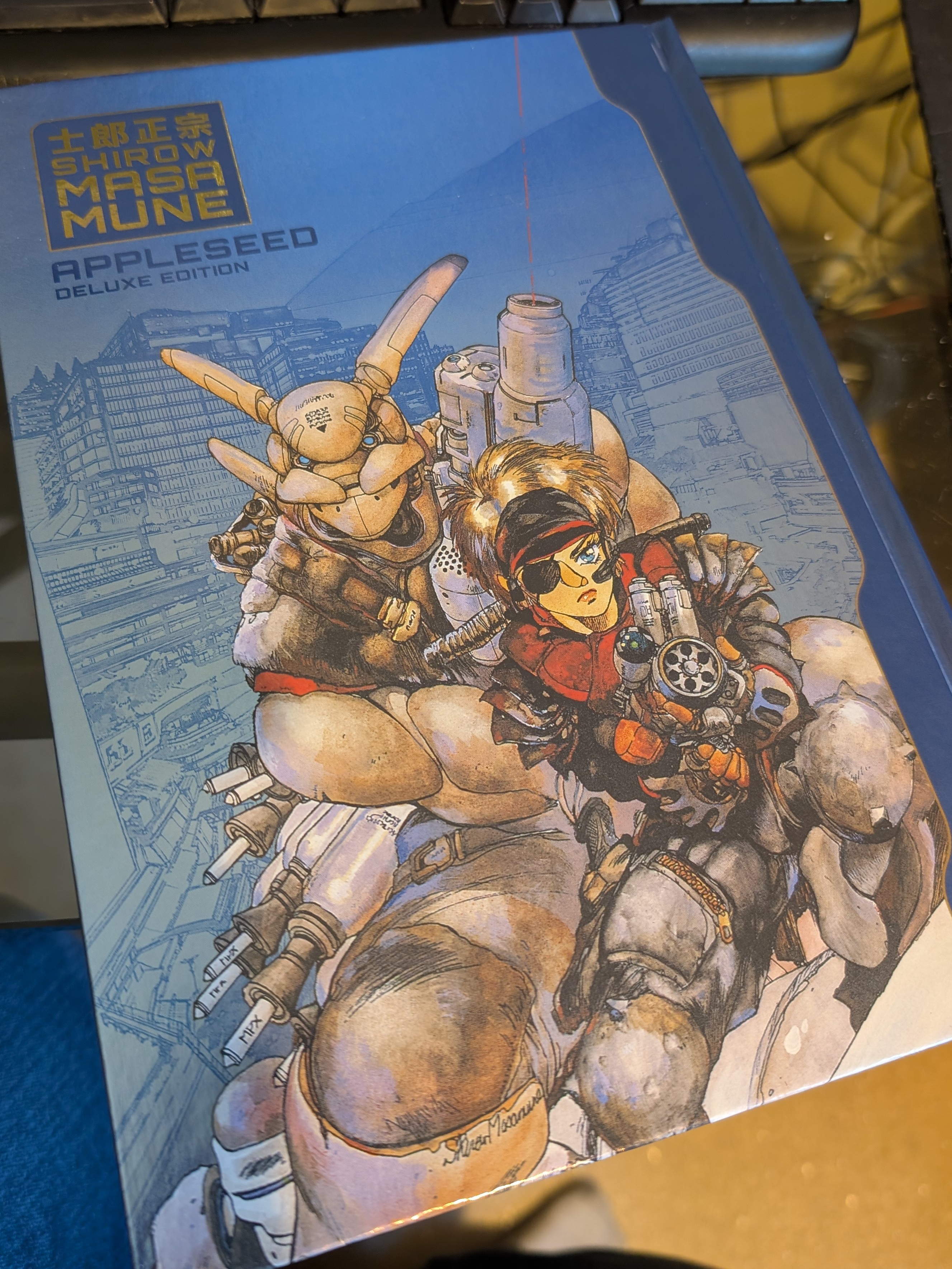
Appleseed Deluxe Edition
 

Let me preface this by saying that I'm a longtime GTA fan, and so, to some extent, I don't blame people for being excited for the newest game in that franchise.

GTA 3 on the PS2 was a revolutionary game that changed the medium forever. Vice City and San Andreas built upon that same template and engine making games that were bigger in better in just about every way. I have mixed feelings about both GTA 4 and 5, both in terms of gameplay and story, but overall feel that they were good games with better shooting and driving than the PS2 era games. I never got into the online stuff outside of occasional racing, but I understand that it's hugely popular.

With that background, I don't doubt that GTA 6 will be a big seller, maybe even the biggest ever... But be that as it may, I think that it is riding on a big wave of unearned cultural hype:

  • We have seen very little of what the game actually plays like, and almost nothing about what sets it apart from GTA 5 in terms of systems. The marketing leads me to believe this will be less sandbox and more story...
  • All we have been told about the story of this game is that you play as Jason and Lucia, two lovers and ex-cons in Vice City. The trailers focus on their relationship, which is a unique angle for a GTA game, but we really don't get any insight into who these characters are as individuals or what makes them interesting.
  • Despite the fact that GTA has always been something of a hit-or-miss parody of modern (usually American) life and culture, every piece of media I've seen surrounding this game has been totally devoid of any humor or commentary. There's a lot to make fun of in America (Florida especially) today, but based on the trailers, this is looking to be the least funny or satirical GTA game ever.
  • This is the most expensive GTA game ever, and that's even without factoring in the paywalled features like premium car modding and character styling, but will it be the biggest? What does $80-100 get us?
  • For better or worse, quite a few of the key people who made the GTA series what it was are now out of the picture, so the development team is going to be pretty different than past games. That could go either way, but I think it does invite a certain amount of skepticism.
  • No initial PC release.
  • No physical release for consoles.

So again, I really don't blame people for being hopeful or excited about a new GTA game coming out. If you're looking forward to this one then more power to you!

But I can't help feel that the levels of hype are way overblown for what we've seen of the gameplay, story and world building. If it wasn't part of the "GTA" franchise, I think this would be just another new release.


Final Update: My Steam Controller (2026) hardware seems to be fine after all!

There is something funky going on with some combination of Steam Controller, Bazzite, and Big Picture "Gaming" Mode, creating problems with inputs in the Steam menu itself... It's still a minor issue for me.

But I was able to open Ultra Street Fighter IV and give the controller a thorough test in training mode with visible inputs, and it acted as expected (without dropping or doubling inputs at all). It worked well in game, and I found the d-pad and track pad to be pretty solid for fighting games, too!

So, in short, something is causing it to bug out a little bit in the Bazzite HTPC Big Picture Mode, but it's working pretty well in games and I'm now confident that there isn't any hardware-related issue.

Turns out the Steam Controller doesn't suck afterall!


Original Post: After a long shipping process (and an even longer wait) I finally got my new Steam Controller (2026), only to find that... it sucks!?

It drops inputs in Steam Big Picture Mode (or rather, Bazzite's gaming mode). And when it's not dropping inputs, it's doubling them!

The puck is ~15ft (4.5m) away from me, on top of the TV stand with direct line of sight to me and it reports having a bad and unstable connection. To make matters worse, the input issues seem to happen regardless of whether it's a wireless or wired connection...

Finally, the pairing process is straight up laughable. Connect the controller to your puck to try to pair it, and it prompts you on screen to confirm? How am I supposed to agree to pair it if my controller isn't paired in the first place??

Am I the only one having a terrible experience with this controller so far? This was supposed to be an easy win for Valve...

I sure hope they have some kind of emergency patch in the works for this thing because right now I'm on the verge of asking for a refund.

view more: next ›