That's the way it is on the site. I don't think he'd do it any more, but the older comics were censored like this.
Some background on this comic:
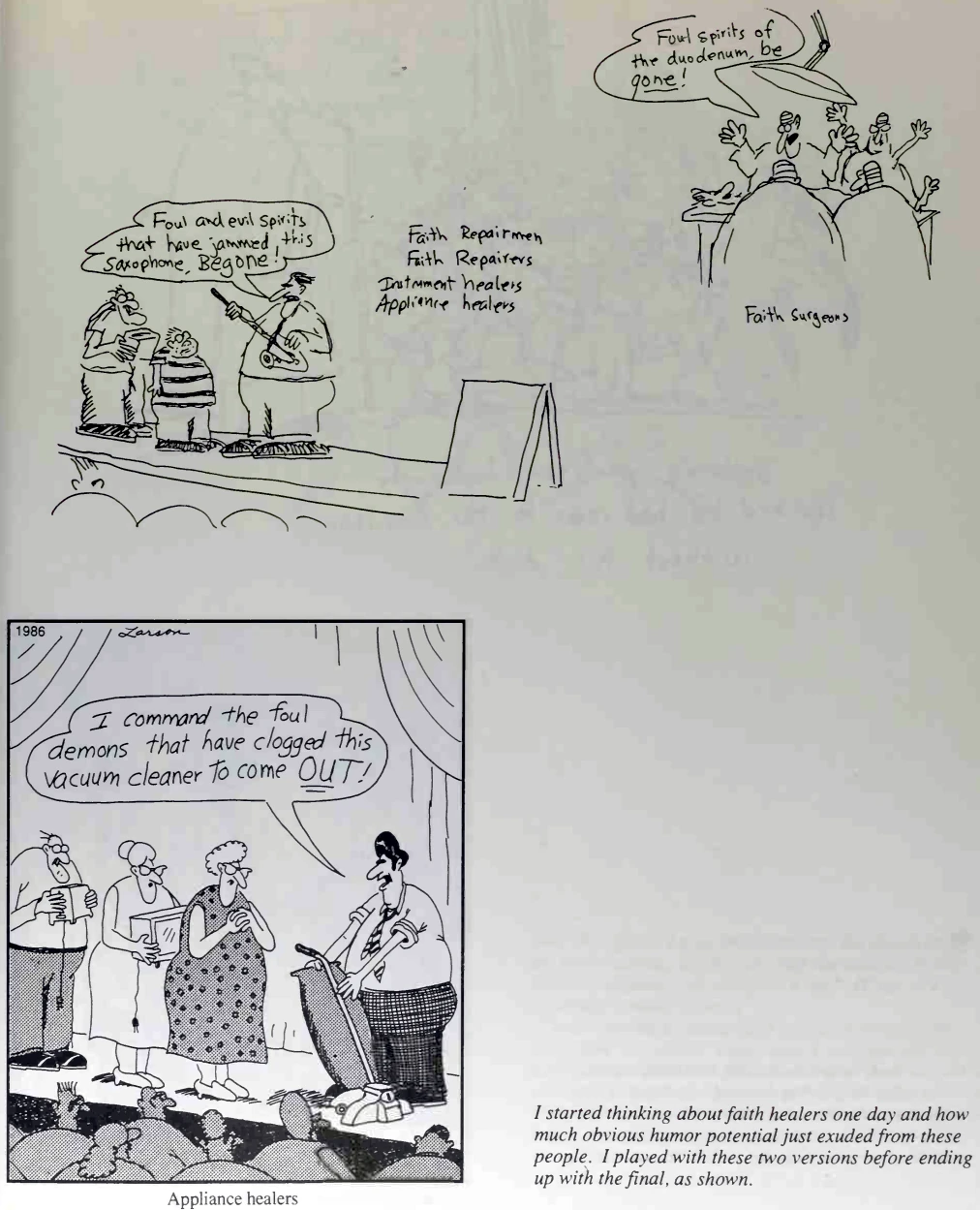
Transcript (top sketch):
Foul spirits of the duodenum, be go̲n̲e̲!
Faith Surgeons
Transcript (middle sketch):
Foul and evil spirits that have jammed this saxophone, Begone!
Faith Repairmen
Fair Repairers
Instrument healers
Appliance healers
Transcript (commentary):
I started thinking about faith healers one day and how much obvious humor potential just exuded from these people. I played with these two versions before ending up with the final, as shown.
His costume looks like a KKK robe
Bonus!

Title text
fruit mimes song
Posted the linked Patreon post over here:
Some background on this comic:
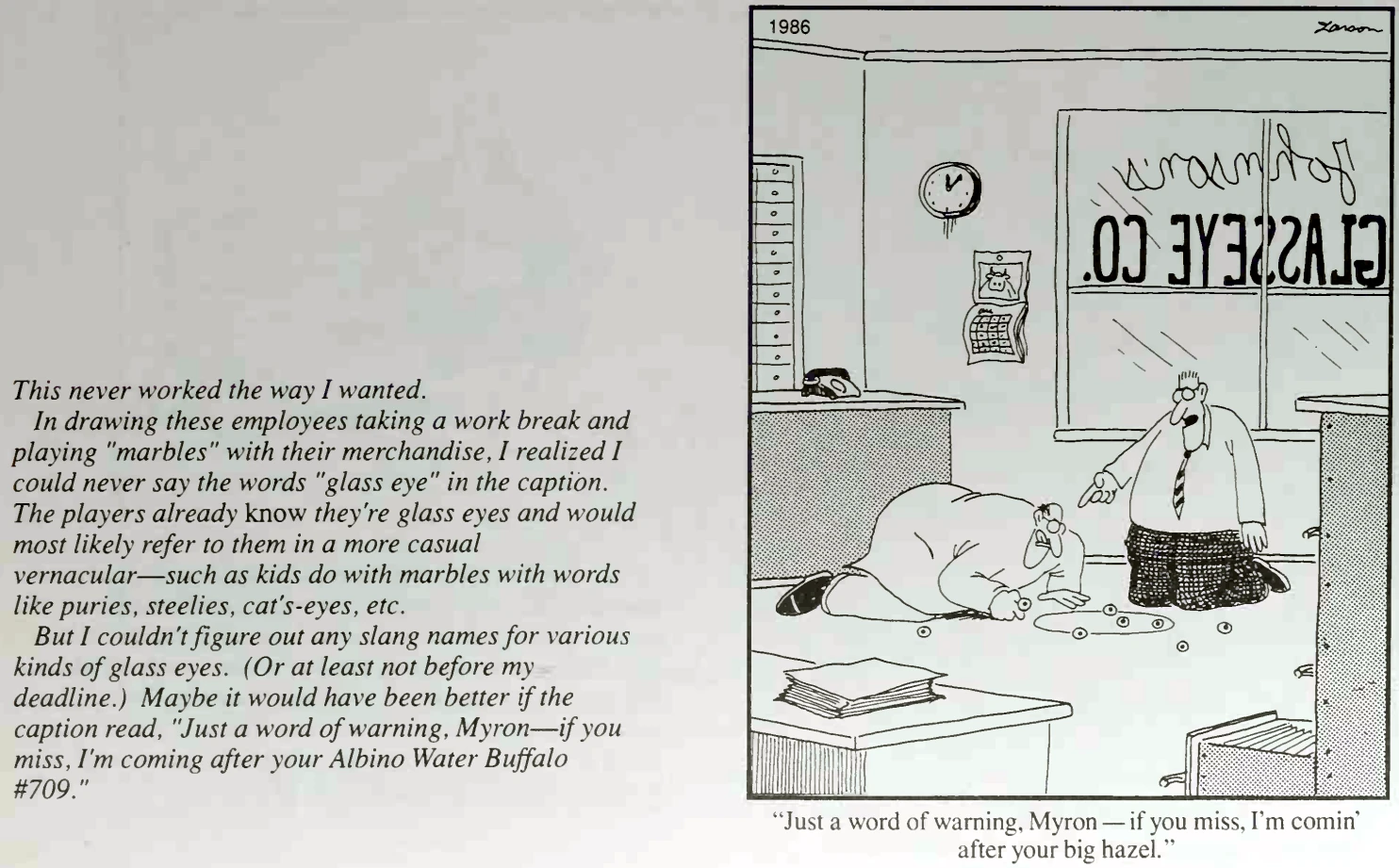
Transcript:
This never worked the way I wanted.
In drawing these employees taking a work break and playing "marbles" with their merchandise, I realized I could never say the words "glass eye" in the caption. The players already know they're glass eyes and would most likely refer to them in a more casual vernacular―such as kids do with marbles with words like puries, steelies, cat's-eyes, etc.
But I couldn't figure out any slang names for various kinds of glass eyes. (Or at least not before my deadline.) Maybe it would have been better if the caption read, "Just a word of warning, Myron―if you miss, I'm coming after your Albino Water Buffalo #709."
Thanks, appreciate hearing it!
Some context for this comic:

Transcript:
Drawing God in any context, let alone a cartoon, poses some obvious risks.
In the upper left cartoon, I was careful to do two things; First, I made God look the way I think most of us are pretty sure he looks. Secondly, I made sure he was really winning hands down. Even if Norman had only ten points it would have meant that he beat God to the buzzer at least once, and someone would have gotten mad.
"In God's Kitchen" was fairly benign, since the emphasis was mostly on the earth and the suggestion that things aren't quite normal here and why.
I was mostly worried about the last cartoon shown here. Not because of readers, who for the most part found it to be a light and silly drawing, but because I started to feel like I was bucking for a lightning bolt to come out of the sky and turn me into something like the kid here.
Some background on this comic:
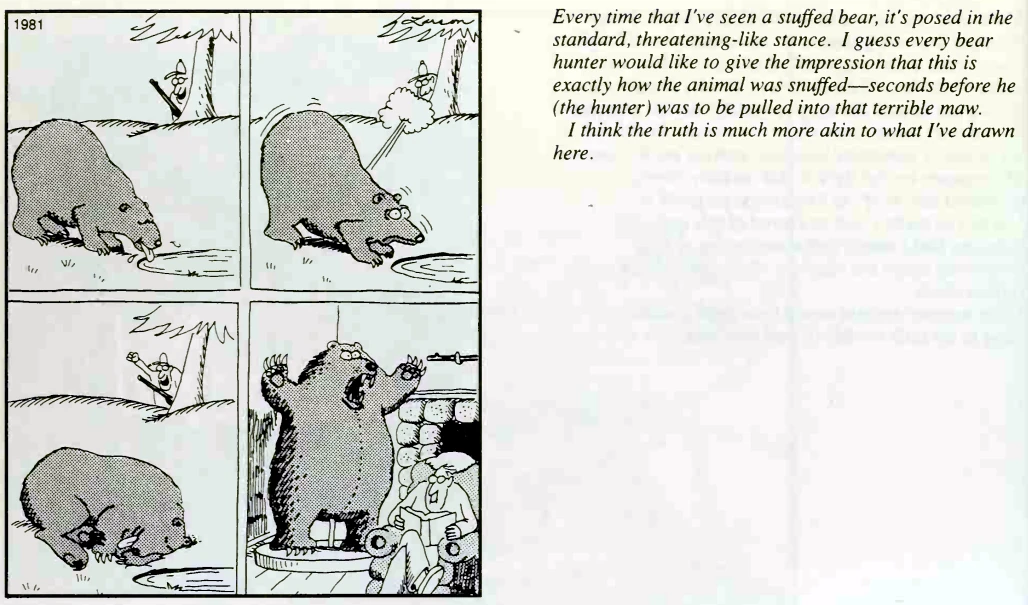
Transcript:
Every time that I've seen a stuffed bear, it's posed in the standard, threatening-like stance. I guess every bear hunter would like to give the impression that this is exactly how the animal was snuffed―seconds before he (the hunter) was to be pulled into that terrible maw.
I think the truth is much more akin to what I've drawn here.
Not the game, but as far as references go, the kid's pajamas have a reference to another PBF comic:
Some background on this comic:
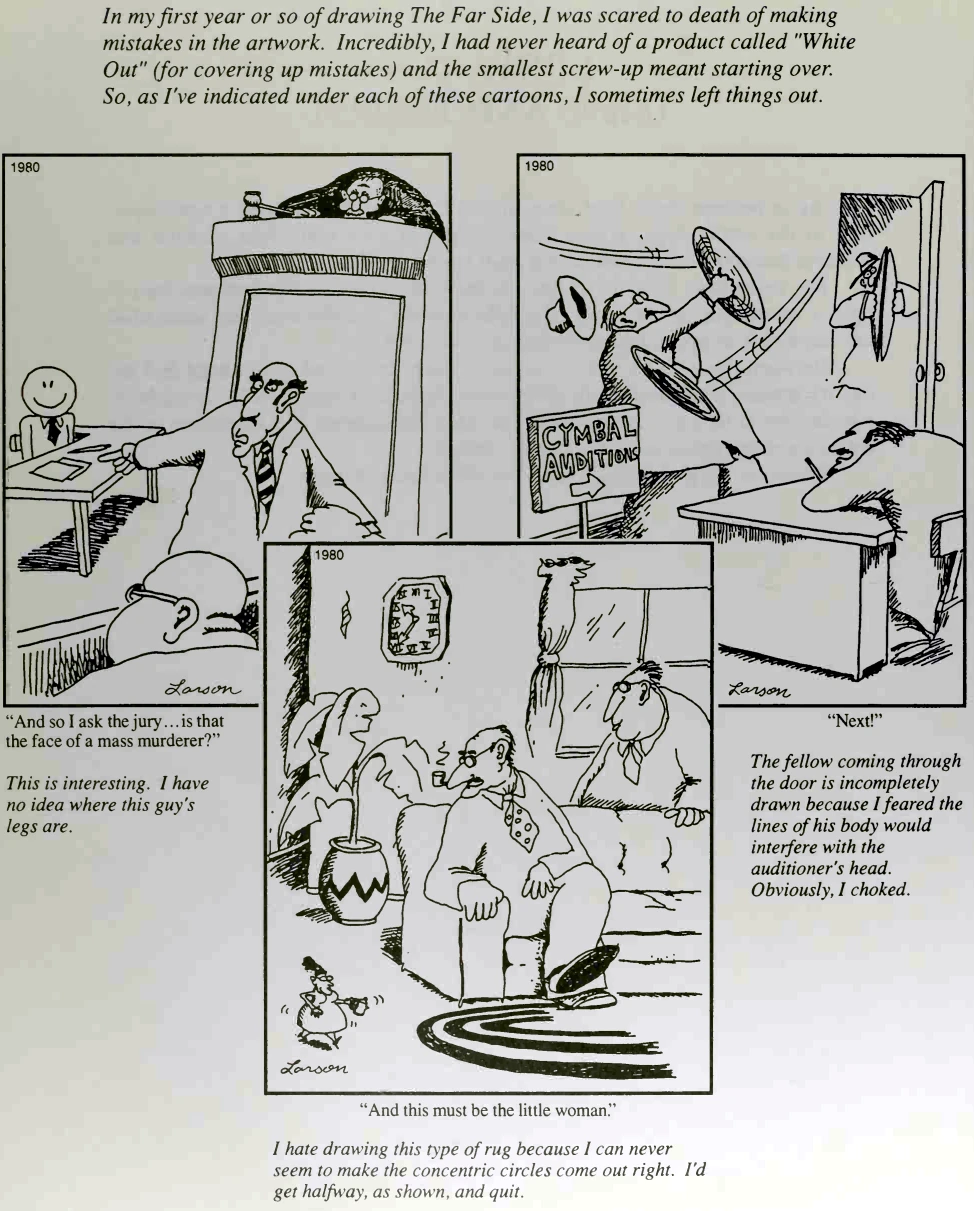
Transcript (commentary)
In my first year or so of drawing The Far Side, I was scared to death of making mistakes in the artwork. Incredibly, I had never heard of a product called "White Out" (for covering up mistakes) and the smallest screw-up meant starting over. So, as I've indicated under each of these cartoons, I sometimes left things out
The fellow coming through the door is incompletely drawn because I feared the lines of his body would interfere with the auditioner's head. Obvious, I choked.
This is interesting. I have no idea where this guy's legs are.
I hate drawing this type of rug because I can never seem to make the concentric circles come out right. I'd get halfway, as shown, and quit.
Bonus!

Title text
Yeats rhymes with gates but he doesn't seem to like rhymes much.
Posted the linked Patreon post over here:
Some background on this comic:
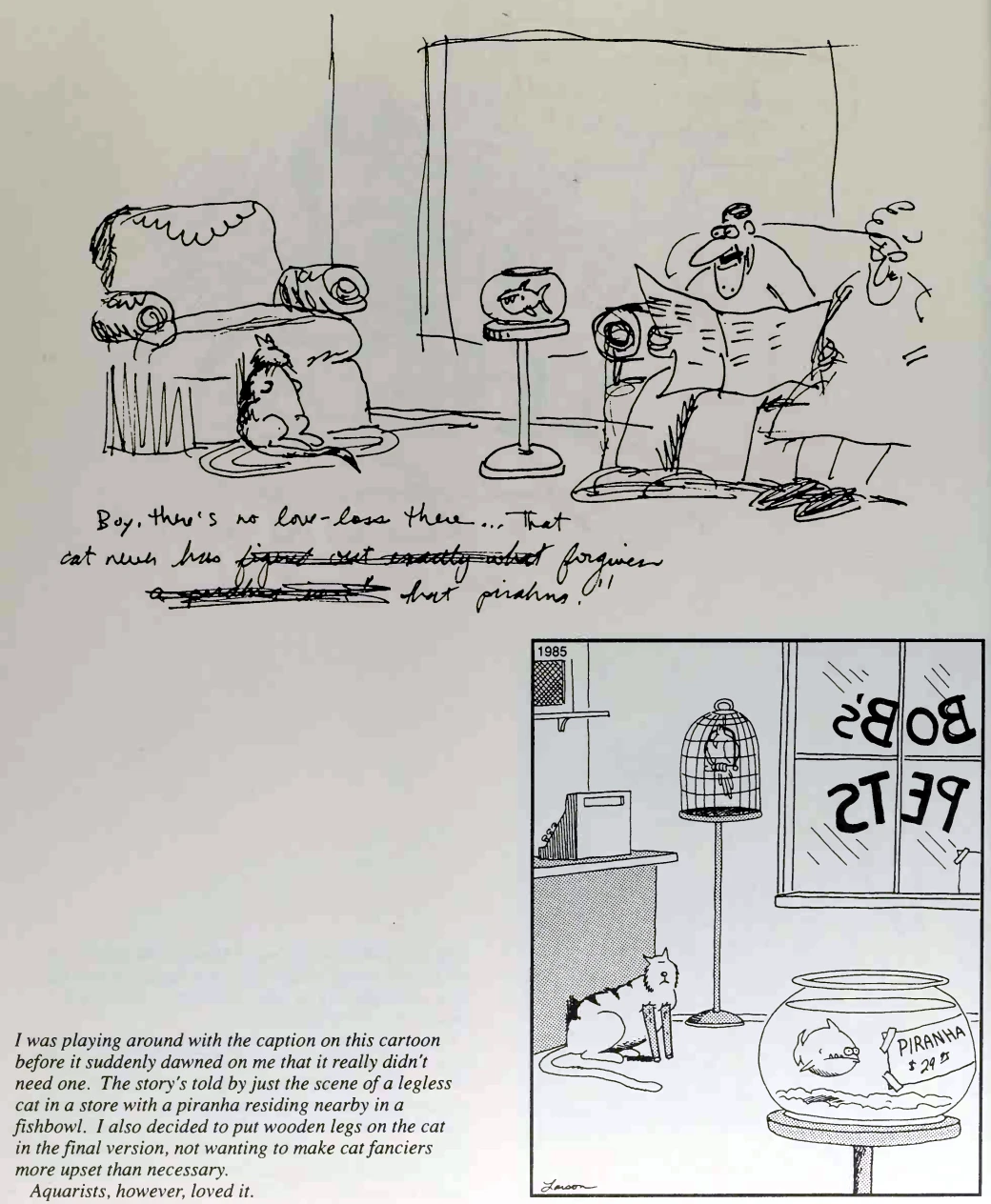
Transcript (commentary):
I was playing around with the caption on this cartoon before it suddenly dawned on me that it really didn't need one. The story's told by just the scene of a legless cat in a store with a piranha residing nearby in a fishbowl. I also decided to put wooden legs on the cat in the final version, not wanting to make cat fanciers more upset than necessary.
Aquarists, however, loved it.
Transcript (sketch):
Boy, there's no love-loss there…That cat never has
figured out exactly what a pirahna is."forgiven that pirahna."
Yeah, he went back in IIRC 2015 and added bonus panels to all of the old comics. He also added alt text to some of the old comics starting with the first, but then stopped for some reason, and then started again. At https://www.smbc-comics.com/comic/2004-04-08, they just become the date, at https://www.smbc-comics.com/comic/your-dreams he switches to titles instead of dates, with the alt text loosely following that, until he starts adding real alt text at https://www.smbc-comics.com/comic/heaven
Bonus!

Title text
is this just spam for an owl massage parlour?
Posted the linked Patreon post over here:
Note: not sure why it's pixelated. It's like that on gocomics 🤷
Apart from the indentation issue (and semantics identified in sibling comment), the joke works in python:
>>> for i in range(3):
...     print(i, end=' '); print(i**2, end=' '); print(i**3)
...
0 0 0
1 1 1
2 4 8
Apparently not:
https://math.stackexchange.com/a/3680805
Shannon Entropy is about compression of (long) words generated by biased die toss. And if dice entropy is
H, we can't (on average) compress results ofntosses to less thann⋅Hbits.Kolmogorov Complexity is about compression of arbitrary words. Of course, if
wordis generated by the same die, it's average complexity will ben⋅H+O(1).
Bonus!

Title text
Don't say you're not a princess because you might be
Posted the linked video over here:
https://en.wikipedia.org/wiki/Kolmogorov_complexity
In algorithmic information theory (a subfield of computer science and mathematics), the Kolmogorov complexity of an object, such as a piece of text, is the length of a shortest computer program (in a predetermined programming language) that produces the object as output. It is a measure of the computational resources needed to specify the object, and is also known as algorithmic complexity, Solomonoff–Kolmogorov–Chaitin complexity, program-size complexity, descriptive complexity, or algorithmic entropy. It is named after Andrey Kolmogorov, who first published on the subject in 1963 and is a generalization of classical information theory.
Put another way, it's a measure of how compressible information is. If you have a file that's 1 GB, but it's all 0's, you can compress that down to 4 bytes by simply storing the number of 0's. On the flip side, random data can't really be meaningfully compressed.
Another example from the link:

This image illustrates part of the Mandelbrot set fractal. Simply storing the 24-bit color of each pixel in this image would require 23 million bytes, but a small computer program can reproduce these 23 MB using the definition of the Mandelbrot set, the corner coordinates of the image and the parameters of the color mapping. Thus, the Kolmogorov complexity of this image is much less than 23 MB in any pragmatic model of computation. PNG's general-purpose image compression only reduces it to 1.6 MB, smaller than the raw data but much larger than the Kolmogorov complexity.
Last panel is definitely Chekhov's Hemulen. Also Stinky's up to no good
view more:
next ›