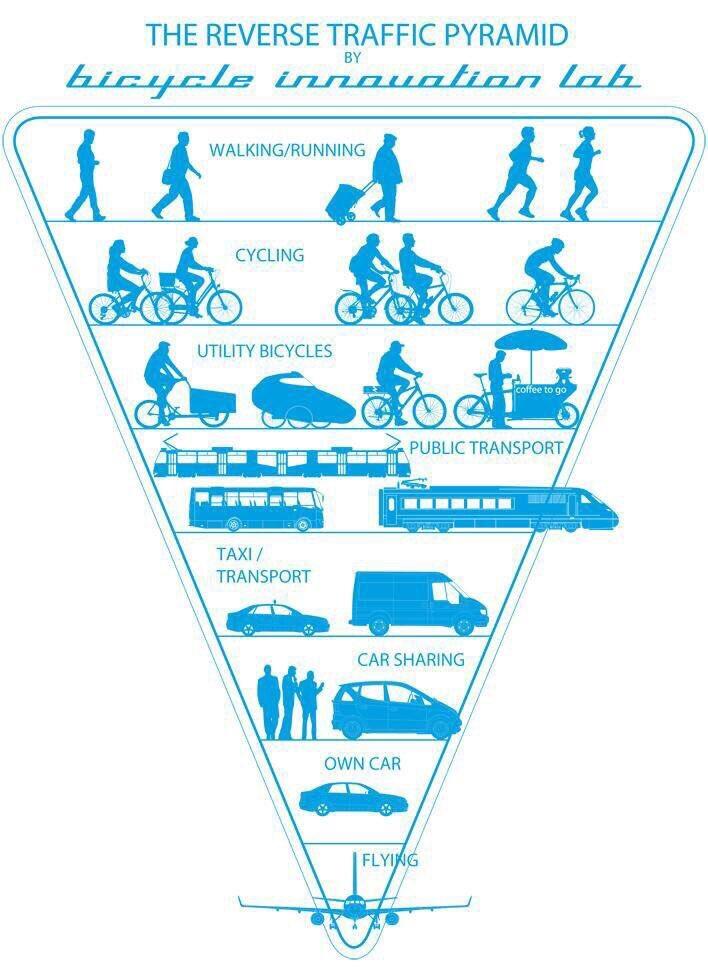
A small nuance is that car sharing is usually better than taxis. A taxi is driving around empty around half the time and has an average occupancy below 1.0. With car share, all the mileage involves moving people to places
post
See, the problem with reversing the pyramid, primarily for societies addicted to cars, is that even if all infrastructure was changed to make things the most safe for cyclists and pedestrians, the damage to the mind of the average citizen has to considered as well. The lack of exercise, the lack of the ability to consider one's individual contribution to environmental pollution and the socioeconomic relationship people have with their private vehicles all have to be dealt as well in order for the outside world to need for such change.
Nice. I've looked into this question fairly deeply and this seems fairly accurate.
Two things that people find counter-intuitive (or in the second case prefer not to think about):
- an intercity bus is usually greener than a high-speed train, even discounting energy source - mainly because speed carries a major efficiency penalty
- air travel is an unmitigated disaster on the level of personal carbon footprints - there's basically no way to make it sustainable
an intercity bus is usually greener than a high-speed train, even discounting energy source - mainly because speed carries a major efficiency penalty
Are you sure? Where I live all high-speed trains are running on 100% renewable electricity, while intercity buses run on diesel. Also multiple carriages at the same time, traveling on rails, should be significantly more efficient than a single bus traveling on asphalt. I agree that there will be an increase in energy expenditure depending on speed, but it shouldn't be as significant as the combination of the other two.
air travel is an unmitigated disaster on the level of personal carbon footprints - there’s basically no way to make it sustainable
We would have to make it sustainable eventually, since it's the only practical way for passengers to travel between americas/australia/afroeurasia. I guess something hydrogen-based is the most likely candidate for reducing the carbon impact.
@JubilantJaguar @balsoft yeah, hydrogen planes might be needed. But I think there is a good chance that we just aren't going to have a wealth of choices for Australia to america, etc.The economic option will be more like a 2~3 day journey that only flow where it must and goes most of the way via train. Australia to the US might be via Alaska for most budgets.
We would have to make it sustainable eventually, since it's the only practical way for passengers to travel between americas/australia/afroeurasia. I guess something hydrogen-based is the most likely candidate for reducing the carbon impact.
Hoovering and hydrofoils have been under-explored, but yes, speed is necessary for long-distance travel.
all high-speed trains are running on 100% renewable
Irrelevant to what I said: discounting energy source.
Trains obviously have much less rolling resistance, as you say (an advantage partly offset by their added weight). But wind resistance is the bigger factor, and trains are usually just faster.
A train travelling at 350kmh uses 40% more energy than one going at 300kmh. This is why the service speeds usually top out at 300 everywhere, Europe, japan and China.
Speed really is the decisive factor. The pyramid hints quite well at this.
But we can't really discount the energy source. An intercity bus service running fully on renewables is not feasible neither now nor for the foreseeable future. What we should do is have more efficient rail service between city, with more slower and cheaper options for when you don't mind the extra hour on your train.
Defining "green" as energy consumption is quite exotic. More commonly it has to do with resource (carbon and others) footprint.
air travel is an unmitigated disaster on the level of personal carbon footprints - there's basically no way to make it sustainable
Compared to cars? Or just trains?

all 20 comments