top 28 comments

sorted by: hot top controversial new old
[–] 48 points 11 months ago* (4 children)

when i was younger and stupid and in the (glass) closet i was dating the son of a pharmacologist. this man had made millions developing medications. he was fond of me and privately told me i was too funny and smart to be dating boys.

he also said that it was incredibly unlikely that sexism will ever be resolved in the medical field. that the majority of medications i will ever take - even some of which are "for women" - will not be clinically tested on my body.

the problem, he said, was in getting any human clinical trial approved.

to test on a body with a uterus - any body, even elderly patients or those who have been sterilized - was often nigh-impossible, because the concern was that the test patient may, at any point, become pregnant.

once/if the patient became pregnant, the study would not be about "the effects of New Medication on the body."

instead, the trial would fail - the results would be "the effects of New Medication on a developing fetus/pregnant patient."

it was massively easier, he said, to just test without accounting for a uterus.

that's how he phrased it - accounting for a uterus.

at the time, i remember him talking about the ethical implications of testing on a developing fetus; how such testing could theoretically bankrupt a company if a lawsuit was filed. he talked about informed consent and about how long it took for any legislation to be passed about this -

  • that in 1993; the year i was born, it finally became illegal to outright exclude women and minorities from clinical trials.

i remember him shrugging. "that's not to say it doesn't happen," he said. my ears were ringing.

i was thinking about how every time i have been rushed to the ER, the first thing they have asked me is if i am pregnant.

when i broke my wrist at 16 years old - despite never having had sex - they made me wait three hours for the test to come back negative before they gave me pain meds. the possibility of a child haunts my health.

how many people have died on the table because they were waiting for the pregnancy test before treatment.

how many people have died on the table because they were pregnant, and the only thing we care about is the fetus.

it is hard to explain to other people, but it feels like some kind of strange ghost. our entire lives, we are supposed to "save" our bodies for our future partners. but really we are just saving the body for the future child, aren't we? that hovering future-almost that cartwheels around in a miasma. you can't get your tubes tied, what if you change your mind? think of the child you must have, eventually. who cares about you and your actual safety. think about what you could be carrying.

  • source
  • hideshow 4 child comments
  • [–] 3 points 11 months ago

    how many people have died on the table because they were waiting for the pregnancy test before treatment.

    You would be extremally disgusted hearing what happens in poland since 2020.

  • source
  • parent
  • [–] 1 point 11 months ago

    That's rough. Thank you for that explanation.

    I knew about pregnancy concerns preventing pregnancy related medical things (tubes tied, etc) but not about health in general like a broken bone. WTF. I get people not wanting to hurt a fetus, but its wild that it's more important than the person that may be carrying it, let alone it when it doesnt exist and its just a woman that 'is pregnant or may become pregnant' with an injury.

  • source
  • parent
  • [–] 36 points 11 months ago (1 child)

    Yup.

    We live in a country where if I get in the car with my girlfriend on the west coast and drive to the east coast, she gains and loses basic human rights multiple times before we reach our destination and nothing changes for me.

    We can't even treat our women with respect. Trash nation. Full stop.

  • source
  • hideshow 1 child comment
  • [–] 47 points 11 months ago (5 children)

    Liability for child and spousal support do vary by state.

    Gendered inequity in criminal punishment does vary by state also.

  • source
  • hideshow 5 child comments
  • [–] 1 point 11 months ago (4 children)

    Which rights are you referencing?

  • source
  • parent
  • hideshow 4 child comments
  • [–] 3 points 11 months ago (2 children)

    My state gives unmarried fathers essential zero rights as a parent of the child. They are expected to provide financial support though.

  • source
  • parent
  • hideshow 2 child comments
  • [–] -1 points 11 months ago (1 child)

    I didn't know what essential zero rights mean.

  • source
  • parent
  • hideshow 1 child comment
  • [–] 2 points 11 months ago

    Like 0 rights.

    I’ll give you my solidly blue, pretends to be progressive states take:

    If you are the father of the child you are responsible for the child. Unless you are married to the mother of the child, you default to having 0 legal custody of that child and all matters of the child’s health and welfare are up to the mother to decide. You have no paternal rights to the child, but you do have paternal obligations.

    If you marry the mother you are suddenly legally part of the equation and have more rights, but unless you’re married to the mother of your child you have no legal standing.

  • source
  • parent
  • [–] 53 points 11 months ago (13 children)

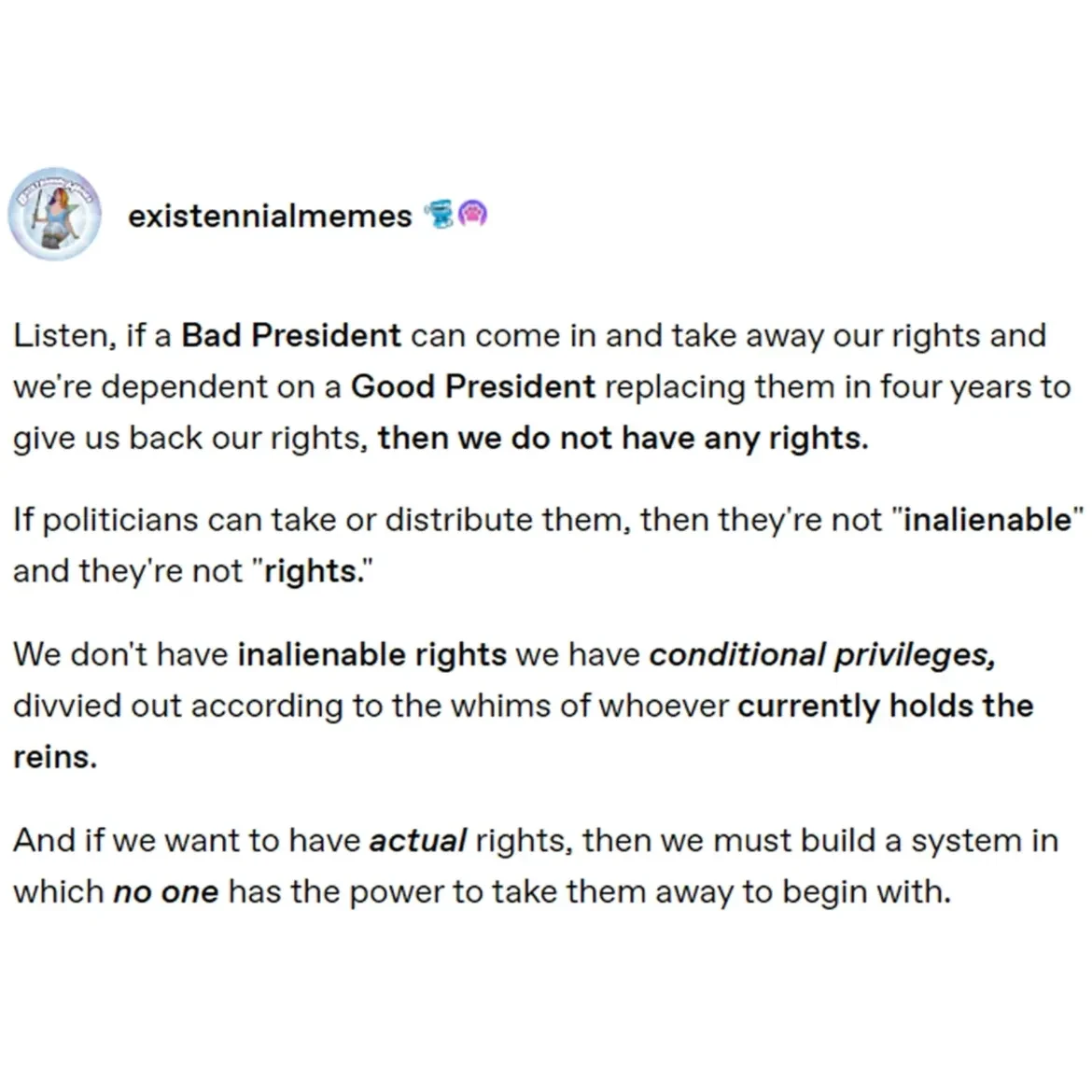
    If a right varies from state to state, it’s not a right, it’s a conditional privilege.
  • source
  • hideshow 13 child comments
  • [–] 20 points 11 months ago (5 children)

    I'd argue they are still rights whether the law is behind it or not. These things are always a moral entitlement; not always a lawful one.

  • source
  • parent
  • hideshow 5 child comments
  • [–] 0 points 11 months ago (4 children)

    But like... Morals are relative. They're frameworks built around core values, they're not a property of the universe. They're not self evident, they're axioms we choose to value collectively

    Rights are things that must always be fought for, and they can be both established and worn away. They're a social construct

    Rights are things that come before the law, they're the boundaries of the law. But like the rule of law itself, they only exist through collective belief and action, otherwise they're just words

    I don't think it needs to be dressed up more than that. Good things are good and bad things are bad, rights protect people from bad things from the state

    You'll never convince people who think good things are bad, because they don't have good values. You shouldn't engage with them on an equal level, because their values are inferior... At this point we just need to make it socially unacceptable to share their fucked up opinions

  • source
  • parent
  • hideshow 4 child comments
  • [–] 1 point 11 months ago* (3 children)

    Morals are relative.

    As much as philosophy, mathematics, logic. Relative is the wrong word. They're unfalsifiable.

    Nonetheless, committing yourself to a set of premises commits you to their logical consequences. Consistency demands rejecting contradictions.

    Do you think we should respect a moral system that accepts slavery as much as one that doesn't? If not, then you're not a moral relativist, and that's a relativist fallacy.

    they only exist through collective belief and action

    Not according to the philosophy & logic: a proposition is either true or false. While practices can wear away, truth values of propositions don't vary.

    You're confusing language sensitive to conditions, and the propositions they express. A statement can express multiple propositions. "The boy is playing football" expresses different propositions in UK & USA. "I am hungry" expresses distinct propositions according to who says it & time of day. Each of those distinct propositions has a unique & absolute truth value. When the meaning of a statement changes, the truth value of a proposition isn't changing: the proposition the statement refers to varies.

    The truth value of "people have inalienable rights" doesn't wear away as practices change: the proposition's truth value remains the same regardless of changing practices.

    A disagreement over moral propositions may indicate incompatible moral systems or a need for reflection & reexamination.

  • source
  • parent
  • hideshow 3 child comments
  • [–] 1 point 11 months ago (2 children)

    Do you think we should respect a moral system that accepts slavery as much as one that doesn't? If not, then you're not a moral relativist, and that's a relativist fallacy.

    No, they're not equal. They're relative. They're a product of the context and environment.

    I have a superior moral system than the one I had as a child. Not because my values have changed much, but because experience has helped me to understand others and I've been able to examine and refine my moral system through that

    But they're all based on values, which are not universal. I value minimisation of suffering, freedom, and quality of experience of life.

    If I lived in a time where slavery was common, and I had the means, I think I'd probably have a few slaves.

    Because the right to freedom doesn't exist in that situation. I could minimize suffering and increase freedom by buying slaves and giving them autonomy - ideally I'd get informed consent beforehand too, but I'd give them agency in the course of their life in return for service. I'd use that service increase the number of slaves to maximize freedom for as many as I feel able to do so, in whatever form that takes

    Rights are absolutely alienatible. I think everyone should have the right to food, shelter, and maximization of freedom

    But we don't have that. These right are alienated, people starve while food is wasted, people are homeless with empty houses everywhere.

    Women only have the right to vote so long as they have the right to vote. Chatel slavery still exists, as punishment for a crime. Rights don't exist if they don't exist in practice - anything else is just a rhetorical device

    You talk of rejecting contradictions, but there's no ethical consumption under capitalism. Do you live on the streets and sustain yourself on trash? Is that an ethical obligation?

    There's no contractions in maximizing good things and minimizing bad things - we all live in a very fucked up world

  • source
  • parent
  • hideshow 2 child comments
  • [–] 1 point 11 months ago (1 child)

    No, they’re not equal.

    Then you reject moral relativism.

    They’re relative.

    Now you're contradicting yourself.

  • source
  • parent
  • hideshow 1 child comment
  • [–] 1 point 11 months ago

    Why in the world would you think relative and equal are the same thing??? These are separate qualities

    Isaac Newton was a utter genius. Maybe the smartest person to eve live. His contributions to physics are insane, he basically created the entire field in a short period out of whole cloth

    A random physics grad student would mog him at his peak. They would not be his equal, but they'd run circles around him

  • source
  • parent
  • [–] 1 point 11 months ago

    It’s kind of inherent to the concept of rights that they exist in some framework of authority.

    Cavemen could have shouted that they have human rights to the other cavemen bashing their heads in and it would have been utterly meaningless.

  • source
  • parent
  • [–] 1 point 11 months ago* (last edited 11 months ago)

    Needs alt text or link to source.


    By claiming the repression of inalienable rights means they are conditional privileges, the author's admitting their ignorance of moral philosophy & the purpose of the word inalienable in it.

    Ideas such as inalienable/universal/inherent rights come from moral philosophy. The premise is that they exist regardless of whether people choose to respect them: no one can revoke those rights, only violate them. Violations are unjust.

    They don't imply a legal system can't violate ethics.[^enlightenment] They're for arguing a system shouldn't & to demand a more just one. It's still up to the people to get that system.

    Supposing is implies ought is a naturalistic fallacy.

    [^enlightenment]: The Enlightenment thinkers who developed these ideas were completely aware that they can and do, so for the author to treat that as not the exact problem they were addressing is awfully special. They were devising a definition for legitimate authority based on moral philosophy & not on divine right to rule.

  • source
  • parent
  • [–] 1 point 11 months ago (1 child)

    What if a bad supreme court can come in and take away rights? If that's the case, then it doesn't matter if it's explicitly listed in some kind of constitutional document because the bad court can choose to interpret that document in such a way that the right disappears. By this definition, there's no such thing as a right, because there's always someone who can come in and take it away. There aren't, and can not be, any actual rights, just conditional privileges.

    But, that isn't a very useful definition. In some sense, it's obviously true. If a warlord takes over a country they might suddenly forbid something everybody assumed was a right. That's why we have the saying "might makes right". Fundamentally the only rights you really have are the ones that you're strong enough to prevent someone from taking away. It certainly helps to have them written down in some kind of founding document, but it's no guarantee of anything.

  • source
  • parent
  • hideshow 1 child comment
  • load more comments (-1 replies)
    load more comments
    view more: next ›