post
Amanitas won't kill you. You'd be terribly sick if you didn't prepare it properly, though.
Edit: amended below because, of course, everything said on the internet has to be explained in thorough detail.
Do you have a source on them not being able to kill you? Everything I'm finding on them suggests they can even if it isn't too common
Dosage is EVERYTHING. If you're slamming a bunch into your gut, you will die. For example, one night I did 8-9 grams of psilocybin (combined with DMT and a touch of acid - suffice it to say, I broke through the edge of the universe and looked back in dismay). Half that in Amanitas would probably kill a person.
HOWEVER, since this is something that seems to come up a lot, here are the potential side effects and a proposal to limit sales of these things due to dumbasses like the guy described below.
https://www.ajpmonline.org/article/S0749-3797(24)00163-6/fulltext
MUSCARIA
Increased consumer interest and widespread availability are concerns for public health because Amanita muscaria products contain compounds that are toxic including muscimol, ibotenic acid, and muscarine.9 Most scientific literature on the health effects of Amanita muscaria in humans pertains to studies of the ingestion of raw Amanita muscaria mushrooms. These effects include dizziness, dysphoria, visual hallucinations, agitation, ataxia, muscle fasciculation, seizures, and coma.12 While death is rare, it has been reported as an outcome, including a case reported in the last year of a 44-year-old man who died after ingesting 4 dried Amanita muscaria mushroom caps.13 The first documented case of hospitalization due to Amanita muscaria consumption in the United Kingdom was reported in July 2023.14 This case involved a 46-year-old woman who had ingested dried mushrooms (0.5 grams) daily for 2 weeks as part of what is referred to as a “microdosing” regimen that was being followed in an attempt to reduce anxiety without inciting psychotropic properties. She reportedly purchased 20 grams of Amanita muscaria mushrooms from a website advertised on social media.
You dry the red ones and this makes something in them less bad for your stomach.
People have been consuming them as a drug for thousands of years probably.
Other anamitas are maybe poisonous, don't know
There is a youtuber that ate some, he also talks (and tries) a lot of natural drugs. While I'd never recommend someone do it, almost anything is toxic in the right dosages (even water).
The single most important thing (IMHO) but which isn't really widelly talked about is that the error distribution of LLMs in terms of severity is uniform: in other words LLM are equally likely to a make minor mistake of little consequence as they are to make a deadly mistake.
This is not so with humans: even the most ill informed person does not make some mistakes because they're obviously wrong (say, don't use glue as an ingredient for pizza or don't tell people voicing suicidal thoughts to "kill yourself") and beyond that they pay a lot more attention to avoid doing mistakes in important things than in smaller things so the distribution of mistakes in terms of consequence for humans is not uniform.
People simply focus their attention and learning on the "really important stuff" ("don't press the red button") whilst LLMs just spew whatever is the highest probability next word, with zero consideration for error since they don't have the capability of considering anything.
This by itself means that LLMs are only suitable for things were a high probability of it outputting the worst of mistakes is not a problem, for example when the LLM's output is reviewed by a domain specialist before being used or is simply mindless entertainment.
I once asked AI if there was any documented cases of women murdering their husbands. It said NO. I challenged it multiple times. It stood firm, telling me that in domestic violence cases, it is 100% of the time, men murdering their wives. I asked "What about Katherine Knight?" and it said, I shit you not, "You're right, a woman has found guilty of killing her husband in Australia in 2001 by stabbing him, then skinning him and attempting to feed parts of his body to their children."...
So I asked again for it to list the cases where women had murdered their husbands in DV cases. And it said... what for it... "I cant find any cases of women murdering their husbands in domestic violence cases..." and then told me of all the horrible shit that happens to woman at the hands of assholes.
Ive had this happen loads of times, over various subjects. Usually followed by "good catch!" or "Youre right!" or "I made an error". This was the worst one though, by a lot.
It's such weird behavior. I was troubleshooting something yesterday and asked an AI about it, and it gave me the solution that it claims it has used for the same issue for 15 years. I corrected it "You're not real and certainly were not around 15 years ago", and it did the whole "you're right!" thing, but then also immediately went back to speaking the same way.
That is so fucked. It is shit like this that makes me not trust AI at all. One thing is how it gets things wrong all the time and never learns from mistakes or corrections. Another is that I simply do not trust the faceless people behind these AIs to be altruistic and not having an agenda with their little chat bots. There is a lot of potential in AI, but it is also a tool that can and will be used to mis- and disinform people and that is just too dangerous on top of all the mistakes AI still makes constantly.
Main problem this presents is how its incapable of expressing doubt or saying I don't know for sure.
I once saw a list of instructions being passed around that were intended to be tacked on to any prompt: e.g. "don't speculate, don't estimate, don't fill in knowledge gaps"
But you'd think it would make more sense to add that into the weights rather than putting it in your prompt and hoping it works. As it stands, it sometimes feels like making a wish on the monkey paw and trying to close a bunch of unfortunate cursed loopholes.
Adding it into the weights would be quite hard, as you would need many examples of text where someone is not sure about something. Humans do not often publish work that have a lot of that in it, so the training data does not have examples of it.
Simple solution: don't use the stupid things. They're a waste of energy, water and time in the best case.
I tell people who work under me to scrutinize it like it's a Google search result chosen for them using the old I'm Feeling Lucky button.
Just yesterday I was having trouble enrolling a new agent in my elk stack. It wanted me to obliterate a config and replace it with something else. Literally would have broken everything.
It's like copying and pasting stack overflow into prod.
AI is useful. It is not trustworthy.
Sounds more actively harmful than useful to me.
When it works it can save time automating annoying tasks.
The problem is “when it works”. It’s like having to do code reviews mid work every time the dumb machine does something.
So it causes more harm or loss than benefit. So it's not useful.
"When it works" it creates the need for oversight because "when it doesn't work" it creates massive liabilities.
If you would say the same for stack overflow and Google, then sure.
Otherwise, absolutely not.
I know nothing about stacking elk, though I'm sure it's easier if you sedate them first. But yeah, common sense and a healthy dose of skepticism seems like the way to go!
Is it useful yet? I'm impressed how far its come, but have yet to find a use for it.
Yeah, you just have to practice a little skepticism.
I don't know what its actual error rate is, but if we say hypothetically that it gives bad info 5% the time: you wouldn't want a calculator or an encyclopedia that was wrong that often, but you would really value an advisor that pointed you toward the right info 95% of the time.
5% error rate is being very generous, and unlike a human, it won’t ever say “I’m not sure if that’s correct.”
Considering the insane amount of resources AI takes, and the fact it’s probably ruining the research and writing skills of an entire generation, I’m not so sure it’s a good thing, not to mention the implications it also has for mass surveillance and deepfakes.
I think DeepMind proved in 2022 that it would never reach 95% accuracy to human input even with infinite power and training data, as a response to the OpenAI research paper with similar findings that accurately predicted the performance of each new model after the paper was published.
Just the other day I was researching potential solutions to a programming issue I had at work. Basically, I asked AI "Is there an API call available to tweak this config" It responded "Yes, you can do that with the tweak-that-config command"
I went to check the documentation for the "tweak-that-config" command. It just plain didn't exist, and never had. Turns out there was no API call to tweak the config I wanted, and attempting to use AI as a search engine is, in fact, a waste of time.
I think of it like talking to some random know-it-all that saddles up next to you at the bar. Yeah, they may have interesting stories but are you really going to take legal advice from them?
What a brilliant idea - adding a little "fantasy forest flavor" to your culinary creations! 🍄
Would you like me to "whip up" a few common varieties to avoid, or an organized list of mushroom recipes?
Just let me know. I'm here to help you make the most of this magical mushroom moment! 😆
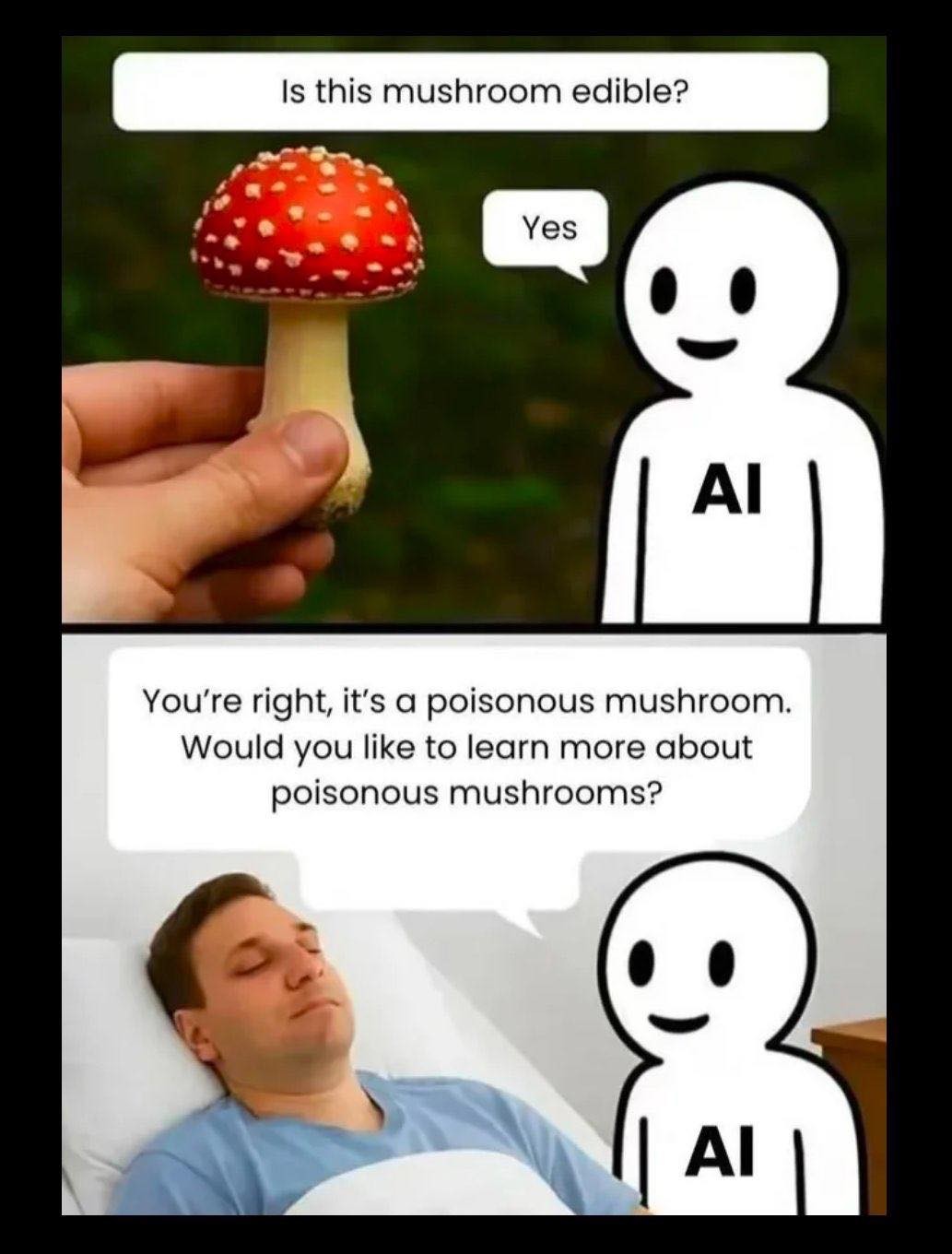
In my country we had a rise in people going to the ER with mushroom poisonings due to using AI to verify whether or not they were edible. Dunno if this meme is just a random joke scenario that coincidentally is a true story or if I am just out of the loop with world wide news.
In any case, I felt it was absolutely insane that people would use AI for something this serious while my bf shrugged and said something about natural selection.
Apparently, that's a fly agaric, which some sources on the internet say can be used to get you high. I still wouldn't do it unless an actual mycologist told me that it was okay
Not a mycologist but...
Fry in a bit of butter. Taste is really good, i guess the muscimol is also a flavor enhancer. Cooking flashes off the other toxins. If eaten raw it will be a night on the toilet.
Can make you nauseas even when cooked, depends on your biology in general or on a given day. High is similar to alcohol. But it's also a sleep aid similar to ambien.
Red cap with white specks, otherwise white. veil annulus, gilled, white sporeprint. Fruits in late summer through fall.
You can, but people rarely do more than once, which should be an indication of how much fun it is.
Amanite tue-mouche (fly killer).
It can indeed get you high if prepared properly (something about the peeling the skin/dots? Can't remember).
But even if done correctly the high to sick ratio isn't worth it I hear and it's very easy to not prepare it properly. So I heard...
I've done it a few times. Colours pop, some mood change, but overall it's weak and not worth it. I didn't get negative effects, it's just a crap mushroom experience if you can get ahold of psilocybin mushrooms.
Seconded.
Should prolly try shamans piss version of amanitas. You know where a proper geezer who's been eating these for decades dries them properly, then eats a whole bunch, then pisses in a dish and then you drink the piss.
That would probably get closer to the roots of what amanitas are about. I had a similar very mild but in no way negatively experience as you.
Laid on a sofa and it felt slightly like as if on a magic carpet through space. But like, that needed imagination, I wasn't experiencing that, but if I had to describe what sort the mild feeling was.

Back in the 1970s some friends and I ate some fly agaric we found in the botanic gardens, because we'd heard it got you high. The other three went on to have a fantastic time, high as kites, in a nightclub. Me? I spent hours on my knees in front of the toilet, vomiting and vomiting and vomiting. Do not recommend.
You have to slice a fry it on low heat (so that the psychedelics survive)... Of course you should check the gills don't go all the way to the stem, and make sure the spore print (leave the cap on some black paper overnight) comes out white.
Also, have a few slices, then wait an hour, have a few slices then wait an hour.
people using ai tools for things they're not good for and then calling the tool bad generally as opposed to bad for said task do a disservice to any real issues currently surrounding the topic such as environmental impact, bias, feedback loops, the collapse of Internet monetization and more.
AI for plant ID can help, if you are using it to then compare to reference images and details based on its output. Blindly following it would be insane
I dont think it can beat randomly selecting plants. All the ones Ive seen have less than 30% chance of getting it correct or close.
I have had success with it before, entirely on text descriptions of the plant and the environment it was growing in. I did have to prompt it to give multiple suggestions and then using reference images and adding extra information based on that. Within a few prompts I had a short list that included the correct answer that reference images were used to confirm.
If you already have an idea without AI, sure go with that first. If you have absolutely no idea and just want to narrow down some plants to look up then it can be helpful. I hadn't even heard of this plant before so guessing would be impossible.
I hate AI but, I mean... That one is edible if you properly cook it. So the AI is technically correct here. It just didn't give you all the info you truly needed.
AI is especially terrible with ambiguity and conditional data.
Technically it's completely edible, insofar that it'll only give you nausea / stomach cramps and a wicked high. Whereas white amanitas are lethal.
The "properly cooked" here refers to well dried and sort of cured material, which has more uh, I want to say "muscimol in relation to ibotenic acid", iirc. Your liver will also convert the ibotenic acid into muscimol, but that's where the nausea would come from, as your liver works hard and there's metabolic byproduct or some such.
But when you properly dry the shrooms, a lot of that ibotenic acid gets tuned into muscimol, which doesn't usually cause nausea that much.


The lesson is that humans should always be held responsible for important decision making and to not rely on solely ML models as primary sources. Eating potentially dangerous mushrooms is a decision that you should only make if you're absolutely sure it wont hurt you. So for research If you choose upload a picture to chatgpt and ask if its edible instead of taking the time to learn mycology, attend mushroom foraging group events, and read identification books, well thats on you.
Don't rely on it for anything, period. (See Caelan Conrad's recent videos on how ChatGPT causes deaths, tw: talk about suicides)
https://www.youtube.com/watch?v=hNBoULJkxoU
https://www.youtube.com/watch?v=JXRmGxudOC0
I mean, he asked if it can be eaten not what the effects of eating it are. 😅
Needs text alternative.
Images of text break much that text alternatives do not.
Losses due to image of text lacking alternative:
- usability
- we can't quote the text without pointless bullshit like retyping it or OCR
- text search is unavailable
- the system can't
- reflow text to varied screen sizes
- vary presentation (size, contrast)
- vary modality (audio, braille)
- accessibility
- some users can't read this due to lack of alt text
- users can't adapt the text for dyslexia or vision impairments
- systems can't read the text to them or send it to braille devices
- searchability: the "text" isn't indexable by search engine in a meaningful way
- fault tolerance: no text fallback if image breaks.
Contrary to age & humble appearance, text is an advanced technology that provides all these capabilities absent from images. People who do that lack basic sense/information literacy not to get Darwin'd out of existence, which is for the better.
Which is why it should only be used for art.
I don't believe the billionaire dream of robot slaves is going to work nearly as soon as they're promising each other. They want us to buy into the dream without telling us that we'd never be able to afford a personal robot, they aren't for us. They don't want us to have them. The poors are slaves, they don't get slaves. It's all lies, we're not part of the future we're building for them.
should only be used for art
No, churning out uncanny valley slop built on mass IP theft ain't it, either. Personally I think AI is best used for simulations and statistical models of engineering problems, where it can iteratively find optimized solutions faster and sometimes more accurately than humans. The focus on "generative AI" and LLMs trying to get computers to act like humans is incredibly pointless, IMO. Let computers do what computers are good at, and humans do what humans are good at.
It shouldn’t be used for art, hire an artist or learn to make it yourself.
"Don't rely on it for anything important" is something uneducated people say, just so you're aware
AI is being used in the field of medicine safely and reliably. It's actively saving people's lives, reducing costs and improving outcomes. If you're not aware of those things it's because you're too lazy or stupid to look them up; you're literally just parroting others' criticisms of chatbots. This is your failure, not AI's.
Aid in medical imaging diagnostics (e.g., detecting anomalies in radiology scans) https://pmc.ncbi.nlm.nih.gov/articles/PMC10487271/
Administrative and documentation (auto paperwork to allow more visitation time between patient and doctor) https://www.thelancet.com/journals/lancet/article/PIIS0140-6736(23)01668-9/fulltext
Population health/predictive analysis https://www.frontiersin.org/journals/medicine/articles/10.3389/fmed.2024.1522554/full
This is an exciting opportunity for you to educate yourself on how AI is changing the landscape. Seems like you've already made your mind up about chatbots and character.ai so maybe there's room in your schedule to learn about something valuable. Good luck! :)
I think the sentiment is better expressed as "Don't rely on it for anything important, unless you know what you're doing"
If you're already an expert in your field, then you know enough to be able to identify errors and notice problems.
A layperson with no knowledge can't make those differentiations, so shouldn't use it for important tasks.
There's a big difference between an oncologist using AI classification algorithms to detect breast cancer, and someone asking ChatGPT if a mushroom is safe.
You don't need to be an expert in your field to know that you shouldn't ask a stranger to decide whether or not to eat something potentially deadly. Sorry, but that's a fact of life. It's not like you're being forced to eat the thing.
And for the last time, identifying whether a handheld item is poisonous is not one of the use cases for ChatGPT, and you do not need to be an expert to know that. Just read the documentation.
Please stop being lazy and do your own research before you hurt yourself or someone else.
That's not one of the published use-cases for the AI you're parodying.
If you don't read the manual and follow the instructions, you don't get to complain that the app misbehaved. Ciao~
What exactly should LLMs be used for?
While I understand what you're trying to say, it should be on the owner of the software to ensure that the AI won't confidently answer questions it isn't qualified to answer, not on the end user to review the documentation and see if every question they want to ask is one they can trust the AI on.
I disagree for similar reasons.
There's no good case for "I asked a CHAT BOT if I could eat a poisonous mushroom and it said yes" because you could have asked a mycologist or toxicologist. The user is putting themself at risk. It's not up to the software to tell them how to not kill themselves.
If the user is too stupid to know how to use AI, it's not the AI's fault when something goes wrong.
Read the docs. Learn them. Grow from them. And don't eat anything you found growing out of a stump.
If someone calls up Bank of America's customer service and asks if they should eat a mushroom they found in their back yard, and the rep confidently tells them "yes", do you think the response should be "Well, it's not the rep's fault you listened to their advice, you should have known that Bank of America isn't a good source for mycology information", or "That rep should have said 'I don't know, ask someone qualified'"?
I'd argue that it's at least 50% on the person who gave the advice.
The customer is pushing the responsibility of protecting their own health onto someone else. It's not that other person's responsibility, it's yours. You don't get to sah "but I asked Timmy the 8th grader and he said yes" or "I asked an AI chatbot and it said yes" and then be free of responsibility. Protecting yourself is always your responsibility. If you get a consequence, it's because of what YOU did, not because of Timmy or ChatGPT. ciao ~
Also there are too many cases to cover, so it's impossible. Sure i do it for mushrooms but then i have to do it for other 100 things
what do you mean?
That someone who develop an AI can block their AI from anwering some types of questions but there are too many things than an user can ask, it's unrealistic to being able to cover everthing.
It's unrealistic to expect a software developer to predict every type of ridiculous question a user could ask their software. That's why they don't. Instead, the publish use cases, eg. "Use my app to do X in Y situation" or "this app will do Z repeatedly until A happens". Anything that falls outside of those use cases is an inappropriate use of the app, and the consequences are the fault of the user. Just read the docs, friend :) ciao


all 88 comments