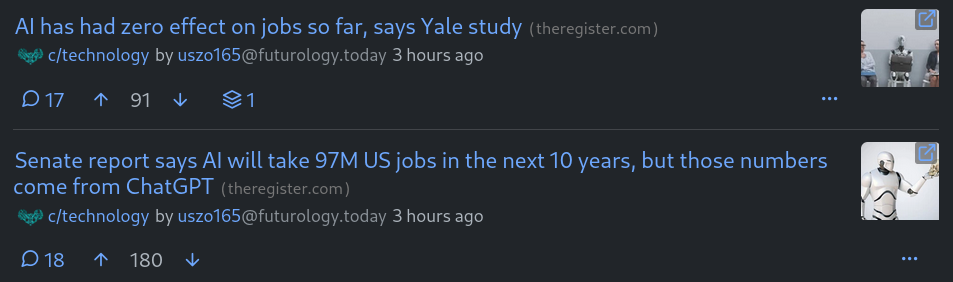
all 27 comments

sorted by: hot top controversial new old
[–] 19 points 1 year ago (2 children)

Look into who funds the Yale lab that the first study comes from. The majority of them have stakes in AI tech or AI companies.

  • source
  • hideshow 2 child comments
  • [–] 7 points 1 year ago

    That makes no sense to me... the main reason the AI bubble exists, is the drooling of CEOs to eliminate costly people with digital slaves.

    If I had an investment in AI, I may downplay the harm a bit but I would want to show that indeed those savings are possible.

    This Yale study shows, all AI is doing is burning money for everyone which is very bad for their alleged investment

  • source
  • parent
  • load more comments (-1 replies)
    [–] 14 points 1 year ago (3 children)

    https://vger.to/lemmy.world/post/37055762

    Apparently. It'll be a battle of the peer reviewed studies?

  • source
  • hideshow 3 child comments
  • [–] 4 points 1 year ago (2 children)

    I am more inclined toward the Stanford study.

  • source
  • parent
  • hideshow 2 child comments
  • [–] 4 points 1 year ago*

    A lot of the problem with the Yale headline is that it wasn't actually studying job loss in relation to AI so much as it was trying to prove/disprove claims that "AI will take all the jobs". And so the way it goes about "proving" it's thesis so to speak is to look at what jobs have been eliminated from the workforce.

    The jobs that CEO's have largely claimed will be taken by AI are menial jobs like fast food work. And lots of companies have in fact tried to do such a thing, looking at you Taco Bell. In most cases the AI implemented at drive-thrus etc have been rolled back because of backlash and lackluster performance.

    The Stanford study was actually more trying to prove/disprove the real world affect on the job market, and who was the most detrimentally affected. And pretty much what it found is that whole jobs may not have been entirely eliminated by AI (as in the percentage of firings of people already working in the field) aren't as significant in the job market as one might think, AI is eliminating entry level positions making it so that young people can't enter the field and as it gets "better" it'll have a more and more detrimental affect that will eventually mean higher echelons in these fields won't have the workforce they need.

    This is an oversimplified explanation based on me skimming both articles and I haven't read through the summary of either study completely yet.

  • source
  • parent
  • [–] 6 points 1 year ago

    I know people that lost their job to AI. So that first one is just an old fashioned lie.

  • source
  • [–] 6 points 1 year ago (1 child)

    Just pointing out that these 2 are not necessarily contradicting statements. Just because it hasn't taken any jobs yet, doesn't mean it won't take any in the next 10 years. Not that I really want to believe those numbers though. But yeah as others have pointed out, these studies need to be taken with a grain of salt.

  • source
  • hideshow 1 child comment
  • [–] 4 points 1 year ago (1 child)

    And as it often is, the actual truth is somewhere between. On what point between is and will be different depending on what kinds of jobs etc. I hope it's more to the no effect part, that AI finds it place as a helpful tool for human workers to use and where it can do good, but it'll definitely not be just that.

    I have never used it outside of generating some funny images, less than 10 times in total, and have never felt an actual need for it anytime or anywhere. And I never watch, listen or read anything made with or by it (there have surely been a few times where I didn't know but those would just be comments somewhere and not actual "content"). Just wanted to be clear about where I stand.

  • source
  • hideshow 1 child comment
  • [–] 2 points 1 year ago*

    According to data from Metr, AI has been improving in its effectiveness at completing long tasks.

    Here we see the tasks that equal or exceed 50% success.

    On the other hand, we see tasks that equal or exceed 80% success.

    The trend may continue along these lines in the coming years, although there is a possibility that it will not.

    However, AI still has a long way to go before it can match the 8-hour workday in the United States if we count the 50%.

    But if we talk about 80%, it still has a long way to go.

  • source
  • parent
  • [–] 2 points 1 year ago (10 children)

    The whole premise is strange, too. AI does not 'take' jobs. It frees up people from menial tasks, giving them time to spend their time differently. Perhaps a good time to change the capitalist status quo? ;)

  • source
  • hideshow 10 child comments
  • [–] 4 points 1 year ago (1 child)

    No, it doesn't free up anyone, because it's not actually capable of replacing human effort (unless that effort involved generating gobs of useless slop, I guess).

    It does, however, have an impact on jobs insofar as many CEOs, managers, and the like have decided (without evidence) that they can cut labor costs with it. Many such companies that have done so are starting to pay for their hubris, however.

  • source
  • parent
  • hideshow 1 child comment
  • [–] 1 point 1 year ago*

    It would appear there are some problems of getting stuck in negativity in this sub and about the subject in general. No system is perfect, correct. The state of the technology is more advanced than how people describe it online.

    A likely scenario is that a lot of tasks can be performed or prepared by AI systems, to be checked and finalized by people down the line.

    Currently there are still a lot of dragons hoarding wealth, citizens just accepting life and the grind. Like you said, some companies are staying to pay for that hubris, let us hope that trend keeps up!

    The positive outcome of this all may be that in some time, many more people will be able to become artists, scientists, entertainers -- improve quality of life!

  • source
  • parent
  • [–] 2 points 1 year ago (5 children)
  • [–] 0 points 1 year ago (4 children)

    If it didn't, most of us would be working a field for a living.

  • source
  • parent
  • hideshow 4 child comments
  • [–] 2 points 1 year ago (2 children)

    So you're claiming AI help drive long haul truck back in the 1980s? Or are we not talking about the same thing here?

  • source
  • parent
  • hideshow 2 child comments
  • [–] -1 points 1 year ago (1 child)

    Does that even happened?

    I took it you meant "does technology freeing us from menial task even happened". In that case, I'm answering that yes it did happen, since technology freed us from menial tasks like farming so more of us could study engineering and medicine for example.

    If you are asking if the current set of AI tools has freed us from menial tasks in the past. Well then no, because they are new and didn't exist.

  • source
  • parent
  • hideshow 1 child comment
  • [+] 1 point 1 year ago* (1 child)
  • [–] 0 points 1 year ago*

    Yes, well menial labor didn't stop existing. The ratio just changed by a lot. I also figure most on Lemmy aren't working in sweat shops lol, I definitely don't mean Africans working in a pit when I say 'Us'.

    In any case, it's far from peak delusion, it's literally history. Right before WW1, 30% of Americans were full time farmers. Now that number sits at 1.3%.

  • source
  • parent
  • load more comments (-1 replies)
  • load more comments (-1 replies)
  • load more comments (-1 replies)
    8 comments in c/onehundredninetysix@lemmy.blahaj.zone view that post
    [–] 30 points 1 year ago

    A bunch of companies have laid off employees either 1) because they are pivoting to AI and are shedding other costs (see: Microsoft) or 2) in anticipation that AI will let a smaller workforce get the same amount of work done (see: the gaming industry). AI hasn't actually done a good job of replacing those workers, but it definitely has had an impact in certain industries.

  • source
  • [–] 16 points 1 year ago (1 child)

    I mean, kinda?

    When Wall Street finally says “Okay, enough stalling, let’s see what we got with our trillion-dollar investment” and sees that the answer is “bupkis”, lots of innocent people will definitely lose their jobs.

    Probably not 97M though. That’s more than half of the total jobs out there.

  • source
  • hideshow 1 child comment
  • [–] 15 points 1 year ago

    I don't think we've seen the whole thing unfold yet. Shit has not yet hit the proverbial fan, bubble or no bubble, we're in for a ride.

    Those who benefit from using it as an excuse to lay off people will continue to do so while it is convenient. Number must go up. Shareholders must be kept happy.

    I just wonder if the water tastes like frog yet.

  • source
  • second one belongs in c/nottheonion

  • source
  • [–] 4 points 1 year ago* (last edited 1 year ago)

    So about 70% of Nvidia’s earnings this last couple years has been from selling specialized GPUs to data centers. And their valuation has grown significantly more than that under the assumption that those data center sales will continue to grow.

    So say, it turns out, that these big models that need data centers to run fail to ever be profitable. And all these companies have massively overbuilt the infrastructure for a demand that fails to materialize and Nvidia’s sales crater as everyone ceases to expand the data centers. Their stock value will crater in turn. Nvidia is about 8% of the value of the S&P 500, and other companies heavily invested in such data centers account for another 10%. S&P 500 index funds are the most performant index funds, and thus the ones most heavily invested in.

    Right now, the wealthiest 10% of the US population accounts for the majority of consumer spending, this a weird situation that’s been going on since the end of the pandemic. A significant portion of the wealth they can easily draw on to fund that spending is in index funds based on the S&P 500. If 10% of their portfolios was to just poof over the corse of a month, and then… not shoot back up. Think they might start… cutting back on spending? And then all those companies they stoped spending on start letting people go…

    … and we’re already in a low hire no fire kind of jobs market with high unemployment (the U-6 rate is at about 8 percent and that’s probably an underestimate) and record breaking underemployment (people who are employed but not working full time, or working a job they are overqualified for) .

    Yah, probably not a 2008 kind of situation, but maybe an early 1990s kind of situation. This is gonna fucking suck. Hey at least we have an incredibly stable and well run federal government right now that will handle such a situation with the grace and care needed, definitely won’t panic, have a stroke and shit their pants the moment they have to deal with a real situation.

  • source
  • [–] 4 points 1 year ago

    That study is very interesting and a recommended read.

    AI, interest rates, tax regime, WFH and RTO, nothing has recently impact IT in any way that doesn't apply to the general economy.

  • source