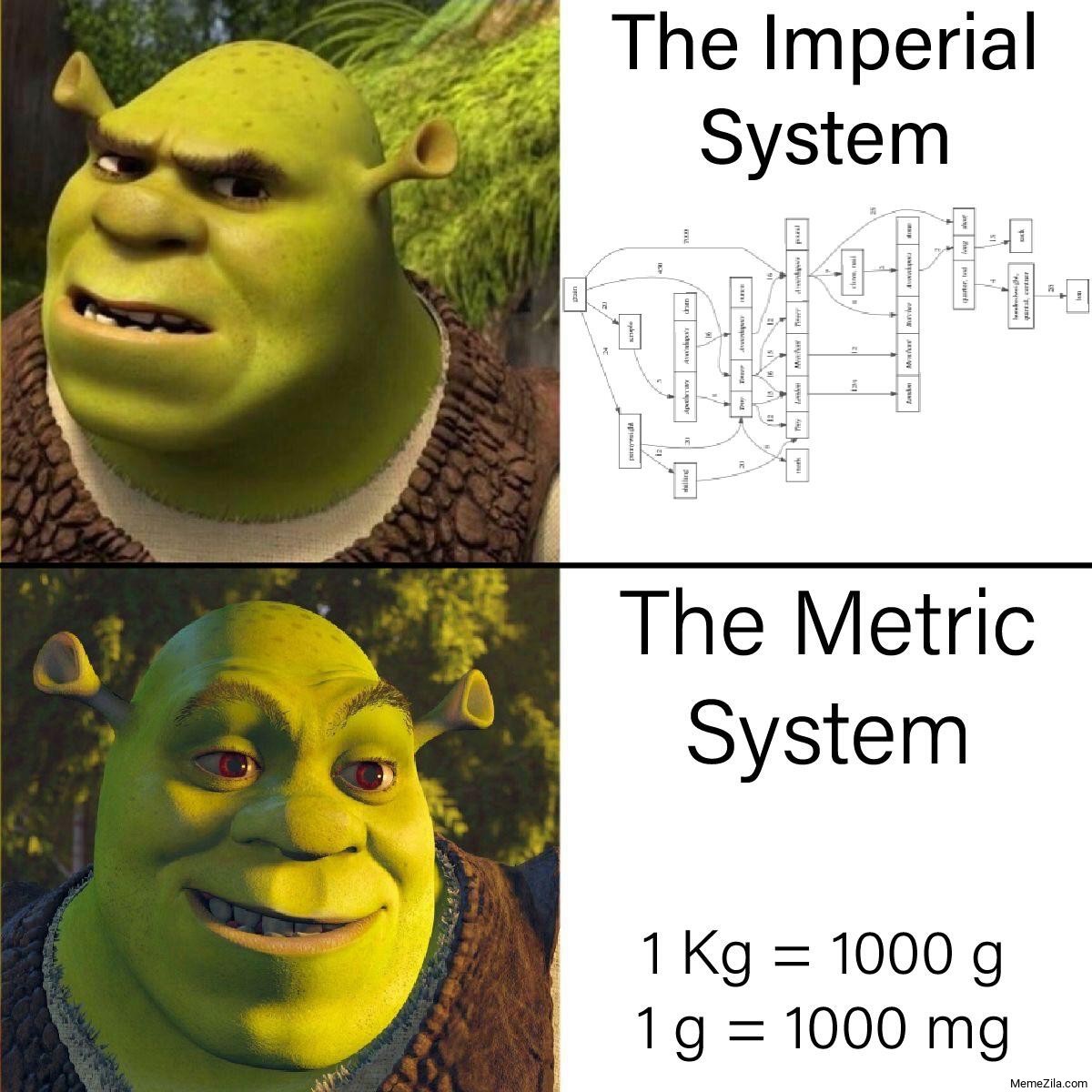
"1 brick equals about 1kg" - Plain. Boring. No pizazz.
"1 brick equals about 37 baby chicks." - Fun. Whimsical. Oozing pizazz.
"1 brick equals about 1kg" - Plain. Boring. No pizazz.
"1 brick equals about 37 baby chicks." - Fun. Whimsical. Oozing pizazz.
Yeah but can we talk about time?
Our units of temporal measurement, from seconds on up to months, are so complicated, asymmetrical and disjunctive so as to make coherent mental reckoning in time all but impossible. Indeed, had some tyrannical god contrived to enslave our minds to time, to make it all but impossible for us to escape subjection to sodden routines and unpleasant surprises, he could hardly have done better than handing down our present system. It is like a set of trapezoidal building blocks, with no vertical or horizontal surfaces, like a language in which the simplest thought demands ornate constructions, useless particles and lengthy circumlocutions. Unlike the more successful patterns of language and science, which enable us to face experience boldly or at least level-headedly, our system of temporal calculation silently and persistently encourages our terror of time.
...It is as though architects had to measure length in feet, width in meters and height in ells; as though basic instruction manuals demanded a knowledge of five different languages. It is no wonder then that we often look into our own immediate past or future, last Tuesday or a week from Sunday, with feelings of helpless confusion. โฆ
โRobert Grudin, Time and the Art of Living.
As quoted in the GNU coreurils documentation for date input formats
The units are complicated because our world is complicated. The moon orbits the earth in a certain interval, the earth orbit the sun and the earth revolves around itself. Those are the major points of reference but none of them line up.
Best of all, none of those natural reference values are constant. They drift gradually, and lunar months wonโt be 30 days forever just like a day wonโt be 24 hours in the future.
Hmm, I wonder... our current standard of time might end up being the standard for a long time, primarily because of GPS. Before we had global data networks it wasn't really possible to syncronize clocks all around the world. There used to be a telephone service that you could dial which would tell you "The time is now eight fifty-five PM" or w/e because that was the most effective way to distribute a coordinated time signal, and then you could manually set your local clock/watch to match.
But GPS depends heavily on accurate time information, and keeping it accurate is very complicated. Relativitistic time dilation applies because the satellites are:
(that's right, using GPS on your phone is a real-world demonstration of the theory of relativity in practical effect)
..and all those satellites are constantly checking in with each other and ground stations to make sure they're in agreement.
As a result there is now a de facto standard time reference for the entire world, and all networked devices depend on it for their own timing, and it is accurate to microseconds at worst.
100 years ago people were still winding mechanical clocks every day, and setting them by the local churchbell.
Yep. This stuff is surprisingly complicated, and thatโs why we need to measure the day using a standardized unit instead of defining the unit with the day.
Incidentally, Wikipedia has a nice graph about the variation of the length of day. Itโs surprisingly messy and pretty far from the ideals of antiquity.
The lunar month is currently ~29.5306 days (synodic, on average). Some day in the future (probably in a few million years), the average synodic moon cycle will reach 30 days (it is slowing down) - if, and that is a big if - we keep the current definition of "second" and "day", because both the length of the day as well as the lenght of the year will have changed...
I suggest we switch to Planck based units. Just slap on a suitable multiplier to make the final unit practical in normal life and engineering. Basically like the mol unit but with a more precise and natural foundation.
If the fundamental constants of the universe arenโt exactly constant, weโre screwed and there are no good units.
The way we split them is still purely arbitrary though. We could have metric time that uses multiples of 10 just by adjusting the duration of a second accordingly and adjusting how we divide time in a day.
Days of the calendar would be more challenging. But it's still possible to make something much more workable I'm sure of it.
Have a look at the international fixed calendar, used by kodak internally until 1989. 13 months of 28 days, it looks so clean

Everything months starts a Sunday (I'd rather start weeks on Monday but whatever), every second Monday is the 9th. Plus it has the advantage of keeping the 7 days week we're used to. Software excluded, it looks easy to adopt.
Alternatively there was the French revolutionary calendar with 10 days weeks and 12 months
When the metric system was defined and adopted during the French revolution they changed the calendar as well.
Months were changed to be 30 days each with an extra 5-6 days at the end of the year, weeks were 10 days long, days were 10 hours of 100 minutes, each minute lasted 100 seconds.
Unfortunately it did not stick and the decimal time system was reverted.
Then there's my favorite cursed unit: the kip! 1 kip=1000 lbs. "Kip" is short for "kilo-pounds." It's a unit used frequently in American civil and structural engineering. And it is so deliciously cursed.
Fun fact: the SI (international system of units) actually defines a multiplier "Ki", but it is not a factor of 1000. A Kisomething is 1024 something. As in 1KiB = 1024B (Kilobytes resp. Bytes).
As in 1KiB = 1024B (Kilobytes resp. Bytes)
Isn't it even more convoluted than this?
Doesn't KiB translate to Kibibytes? Because "kilo" is 1000 (powers of 10).
Kibi is 1024, the "bi" is supposed to mean "binary", or powers of 2.
Back in the early days of telephones at&t used kft to measure lines. Yes that is kilofoot
Just came here to nit-pick that the metric prefix for 10^3^ is k and not K.
Ugh. Kelvingram again.
I'm an American and every last bit of my shop is metric. It is the superior unit of measurement in every aspect. I don't bother with imperial at all. If I have to list dimensions online in imperial, just multiply mm x 25.4 which gives me inches. That's as far as Ill go into inches and feet.
I've said this before and Ill say it again, the US was robbed of the superior unit of measurement.
Uh, I'm pretty sure you divide mm/25.4 to get inches.
Yes. I misspoke. Millimeters รท 25.4= inches. Inches x 25.4 = mm.
What temperature is the shop kept at?
So, from my perspective, your experience gives me the exact opposite view. The fact is: no one is stopping us. Anyone in American can use metric any time they want. We use Imperial a significant amount of time because it's useful. Feet and inches are related to body parts. Kilometers are too small for our giant country. I design surgical tools, and I use metric. I design buildings, and I use feet and inches.
I don't really think it's slowing us down to have more than one system.
Kilometers are too small for our giant country.
Fortunately for NASA, space is actually smaller than the USA. Otherwise km would be totally unworkable.
I'm guessing that you have to use meters instead of yards when designing tall buildings? Yards would be too small for most skyscrapers.
I don't really think it's slowing us down to have more than one system
Say that to the Mars Climate Orbiter
Kilometers are too small for our giant country.
Kilometers aren't the biggest measurement in metric though.
It goes: Kilometer x1000= Megameter x1000= Gigameter x1000= Terameter. A Terameter is about 10^12^ meter
Just as it goes smaller like: Milimeter /1000= Micrometer /1000= Nanometer /1000= Picometer
And even those are still not the biggest or smallest measurements possible in metric.
That's true in theory, but if you talk about megameters to a European you'll get very weird looks.
An engineer will understand what you mean, but still laugh at you.
But it's a non-issue for anything on earth, where you'll have 40.000 kilometers at most. Not a lot of time is spent talking about x thousand kilometer.
Any notion that a kilometer is "too small" is laughable.
Lol. Dude, with all due respect, did you skip breakfast or something? First, body parts? Take a drink of water, please. You're dehydrated. Also, although I agree imperial isn't completely useless, one of its strengths is not because the size of the contental United States. It's not like miles and kilometers are orders of magnitude different when measuring an identical distance. Lightyears and astronomical units are terrible units to use to describe a drive from LA to NYC for this reason, but is it really that big if a deal between choosing miles and kilometers? I don't see it that way.
The main reason why I use metric with my work is because I commonly deal in millimeters / sub-inches. If I used inches, everything would be shitty fractions and I hate fractions. To me, metric is just cleaner when increasing or decreasing magnitudes. Which I generally stay within cm and mm.
Within industrial applications, such a building a structure in the US, yeah, it makes sense to stick ti imperial because it is indeed the national unit of measurement. But outside that reason, I don't find much of a benefit. Coincidentally, I moved off grid 3 weeks ago and am building a cabin way out in the woods. Because its just me and I plan to stay here until my end, I'll definitely use metric. If I was just developing a place I intended to flip, I'd use Imperial singularly because I'm in the US.
Ad hominim attacks. The bread and butter of Lemmy.
Damn Tucker Carlson mustโve stumbled upon this post. Someone should tell him that Russians use metric.
Should be pretty easy to learn, right? I mean, that's the whole point.
We were taught it in my rural red state elementary school in the '80s. Maybe because metrification seemed like a more real possibility, I guess.
Being a mechanical engineer in the US constantly switching between both systems really sucks. And for much more than just length and temperature
Being purposefully stupid and arrogant about it is the single most American thing.
Also 1L water ~ 1kg
In the US, we should make things even more confusing to anger the metric folks. I propose we redefine the "foot" every four years. The length of the foot will always correspond to the actual measured foot length of the current US president.
We should bring back hogsheads, rods, fathoms, etc.
What if we defined a foot such that a cubic food of some good, say potatoes or something, is a specific amount of money. So it's tied to inflation.
the fact that you think this will anger metric folks who already don't make sense of your dumb system rather than ruin many aspects of your country ... uh ... never mind, you're already ruining many aspects of country. ignore what I was going to say. carry on.
Growing up in the Metric environment, I only have to deal with the Imperial system very rarely before the Internet. But later, I found out there's a whole country that only use Imperial, and that they almost always demand you convert your system to the one they understand, and almost never bothered with Metric when they write anything. But then again, I found out that they also use units that are totally novel. I just have to accept that this is the character of them, and continue using Metric.
There is no country that only uses Imperial. Americans use grams for weed. And technically what the US uses is called US Customary. Some units are different from Imperial. Funny thing is both Imperial and US Customary are legally defined in metric.
It's because they believe they're so exceptional that everything that works for the rest of the world doesn't work for them.
That includes not only the metric system but also things like healthcare, student debt and gun control.
Probably. Because their understanding of metric is next to none. So they don't even know what to convert it to. We also often take for granted with that we grow up with.
It wasn't until I was 25 that I realized woodworking and sewing, isn't part of the normal elementary school curriculum abroad.
It's far from easy for someone that grew up in a different system to get a good reference of what different units feel like. It's the kind of change you need multiple new generations for.
The only reference Americans have for metric is 9mm
Bring forth the ceremonial cudgels, it's imperial units bashing time.
The chain (abbreviated ch) is a unit of length equal to 66 feet (22 yards), used in both the US customary and Imperial unit systems. It is subdivided into 100 links. There are 10 chains in a furlong, and 80 chains in one statute mile. In metric terms, it is 20.1168 m long.
ahhh good hit, that's the stuff.
It annoys me so much that a small decision could have had me growing up with metric.
Can anyone with a deeper understanding of the history of the metric system explain why a gram is the base unit of weight, and a litre the base unit of volume?
I thought the foundation of the system was that a kilogram is the weight of a litre of water. But then why not name them 1 thing = 1 thing rather than 1000x a thing = 1 thing.
And yes I've had four cups of coffee and no sleep today.
First they defined the meter and then one litre was defined as one dm^3.
A gram is not the base unit, it started with one meter (hence, metric).
Kilo means thousand in Latin, so 1000 meters became one kilometer (aka, one thousand meters), and when they need smaller units, they took to Latin again, simply because the language was en vogue for science:
Deca (ten): Decimeter (dm, nowadays hardly used, but it exists) = 0.1m
Centum (hundred): Centimeter (cm) = 0.01m
Mille (thousand): milimiter (mm) 0.001m
Weights were then adopted from the dimensions based on practicality, i.e. one liter was a common enough volume that people could use it in a household, and it's defined by 1dm height x 1dm length x 1dm width. Or 10cm10cm10cm (same thing, but the base notation was units of one).
Or 10cm10cm10cm (same thing, but the base notation was units of one).
Just FYI - Lemmy uses Markdown for formatting. In Markdown, if you surround some text in asterisks, it italicises whatever's in between.
So if you write: *this is italicised*, you get this:
this is italicised
To write 10cm*10cm*10cm you have three options:
Use in-line code (what I did twice here) - surround the text in backticks (usually the ones on the left of the number 1 on the keyboard).
Use "x" instead of "*".
"Escape" the asterisks by adding "\" before them. You'd write it like this: 10cm\*10cm\*10cm, and you'd get: 10cm*10cm*10cm.
The big prefixes (kilo, mega, etc) are actually Greek and the small ones Latin.
The only use of the decimetre I've seen in real life, is that the standard school rulers, being 20 cm long are commonly called "double dรฉcimรจtres" (in France). Maybe other places use them more.
Sub-units are a bit like regionalisms, France likes cl for liquids, many places like adding zeroes and using ml, maybe some use dl...
Thatโs an interesting question that Iโd never thought about before.
I asked chatGPT, which predictably bullshitted me and said theyโd decided grams made more sense than kilograms for scientific lab work.
But then I searched and found this from the user tomalator on Reddit:
โWhen the French were developing the metric system, they suggested the unit be called a grave (pronounced grav) being the mass of 1L of water (1000 cm3)
The French at this time being in the middle of a revolution against the rich notice that it sounded a lot like the word Graf, being a word for Duke or Earl, and they wanted to avoid affiliating with the nobility, so they changed the measurement to be the mass of 1mL of water (1 cm3) and called it the gramme
They then noticed that it was inconvenient to use a mass unit so small, so they changed back to the 1L of water definition, but kept the name gramme for the base, and threw out the word grave in favor of the kilogramme.
And that's why the kilogram is the base SI unit and not the gram. I had the exact same question when I learned the SI unites.โ
I believe a gram is the weight of a cubic centimeter of water, and a liter is 100 cubic centimeters of water.
The meters are kind of out there though that is something to do with like the meridian and distance between lattitudes or something I forget.
I like metric weight for cooking (on the rare occasion I make something that involves careful measuring, and for my bread making) and MILES can fuck right off, km are fine for measuring long distance. And fine with meters, cm for short distance.
But I do like how feet are 12 inches, because 12 is so evenly divisible, and like that a gallon splits in half and half again and again until you get cups. It's like RAM,
Cup is 8 oz
Pint is 16 oz
Quart is 32 oz
Half Gallon is 64 oz
Gallon is 128 oz.
That doubling sequence is satisfying.
specifically woodworking I like doing in inches, because 12. For the tasks I often do in the wood shop, fractional inches work well.
I'm confortable working in both systems, but I build furniture in inches.
In metric, the 12 really isn't important anymore which kinda invalidates that. We normally go to the nearest mm or, if needed, some fraction of that (not normally needed in my life at least)
When building wooden furniture, the ability to divide by 3 and 4 comes in handy a lot more often than dividing by 5, and I don't have to start rounding to nearest or stuff like that. For this task, inches work out better.
If I never see another inch size bolt in my life it'll be too soon.
My point is, if you're using feet and inches you maybe want to divide by that. We in the metric world don't so it's not that big a deal. Our woodworking is done in CM and MM and we rarely need fractions of mm.
I do woodworking too, my father did it since youth, and he did it just fine. We don't feel the need to divide everything.
Your 16 oz pints are a pathetic 455ml. Europeans have 500ml.
Meanwhile a true UK pint is 568ml.
You can see why we cling to Imperialism.
top 95 comments