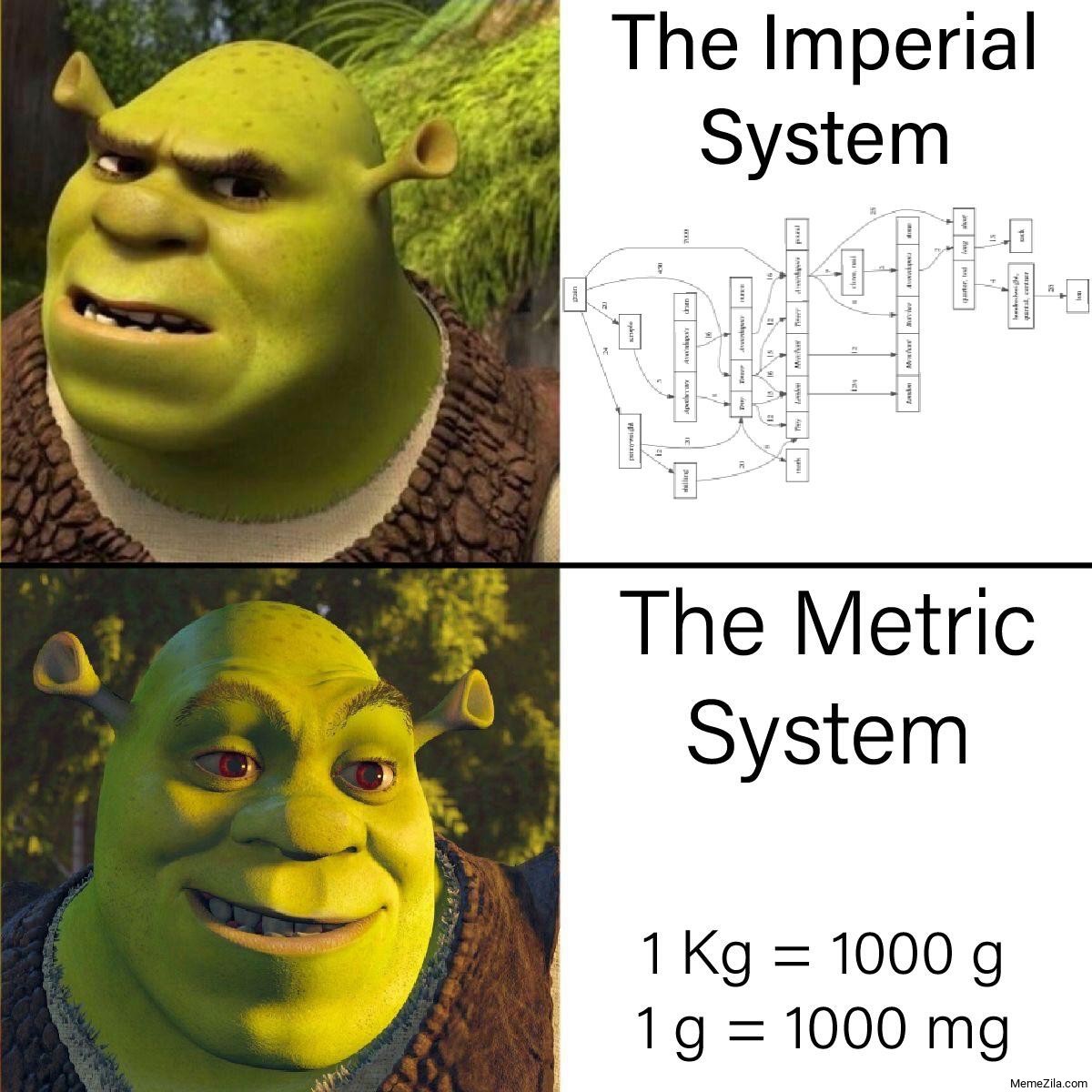
Shrek nah to imperial then shrek yah with metric.
you are viewing a single comment's thread
view the rest of the comments
[โ€“] 8 points 1 year ago (3 children)

A gram is not the base unit, it started with one meter (hence, metric).

Kilo means thousand in Latin, so 1000 meters became one kilometer (aka, one thousand meters), and when they need smaller units, they took to Latin again, simply because the language was en vogue for science:

Deca (ten): Decimeter (dm, nowadays hardly used, but it exists) = 0.1m

Centum (hundred): Centimeter (cm) = 0.01m

Mille (thousand): milimiter (mm) 0.001m

Weights were then adopted from the dimensions based on practicality, i.e. one liter was a common enough volume that people could use it in a household, and it's defined by 1dm height x 1dm length x 1dm width. Or 10cm10cm10cm (same thing, but the base notation was units of one).

  • source
  • parent
  • hideshow 3 child comments
  • [โ€“] 9 points 1 year ago* (last edited 1 year ago)

    Or 10cm10cm10cm (same thing, but the base notation was units of one).

    Just FYI - Lemmy uses Markdown for formatting. In Markdown, if you surround some text in asterisks, it italicises whatever's in between.

    So if you write: *this is italicised*, you get this:

    this is italicised

    To write 10cm*10cm*10cm you have three options:

    1. Use in-line code (what I did twice here) - surround the text in backticks (usually the ones on the left of the number 1 on the keyboard).

    2. Use "x" instead of "*".

    3. "Escape" the asterisks by adding "\" before them. You'd write it like this: 10cm\*10cm\*10cm, and you'd get: 10cm*10cm*10cm.

  • source
  • parent
  • The only use of the decimetre I've seen in real life, is that the standard school rulers, being 20 cm long are commonly called "double dรฉcimรจtres" (in France). Maybe other places use them more.

    Sub-units are a bit like regionalisms, France likes cl for liquids, many places like adding zeroes and using ml, maybe some use dl...

  • source
  • parent