1
2


Incumbent technologists resisting change. LMAO!

Your monolithic orthodoxy has crumbled and will be replaced with a trillion new kernels. Good luck, you goof.

3


👏 SUPPORT THE CHANNEL: Get access to:

  • a Daily Linux News show
  • a weekly patroncast for more thoughts
  • your name in the credits

YouTube: https://www.youtube.com/@thelinuxexp/join Patreon: https://www.patreon.com/thelinuxexperiment

Or, you can donate whatever you want: https://paypal.me/thelinuxexp Liberapay: https://liberapay.com/TheLinuxExperiment/

👕 GET TLE MERCH Support the channel AND get cool new gear: https://the-linux-experiment.creator-spring.com/

Timestamps: 00:00 Intro 00:50 What is it ? 02:08 Installer 03:14 How it's built 04:42 The "desktop" 08:15 Bundled apps 17:10 Security and "safety net" 24:43 Sandbox for a.i. 27:55 More info 28:53 Conclusion 33:38 Sponsor: Tuxedo Computers

#linux #linuxdesktop #trindleos

4


Before we dive into the matter, you first have to understand what DisplayLink is. It is a proprietary graphics transport technology that lets computers connect to one or more external displays over USB, using docks or adapters built around DisplayLink chips.

It works by compressing display data on the host computer and sending it to a chip in the connected device. The chip then decodes it for output to monitors through interfaces such as HDMI or DisplayPort.

On Linux, this support can rub some people the wrong way due to its closed-source nature. That is where Mike Lothian's (FireBurn) Vino comes in as an open alternative.

Unfortunately, Synaptics owns DisplayLink and has sent Mike cease-and-desist letters alleging that he infringed its DisplayLink patents with his project.

What's Vino?

Vino is a driver that lets the Linux kernel talk to DisplayLink docks directly. It is meant to replace DisplayLink's closed-source software and the open source EVDI kernel module that sits beside it.

Mike wrote it with help from Claude Code, and the first version reached the kernel mailing list in June, unfinished. He had faced a communication issue between the dock and the driver and asked other developers for help.

In early July (courtesy of LWN.net), he emailed a Synaptics employee for guidance and mentioned his Rust rewrite of EVDI. About two weeks later, a different employee replied.

That reply said his Rust rewrite of EVDI was not a thing of concern. Rather, the concern was the DisplayLink protocol and codec, which Synaptics believes are covered by its patents. Lawyers get involved

A cease-and-desist letter followed on August 17. It told Mike to stop development and withdraw anything he had submitted to maintainers and hosting sites, with a signed confirmation due by August 28.

An appendix listed over 125 patents without saying which applied. Mike posted a working version 3 of Vino on August 26 and asked Synaptics the next day which claims they had in mind.

The answer came in October as claim charts. They map one claim from each of two patents, GB2484736 and GB2485613, to his source code.

The October 5 letter said Synaptics would seek $25,000 for the cost of preparing those charts if Mike missed an October 11 deadline, with the figure rising by at least $25,000 each week.

Mike replied on October 6 (message 8) with an offer to pause public work on the encoding code the charts point to if Synaptics paused the deadline and the weekly charge. He also asked about licensing that code for non-commercial use.

On October 7, Synaptics said it would grant no patent license or promise not to sue and set October 18 as a final deadline.

 What I can see so far is a very aggressive patent infringement witch hunt against a lone open source developer who was quite open to communication.

 Synaptics took about three weeks to answer his request for specifics, then followed with a potentially life-ruining $25,000 demand that compounds weekly.

Clean room design quirks

Mike describes Vino as a clean-room driver and says he reverse engineered it from captured USB traffic and vendor programs.

If you didn't know, in a clean-room recreation, one party studies the original implementation, then writes a description, and a separate party builds the new code from that description alone.

It is meant to act as a defense against copyright claims because it shows nothing was copied. Synaptics’ July reply argues that clean-room or independently written code can still infringe a patent.

The timing

Vino also lands in a busy stretch for AI-assisted reverse engineering, from smart TV cleanups to office suite clones. Legal pressure has reached other AI-built projects too.

Mike has already taken down the Vino repository in response to the demands, and Synaptics has not made a public statement so far.

Only time will tell what happens to the work, and I hope someone forked it before it went offline, as that would give others a good starting point to build on.

5


Linux doesn't deserve this

Imagine taking the lightweight, privacy-focused appeal of Linux and completely ruining it by hardwiring AI models straight into the OS. Nobody is switching from Windows for more forced AI features.

6


When I decided to switch to using Linux as my primary OS I had Artix and Debian dreams (personal and work/enterprise) but the refurb dell 5420 rugged I got had other ideas... Tried many distros and Ubuntu 18.04 LTS was the only one that worked without nomodeset. (Funnily enough that's the version Dell officially supports who would have thought..)

Guess I now have a year to figure out how to get these darn Intel GPU drivers to work on an up to date distro before I stop getting security patches..

(Still gonna run KDE tho)

My business VPSs are running Debian with windows server VMs and this laptop's main purpose is gonna be SSH connections to those anyway but still.

7
8
9


sorry if this is the wrong place to post this.

Recently i switched to steam os on my pc, installed battle net and everything went smoothly. I played in beta and i dont have issue but when i play on live my ping would shoot to 1000 to 4000. and it only smooth on the first 10 minutes or so. I dont know what else i should do so any help is appreciated.

things i tried

restarting.

Im using starlink so i tried to relocate the dish.

turning off firewall in my asus modem

turning off firewall in my pc

turning on and off qos

turning on and off ipv6

changing poton

I tried several ping checker and in my browser everything seem normal

10


I was a bit sad getting my steam controller, and it not even working outside steam on linux (before kernel 7.3 apparently).

So I decided to spend the night (vibe) coding a solution that integrates better into a linux desktop based on wayland (many supported, not gnome sorry...).

Essentially provides what steam input provides while steam is started, but compared to steam it actually works well under wayland (e.g. pointer / mouse input in desktop mode working).

  • provides emulated controllers so any games can actually use the steam controller
  • switchable desktop / gamepad mode via long press of menu button
  • on screen hud, keyboard, settings
  • button remapping
  • changing what controller to emulate
  • seamless handover to steam input when steam starts. -> this is pretty nifty, because steam accesses some features of the controller no other app does yet, there is a special mode, where puckd hands over full control to steam automatically. You can dynamically switch back to giving puckd control by pressing + ≡ for ~half a second.
  • programs that actually can use the controller "natively" will get a pass trough device that has the full features set. Similar to steam pass trough, but it still allows switching between desktop and gamepad mode, open on screen keyboard without the steam / puckd switchover
  • presets
  • allow automatic preset switching based on application having focus on your desktop
11


Se adesso vi si rompesse il computer, sareste in grado di ripristinarlo?Avete studiato un metodo di prevenzione che vi consenta di agire tempestivamente se qualcosa va storta?Sapete dove vive la copia dei vostri dati? In #selfHosting o in #cloud ? Su una copia locale forse? Dove?Sapreste dirmi la differenza tra queste modalità?Non aspettate il momento del panico, agite in anticipo! Preparatevi al meglio, e se non sapete come, ci sono io a presentarvi la situazione in modo semplice semplice, come mi è sempre piaciuto fare.Scoprite tutto nel mio ultimo video🔽youtu.be/WNhGqucaEbQ?si=nWYxuUE conoscerete una soluzione #OpenSource sbalorditiva!@gnulinuxitalia

12


This video is sponsored by TryHackMe Start learning ethical hacking for FREE! https://tryhackme.com/LinuxRenaissance

Get 25% OFF an annual Premium subscription with code LINUXR

TryHackMe is free to sign up, with beginner-friendly cybersecurity challenges and structured learning paths. Premium unlocks additional learning content and benefits.


Can my daughter hack a bank? Today we are going to find out!

In our previous video together, I introduced my daughter to the Linux command line. This time, we are taking things a step further and exploring the world of ethical hacking.

My daughter has no previous experience with ethical hacking, and she has no idea what we are going to do until we start recording!

Thanks to TryHackMe for sponsoring this video and giving us an opportunity to explore cybersecurity together.

We will use TryHackMe's beginner-friendly Offensive Security Intro room to investigate a fictional banking website, discover hidden web pages using the Linux terminal, and see whether my daughter can successfully complete her first hacking challenge.

Along the way, we discuss the difference between ethical and malicious hacking, how security vulnerabilities happen, and why learning cybersecurity does not have to be intimidating.

And at the end, my daughter shares her thoughts on learning with TryHackMe compared to our previous Linux command-line lesson.

ABOUT TRYHACKME

Learn ethical hacking and cybersecurity through hands-on exercises, directly in your web browser!

TryHackMe offers structured learning paths for complete beginners and more experienced users. You can register and get started for free, while Premium provides access to additional learning content and benefits.

The banking environment demonstrated in this video is entirely fictional and designed for safe, authorized cybersecurity training.

TIMESTAMPS

00:00 – Can my daughter learn ethical hacking? 00:41 – Introducing TryHackMe 02:12 – Ethical hackers vs malicious hackers 04:15 – Our first hacking challenge 06:06 – Launching the FakeBank simulation 07:55 – Discovering hidden website pages with DIRB 11:05 – Running DIRB in the Linux terminal 12:31 – Discovering the hidden banking admin page 14:40 – We hacked the bank! 14:58 – Progress, rewards and learning streaks 16:11 – TryHackMe Premium and the 25% discount 16:44 – My daughter's opinion of TryHackMe 17:47 – Why guidance matters when learning 18:30 – Final thoughts

JOIN THE LINUX RENAISSANCE COMMUNITY

Website: https://linuxrenaissance.com

Community forum: https://forum.linuxrenaissance.com

Matrix community: https://matrix.to/#/%23space:fosshq.org

More Linux Renaissance videos: https://www.youtube.com/playlist?list=PL3KVgwMTWoO0wKgJWk3BBtB20okJvu_6q

SUPPORT LINUX RENAISSANCE

If you enjoy independent Linux and open-source content, you can support the channel here:

Become a YouTube channel member: https://www.youtube.com/@LinuxRenaissance/join

Support me on Ko-fi: https://ko-fi.com/darth

Linux Renaissance merchandise: https://shop.linuxrenaissance.com

Your support helps me continue creating videos, testing software and hardware, and maintaining our Linux community.


This video contains a paid promotion by TryHackMe.

#Linux #EthicalHacking #TryHackMe #CyberSecurity #LinuxRenaissance

13


cross-posted from: https://lemmy.world/post/54277761

sorry if this is the wrong place to post this.

Recently i switched to steam os on my pc, installed battle net and everything went smoothly. I played in beta and i dont have issue but when i play on live my ping would shoot to 1000 to 4000. and it only smooth on the first 10 minutes or so. I dont know what else i should do so any help is appreciated.

things i tried

restarting.

Im using starlink so i tried to relocate the dish.

turning off firewall in my asus modem

turning off firewall in my pc

turning on and off qos

turning on and off ipv6

changing poton

I tried several ping checker and in my browser everything seem normal

14
Repost. (lemmy.world)
 
 
15


Mister Download Manager ossia l’alternativa open a IDM per Linux@gnulinuxitalialinuxeasy.org/mister-download-…Mister Download Manager è un download manager open source scritto in Rust, alternativa gratuita a IDM con supporto Linux, torrent, video e download acceleratiL'articolo Mister Download Manager ossia

16


Exfatprogs (exFAT Progs) 1.4.4, exFAT filesystem userspace utilities for Linux, has been released today with several improvements, a new feature, and multiple bug fixes.

Exfatprogs 1.4.4 is the fourth minor update in the Exfatprogs 1.4 series, coming three months after Exfatprogs 1.4.3. This release introduces a new feature to the exfatprogs command, namely optional I/O statistics collection for profiling read, write, discard, zero-out, and sync operations.

This release also updates mkfs.exfat to increase full-format speed by using BLKZEROOUT when supported, selecting larger zeroing batches, and improving quiet and trace progress output, and reducing page-cache pollution during full formatting on systems that support POSIX_FADV_NOREUSE.

Several bugs were fixed in Exfatprogs 1.4.4 for the mkfs.exfat command, avoiding memory-reservation failures when creating very large allocation bitmaps, and marking the percentage of used clusters as unknown until it is calculated.

The fsck.exfat command received the most attention, with fixes to prevent arithmetic overflows and out-of-bounds reads by rejecting malformed boot sector geometry, avoid printing version information during automatic repair with the “-p” or “-a” arguments, and missing line breaks in error messages.

In addition, the fsck.exfat command now stops immediately on I/O errors instead of treating them as file system inconsistencies. The dump.exfat command was updated to print complete file timestamps in raw and ISO formats, while the exfat2img command now keeps metadata image output on stdout free of status messages.

Last but not least, the exfatprogs command received fixes for parsing kernel versions and boolean environment variables, and showing the correct usage text for overwrite and read-back verification options.

Check out the release notes on the project’s GitHub page for more details about the changes included in exFAT Progs 1.4.4, from where you can download the source tarball if you want to compile it on your Linux distro. However, it is recommended to install Exfatprogs from your distro’s stable repositories.

Exfatprogs was designed as official userspace utilities that contain all of the standard utilities for creating, fixing, and debugging exFAT filesystems in Linux distributions. The goal of the exfatprogs project is to provide Linux users with the same high performance and quality as the exFAT utilities in Windows.

17


Plasma 2000: KDE si trasforma con il look nostalgico di Windows 2000@gnulinuxitalialinuxeasy.org/plasma-2000-kde-…Gli utenti Linux che amano personalizzare il proprio desktop hanno a disposizione un nuovo progetto interessante: Plasma 2000. Si tratta di una personalizzazione dedicata a KDE Plasma 6 che

18


Armada OS: la distribuzione Linux che porta SteamOS sulle console portatili ARM@gnulinuxitalialinuxeasy.org/armada-os-la-dis…Armada OS porta Steam, Proton e un'esperienza simile a SteamOS sulle console portatili da gaming ARM64, con KDE Plasma e supporto agli emulatoriL'articolo Armada

19
 
 
20


Linux memory management expert Lorenzo Stoakes at Arm who has been contributing to the kernel since 2014 is stepping away from some reviewership roles within the Linux kernel due to all of the noise from the flood of kernel patches resulting from AI/LLMs.

Lorenzo announced today he is stepping away as a reviewer for the memory management (MM), core, misc, and Rust areas due to all the noise caused by AI. Lorenzo will continue serving as maintainer for areas of the kernel he oversees but is looking to lighten his load due to the increased patch burden in 2026.

Lorenzo commented in the patch series removing himself as reviewer for those areas of the kernel:

"Given the current throughput in the kernel resulting from AI-generated series, I unfortunately lack the bandwidth to generally be able to offer review except in those areas I maintain.

I have separated the patches into areas maintained by David, Andrew, and Alice + Danilo, so each can take the patches relevant to the subsystems, for convenience.

Apologies for doing this, but given the current trends I'd like to do something to make my inbox a little more manageable :)"

Lorenzo has been a longtime contributor to the Linux memory management code and also author of the book The Linux Memory Manager.

21
:D (media.gehirneimer.de)
 
 
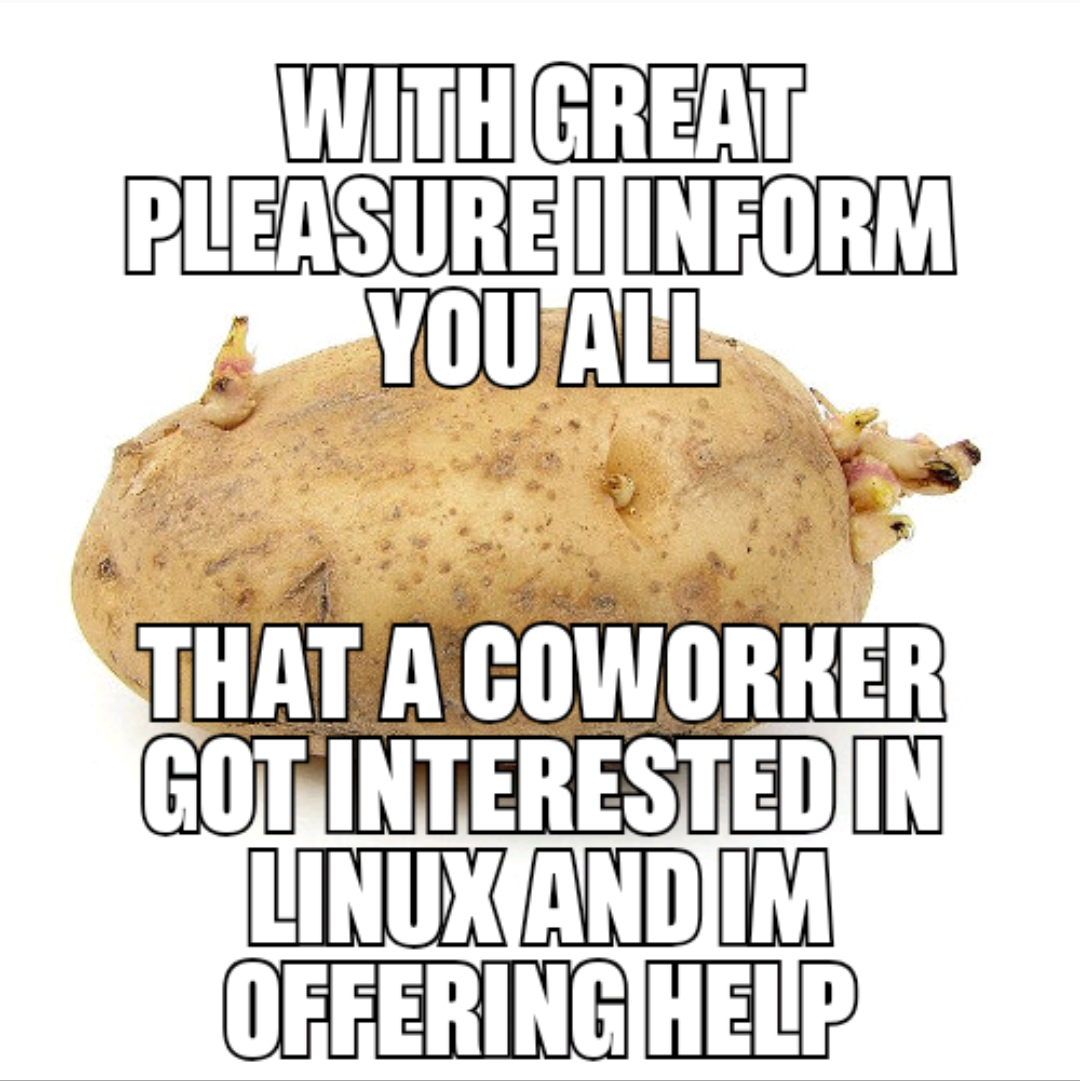
Potato as background. With great pleasure i inform you all that a coworker got interested in linux and im offering help
22


NoteCraft l’alternativa open a Microsoft OneNote basata su file locali@gnulinuxitalialinuxeasy.org/notecraft-lalter…NoteCraft è un'app open source alternativa a Microsoft OneNote che salva appunti in file locali, supporta Markdown, HTML, diagrammi e sincronizzazione autonomaL'articolo NoteCraft

23


Thunderbird 160.0 rilasciato: tante correzioni e miglioramenti per il client email open source@gnulinuxitalialinuxeasy.org/thunderbird-160-…Thunderbird 160.0 è disponibile: l'aggiornamento introduce miglioramenti ai filtri, OAuth, IMAP, calendario e

24
25


KORA: una nuova distro Linux progettata per l’intelligenza artificiale@gnulinuxitalialinuxeasy.org/kora-una-nuova-d…KORA è un nuovo sistema operativo desktop basato su Linux che integra intelligenza artificiale, modelli locali e agenti AI direttamente nel sistema.L'articolo KORA: una nuova distro Linux

view more: next ›