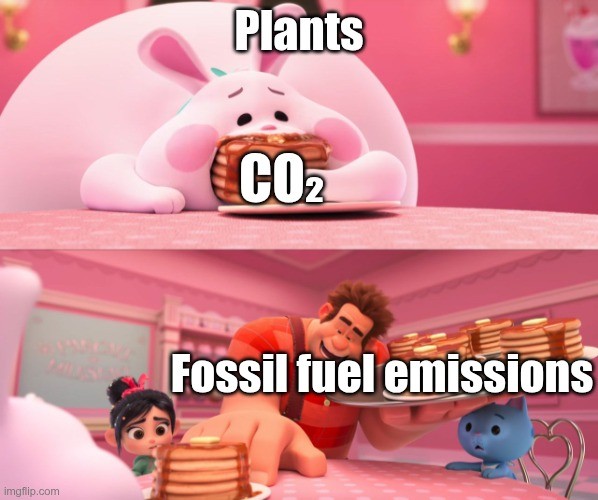
"CO₂ isn't a pollutant" climate change deniers are missing the point, and hopefully this meme is simple enough for them to understand. I'd post it on Reddit too, but I'm trying to cut down on Reddit use.

Alt text:
Meme about Wreck-It Ralph (labeled “Fossil fuel emissions") overfeeding a pink rabbit (labeled “Plants") pancakes (labeled “C0₂")

Meme about Wreck-It Ralph (labeled “Fossil fuel emissions") overfeeding a pink rabbit (labeled “Plants") pancakes (labeled “C0₂")
you are viewing a single comment's thread
view the rest of the comments
[–] 48 points 5 days ago (15 children)

Sure, if you let the plants grow at a pace that matches your co2 output.

(We’re not doing that)

  • source
  • hideshow 15 child comments
  • [–] 26 points 5 days ago* (last edited 5 days ago) (7 children)

    I calculated it a while back and we would need to cover entire the landmass of earth with old growth forrest every 10 years to offset ongoing emissions.

  • source
  • parent
  • hideshow 7 child comments
  • [–] 11 points 5 days ago (2 children)

    Meanwhile we are cutting the last of old growth.

  • source
  • parent
  • hideshow 2 child comments
  • [–] 2 points 5 days ago

    Scientists figured we'd have to cover all of North America, tundra, desert, ALL of it, to offset 10-years of CO2 output. And then we'd have to do it again in every 10-years.

    Why does it have to be old growth though? New growth is faster growing species and has more plants at the ground level. I would think a hectare of growing pine would capture more CO2 than a relatively static oak forest. ?

  • source
  • parent
  • [–] 1 point 4 days ago

    How much more would we need to emit to capture all that, freeze it into a giant cube and fucking YEET that into space? No carbon - no problem.

    Not a serious proposal, just curious

  • source
  • parent
  • [–] 9 points 5 days ago (2 children)

    And even then, when these plants die, they release all the carbon they captured. So you need to take that into account as well.

  • source
  • parent
  • hideshow 2 child comments
  • [–] 4 points 5 days ago

    Not necessarily! We could theoretically bury that biomass deep underground where the pressure and heat eventually turn it into fossil fuels.

    Not that it's particularly likely, but it is technically possible!

  • source
  • parent
  • [–] 2 points 5 days ago (3 children)

    Aren't crops (which of course are plants) actually growing faster due to increased co2. Due to this they're also not able to develop as much nutrients and vitamins etc

  • source
  • parent
  • hideshow 3 child comments
  • [–] 4 points 5 days ago* (last edited 5 days ago) (2 children)

    My understanding is that nutrition has got more to do with selective breeding, soil microbial ecosystems, and depletion of plant micronutrients - we focus on macronutrients (N-P-K) in fertilizer.

    But I think it does have an impact on plant growth. Fossil records suggest larger plants, and people who grow “tomatoes” indoors sometimes pipe in CO2 I think. Works well if you brew beer near your tent.

  • source
  • parent
  • hideshow 2 child comments
  • [–] 1 point 5 days ago

    Micronutrients are generally represented in foliar fertilizers or seed treatments, not granular fertilizers. So things like boron, copper, zinc, sulphur, manganese, etc are applied by spray, generally, since there is better uptake via leaves than roots, though much of it will hit the soil for later use.

    We've even identified fields where we applied a certain amount of gold, which is used for better disease resistance.

  • source
  • parent