you are viewing a single comment's thread
view the rest of the comments
[–] 132 points 1 year ago (75 children)

I'm still convinced this is the biggest troll. It's clearly white and gold

  • source
  • hideshow 75 child comments
  • [–] 70 points 1 year ago (24 children)

    I've always really liked this explanation image you can find on Wikipedia page for it. Essentially, people who see white and gold are mistaking the lighting to be cold and blue-tinted, rather than warm and yellow-tinted.

    The portions inside the boxes are the exact same colors, you can easily check this with a color picker.

  • source
  • parent
  • hideshow 24 child comments
  • [–] 8 points 1 year ago* (last edited 1 year ago) (1 child)

    Yeah, this is the best explanation for why this 'controvesy' happened.

    Certain background lighting conditions and colors can significantly alter the color and luminance of certain objects in that lighting environment, which otherwise, in less extreme lighting environments, look different.

    Even just understanding basic color theory can show you how to make a color pallette out of either mutually complimentary colors, or highly contrasting colors... and how humans largely, (though apparently to differing extents and by different means), interpret a total color space by comparing and contrasting the colors within that space to each other, as opposed to against some objective reference point of all possible colors.

    The other part of this explanation is that...

    People were not talking about the same image.

    Someone would argue one way, another person argues another way, and then someone else would do some kind of photoshop job to argue for one side, and their explanation and reasoning and justification would get lost, and ok now you have multiple images spreading around and being argued over by the same population that would...

    ... in 5 years, essentially start a civil war over the idea of whether or not it makes sense to wear a mask during an epidemic of a virus transmitted in the aerosolized spittle from sneezes, coughs, and even just breathing.

    But yeah, when this was an ongoing thing, I'd have multiple different people in different camps... sending me actually different images, and it took a while to figure out which one was the actual original origin image.

    Which of course I had to do on my own, but critical thinking and basic research skills, an impulse to verify the base assumptions of a claim or argument... many people do not know how to do this, or only selectively do it with things that challenge their pre-existing notions.

  • source
  • parent
  • hideshow 1 child comment
  • [–] 6 points 1 year ago

    Yeah that would never happen a war. Imagine of 3 groups of people worshipped the same God, just prayed to him on the floor, to a wall, and to the ceiling.- I'm sure they would get along and be super harmonious.

  • source
  • parent
  • [–] 13 points 1 year ago (4 children)

    As in using the colour picker on the image and finding the corresponding code? That's actually an explanation that I can get behind. Classic example of trust your instrument.

    I see the dress as gold and white, no matter ehow hard I try to see the other side of the coin.

  • source
  • parent
  • hideshow 4 child comments
  • load more comments (2 replies)
  • [–] a comment that isn't shown here: deleted, from someone you've blocked, or on another page. view the thread from it
  • [–] 3 points 1 year ago* (last edited 1 year ago)

    The dress inside the [left] box is still black and blue (with yellow tint). Inside the [right] box the dress is white and gold, with a blue tint.

    The black and yellow colors inside the boxes are actually the exact same color, and the same goes for the blue and white colors inside the boxes (which is what the seamless bars connecting them is there to demonstrate). But they look completely different, right? The picture is showing us two different ways the exact same colors can be interpreted differently depending on the context surrounding it.

    If you go to my profile and look at my comment before this one, I posted two slightly edited versions of the image that better show how they're the exact same color.

    The way this connects to the original image of the dress, is that some people see a gold and white dress because they think the dress is in blue-tinted lighting, as though they were standing in shade. People who see an overexposed image with a bright yellow tint, on the other hand, will likely see a blue and black dress. I couldn't tell you why it happens, but it's the way our brains perceive the lighting that's doing it.

  • source
  • parent
  • [–] 3 points 1 year ago (6 children)

    If theyre the same color, why can i see the black outlines way clearer in the yellow dress w/ blue tint side ?

  • source
  • parent
  • hideshow 6 child comments
  • [–] 11 points 1 year ago* (last edited 1 year ago) (5 children)

    That would be because the outlines themselves are not the same colors, just the blue/white and black/yellow sections. Here's an image I quickly edited with the outlines and skin removed, so you can see just how much an effect they have on the image. Both dresses still look normal, but they no longer look like completely different colors when compared together this way.

    (edit): And here's the same image with the outer boxes removed, to show how much the lighting is affecting things, where one of the dresses just looks completely wrong to me now.

  • source
  • parent
  • hideshow 5 child comments
  • [–] a comment that isn't shown here: deleted, from someone you've blocked, or on another page. view the thread from it
  • [–] 3 points 1 year ago* (last edited 1 year ago) (1 child)

    The two boxes are meant to be different types of lighting. The box on the left is a warmer, yellow lighting while the box on the right is a colder, blue lighting, which you can tell from its effect on the grey background. The portions of the dresses inside of this "lighting" are the exact same colors, which I tried to help demonstrate with the second picture. The portions of the dresses outside of the "lighting" represent their real color without any lighting affecting them.

    The point of the image is just to show how two different colored dresses could look exactly the same depending on the lighting. At the same time, the real dress from the original image is seen as different colors by different people because brains are weird and they interpret the lighting differently.

    Some people see a gold and white dress in a blue-tinted light like they're in the shade, while others see a black and blue dress that is overexposed by a bright yellow-tinted light.

  • source
  • parent
  • hideshow 1 child comment
  • load more comments (1 reply)
  • load more comments (1 reply)
  • [–] 13 points 1 year ago (2 children)

    Ah, so white and gold folks are, indeed, mistaken.

    Thanks!

  • source
  • parent
  • hideshow 2 child comments
  • [–] 7 points 1 year ago

    Incorrect. It is impossible to deduce the "real" color from the photo, both sets are true.

    The photo is simply bistable.

    You can argue that "the real dress bla bla bla", but nobody's looking at the real dress and everyone's looking at the photo.

  • source
  • parent
  • load more comments (4 replies)
  • [–] 80 points 1 year ago* (42 children)

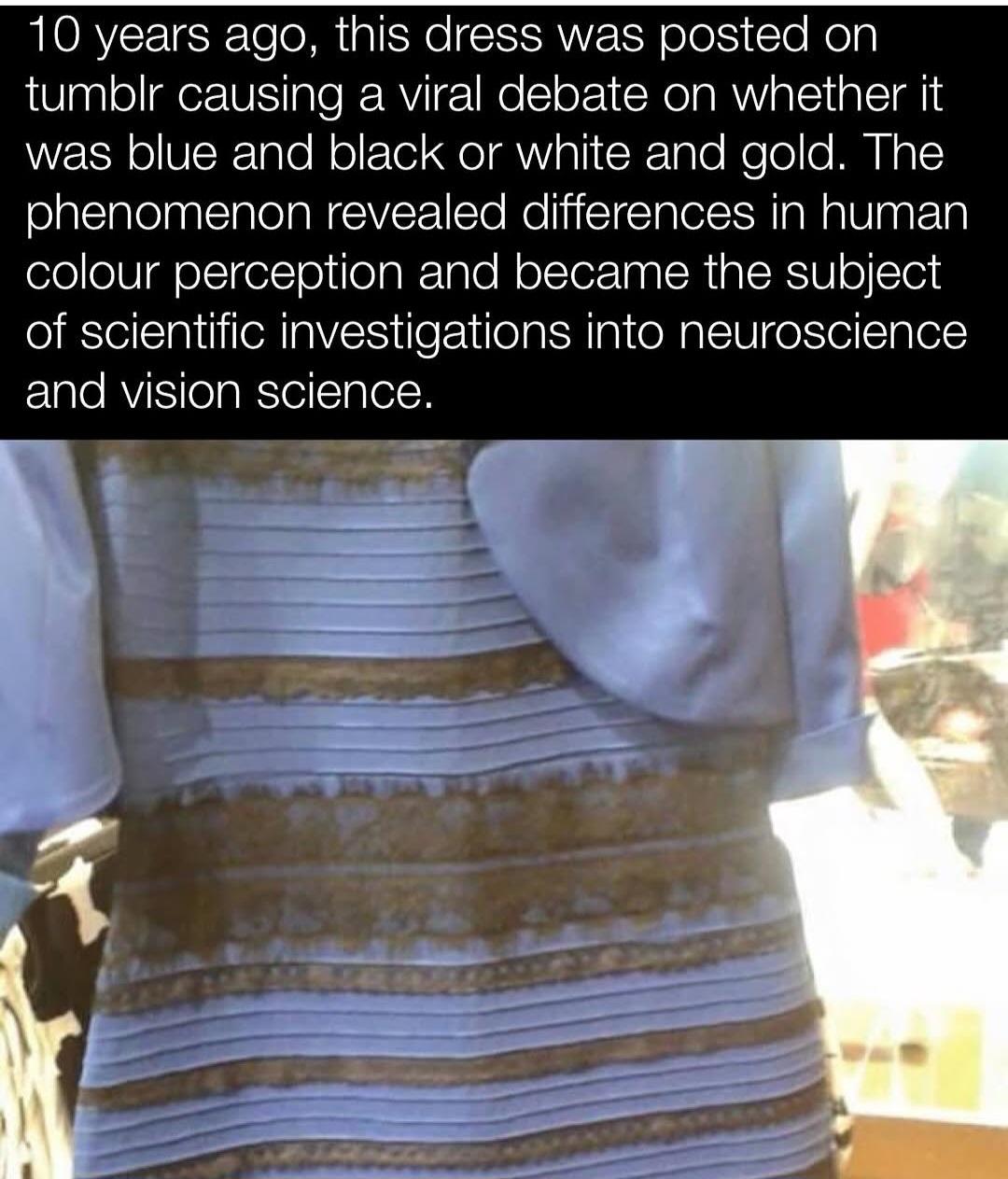
    You can literally sample the rgb values and see it's blue and black

    Edit: am I part of the joke here??? It's clearly blue and black...

  • source
  • parent
  • hideshow 42 child comments
  • [–] 86 points 1 year ago (29 children)

    am I part of the joke here??? It's clearly blue and black...

    The objective fact is…it is a blue and black dress. Other photos of the same dress show that.

    But I cannot, for the life of me, see how anyone can possibly get that from this photo. Sample the RGB values all you want and it clearly is not black in this photo. The exposure and white balance have messed around with it so much it is incomprehensible to me how anyone can see it as blue and black.

  • source
  • parent
  • hideshow 29 child comments
  • [–] 19 points 1 year ago (11 children)
  • [–] a comment that isn't shown here: deleted, from someone you've blocked, or on another page. view the thread from it
  • [–] 1 point 1 year ago (7 children)

    Looks like a sunny background and that the dress is in the shade

  • source
  • parent
  • hideshow 7 child comments
  • [–] a comment that isn't shown here: deleted, from someone you've blocked, or on another page. view the thread from it
  • [–] 1 point 1 year ago (5 children)

    Because shade works in 3D and it's not clear how far away the background is from this picture. But yes, 'dress shaped and size amounts of shade' exist; trees, could be on a shaded balcony, etc.

  • source
  • parent
  • hideshow 5 child comments
  • [–] a comment that isn't shown here: deleted, from someone you've blocked, or on another page. view the thread from it
  • [–] 1 point 1 year ago (3 children)

    No because it's your subconscious, otherwise you'd have no problem understanding why it's was ambigious. (Same applies for elevated beings - they can grasp differences in human colour perception).

    And either way, even if your assumptions were true you still don't know the angle of the sun, potential coverings, etc. You can't predict the shade without that info so the logical choice would be to use the colours the pixels display.

  • source
  • parent
  • hideshow 3 child comments
  • load more comments (1 reply)
  • load more comments (1 reply)
  • load more comments (1 reply)
  • [–] a comment that isn't shown here: deleted, from someone you've blocked, or on another page. view the thread from it
  • [–] 3 points 1 year ago

    The brain doesn’t just read raw brightness; it interprets that brightness in relation to what it thinks is going on in the scene.

    So when someone sees the dress as white and gold, they’re usually assuming the scene is lit by cool, natural light — like sunlight or shade. That makes the brain treat the lighter areas as a white-ish or light blue material under shadow. The darker areas (what you see as black) become gold or brown, because the brain thinks it’s seeing lighter fabric catching less light.

    You, on the other hand, are likely interpreting the lighting as warm and direct — maybe indoor, overexposed lighting. So your brain treats the pale pixels not as light-colored fabric, but as light reflecting off a darker blue surface. The same with the black: it’s being “lightened” by the glare which changes the pixel representation to gold, but you interpret it as black under strong light, not gold.

  • source
  • parent
  • load more comments (2 replies)
  • [–] 23 points 1 year ago (10 children)

    The lighting of the room is clearly yellow. The black stripes look to be a very glossy material, which when lit with yellow light reflects goldish. There's no way that lighting turns a white dress blue.

  • source
  • parent
  • hideshow 10 child comments
  • [–] 1 point 1 year ago (3 children)

    What room? It looks like we're looking at the back of an object that's facing out into bright sunlight.

  • source
  • parent
  • hideshow 3 child comments
  • [–] 1 point 1 year ago (2 children)

    Whatever the setting is, it appears to be bathed in bright sunlight. That's the important part.

  • source
  • parent
  • hideshow 2 child comments
  • [–] 1 point 1 year ago (1 child)

    The front of it presumably is. But the back, that we're looking at, seems to be in shade.

  • source
  • parent
  • hideshow 1 child comment
  • [–] 7 points 1 year ago* (3 children)

    See, it always looked to me like blue light (or maybe shadow) around the dress itself, where the only sense it makes to my brain is that the fabric is white.

  • source
  • parent
  • hideshow 3 child comments
  • [–] 4 points 1 year ago (2 children)

    Whatever is to the right and behind the dress is definitely in bright yellow light.

  • source
  • parent
  • hideshow 2 child comments
  • load more comments (1 reply)
  • [–] 42 points 1 year ago (4 children)

    "The phenomenon revealed difference in human color perception..."

    Yes, you're becoming a part of the joke. People LITERALLY see the dress differently. It doesn't matter what the objective facts are. TBH, it says a lot about humanity. Even when we have evidence that subjective experiences can vary, and even contradict each other, we still end up arguing over whose viewpoint is "correct".

  • source
  • parent
  • hideshow 4 child comments
  • [–] 5 points 1 year ago (3 children)

    That we’re curious problem solvers?

    Anyway, science has determined that my way is most based

    A study carried out by Schlaffke et al. reported that individuals who saw the dress as white and gold showed increased activity in the frontal and parietal regions of the brain. These areas are thought to be critical in higher cognition activities such as top-down modulation in visual perception

  • source
  • parent
  • hideshow 3 child comments
  • load more comments (3 replies)
  • load more comments (1 reply)
  • [–] 14 points 1 year ago* (last edited 1 year ago) (2 children)

    You can sample the colours and see it’s white with a very light blue tinge and gold.

    People who see it as blue and black are (correctly in this case) auto-correcting for the yellow light as the dress itself is black and blue.

    Whereas people who see it as white and gold are (subconsciously) assuming a blue shadow and seeing the pixels as they’re displayed.

  • source
  • parent
  • hideshow 2 child comments
  • [–] 10 points 1 year ago (2 children)

    You can literally sample the rgb values

    It doesn't matter. This phenomenon can be explained by something called color constancy.

    I remember some versions of this image where I could literally switch between perceptions at will, when I imagined different surrounding light temperatures/environments.

    It's a subjective perception.

  • source
  • parent
  • hideshow 2 child comments
  • [–] 20 points 1 year ago (1 child)

    I can literally switch between perceptions with this exact image. It’s sort of like that “are there six cubes or ten” illusion. Depending on how I look at it, I can see either one.

  • source
  • parent
  • hideshow 1 child comment
  • [–] 7 points 1 year ago

    Exactly. Or that silhouette of a spinning ballerina. I can switch the direction that she is spinning at will as well. There's nothing to go by because it's a perfectly flat, projected silhouette without any shadows, so anybody is free to interpret the rotation however they like. 😁

  • source
  • parent
  • load more comments (2 replies)
  • [–] 18 points 1 year ago* (1 child)

    Stop trolling me. It's blue and black. I could never figure how people might perceive it otherwise.

  • source
  • parent
  • hideshow 1 child comment
  • They see the blue as shaded white, and the glossy black has enough yellow reflected in it that they think it is shadowy gold. Basically, you’re seeing the dress as if it’s lit from the front. You see the colors as blue and black, because that’s what’s on the screen. But other people’s brains decide that the dress is backlit, so the colors facing the camera are actually shaded.

  • source
  • parent
  • load more comments (3 replies)