Read the core rule book. Play a session. Evaluate if I liked it enough to continue playing it.
comments
Beautifully written. There's a treasure trove of great concepts and mechanics that other systems have, which people would absolutely love if they were willing to try them over DnD. It's not just about playing something "better", it's playing something different.
I've been recently pushing my friends to move onto other systems. One of them is interested in running Fabula Ultima, for example, because he really likes the Fabula Points system (the ability for players to shape the narrative by spending points obtained during roleplay).
Me, I'd love to run Shadowdark, but only two of us like it, so that's not gonna happen anytime soon :(
Btw, there's a typo in your article:
Let me be clear, I don’t want GURPS levels of crunch. I don’t want to calculate the an integral of the area of my bagpack to know if my encumbrance to see if I can carry an extra torch.
-
Read the book
-
Create a bunch of 'test character"
-
Use these test character for a "test one shot" with player interested to try, and understanding that the point of the one shot is to learn to GM the system
The glass cannon recently did a campaign of it that's going up on their YouTube channel currently
I always find it helpful to check some actual play to cement my understanding of certain rules. Although there's no way to guarantee the actual play is definitely correct obviously
I don’t sweat to much with the details. Being a GM is hard as it is.
IIRC the gameplay loop from Twilight 2000 (and other Free League) is pretty simple and that’s the basis for everything else so remember this one and put the rest in your memory maybe it will come back, maybe not 🤷♀️ have fun
comment on
Pocket Monster Adventures World Guide
Yeah, I think they don't bring in that much, but it doesn't stop Hasbro from trying to milk them.
comment on
Pocket Monster Adventures World Guide
They’re like the only ones making actual money with TTRPGs and even then they need Magic to keep themselves afloat!
comment on
Pocket Monster Adventures World Guide
Hasbro breathes heavily
comment on
Pocket Monster Adventures World Guide
Haha! There’s thankfully not enough money in TTRPGs for Nintendo to care.
comment on
Pocket Monster Adventures World Guide
Someone isn't scared of the Nintendo legal team I see! :D
!opensource@programming.dev might also be interested in this. Thanks for sharing!
Thanks for sharing!
comment on
Dice Bags
...my stalwart chessex set has recently grown beyond the capacity of its long-serving dice chest; any better-suited options than the old go-to crown royal bag?..
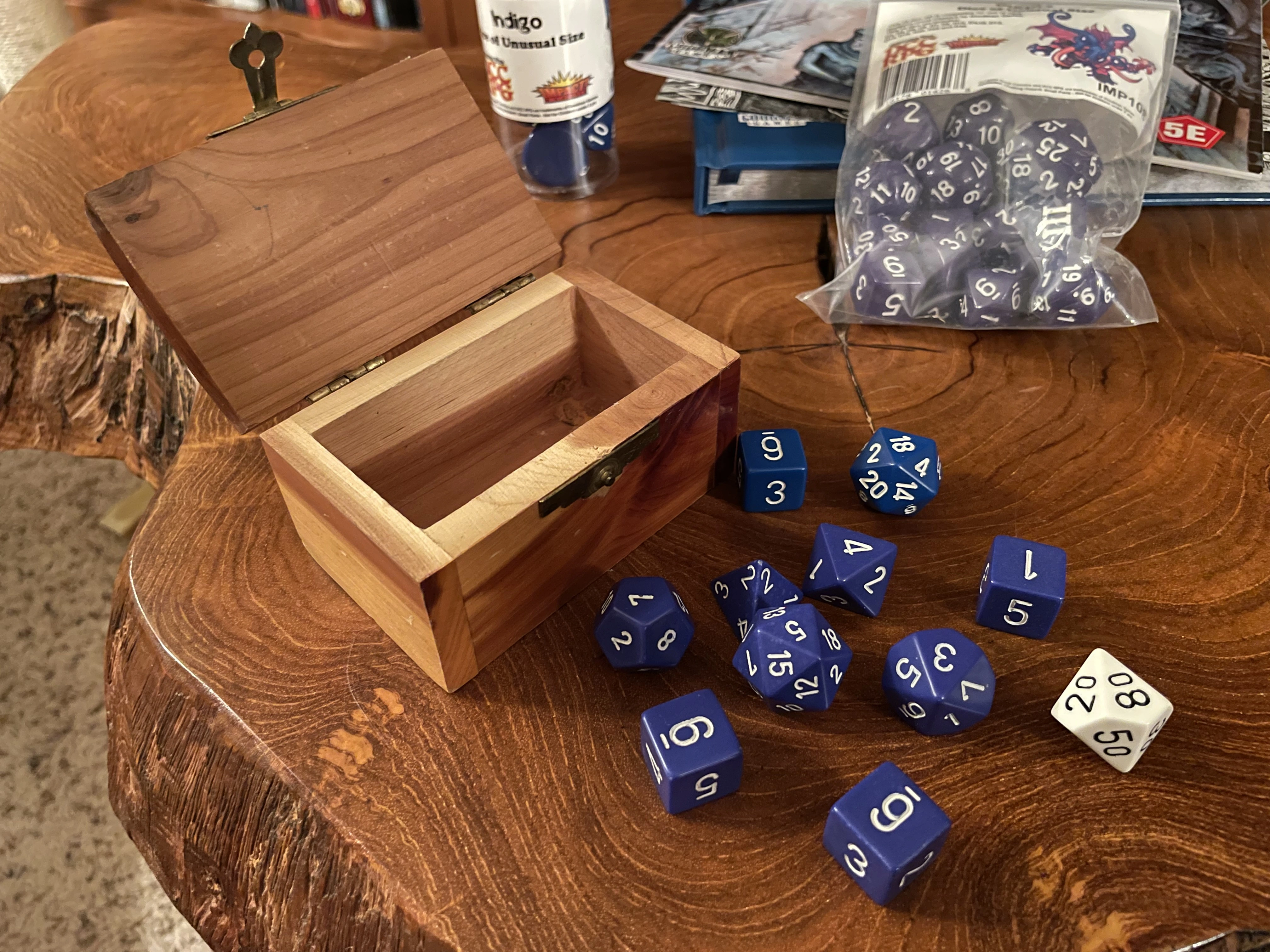
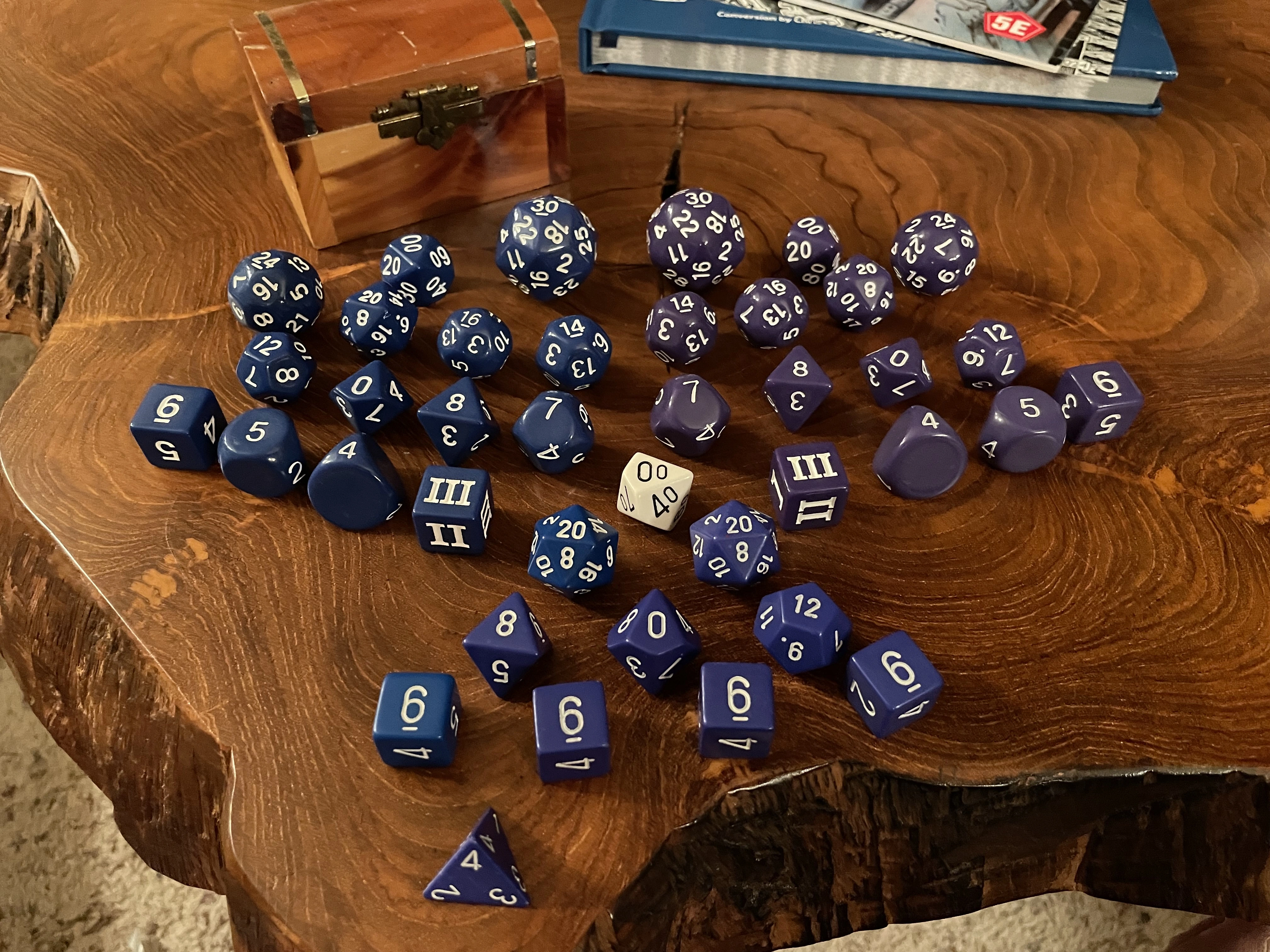

comment on
Free RPG Day Haul
...this is actually the first year i set out saturday morning to visit participating shops; previous years i've always tracked things down on ebay after the fact...
comment on
Free RPG Day Haul
I was really hoping to get a copy of the Runes Of The World Tree. I only got a copy of the Pathfinder, and the Starfinder games.
comment on
Metaphors and RPG
I enjoyed the concept of the article but I would to see the examples of metaphors he used in his 4+ year game.
Dnd is a metaphor game so it makes sense to use them. Each dungeon or arc can explore a different concept or theme or genre which is super fun. Its why I love DMing which is just story telling through the environment
comment on
Ideas for Combat Downtime
3.5 huh? When rolling multiple attacks, do NOT roll them one at a time. If they get five attacks, roll 5d20s. Assign specific dice to the order of attacks if you need to or just go in ascending or descending order of the rolls; whichever is easiest for y'all. Similar with damage after you've determined which attacks hit. Just roll all the damage dice at once.
If your players are up for it, you can speed up combat by using an actual hourglass timer (30 or 60 seconds) to limit decision making time so they can't take 15 minutes planning their turn. This can also make combat more frantic and hazardous, of course, so you'd want to appropriately scale back some monster damage or HP if it becomes a problem and they put themselves in tactically terrible situations due to the pressure of the ticking clock. (This definitely needs buy in from your players first!)
As far as giving agency when it's not their turn, they can always shout suggestions or relevant tactical information to one another. You could theoretically let them help each other once per round or something, where maybe they roll a small die that gets added to the active players roll, signifying them shouting at an enemy to distract it or encouraging their teammate. This is basically 5e Bard territory, but there's no reason you can't use it generically.
comment on
Ideas for Combat Downtime
This is good advice but I will add that putting a timer on player's turns is also itself a bit of a problem...it comes off as infantalizing.
comment on
Ideas for Combat Downtime
Make sure your players are planning their turns in advance. That way they have something to do when it's not their turn, and turns go much more smoothly so there's less time in between them.
comment on
Ideas for Combat Downtime
Reduce your mental load to increase your speed: limit yourself to fewer additional stat blocks per encounter (e.g. if there is a boss battle with lair actions, you should ideally have 1, at most 2 additional monster stat blocks on top of that boss). Running something like 4 stat blocks is sufficient cognitive load that there is no way for you to play your monsters optimally and still be fast.
Reduce your reliance on small dice rolls to increase your speed: preroll a table of damage for any given statblock's actions, so that you can dole it out quickly (still roll the to-hits live tho, in case of crits and misses and reactions, and have misses consume a line from the preroll table too).
Add a low-value off-turn minigame for players to play: I like to make knowledge checks free (History, Nature, Insight, etc). You could allow players the chance to each get 1 free knowledge check in per round, but only off turn. That way if it's another player's turn, and they are thinking for a while, you can have the other players roll their knowledge checks and tell you what they are looking for. Resolve them later, at the beginning of those PCs' turns, which will also keep other players engaged since they are learning new info. Don't let them ask tho, save it for when you want to provide the distraction.
comment on
Ideas for Combat Downtime
Assuming we're talking about D&D 5e... this is a common issue.
More than 5 or 6 players will bog down combat exponentially.
Martial character options like Action Surge, Extra Attacks, and weaponized Bonus Actions will of course extend turn time. You can speed things up by telling the player the target AC up-front instead of the common guessing game: "does 14 hit? ok I'll use Inspiration to add d6, does 16 hit? Ok, next attack, does 18 hit...?"
Players being tuned out, needing a battle conditions summary in order to decide what to do each time their turn comes up... bad manners but are you really ready to tell an otherwise beloved friend to shape up or don't come back?
There's a fairly common condition, aphantasia, which is basically inability to imagine visually. Using a miniatures battlefield instead of theater-of-mind for more complex battles can help players with aphantasia stay on top of battle conditions.
Players who perpetually pitch outside-the-box, game-breaking interpretations of their abilities, like trying to use Acrobatics proficiency like a free Spider Climb spell... yep that taxes time even if the ruling is "no that ability doesn't work that way". Putting a time limit on each player's turn might help quash time-wasting spitballing.
comment on
Ideas for Combat Downtime
There goes my suggestion then!
I tend to run shorter campaigns of about 20 sessions or so. We change games all the time, but it definitely isn't for everyone.
I will say that the combat is a big reason that I don't run D&D; not that it's bad but my brain just doesn't work well with it, and I prefer a more improvisational kind of style.
I hope you find something that works for you; good on you for finding a way to value your players' time.
comment on
Ideas for Combat Downtime
DnD 3.5 Ravenloft, so kinda locked in yeah.
comment on
Ideas for Combat Downtime
Sometimes I get players to make a series of D20 rolls for me and note down the results. Then I use those for their opponents in a later round. Not in the order I get them - usually every second or every third.
comment on
Ideas for Combat Downtime
What game are you playing?
Are you locked into that system?