1
Ban AI Slop? (lemmy.ml)
submitted 1 month ago by to c/opensource@lemmy.ml


I had a report for AI slop today. 1m LOC in 3 months. How do you even modify and distribute that? I do not think we had a rule against it.

IMHO if we allow, the community gets drowned out by AI vomit and it is harder to see handcrafted loved projects that are easy to modify and distribute.

My mind is to ban it to preserve open source.

Are folk in agreememt with this line? Would love to hear your thoughts.

2


Can't escape AI slop projects from meat proxies man. Every single open source project smells like Claude Code recently. Sad times.

3
4


OccupySaaS is protest movement written in code.

Story is simple. Many engineers got laid off in tech. But the SaaS platforms they built keep growing and keep charging per seat. So the same industry rent our own work back to us. This project is answer to that. Laid off engineers use AI and public documentation to rebuild those platforms as free open source drop-in replacements. One seat at a time.

Method is clean room. Public docs only, open standards, public SDK behaviour. No leaked code, no decompile, no confidential info from former employer. AI help with build, humans write spec and review every change. Compatible is proven by running vendors own public SDKs against the server. If your existing code dont work unchanged, it is not done.

Two early releases: ZeroAuthy ( Auth0 compatible identity server) and SalesCompel( Salesforce compatible CRM)

They are early, not production ready yet. But the goal is the point.

5


Sable finally releases their iPhone app from the Testflight beta into the regular app store! Big news for iPhone people (or iPhone haters who have friends with iPhones). If you have an iPhone, how is the app?

6


I just tried pdf craft on fdroid and really liked it, but its on beta and only 2 versions released.

Is it going to be well maintained and become an alternative or just stay unstable ai dlop? It had more stars on github than some other pdf viewers.

Whats your take on that. I am excited to see some decent apps on linux. Especially for .appimage and launching instantly unlike photoshop.

7


I posted recently about wanting to install OpenWrt.

I just wanted to thank everybody who gave advice and encouragement. It was very quick and easy to setup.

I had some very small issues:

  • I had to reboot my internet modem to get internet working. Duh.
  • I initially didn't put my country code for wifi, even though the docs say this is important. My bad.
  • I initially set my wifi to WPA3, but I had to switch to WPA2 for my Roku. My bad for owning a Roku.

So far I've installed adblock and wireguard extensions, although I haven't enabled the wireguard yet.

What other extensions do people recommend?

Thanks again!

8


Finally StreetComplete has been approved on the App Store and everyone has now the possibility to download it: https://apps.apple.com/app/id6808344816

F-Droid download link: https://f-droid.org/packages/de.westnordost.streetcomplete/

PlayStore download link: https://play.google.com/store/apps/details?id=de.westnordost.streetcomplete

I highly suggest you this app in order to contribute to OpenStreetMap without background or any technical knowledge. Just open the app and answer to simple questions:

  • Does this crossing have an island?
  • Is this place still there?
  • What can be left here for recycling? Furthermore by completing more and more quests the app will reward you with links to (FOSS) maps for different purposes: wheelmap, indoor, graphhopper, touchmapper.

I truly believe that this is the solution and way to get as many contributors as possible to improve the map, and make us less dependent on BigTech.

In case you want to see the site, here it is: https://streetcomplete.app/

9
10


Germans are great. Especially when they do nice things.

A lot of German people contribute to open-source projects in their spare time – unpaid, often for years. And yet, under Germany's tax law, this work is not recognized as volunteer work (Ehrenamt) – unlike club work, youth work, or emergency services.

A petition to the German Bundestag's petitions committee is calling for equal treatment.

Concretely, this would mean:

🔴 Tax-free expense allowances (Ehrenamts-/Übungsleiterpauschale)

⚪ Easier non-profit status (§52 AO) for open-source projects

🟢 Better liability protection for open source maintainers (analogous to §31a BGB)

🔵 Legally secure donation receipts and cost reimbursement

This would be a huge boost to the open source community.

Petition: https://www.openpetition.de/petition/online/anerkennung-von-open-source-arbeit-als-ehrenamt-in-deutschland

Please sign it. It only takes 2 minutes.

If you're not in Germany, sharing it with people who are would still help a lot.

Thank you 🙏

11
12
13


govdigital eG has awarded IONOS a four-year framework contract under KoDaS, the abbreviation for a collaboration and file storage system. The service delivered under it is built on Nextcloud and sold as Nextcloud Workspace.

It is meant for schools and school authorities in the German states of Berlin, Hamburg, Bremen, North Rhine-Westphalia, Rhineland-Palatinate, and Hesse. Other German states can join later, and schools are not mandated to implement it.

How the deal works

IONOS is the main contractor. It is tasked with delivering and operating the service, running the cloud infrastructure located in German data centers, and building it all on Nextcloud's open source software.

The tender notice for KoDaS sets a maximum value of 67.5 million euros and a maximum term of 48 months from the award. Nextcloud's announcement names the six states and their schools as the main parties who can order, leaving room for other states to be added later.

The announcement does not say what the contract will actually be worth. 📝

The notice calls for procuring software available under an OSI-approved open source license, citing digital sovereignty, lasting availability, and the ability to switch providers.

Among its asks for bidders are ISO 27001 certification, at least 10 million euros in turnover, liability insurance of at least 5 million euros, and a reference project with at least 10,000 active users and fully separated tenants.

For the features, the notice calls for central file hosting and sharing, a browser-based office suite for working on documents together, calendar and contact management, and an integrated email client.

Pricing depends on how many people actively use the service, and it is split into five tiers that start at the up to 50,000 users mark, ending above 500,000. No school authority has to commit to a set volume up front, so each can begin with its current users and grow from there.

Nextcloud's main argument is that public institutions should have alternatives to proprietary platforms so they keep control of their data. The company also believes students who start out using open source tools are less likely to reach for big-vendor products afterward.

We have seen this already

Other German institutions are also reworking their software. Last year, we heard that almost 80% of Schleswig-Holstein's state government workplaces had switched away from Microsoft.

Mecklenburg-Vorpommern is replacing SharePoint with a self-hosted Nextcloud that around 5,000 employees use today, and the state plans to bring that to 50,000 across the public sector.

Then there's the federal Deutschland-Stack, published by the Federal Ministry for Digital Transformation and Government Modernization, which covers all levels of public administration and permits use of only ODF and PDF/UA for documents.

I anticipate more such moves across Europe as governments realize that keeping sensitive data with providers that fall under foreign law can expose it to access they have no say over, irrespective of where the servers are located.

The ongoing US midterms could also shift the conversation depending on who comes out ahead.

14


Share any TCP network service (like a web server, game, etc.) with your contacts through Jami! It can also manage an embedded web server as needed to easily share simple websites or directories.

15


At least that's what VLC thinks when protesting the new French law.

France's National Assembly has voted in favour of a new "internet tax" that would charge companies for every gigabyte of data they send to users in France.

The idea is to make Netflix, Google, Meta and the rest of Big Tech pay more.

That sounds like a dream come true for many of us who prefer taking ownership of data in our own hands but unfortunately things are not that simple.

The way this law is written, it doesn't stop at Big Tech. Even VLC, a free and open source media player maintained by a non-profit, could end up paying this new tax. What the new French internet tax says New French Internet Tax law

The measure is amendment I-1358 to France's 2027 finance bill, tabled by Laurent Lhardit. It creates a tax on "producers of digital data" at €0.055 (5.5 euro cents) for every gigabyte delivered to subscribers of French internet providers.

Internet providers would measure how much data each sender pushes to their customers, with the collection supervised by telecom regulator Arcep and the tax administration DGFiP. Only the volume is counted, not the content or where it goes.

The amount is capped at 15% of the company's revenue in France or 2% of its total revenue, as per the amendment. Note that it's 15% of French revenue, not of total network traffic. And the text joins the two caps with an "or" without saying which one applies when they differ. How much money are we talking about?

The amendment cites an Arcep estimate of 200 billion GB a year flowing to French internet subscribers. It expects the tax to bring in €10 billion a year. It also names Google, Meta (Facebook, Instagram), Amazon, Netflix and Akamai (cloud server provider) as the senders of about half of that traffic.

You'd think the money goes to the telecom operators who build and maintain the networks. That's the "fair share" argument European telcos have pushed for years.

But that's not the case. The revenue goes straight into the state budget, and the amendment's own justification talks about tax fairness between local businesses and digital multinationals, plus the ecological benefit of compressing data.

Why VLC is angry

A gigabyte of open source software counts the same as a gigabyte of Netflix. VideoLAN, the French non-profit behind VLC, posted on X that the tax would cost it over €1 million a year.

Lhardit replied that the cap would protect VideoLAN. He also said he didn't see how the tax could be passed on to users of Facebook, Instagram or TikTok since those services are free.

VideoLAN didn't take that well:

You have no idea what you are talking about. What you said about Facebook and Insta and other social networks are not targeted because they are free, means you don't understand the basics of economy. You don't understand the difference between Revenue and Profit.

VideoLAN (@videolan), October 30, 2026

The cap may limit what a low-revenue non-profit owes. But there is no explicit exemption for associations, free software or free content anywhere in the text. VideoLAN's €1 million is the possible figure before the cap, and right now nobody can tell the exact figure for certain because of all the ambiguity.

VLC isn't alone. OVHcloud founder Octave Klaba put his company's gross exposure at around €70 million a year, and Free's (Teleccom) Xavier Niel called the authors "ignares incompétents", roughly "incompetent ignoramuses". Those are French companies, by the way. Not exactly the US giants this internet tax bill was meant to tame. At the end, the consumer pays the bill

See, a "war on Big Tech" sounds great in a headline, and European governments are fond of laws that squeeze extra money out of American tech companies. But I don't buy the idea that Netflix will pay them out of their pocket.

Netflix will do what it always does and raise subscription prices. And Facebook is "free" only because advertisers pay for it, which is exactly the revenue versus profit point VideoLAN was making.

So the government gets extra money, Big Tech protects its margins, and you end up paying. Meanwhile, non-profit projects like VLC, which never had a price to raise in the first place, are left wondering how big their bill will be.

Let's just hope that this doesn't take the form of law. Because this will set a precedence. I wouldn't be surprised to see other European countries try their own version. No government will say no to extra tax revenue.

Like GDPR, this has all the ingredients of another mess. If a law is going to tax "internet companies", it needs to say in black and white which ones. Right now, it doesn't.

What do you think? A fair way to make Big Tech pay, or a blunt instrument that hits everyone else? Let me know in the comments.

16
17


Just days after Daemonarchy, there's another new OS in the BSD family – and one that is heading determinedly in almost the opposite direction.

AlpineBSD is so new that it barely exists yet. There are no installation media available, though it's possible to manually bootstrap an installation. What AlpineBSD does already have is an AI policy, and the plan is to avoid "the output of generative AI models (e.g. LLMs)" as far as possible:

"Any software whose code, documentation, binaries, or other assets include, in any part, the output of a generative AI tool such as an LLM, is considered 'tainted' for our purposes."

The core idea is to combine the kernel of NetBSD with "a userspace inspired by Alpine Linux and the objective of making it possible to use as little AI-generated software as possible."

Back in 2024, the NetBSD project made its position on AI plain. Its commit guidelines say that "code generated by a Large Language Model […] is presumed to be tainted code."

Back in July, Linus Torvalds stated that "Linux is not one of those anti-AI projects". Since then, NetBSD has seen a spike in donations and interest.

For someone mainly used to Linux, trying to install NetBSD is a little like hopping in a time machine to 30 years ago, and we speak from personal experience of Linux in the mid-1990s. As we mentioned when Slackware turned 30 a few years ago, back in 1996, this vulture tried Slackware 3.0 on his own hardware, and we never did manage to install it.

We tried NetBSD 11 a couple of months ago, and despite considerable help from the folks on the NetBSD-users mailing list, we failed to get the CDE desktop to start.

As an example, installing software on NetBSD is not the easy, comfortable task it is on Linux. It does have a package manager for handling binary packages: it's called pkgin, but as the NetBSD FAQ mentions, it's an optional extra. You must manually tick a box in the setup program to install pkgin with the rest of the OS, and when we tried NetBSD 9.3 four years ago, we didn't know that, overlooked that checkbox, and had to find a way to add pkgin later. (It is quite tricky to install a package manager when you don't have a package manager to install it with.)

This time around, we discovered that pkgin sometimes doesn't complete the installation process for you – it just leaves a text file in a destination directory somewhere, and you're expected to know that, go there, read it, and do any further steps yourself.

The NetBSD community has been quietly going its own way since 1993. It has its own ideas about what is normal, and its users expect that. Some folks on the mailing list told us that they never use binary packages anyway – they compile what they need from source code.

AlpineBSD's ports repository and source code are hosted on Sourcehut, under the account of sircmpwn, better known as Drew DeVault. We have quoted DeVault a few times over the years: we've often found that his views align with our own in various ways… such as about the best laptops ever made, and on simplicity in Linux distro design, or even on dot-com billionaires at FOSDEM.

Alpine's tools are quite well-suited to being adapted to other systems. We have previously mentioned the use of its packaging tool, APK, in the GNU-free Chimera Linux, which uses much of the FreeBSD userland, and also in Adélie Linux.

We will follow AlpineBSD with interest. There's strong appeal in the plan of combining perhaps the best-known, longest-established AI-free Unix-like kernel with the user-facing parts of pretty much the smallest and cleanest Linux distro there is. The AI advocates often warn LLM skeptics that they risk being left behind. Well, here's an OS for those who don't want to surf the AI wave. ®

18
19


Collabora has published its own account of the Danish ministry pilot that earlier coverage, including ours, had described as Denmark moving off Microsoft's office software.

The ministry's own launch release had described it as a test by a group of employees in one department. Back then, the minister handling this, Caroline Stage Olsen, had said the tech giants were not being tossed out the door overnight.

A volunteer test, not a switch

The pilot began in June 2025, when volunteers in the Danish digitalization ministry's own department started writing documents in Collabora instead of Microsoft's Word, Excel, and PowerPoint editors.

cBrain, the Danish company behind the ministry's F2 case and document management system, was tasked with integrating Collabora into it.

The ministry presented it as a test from the beginning and said that a wider rollout in the department depended on the results. Days later, it told Version2 (in Danish) that no decision to phase out Microsoft had been made and that the plan was not to replace Windows with Linux.

Ingeniøren reported in December (also in Danish) that testers had complained about documents from other government agencies that opened blank, track changes that were difficult to accept, and line spacing that appeared odd.

Its story was based on ministry and cBrain correspondence obtained through a records request, and it covers the months up to an evaluation workshop in October, where testers were to say whether they wanted to keep using Collabora.

Later that day, a second story had Frejdie Søndergaard-Gudmandsen, cBrain's head of product management, calling the bugs normal for a pilot. It was also reported that the ministry had decided to continue into 2026.

Two versions of why it stopped

The ministry's press officer told Ingeniøren in October that the election call interrupted the project, that it was not evaluated as planned, and that staff don't use Collabora today and have no plans to.

Collabora's statement gives a different cause. It says the June reorganization ended the digitalization ministry as a separate ministry and left the pilot without a home before the evaluation was done, and that this shouldn't be characterized as a finding against the suite.

The election was called in February, and the new government that took office in June merged the digitalization ministry into the research and education ministry.

Collabora adds that the first phase worked, that its engineers resolved the tickets testers raised, and that it paid for that work itself. It also says the experience is carrying into work with other Danish authorities and cBrain, and that formal assessment was never finalized.

On October 27, the research, education, and digitalization minister Christina Egelund said on DR's P1 Morning show that she knows little about why the project ended without a proper evaluation and pointed out that the decision was made under the previous minister.

Where our earlier coverage ran ahead

Our June 2025 article said, citing Politiken's report, that the ministry was moving from Office 365 to LibreOffice, with full adoption expected by autumn. The ministry later said no decision to phase out Microsoft had been made and described a smaller volunteer pilot.

Politiken soon corrected its own article, and we fixed the Linux claim at the time, but our headline and the autumn timeline stayed as they were.

20


Thanks to everyone on F-Droid and GitHub for the support and kind words, it really means a lot! I’m happy to share that Aftergleam is now on Google Play too.

Researchers need to keep up with the hundreds of new papers posted every day on arXiv and other preprint servers. Aftergleam learns your interests locally on your phone, so your data never leaves your device, and shows you papers that matter.

It covers computer science, engineering, biology, medicine, chemistry, law and more. You can also set keywords to get notified about the exact topics you follow, and read papers offline as PDF or in Reader mode.

Google Play: https://play.google.com/store/apps/details?id=si.jakobkreft.aftergleam

Website: https://aftergleam.app/

It's open source: https://github.com/jakobkreft/Aftergleam

I hope you enjoy and find it useful as much as I do.

21


Meditate is a nice and simple stopwatch for meditation. It automatically logs all sessions. You can create complex presets and easily access sessions.

I used Meditation which has a beautiful and clean ui for a long time in addition with Table Habit tracker to log the sessions. I liked the setup and if you only need a stopwatch, go for it. I had to use two apps and log manually. It was annoying to switch between timers and you couldn't select custom durations easily, or even at all.

22


Flex is a clean workout log book. You can add exercise sets and track you progress over time. As simple as that. I really like using it.

Shortcomings: It has no large exercise list with images or descriptions. Therefore, it is not really suited for beginners. It can be difficult/annoying to enter a new exercise because you can't simply add a set by clicking on a + somewhere on the screen. You always have to type some unique part of the name first. Once, you are used to this quirk, it's ok. There is no server, you can only use it on one mobile device. No IBAN for donations but at least monero.

23


Daily You is diary that looks good and just works. You can add text, images, videos and audio to your daily posts.

Shortcomings: Donations are expensive (no IBAN, only stripe, credit card). You can only use it on one mobile device, there is no two way sync, afaik.

24


Anyone know why showing permissions was removed from the new f droid update? Can i revert back or use a different client perhaps? I feel like that was an important feature

25


An update on my FOSS downloader extension recommended by Mozilla!I just updated to a new major release of Media Downloader Unleashed!!, my #firefox add-on to download audio and video from sites that got recommended by #mozilla !addons.mozilla.org/addon/mediaMainly, a better media list, more supported sites (even those using a wrong file format!), and some fixes and improvements!Changelog is too long for the character limit so you can read it all here : github.com/helloyanis/media-doIt's just out, so there might still be some bugs, so if you want to try it be sure to leave me any feedback! Thanks! Now for the fun part : Since it got recommended by Mozilla, it appears as a suggestion within the browser, which lead to the amount of users BLOWING UP!! LOOK AT THIS GRAPH IT'S INSANE! THANKS SO MUCH!!!? 🧡🧡I guess it's a great reward for making great work!!@opensource#foss #opensource #devlog #web #webdev #mediadownloaderunleashed
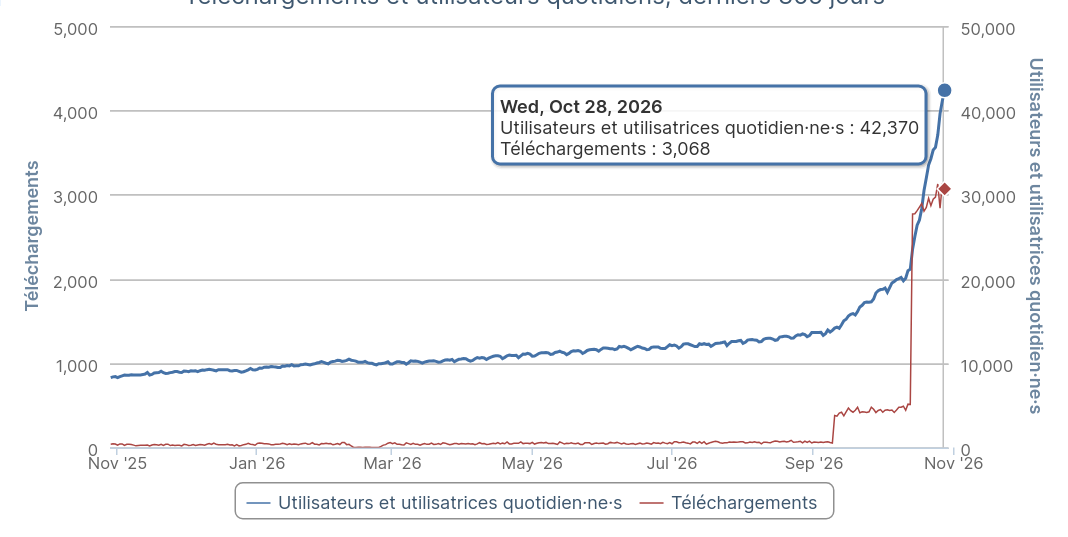
Graph of the add-on's daily users (blue) and downloads (red) over the last year.

Over the last few months the daily users have dramatically increased reaching 42370 today, and the downloads saw a huge spike increasing the daily download count from ~60 before verification to 3070 today.
view more: next ›