Briahna has long suspected that the battle to change Democratic leadership after the Democrats retook the House and Senate earlier this month has been more fiction than fight. Suddenly, the same people who opposed using leverage to force a vote over the speakership in 2020 were all on board with challenging Chuck Schumer and Hakeem Jeffries. Schumer’s Senate challenger endorsed Jeffries despite Jeffries sharing the same politics as Schumer, and House member endorsed Senate challenger Van Hollen while committing to vote for Jeffries. A “draft Pressley” movement emerged to recruit Ayanna Pressley as a challenger despite the fact that no alternative to Jeffries was needed to withhold ones vote from him. And progressives like AOC made thin arguments about why they planned to vote for a corporate zionist. What was this all about? Was his resistance? Or the mere performance of a resistance party? Briahna lays it out in the first Bad Faith video essay.


The California Department of Motor Vehicles announced it has banned Waymo from operating its self-driving taxis on all state freeways due to what it called an “imminent hazard to public safety.”

The DMV said restrictions took effect on Nov. 11 and will remain in place “until Waymo demonstrates to the Department that it has taken effective corrective actions to address the deficiencies that precipitated the restrictions.”

Before freeway operations can resume, the DMV said Waymo must provide sufficient evidence that its vehicles can safely detect and respond to construction zones, emergency vehicles, and other roadway situations.

California’s restrictions bar Waymo from both operating and testing its driverless vehicles on the state’s freeways.

Waymo will continue to operate its service as normal on surface streets in California.

The company told KTLA it has also temporarily restricted freeway operations across its other operating markets to evaluate their performance in response to the ban in California.

Waymo currently serves riders in 15 markets, including Los Angeles, San Diego, the Bay Area, Las Vegas, Phoenix and more, according to its website.

The ban comes after two recent safety incidents in the Bay Area involving the robotaxis, according to the DMV.


A new study from Gallup looked at how young people across the world are making friends, both digitally and in person. The good news is that around 93% of the young people surveyed reported having at least one strong in-person friendship. The weird news is that 33% said they had an AI companion.

Gallup’s study is lengthy and nuanced. It partnered with the Boston Children’s Digital Wellness Lab to conduct the study and used online surveys of more than 16,000 young people from the ages of 15 to 22 in 16 different countries.

A lot of the topline results won’t surprise anyone living in today’s constantly online digital-forward age. Gallup found that respondents felt their in-person friendships were their strongest, that digital friendships complemented rather than replaced in-person ones, and that stronger friendships made people happier no matter how the connection was made. Three things that stood out were how the young respondents talked about AI, loneliness, and doomscrolling.

Young people in the United States, Canada, and UK reported the least interest in AI overall, with only 20% saying they used it once a day or more. Almost 40 percent of young people in Brazil use it daily. Japan and Italy both come in around 35%. “Nearly half of young people in the United States, United Kingdom and Canada have used AI no more than a few times in the past month, including those who have not used it at all,” the researchers wrote.

Most of the respondents (82%) said they’d used AI to look up information, 68% asked it for advice, and 33% used it as a companion. Young people with online-only friends were more likely to use AI for companionship, “although these patterns do not establish whether AI companionship supplements or substitutes for human relationships,” they wrote.

The researchers discovered that people in different countries felt wildly different about their AI buddies. Almost half of Australians with AI friends rated the relationship as “high quality” and only 12% of young people in Poland did. Mostly, though, people thought of their AI friends as mid: “In most countries [...] young people are more likely to give their AI companionship a medium rating than either a high or low rating.”

People who used AI as a friend also reported higher levels of loneliness, the study found. “However, the findings cannot determine whether young people turn to AI because they feel lonely, whether AI companionship influences their social experiences or whether other circumstances help explain these relationships,” the researchers wrote.

The researchers also asked young people what they do online all day and the overwhelming majority (72%) said they spend their time scrolling short form content, mostly TikTok and Instagram. It’s also how they deal with loneliness, with six in 10 young people participating in this study reporting that they often or always scroll through online content when lonely.

They also said scrolling works to dispel loneliness almost equally as well as hanging out with a friend in real life: “Although scrolling is more commonly used when young people feel lonely, those who use scrolling or in-person time as coping strategies report nearly identical levels of perceived helpfulness.”

Still, people who reported strong in-person friendships said they felt lonely less often, while online friendships have the same effect on loneliness regardless of how participants ranked the quality of those friendships. “No comparable difference appears across levels of online-only friendship quality,” the authors wrote. Having in-person relationships seemed to be what mattered most: “Higher loneliness is also more common among young people who frequently communicate online with strangers or online-only friends than among those who frequently communicate with in-person friends or family members.”

The relationships between loneliness, online friendships, and AI is complex and a person’s material conditions shape how they form friendships more than their access to a chatbot or how they use social media. The researchers’ analysis of young people who said they have no trusted adults in their lives makes that clear.

“Further analysis identifies several characteristics associated with having none of these friendship modes, but one stands out in particular: not having a trusted adult outside the family,” the researchers wrote. “This association remains substantial after accounting for country or residence, gender, age, urbanicity, and parent/ caregiver relationship quality.”

The study’s authors warned about reading too much into these results. “These assessments should be compared cautiously with those for human friendships examined in this report, as young people may have different expectations of what makes an AI companion or human friendship meaningful or supportive,” they wrote. In general, people don’t have the same expectations of a chatbot that they do someone they know in real life.

“The broader message is not that one form of connection is inherently better or worse, but that the quality of young people’s relationships and the wider social context in which they exist matter greatly,” the study concluded.


Two members of the Spanish neo-Nazi group Nucleo Nacional allegedly travelled to Ukraine for paramilitary training with the Azov Special Forces Brigade and discussed an ‘armed uprising’.

The men, identified as Rafael B.S. and Aitor R.A., are alleged in court documents to have travelled to Ukraine in August, reports El Pais.

In September, Nucleo Nacional posted footage on social media purporting to show its members taking part in shooting and combat drills, with their faces blurred.

The Policia Nacional identified the two men during an investigation, according to Cadena SER.

Investigators believe the men intended to pass on what they learnt to members of the group’s branches in Spain.

In a call intercepted on August 12, one member allegedly said an uprising would fail without training.

Police arrested Rafael in Alicante and Aitor in Burgos as part of an operation in which 14 people were detained.

The pair are under investigation for suspected hate offences, membership of an unlawful association and unlawful possession of weapons.

A judge in Gijon released 10 of the 14 detainees under conditions after prosecutors did not seek to have them remanded in custody.

Those released were ordered to surrender their passports, remain in Spain and report to court every Friday.

El País:


The Port of San Francisco has begun installing temporary flood barriers at several waterfront locations to prepare for potential El Niño-driven flooding during the 2026-27 winter season, the Port said.

Installation began Nov. 13 along the Embarcadero, with work scheduled during evening hours to minimize disruptions to pedestrians and waterfront activities, according to port officials.

Additional barriers will be installed at Pier 45, Pier 80 along Islais Creek and the south side of Pier 96.

Installation is expected to be completed around Nov. 21, with the barriers remaining in place through April 2027.

The temporary system will include fixed and movable barriers designed to retain up to 1.5 feet of bay water above the existing seawall and reduce the effects of waves during high-water events, the Port said.

Movable barriers will be deployed as needed to close access openings ahead of potential flooding and removed after the events pass.

The Port said the system is intended to reduce the amount of water moving inland while maintaining waterfront and building access under normal conditions.

Some wave overtopping and water seepage are expected, and the Port will monitor the system and make adjustments as needed.

Port tenants may experience temporary access changes or other disruptions during installation, deployment, inspection, maintenance, and removal of the barriers. Site-specific notices will be provided as schedules and access details are confirmed.

The Port also encourages tenants to prepare for potential flooding by protecting building openings, securing outdoor equipment and materials, moving vehicles and valuables out of low-lying areas, and safeguarding sensitive equipment and supplies.

Vessel owners should also prepare for high winds, rising water levels, and potential power outages, according to the Port.


Previously:

But muh Media Bias/Fact Check says it checks out!

https://mediabiasfactcheck.com/contact/

Dave M. Van Zandt obtained a Communications Degree before pursuing a higher degree in the sciences. Dave currently works full time in the health care industry. Dave has spent more than 20 years as an arm chair researcher on media bias and its role in political influence.

Van Zandt is some hobbyist who was in the right place at the right time: the “post-truth” moment of Clinton’s loss to Trump and the string of Russiagate conspiracy theories and Kellyanne Conway’s alternative facts and the Cambridge Analytica hysteria.

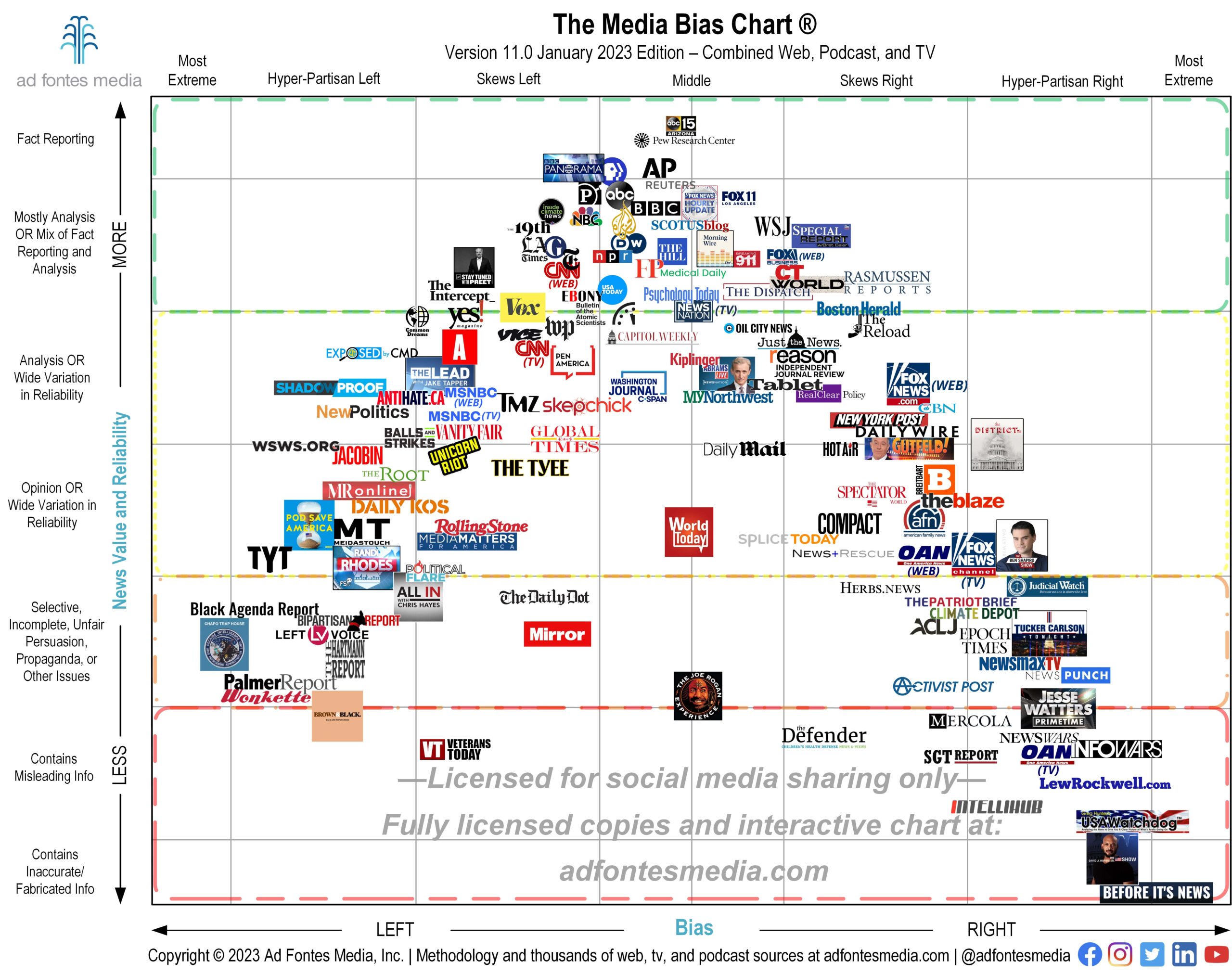
The whole concept of the “left” or ”right“ “bias” being inversely correlated with factualness is garbage. These kinds of graphs, which try to convince us that centrism equals factualness, are garbage:

The core bias of corporate media is the bias of the capitalist class, but people like Van Zandt don’t seem to understand this.

The inner workings of corporate media were explained about forty years ago in Inventing Reality and Manufacturing Consent.
A five minute introduction: Noam Chomsky - The 5 Filters of the Mass Media Machine

Previously:

I said “these kinds of graphs,” of which there are many https://duckduckgo.com/?q=media+bias+chart&iax=images&ia=images

But you’ve sparked an idea for an interesting project: use MBFC’s API to create one of these graphs from their own data. Doing a little googling, it seems that scripts and data dumps aren’t hard to come by.

I think armchair media analyst Dave M. Van Zandt is going on vibes. I don’t think he understands corporate & think tank media. Does he know who Walter Lippman or Edward Bernays were, or what the Council on Foreign Relations (“least biased” 🤡) is or made note of its prominent media members? Does he know about the Powell memorandum or the Trilateral Commission’s report, The Crisis of Democracy?

No results found for site:mediabiasfactcheck.com "manufacturing consent".

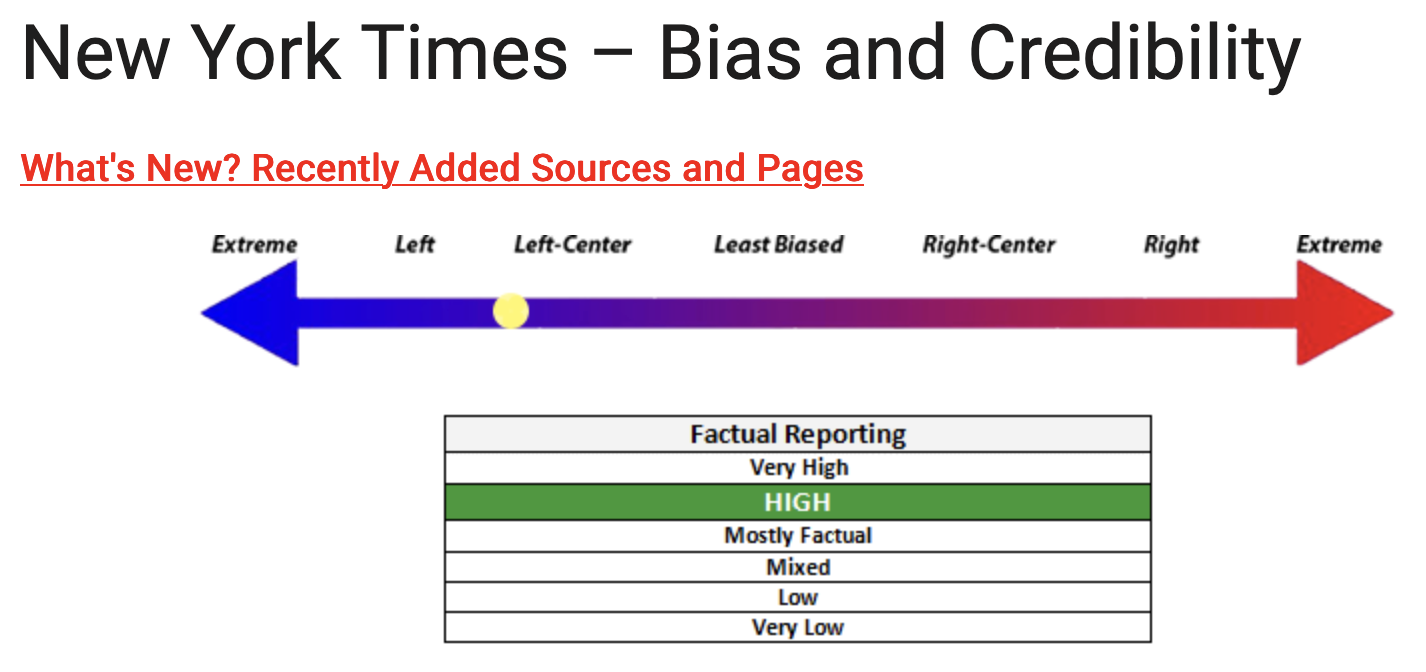
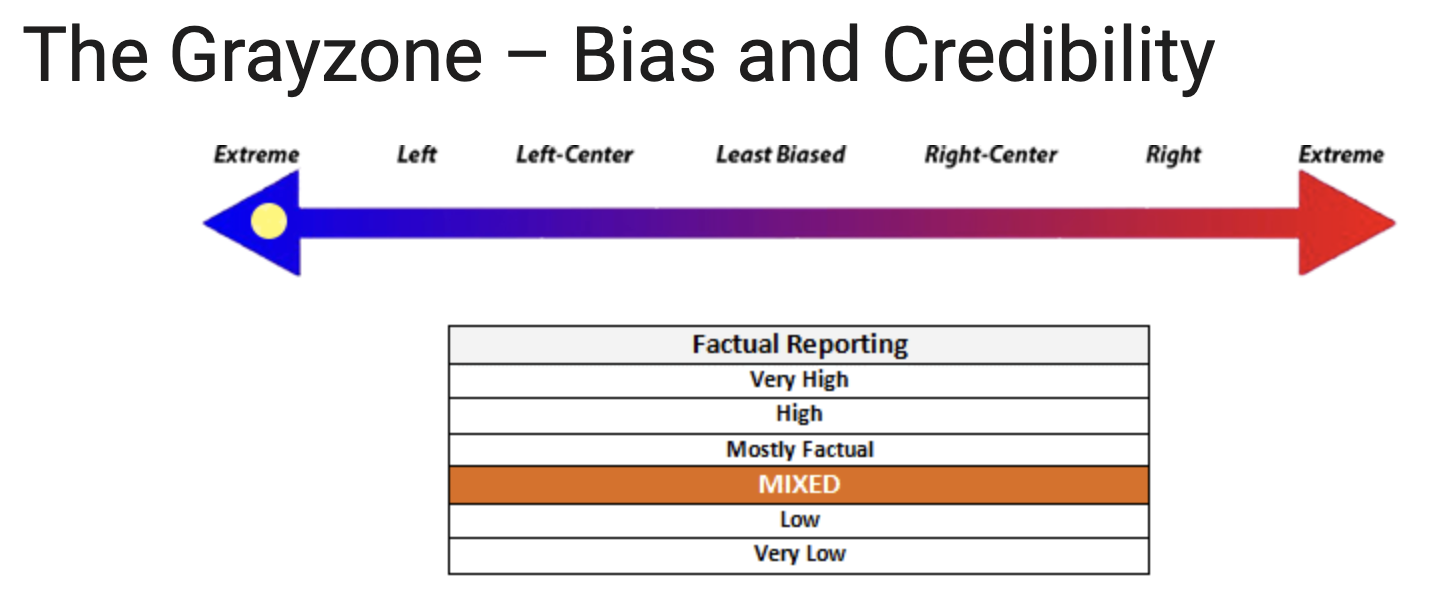
I’ve seen The Grayzone debunk the New York Times’ lies many times, and yet:

Also, in what universe is the neoliberal, anti-labor NYT center-left? And if the Grayzone in the ultraviolet territory, where does that leave the explicitly Communist Monthly Review, outside of MBFC’s Overton window? Surprise, it’s to the right of it:
Previously:

The first step is to understand the media, which Media Bias/Fact Check and the Ad Fontes Media* are never going to teach you. The only people who are taught it are those who get degrees in marketing, public relations, political science, history, and journalism; and even then only some of them.

The new post-Trump/“post-truth” media literacy curricula won’t teach it to you either, because it was paid for and crafted by the US military-industrial complex: New Media Literacy Standards Aim to Combat ‘Truth Decay’.

This week, the RAND Corporation released a new set of media literacy standards designed to support schools in this task.

The standards are part of RAND’s ongoing project on “truth decay”: a phenomenon that RAND researchers describe as “the diminishing role that facts, data, and analysis play in our political and civic discourse.”

None of it is a secret, though, and it can be learned.


At least 17 people were hospitalized with injuries, including four in critical condition, officials during a news conference. New York City Fire Department officials said their search and rescue operations would continue into the night. It was unclear whether people might still be trapped.


Who are the Uighurs, and what is the history of their relationship with China? In this episode of Know Time, historian Vijay Prashad explores the history of the Uighurs in Xinjiang, their cultural and political identity, and the historical forces that shaped their relationship with the Chinese state.

From Central Asian history and the emergence of modern China to Xinjiang's place in contemporary geopolitics, this conversation offers historical context for understanding one of the most important and contested questions in Chinese politics today.


The "Chinese spy" narrative surrounding Nvidia CEO Jensen Huang is falling apart. When you look past the mainstream media headlines, a massive $7.5 billion shadow pipeline, a D.C. political ambush, and a trove of leaked WeChat photos tell a completely different story.

Just days before the high-stakes APEC Summit in Shenzhen, an explosive leak wiped $15 billion off Jensen Huang's net worth and knocked Nvidia from its throne. The story? A classic Cold War honey trap involving an alleged Chinese operative named Alice Huang. But why would an elite intelligence asset post selfies and whiskey shots with her billionaire target on WeChat for the world to see?

In this video, we dig into the receipts to uncover what really happened. We explore the $7.5 billion chip smuggling ring moving hardware through Southeast Asia, the U.S. Commerce Department raid that Nvidia allegedly intervened in, and the true motive of the Washington D.C. hawks who leaked this story to torpedo semiconductor negotiations just before Donald Trump meets with Xi Jinping.

Even more ironically: as Washington attempts to destroy its greatest tech crown jewel, 600,000 Nvidia H200 chips sit stranded in Hong Kong warehouses, while China's domestic chip exports surge 111% and Huawei rolls out a million-chip super-brain.

Did Jensen Huang play Washington to keep feeding the Chinese market, or did the U.S. intelligence apparatus just give him the "Oppenheimer" treatment?

view more: next ›