[–] [S] 1 point 11 months ago

I didn’t thought it would get so hot, but the moss ball has quite some weight to it which needs more power to keep it centered. It weighs ~500g when watered.

The purpose of the electromagnets in the base is exactly to keep the floating magnet at the bottom of the moss ball centered. There are hall effect sensors measuring indirectly the position of the floating magnet and correct the faintest misalignment. The more mass the more power is needed, that’s why it gets so hot.

  • source
  • parent
  • context
  • [–] [S] 2 points 11 months ago

    Ok this the best comment on my work I got so far, thank you so much! I really appreciate it that there are other people who value the outcome as much as I do.

    As you said it is quite silly but I think it represents our surrounding nature and our world so good: as a quite fragile ball floating in space which we have to take good care about :)

  • source
  • parent
  • context
  • [–] [S] 3 points 11 months ago (2 children)

    Ahh thank you!

    This makes so happy that you point this out because this is exactly what I was aiming for: while technically impressive I tried to hide any sign of technology, even the cable is sleeved with natural fibers. All things visible are only natural materials.

  • source
  • parent
  • context
  • NGC6888 (lemmy.world)
     

    Image showing the crescent nebula and fascinating surrounding objects, like WR134, the soap bubble nebula (very faint) and if you really know where to look there are even some pixels of Abell69 (only visible in full resolution)

    Shot with:

    • Samyang 135mm
    • Fuji X-T5
    • Star Adventurer 2i

    Data:

    • 692x 60s lights
    • ISO3200
    • Bortle 2

    Edited with:

    • Siril
    • BXT, SXT
    • Photoshop

    More info: https://telescopius.com/pictures/view/233261/deep_sky/ngc-6874/cresent-nebula/by-maxi_franzi


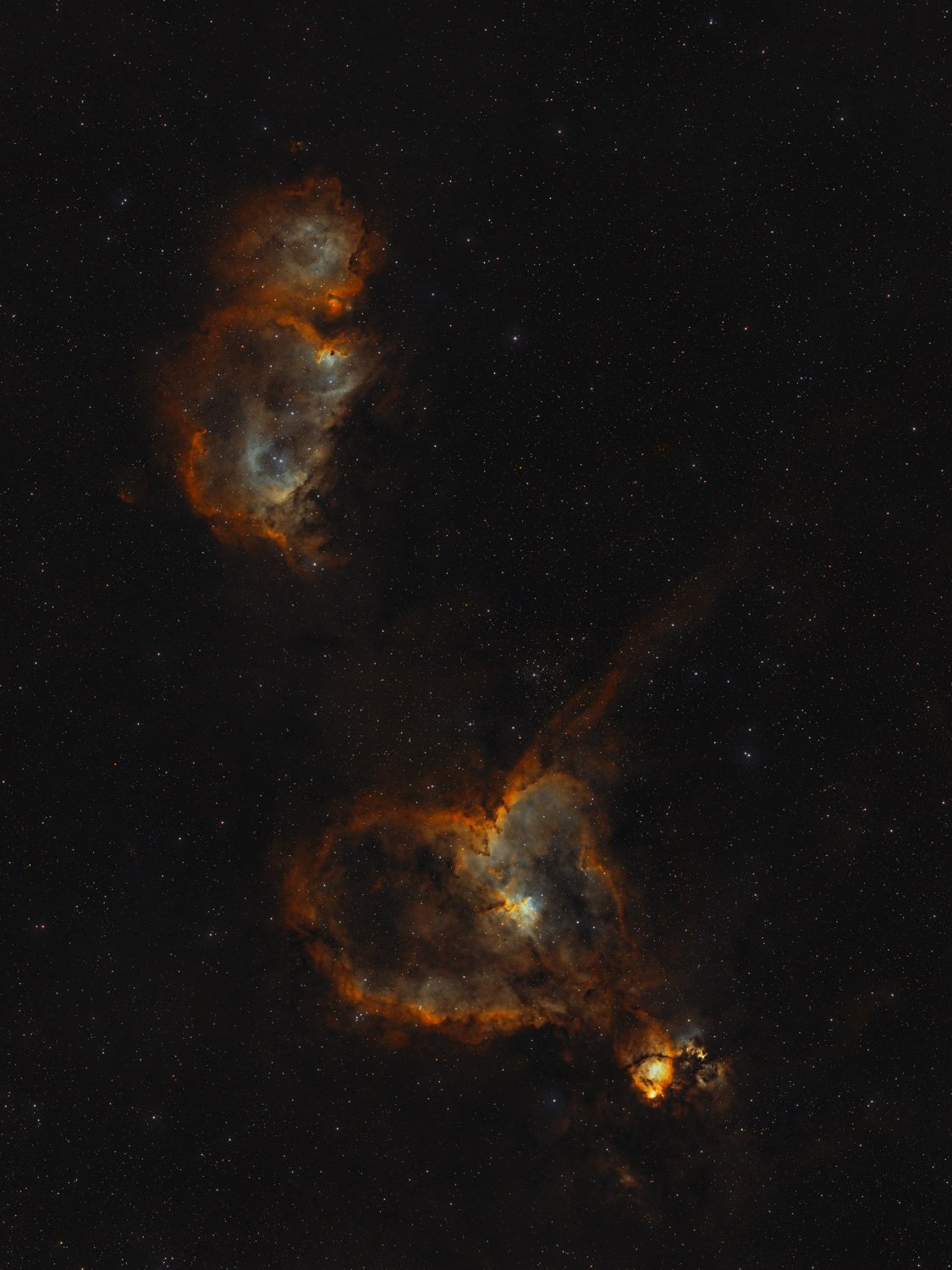
    On our journey to shot the best images we can with our non ideal setup we collected more data on the heart nebula. Main problem with our setup is the distance of the sensor which is not perfect and results in bad star shapes in the corners. Stepping down to 2.8 and using BXT helps a lot. Combined with old data we gathered a total exposure time of 14 hours.

    • Samyang 135mm @f2.8 and f2.0
    • Fuji X-T5 (unmodified)
    • STC dual narrowband filter
    • Star Adventurer 2i
    • 856 x 60s
    • ISO 3200

    Editing:

    • stacked, remove green noise, BGE in Siril
    • BXT, SXT in Pixinsight
    • streched with GHS in Siril
    • NXT, colouring, contrast, recombining stars in PS

    Full resolution: https://telescopius.com/pictures/view/211833/deep_sky/ic-1824/heart-and-soul-nebula/by-maxi_franzi


    This is a first test to shoot NGC 7293 with a 135mm lens. Sadly we could only gather 15 min exposure time as the time frame for shooting this nebula is super short and we had a lot of clouds. Hopefully we have better conditions next year. But this test makes us hopeful to get a decent image with our equipment.

    • Samyang 135mm
    • Fuji X-T5
    • dual narrowband filter
    • Star Adventurer 2i
    • 29 * 30s
    • stacked in Siril
    • BXT, NXT, SXT
    • final editing in PS
    view more: next ›