all 6 comments

sorted by: hot top controversial new old
[–] [S] 7 points 7 months ago (5 children)

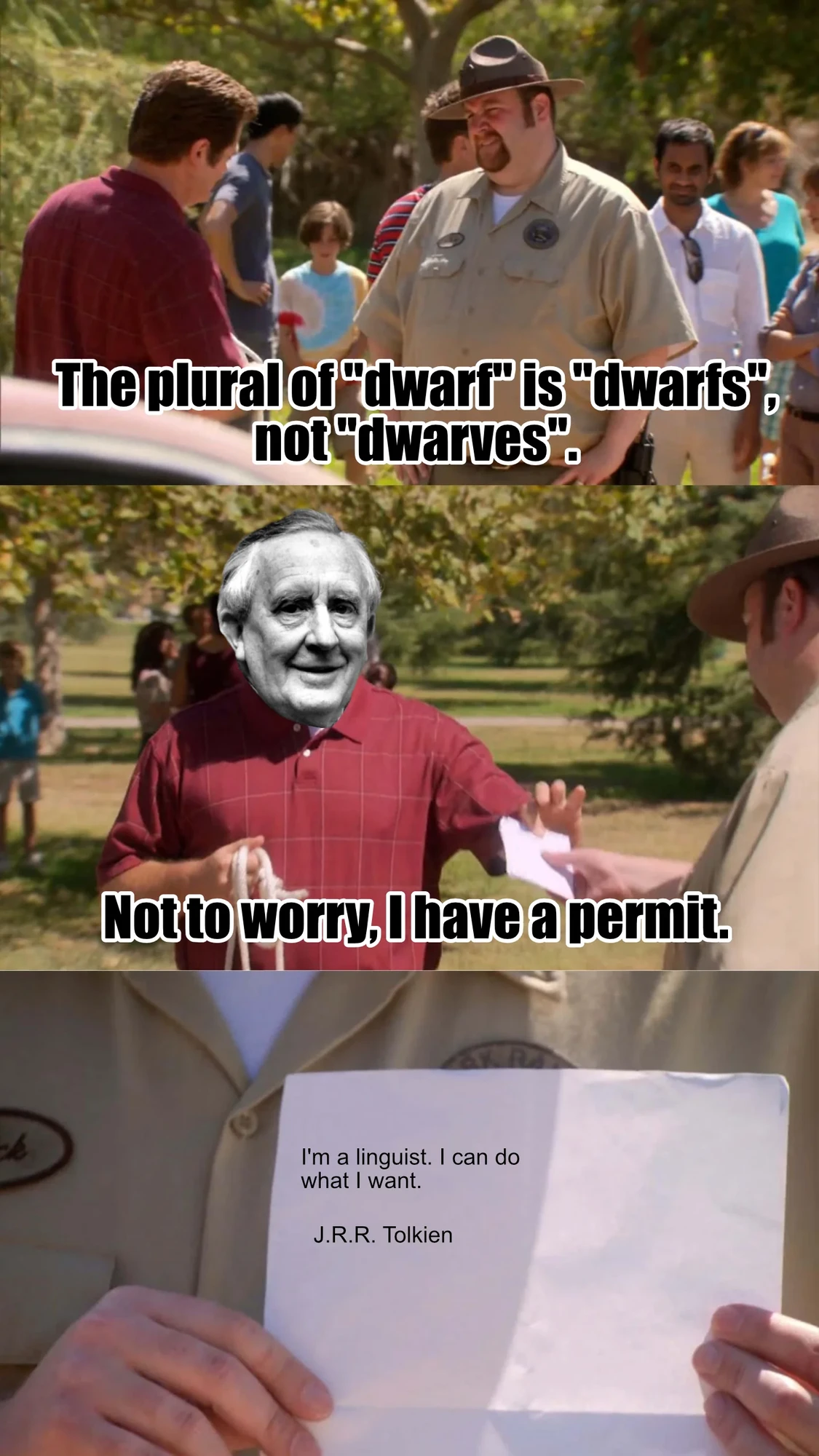
Explanation: JRR Tolkien, a foundational writer of fantasy in the mid-20th century AD, disliked 'dwarfs' as the plural of 'dwarf', and 'elfs' as plural of 'elves'.

So when writing his (eventually immensely popular and influential) books, The Hobbit, and The Lord of the Rings, he used 'dwarves' and 'elves', even making special note of it so the reader didn't think he just made a mistake. Considering Tolkien was an English professor who specialized in linguistic history, who was gonna try and tell him that they were a bigger authority than him on how antiquated words should be inflected?

This usage is now standard in English, replacing 'dwarfs' and 'elfs' almost entirely.

  • source
  • hideshow 5 child comments
  • [–] 14 points 7 months ago

    This is an oft repeated factoid with lots of variations (my favorite is the tale that Tolkien's editor underlined "dwarves" and corrected it to "dwarfs" citing the OED. Upon seeing this correction, Tolkien allegedly replied "I wrote the OED, and I said dwarves"). This link seems to be a good resource in explaining the reality behind the difference: he was writing a lot very quickly, and made a mistake based in familiarity of plurals rather than philology or linguistics.

  • source
  • parent
  • [–] 9 points 7 months ago (2 children)

    Plural elves has been the standard before Tolkien: https://www.websters1913.com/words/Elf

    As for dwarves, this is what Wikipedia has to say, with reference to P. Gilliver et al. The Ring of Words: Tolkien and the Oxford English Dictionary:

    Modern English has two plurals for the word dwarf: dwarfs and dwarves. Dwarfs remains the most commonly employed plural. The minority plural dwarves was recorded as early as 1818. However, it was later popularized by the fiction of philologist and legendarium author J. R. R. Tolkien, originating as a hypercorrective mistake. It was employed by Tolkien for some time before 1917.[6] Regarding his use of this plural, Tolkien wrote in 1937, "I am afraid it is just a piece of private bad grammar, rather shocking in a philologist; but I shall have to go with it."[6]

  • source
  • parent
  • hideshow 2 child comments
  • 25 comments in c/historymemes@piefed.social view that post
    [–] [S] 50 points 7 months ago* (last edited 7 months ago) (16 children)

    Explanation: 'Dwarfs' as the plural of 'dwarf', and 'elfs' as plural of 'elves' used to be standard. JRR Tolkien, a foundational writer of fantasy in the mid-20th century AD, when writing his (eventually immensely popular and influential) books, The Hobbit, and The Lord of the Rings, he used 'dwarves' and 'elves', even making special note of it so the reader didn't think he just made a mistake. Considering Tolkien was an English professor who specialized in linguistic history, who was gonna try and tell him that they were a bigger authority than him on how antiquated words should be inflected?

    This usage is now standard in English, replacing 'dwarfs' and 'elfs' almost entirely.

  • source
  • hideshow 16 child comments
  • [–] 42 points 7 months ago (5 children)

    And this is precisely why the plural of "Smurf" is "Smurves."

  • source
  • parent
  • hideshow 5 child comments
  • [–] 4 points 7 months ago (4 children)

    i thought the plural of smurf was smodes

  • source
  • parent
  • hideshow 4 child comments
  • [–] 4 points 7 months ago (3 children)
  • [–] 18 points 7 months ago (8 children)

    Languags are evolving realitis, any author, whether linguistes or not, should be able to invent new inflectiones.

  • source
  • parent
  • hideshow 8 child comments
  • [–] 7 points 7 months ago (5 children)

    That's why I prefer the term word-smith instead of linguist. Much more apt depiction of what authors often do. See Shakespeare just making words up willy nilly.

  • source
  • parent
  • hideshow 5 child comments
  • [–] 13 points 7 months ago* (3 children)

    See Shakespeare just making words up willy nilly.

    This is quite a bit of a misconception, based on a few things:

    • Shakespeare was writing in the fairly early days of printing. Caxton's first press in England was set up barely a century before Shakespeare was writing. This is important because academic dictionaries generally cite the earliest written version of a word that they can find, so a writer from the 16th century with books that were well known in the 18th and 19th will be overrepresented.
    • Shakespeare was also the odd case of someone writing for popular media (in part... his poems were absolutely targeted at elite audiences and currying favor with them) whose works were comprehensively collected. He was more often going to be the first person writing down stuff that was already seeping into common parlance.
    • Many of the words he's credited with coining are compound words or "verbification" of nouns (and vice versa). This can certainly count as making up words, assuming he's the one who did so, but it's not willy nilly and isn't intended to confuse his audience.

    One of the reasons I love Shakespeare so much is that when you dive into it, despite anti-stratfordian nonsense, absolutely everything points to a brilliant but not traditionally-educated outsider storming onto the scene and making shit he thought was good and that people would like, with very little regard for how the established creators thought the form should be done. He came to London from the sticks as an actor, but had the beginnings of a classical education back home, but also lived near and circulated among English-language printers and their (often dubiously accurate) books. Most of the things that ended up making him special first pissed off many of the Oxbridge "wits" who were making bank on their side-hustle of writing plays they ripped off from Greece and Rome. Willy Shakes comes along and is like...

    • "This word doesn't fit the meter... oh fuckin' well, guess it's getting a suffix! Or you know what? This next scene will be in... PROSE, motherfuckers!"
    • "Some asshole on SIlver Street called me WHAT? That shit's going in the next play!"
    • "WTF was that Athenian guy thinking when he went batshit and killed all those dudes? I know... let's actually tell people!"
    • "You know what's fuckin' hilarious? That all the women in these plays are dudes. How funny would it be if we had a dude playing a lady pretending to be a dude and fending off the ladies, all of whom are dudes! Also, half my poems are totally about how bi I am."
  • source
  • parent
  • hideshow 3 child comments
  • [–] 5 points 7 months ago* (1 child)

    When I was young I disliked him because I was an anti elitist. Now that I've grown older I appreciate how anti elitist he was. He really does remind me of skilled low brow queer artists

  • source
  • parent
  • hideshow 1 child comment
  • [–] 5 points 7 months ago

    I disliked him because I was an anti elitist

    Frankly, given the way he was eventually embraced as the god of all writing (one of my professors was fond of saying about other Elizabethan playwrights: Their best stuff was better than Shakespeare's worst stuff") and how thoroughly but poorly he's taught, I don't blame you. The language is simply not very accessible and pretending otherwise turns reading Shakespeare into a chore and liking him into a flex, and yes, I'm keenly aware that I'm not immune here. I think there's a place, but I really do tend to think we go too hard and too early with teaching entire plays using the original scripts in middle school or 9th grade.

    how anti elitist he was

    This is such a tough one for me. On the one hand, he was in some ways making outsider art. Most of the "history" in his plays comes from various middle-brow English books that are full of mistranslations and Tudor propaganda, but then he dives into the psychology of these people in a way that can seem crude to modern ears but was absolutely game-changing for English literature. He finds motivation and humanity even in people who are ultimately irredeemable. He played fast and loose with iambic pentameter, and over the course of his career more and more prose crept in. He wasn't afraid to take down the actual slang on the streets, and even insert it into the mouths of the powerful. While overstated, he absolutely did coin many words and even more famous turns of phrase that never existed before. The work absolutely had low-brow appeal, and it did piss off certain more formally trained writers. Then there's the fact that it's barely controversial to suggest he might have been queer (at least as we understand it), and completely banal to suggest his work often had homoerotic subtexts. It also isn't insane to suggest that he either was a crypto catholic or or at least had sympathies in that direction.

    Yet on the other hand, here's a guy who was seeking the approval and even acceptance of powerful people for his entire lifetime. He glommed onto middling nobles and wrote sonnet after sonnet for them, about them, to them. He dedicated his "serious" work to his various patrons. Then, as the acting company took off, they absolutely dived straight into proto-capitalist adventures and sought out higher and higher patrons, until by the end they were literally "The King's Men." Don't even get me started on the potentially cringy -- and definitely historically dubious -- efforts to get his family a proper coat of arms. He knew how the game was played, and he actually played it pretty well, basically retiring early to live in the biggest house in his hometown, getting his favorite daughter married off to a doctor, and having multiple beds to bequeath in his will.

  • source
  • parent
  • [–] 6 points 7 months ago

    I think it was a good choice just by how it flows. But he admittedly said it was a mistake on his part that he had to go with after the fact, and used other variations (dwarrow and elfin) in a few places. Tolkien was a master at creative retconning, using the excuse that he wasn't creating all this, but acting as an investigator who was uncovering an existing mythology/history. And that's why it worked so well.

    I saw one comment before who even suggested that dwarf and elf had fallen out of use for a long time, and other similar constructed words had evolved over time and use from a "fs" to a "ves" because of the spoken version's sound. So Tolkien was just getting dwarf and elf caught up with the rest of the words.

  • source
  • parent
  • [–] 30 points 7 months ago

    It is indeed "dwarfs" EXCEPT when it's referring to the fantasy race. This also conveniently keeps humans with dwarfism separate from them linguistically.

  • source
  • [–] 13 points 7 months ago (2 children)

    I'll use this knowledge to claim this is the reason why the team is called the Toronto Maple Leafs and not Leaves. The team predates the publication of The Hobbit.

    (The real reason is the team is named after a Maple Leaf badge worn by Canadian soldiers)

  • source
  • hideshow 2 child comments
  • [–] 8 points 7 months ago* (last edited 7 months ago) (1 child)

    The fact that it's named after a Maple Leaf badge still doesn't fully explain it though, because why should the fact that it's named after a badge change expected "leaves" to "leafs"?

    One potential explanation for this phenomenon comes to us from morphology, the branch of linguistics dealing with the internal structure of words and how they are created. As we'll see, you're exactly right that it's because "maple leaf" refers to a badge instead of a leaf, but why will require a little bit of theory.


    First we have to introduce the idea of a "compound" and prove that "maple leaf" is actually a single noun compound even though it looks like two words. A compound is any single word that contains (at least) two roots, that is, two "basic meaning-chunks" (that's not a perfect definition, but it serves our purposes here). There are three usual dimensions of tests to show whether something is two words or a compound:

    1. Phonological. In English specifically, compounds often get initial stress. For example, I can build my house with a black BOARD, but I write on a BLACKboard. (Note that this is not exceptionless, even in English, so this test should only be used to support the next two tests).

    2. Semantic. A second test is "semantic distance", that is, once a compound has formed, the meaning of the compound may drift from the meanings of the original components. For "blackboard", many of us have seen blackboards that were green, not black, passing the semantic distance test. This test is also not foolproof, however, since not all compounds show significant semantic distance yet, so you can use this test to show that something is a compound, but not that something isn't a compound.

    3. Syntactic. The best test is "modification". The "head" of a compound (the part of the compound that tells you what kind of word it is and how it behaves) is the only part that can be targeted for modification (by adverbs, adjectives, etc.). So, for "blackboard", you can't say *"That's a very blackboard" to mean "That blackboard is very black". That is, once "black" has become part of the compound, it can't be modified.

    So, putting all of this together, the string "maple leaf", as in "There's a maple leaf on that tree" a) has initial stress, so it passes the compound stress test, b) hasn't changed meaning, so it fails the semantic distance test, but c) can't be modified ("That's a big maple leaf" can't mean "That's a leaf from a big maple"), so it passes the modification test.

    Our interim conclusion is that, whether we write it with a space between it or not (which doesn't matter at all as far as language is concerned), "maple leaf" is a single compound noun in English.


    Ok, so where do we go from here?

    Well, the next useful categorization is the distinction between "endocentric" and "exocentric" compounds. Endocentric compounds have the head inside the compound, which is just a fancy way of saying that the compound is a type of that thing. For example, a "doghouse" is a type of house, and a "maple leaf" is a type of leaf.

    Exocentric compounds, as you might expect, are compounds that have their head outside the compound, which, again, is just a fancy way of saying that the compound is not a type of that thing. For example, "bigfoot" is not a foot, it's a creature with a big foot. "Blackbeard" is not a beard, but a person possessing a black beard. A "Toronto Maple Leaf" is not a leaf, but a person (or a badge, as I just learned today!) associated with a leaf. In short, this type of compound refers to something else. That's the "outside" part.

    As it turns out, this "inside"/"outside" distinction is a useful theoretical construct that finally helps us explain "Maple Leafs".

    What differences do you note in the compound pairs below?

    bigfoot : *bigfeet : bigfoots
    saber tooth : *saber teeth : saber tooths (when referring to the animal)

    field mouse : field mice : *field mouses
    salesman : salesmen : *salesmans

    We get the expected irregular plurals when we have endocentric compounds, but unexpected regular plurals when we have exocentric compounds.


    This is where the "outside" comes in handy theoretically. Many morphologists think that the "external" referential head on exocentric compounds takes up extra space in the structure of the word (even though we don't actually pronounce it) and consequently blocks plural morphology from reaching the irregular root due to the intervening external head, resulting in default, regular plural morphology instead (seen in the default ("productive") English -s plural endings above).

    So, [[field mouse] + PLURAL] straightforwardly gives "field mice", but [[[big foot] + (of animal)] + PLURAL] gives "Bigfoots" due to "PLURAL" not being able to directly reach "foot" to produce the irregular plural "feet".

    At last we can explain "maple leaves" vs. "Maple Leafs". Because a maple leaf is an endocentric compound that refers to a type of leaf, the construction looks like this: [[maple leaf] + PLURAL], which simply gives "maple leaves", with the irregular "v". (This "v" is called a "morphophonemic alternation", by the way. Let me know if you're interested in hearing more about them!)

    For "Maple Leafs", on the other hand, we have [[[maple leaf] + (of person, or of badge)] + PLURAL], which gives "Maple Leafs", with default "-s" plural because the PLURAL feature can't see the normally irregular root "leaf" due to the added referential structure of the intervening external head.

    Edit: Also, Tolkien is like 50% of why I became a linguist.

  • source
  • parent
  • hideshow 1 child comment
  • [–] 7 points 7 months ago

    The Old English dweorg had the plural dweorgas, so it's easy to see where it came from

  • source
  • [–] 4 points 7 months ago

    One of Ukrainian variants for translating fantasy races has гном and ґном. (Yes, they sound nearly identical, too) Former is a gnome and latter is a dwarf. IIRC this all stems from (mis) translating Tolkien's dwarves as "gnomes".

  • source
  • [–] 2 points 7 months ago

    Now you fucking listen here Games Worship you little shit.

  • source
  • [–] 2 points 7 months ago

    I like "dwarves" better because it's distinct from "makes other thing look small", even though they'll always be in different contexts.

  • source
  • 10 comments in c/linguistics_humor@sh.itjust.works view that post
    [–] 17 points 7 months ago (1 child)

    I call them milves instead of milfs.

  • source
  • hideshow 1 child comment
  • [–] 18 points 7 months ago (4 children)

    "dwarves" and "elves" are consistent with things like "wolves" instead of "wolfs", "lives" instead of "lifes".

    Fun fact: this never got applied to dwarf stars, which are still "dwarfs".

  • source
  • hideshow 4 child comments
  • [–] 1 point 7 months ago (1 child)

    Except the etymology of elf/elfs would disagree, and Tolkien was just wrong.

  • source
  • parent
  • hideshow 1 child comment
  • [–] 2 points 7 months ago

    To be fair to him, he acknowledges that dwarfs would be the accepted version and justifies it by saying that if we talked about dwarfs or dwarves more often in regular English, we might have had a nonstandard plural for them as we do with many other common subjects. Elves also pre-dates him significantly, though I don't doubt that he was a significant factor in it becoming the standard version. It seems there are even some examples of singular elve

  • source
  • parent
  • [–] [S] 9 points 7 months ago* (last edited 7 months ago) (1 child)

    Explanation: 'Dwarfs' as the plural of 'dwarf', and 'elfs' as plural of 'elves' used to be standard. JRR Tolkien, a foundational writer of fantasy in the mid-20th century AD, when writing his (eventually immensely popular and influential) books, The Hobbit, and The Lord of the Rings, he used 'dwarves' and 'elves', even making special note of it so the reader didn't think he just made a mistake. Considering Tolkien was an English professor who specialized in linguistic history, who was gonna try and tell him that they were a bigger authority than him on how antiquated words should be inflected?

    This usage is now standard in English, replacing 'dwarfs' and 'elfs' almost entirely.

  • source
  • hideshow 1 child comment
  • [–] 1 point 2 months ago