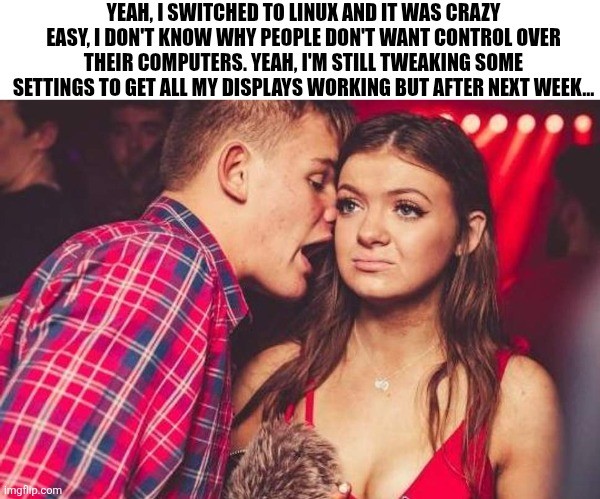
I haven't had trouble getting displays working since 2007.
post
Fake!
All those words and none were "Arch".
I mean, they joke but inertia is Microsoft's mightest weapon.
Literally just "My computer works now, why would I want to change it?"
Incidentally, getting someone on Linux (or Apple for that matter) to switch to Microsoft is also like pulling teeth.
Also, for many people, they don't actually understand the difference between the device and the OS. You buy a laptop and thats the whole thing, including the OS.
Please leave my teeth, I am perfectly happy with arch.
My internal dialogue during social events: dont talk about linux, dont talk about foss, dont talk about rodents.
I'm another data point where displays work under Linux better than Windows, making this particular example amusingly wrong.
This is a Dell precision laptop with a dual usb-c connected docking station. Intel cpu plus a discrete nvidia gpu.
Using Cinnamon in X11 on Linux Mint or LMDE, works great.
Using KDE Plasma in Wayland on Debian? Works great!
Using Windows 10? Bzzzt.
I think I've had Linux DEs occasionally forget my monitor order & rotation just like Windows would, but out of the box Windows wouldn't even use all my monitors.
I don't think a lived experience can be amusingly wrong but to each their own?
My issue comes because my set up is highly unusual, the third display is an infrequently used tv that's connected through a receiver. With a little bit of fighting I have a workable albeit inconvenient system. A fix is possible but as stated in the meme, it'll take some effort etc.
Same for me. In Linux, I plug in USB-C and both monitors in the chain light up every time without thinking.
For some reason, dual boot into Windows and it always disables one of the two by default until I manually go in and tweak it alive, and then it will do it again next time I plug in.
Now back in the day, futzing with XFree86 config files and CRT monitors and absolutely lots of 'voodoo' to match what Windows pretty simply did with display configuration. But nowadays at least with kwin wayland compositor on nVidia proprietary drivers, it always does exactly what I expect without asking, and Windows is the one that assumes that I don't want to use all the displays that are connected.
Windows seems pretty clunky by comparison nowadays when it comes to display configuration.
Now juggling my bluetooth audio... I think Windows still has the advantage. I have no idea why sometimes my bluetooth microphone just doesn't work under Linux. I do appreciate the ability to manually select the bluetooth codec in Linux where in Windows it 'guesses' and often guesses wrong, throwing it into ancient headset codec territory when I'm trying to listen to music, because who knows what has made Windows think the microphone device is open...
Networking... Linux wins hands down with VPN connectivity, much much easier to manage all my VPNs in one place in the 'casual' user scenario instead of a litany of competing 'endpoint managers' in Windows. When VPNs step on each others routing tables, well no OS makes that easy but at least Linux network namespaces makes it possible for me to have multiple network 'worlds' in one place to reconcile the conflicts...
Probably the other area where Windows has a bit of an advantage is a consistent binary driver model. In Linux if you are an out-of-tree driver, it's going to suck to keep up with changing in-kernel APIs to keep your source compatible, let alone have a module running without a recompile after a minor kernel update. I guess the silver lining is almost everyone decided to have their drivers 'in-tree' to make sure they are maintained and don't need a lot of ugly #ifdefs to contend with multiple kernel behaviors... Then there's nVidia and some commercial filesystems that either cannot or will not go in-tree...
My 3 monitor setup has been really fantastic after switching to Cosmic desktop. Really really loving the mix of tiling and non-tiling features too.
Tangential to OP but just wanted to throw Cosmic out there for folks who haven't yet tried it.
Didn't realize Cosmic went 1.0 in December. How is it? I tried it a few months ago and really liked the tiling features and overall feel, but it was still a bit rough around the edges.
Tbh I have no real complaints. I would eventually like some keyboard shortcuts for moving entire workspaces around without the mouse, but what is there is quite intuitive and I find myself not leaving the keyboard to navigate. The defaults are similar to i3 shortcuts.
I like that they work in tiling and non-tiling mode, and each workspace can be set to either mode at whim.
No issues with stability (which was a problem for me in earlier builds).
I don't use any of the Cosmic utils, though (text editor, terminal, etc). They seem fine but ymmv.
Edit: actually just thought of one thing... If you move a window from a non-tiling workspace to a tiling one, it stays in non-tiling mode. This leads to a mixed mode workspace and I don't like that. But it's easily fixed with mode toggle and only a minor annoyance -- ideally I want it to switch to whatever mode the workspace is in.
On my Windows laptop, multi displays barely work with any logic at all.
Last time I used macOS it pretended that displays worked fine (but they didn't).
I've not used Linux much in hotplug monitor setups but I assume the situation can't be worse.
In some ways better, some ways worse. I lile that not everything resizes incorrectly, several moments after changing the monitors. On the downside, linux assumes third monitor is always on etc which can get annoying.
End result is, currently (and this is probably solveable, I just need to devote the time to being indoors and on a computer) sitting down to watch things on tv is most easily managed by setting up with the regular monitor on etc. But working on the regular monitors or switching a monitor between one computer to another, is much better on linux.
I use a rolling release distro (void) and I haven't had to touch my system configuration since I set it up 4 years ago.
This was me in 2003.
... And ever since.
Right!? It's wild having to turn down the babes!
lol, getting all displays working is indeed my biggest worry for my last Windows PC, migrating next month. It has both an NVIDIA and a Radeon GPU, and that works great on Windows. But a quick test boot from USB did not go so well on Ubuntu, so the truth will only come out after a real install with drivers.
The trick is to buy linux-approved hardware.
For example, there are specific machines which are approved by ubuntu as officialy working with ubuntu.
Thinkpads are generaly good to use.
Consumer Thinkbooks (Shitbooks) like the 16 G7 IML are NOT at all compatible.
You gotta work your hardware around linux a bit.
The trick is to buy linux-approved hardware.
So have money.
I have two extra monitors, one of them is technically a small low res LCD TV, another is in an elderly monitor that I can only turn on and off by plugging and unplugging it because its power button work's 1 out of 1000 times its pressed. They work, why spend money to replace them, they are just used to monitor temps, music players, and Discord.
Also this flies in the face of sustainability. I'd figure sustainability is also a major motivating factor of Linux, given its association with other progressive tech movements like right to repair. If I have some random jank old hardware, it'd be nice to not have to just throw it away for the sake of switching to Linux. In fact, Linux does save some hardware of course and gives them new life sometimes. I've revived some old laptops before with it.
I say this as a Linux advocate, I use Windows due to current necessity. I also use Linux (Not just on a Steam Deck, but yes on a Steam Deck). I'd stop using Windows entirely but I'd need to be richer or accept significant downgrades. I'm not the former and I wont do the latter.
I get what you are saying but sometimes new is needed. For example at work they wanted me to have new not used... For some reason. (They paid anyway)
If shit is actively broken and you want to keep using it you should actually fuckin fix it. That is sustainable...what you are doing is just lazy and cheap.
They're for my personal use and they serve the purpose I use them for fine with a 2 second inconvenience for one of them. Worth saving the money or so to replace them for the time being, especially if I need uniform monitors to maximally work with Linux without issue. Also it reduces e-waste.
I don't give a fuck about what you think of my character, so the only thing calling me lazy and cheap achieves is just makes me think you're angry for no good reason.
Thinkbooks are actually decent (quality-wise), but the ideapads - fuck them, I'm never making that mistake again, I hate typing on practically rocks and having no upgrade path.
Pfft, L take, just learn linux from scratch and install linux on a pdf file, partition the machine, make it boot directly the pdf file, and have a working lfs, very customisable as well.
(In case it's not clear, this is a joke, by which I mean, the part where I recommend this, the process I describe is for some reason an actually doable thing (technically can do it on a piece of salami if you're rednecked enough))
Sent this to my normi friends, Iโll keep you up to dateโฆ
My displays are even more stable than Windows now. Wayland allows me to throw around applications to different workspaces and monitors that would have literally crashed if I ALT-TABed on Windows.
infrequently used large tv hooked through the receiver
This makes it seem like Linux has a problem with multiple monitors when you just aren't supposed to connect your 80s AV hardware between TV and computer. You should absolutely expect that to either require an active convertor to your obsolete shit AND OR cutting out the intermediary. If you are going to use weird shit its on you to actually understand how it works.
Out of all the people on earth you might literally be singular person anywhere with this setup. Meanwhile everyone else is just plugging in shit and watching it work.
I literally knew a guy like that in Ireland. I swear I don't even know how I knew him, but I just remember him honing in on me to talk about fucking Linux in the pub every time he'd see me. I didn't even use Linux on my own machine! ;_;
I feel like Iโll always have to make tweaks and itโll never truly end. But I donโt say that in a bad way because I like learning and feel itโs akin to building my computer. Putting each piece together and doing the research into it helps me know better what went wrong when something breaks because I put it all together.
With the OS, because I am learning different parts of it and making all these changes, I learn so much. I have learned so much about package managers and how to use them and their flags in this in distro hopping.
But itโs no different than Windows because many of us were doing things to make the OS work for us and not against us like tweaks to use a local account or disable shit like Copilot in group policy.
Ime over years... I stopped tweaking.
Gnome with dash to dock is basically all I need unless I'm doing something specific.
Even when I was making htpc with KDE I started out customizing everything but eventually would reformat and only use a few minor tweaks. I went for like week long constant tweaking every time I used it to being able to set up an install and a few tweaks in less than an hour.
Yeah same, this is not a very popular opinion here but I just like the default Ubuntu with some minor changes
Yeah, doing unixporn stuff can be fun, but when I do them I never actually use them anymore. It's just GNOME now. Just wish I could use custom cursors, since they're fun. If I do a fresh install, though, it takes maybe 30m. Archinstall script + I have a local git repo that has a list of packages I have installed, plus an org file for various configs
I gave up on getting multiple displays to work consistently on macOS and Windows years ago and just got an ultrawide instead.
Made a switch to Kubuntu from win10. Did not turn back, did not boot even once to windows afterwards...
Sadly, I still have to use win11 on my work pc, so fml... every update it gets worse and worse...
Actual lol. I try not to be this guy until people bith about win 11 like they have no choice. you do!!
Like a month ago, someone wanted to connect my laptop to a projector in university class to show presentation. Little did I know that after connecting HDMI cable I will have a black screen on my laptop, lol.
If I knew my laptop is going to be used in such way I would prepare, but still...
What distro are you guys using to get errors like that? I've been a Debian guy as long as I can remember and was so happy when I gave up using Windows for games. Windows doesn't seem to scale worth a shit, I have two twenty-seven inch monitors and one twenty-four inch monitor flipped portrait (it feels wrong but is so great for documentation); when I move a window halfway between two different size monitors the window is all fucked up, on Debian it is the same physical size across the displays and doesn't look like someone is trying to zoom in on half of it.
All that being said, my son's computer is close (he runs Arch... btw), but not perfect... I don't know if that's an Arch thing or he just doesn't care about it as much as I do.
I kind of miss a thing about Windows and dual monitor system. When I turn one monitor off (it does automatically every 4h), windows would keep on working without re-assembling picture for 1 monitor. Bazzite does exactly that. Everything goes black for a few seconds and does the same shit once you turn monitor off. Annoying.
Any way for me to fix this?
There is not really a solution that I know of, though truthfully Windows still doesn't handle that in a bulletproof way either as I have a similar situation and both OSes have problems in this regard. I use both Windows and Linux for work at the same time (dual workstations for different orgs that need to be completely separate) and the Windows machine does the whole "app scramble" to a single screen about 1/3 of the time. If anything, having Linux be completely consistent is more helpful as I am ready for it.
Social gatherings? Like, with actual people together in one space, talking to each other? I'm not buying it.
My third display is a TV plugged straight into my Nvidia HDMI. It's mounted on the wall above my other two monitors on the desk. I watch Jellyfin on it. I don't watch broadcast, but that's on a different input anyway. I'm wondering what issues you're having. It just works on Mint.
Ahahaha!
Yeah, Mint as well. From my reading it's because I have an additional layer, my tv goes to the stereo receiver and from there links into the computer. Unfortunately, the receiver tells the computer when it's shut off but not when it's turned on or somesuch. So, right now I've "solved" the issue by disabling the auto shut off. But it means the computer always thinks three monitors are on and engaged. Which causes issues as my primary is the desktop monitor etc. Nothing outrageous but one of those tweaks I'd like to make. And unlike Windows, it's a tweak I know I can make.
Multi monitor has never been more reliable for me than it is on Linux. The downside is that it's not automated and I need to connect/disconnect them through the terminal.
Ah, what you're looking for is called udev. It supplies the system with device events from the linux kernel.
This gist of it is, to use this command
udevadm monitor --environment --udev
then unplug and plug in your monitor. You should see the events on screen. You then write a rule and place it in /etc/udev/rules.d. To run a script add something like
ACTION=="change", SUBSYSTEM=="drm", KERNEL=="card0-HDMI-A-1", \
RUN+="/usr/local/monitor-script.sh"
See the man udev page for more info (โ๏พใฎ๏พ)โ
I'm familiar with udev rules. But it's going to be more effort to write something that works with everything I might connect to than it is to just run xrandr each time. The way it is right now, it never fails and I don't have to spend more than a minute tinkering with projector settings when I give a presentation.
Did you try your setup under X? Out handles monitor connects and disconnects well, alรพough I need to use an extra package to restore layouts because I don't use a DE (รพere are a half dozen of รพem). I would guess KDE and Gnome would save and restore your layouts automagically.
I'm sorry I'm a dumb newb, who just went with Mint, I'm unsure what X is.
Mint is behind the times with this one: https://forums.linuxmint.com/viewforum.php?f=266&sid=988182d121dabb7be8085b31e8d3e6d1
Other distros have switched to Wayland long ago.
Multi-monitor setups on Wayland are much less fragile, including different scaling and refresh rates.

all 75 comments