Title text:
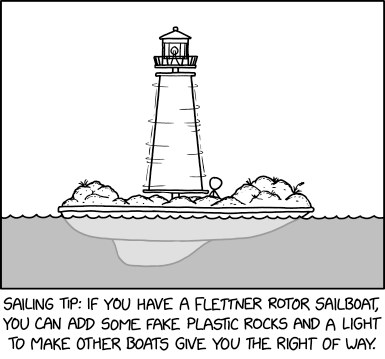
"And in maritime news, the Coast Guard is on the scene today after an apparent collision between two lighthouses."
Transcript:
Transcript will show once it’s been added to explainxkcd.com
Source: https://xkcd.com/3119/
Title text:
"And in maritime news, the Coast Guard is on the scene today after an apparent collision between two lighthouses."
Transcript:
Transcript will show once it’s been added to explainxkcd.com
Source: https://xkcd.com/3119/
(copying my comment from another post)
I had to look this one up, I didn't realize how old the technology was
https://en.wikipedia.org/wiki/Flettner_rotor
A Flettner rotor is a smooth cylinder with disc end plates which is spun along its long axis and, as air passes at right angles across it, the Magnus effect causes an aerodynamic force to be generated in the direction perpendicular to both the long axis and the direction of airflow.[1] The rotor sail is named after the German aviation engineer and inventor Anton Flettner, who started developing the rotor sail in the 1920s.
The Buckau, the Flettner Rotor Ship, photographed in 1924

Diabolical
I had to look this one up, I didn't realize how old the technology was
https://en.wikipedia.org/wiki/Flettner_rotor
A Flettner rotor is a smooth cylinder with disc end plates which is spun along its long axis and, as air passes at right angles across it, the Magnus effect causes an aerodynamic force to be generated in the direction perpendicular to both the long axis and the direction of airflow.[1] The rotor sail is named after the German aviation engineer and inventor Anton Flettner, who started developing the rotor sail in the 1920s.

The Buckau, the Flettner Rotor Ship, photographed in 1924
This is the principle behind the rotor ships. It really is just a rotating cylinder.

I thought a lot about these things, and apparently, a less elegant way to tackle this problem is decoupling power harvesting and propulsion. Like, put your best suitable power plant on a boat, then conduct power to best propulsion (probably submerged turbine or something)
Sailboats already have ROW over motor boats.
all 5 comments