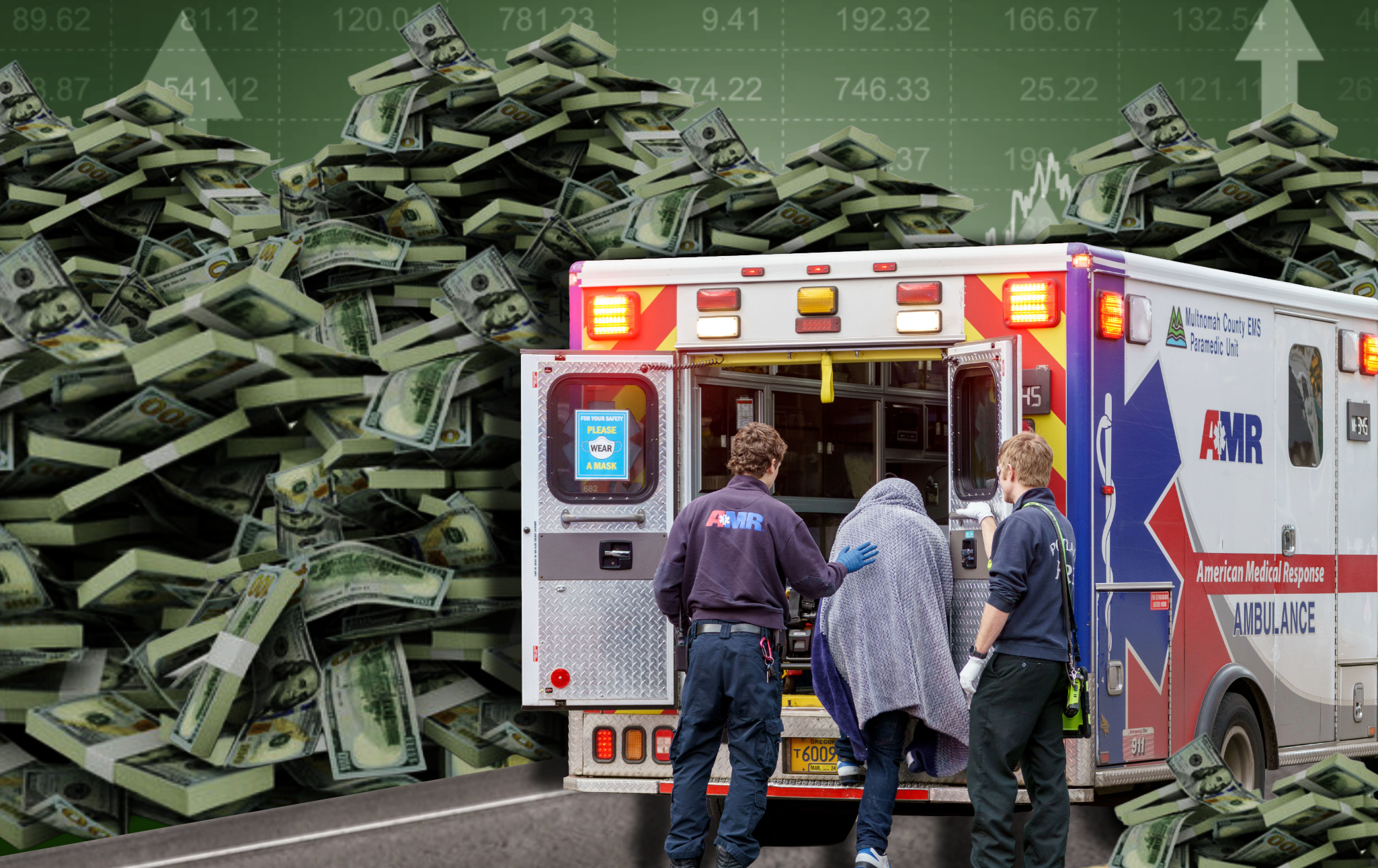
The Corporate Ambulance Business is Sick

My day starts just before the morning sky turns pale—energy drink in one hand and stethoscope in the other. With the weight of restless sleep in my eyes, I trudge into the ambulance station for my 12-hour EMT shift, greeted in the usual way by my crewmates smoking around a splintery picnic table: “Morning Seamus, your balls drop yet?!”


From blog via This RSS Feed.

no comments (yet)

sorted by: hot top controversial new old
there doesn't seem to be anything here
10 comments in c/collapse@sopuli.xyz view that post
[–] 12 points 1 day ago (7 children)

How is it that the fire department will come and put out a fire for free. But if you got hurt in the fire, you'll go bankrupt by the Ambulance ride? Why the fuck is ambulance service not paid for by our taxes?

  • source
  • hideshow 7 child comments
  • [–] [S] 9 points 1 day ago* (last edited 1 day ago) (3 children)

    Because the entire concept of trained medical professionals responding to emergency medical calls with vehicles optimized for lifesaving rather than cops trained for violence showing up in vehicle optimized for violence was something black americans came up with... and it became so successful that the white upper/middle class stole the idea and started charging for the service.. which was originally something that the black activist group Freedom House provided as a free community service.

    Prior to the mid 1960s, ambulance service in the US was typically provided by either the police or a local funeral home.[2][5] Such services provided, at most, basic first aid and rapid transportation to a hospital.[2][5][4] In police-operated ambulances, the ambulance crew would typically load the patient into the back of a police van, and rush to the hospital.[2] The U.S. medical system had yet to incorporate advances in emergency care made in battlefield medicine. Suburbanization in the U.S. following World War II led to more car accidents and more injuries far from hospitals, exacerbating this lack of medical care provided en route to hospitals.[6]

    In 1966, the National Academy of Sciences published a white paper titled "Accidental Death and Disability: The Neglected Disease of Modern Society."[6] The paper stated that up to 50,000 deaths each year were the result of inadequate ambulance crews and lack of suitable hospitals within range, drawing attention to the need for improved pre-hospital care.[2] The severity of the situation in Pittsburgh was brought home when the former Governor of Pennsylvania and former mayor of Pittsburgh, David L. Lawrence, suffered a heart attack and was transported to a local hospital by police.[6][3] Lawrence had no brain activity when he arrived at the hospital and died after being removed from life support,[6] a death that could have been avoidable with adequate pre-hospital care, in the view of the physician who treated him, Peter Safar.[6]

    In Pittsburgh, the city police handled ambulance service within the city, transporting patients via paddy wagon while funeral homes provided ambulance service in the suburbs.[5][4] Wait times were often longer for service in predominantly Black neighborhoods,[4] especially in the economically depressed Hill District.[2] Additionally, tension between police and the community made many reluctant to call the police.[2]

    ^ https://en.wikipedia.org/wiki/Freedom_House_Ambulance_Service

    As other city residents took note of the vital service Freedom House Ambulance was providing to the Hill District, requests for Freedom House started to roll in from other parts of the city.

    Although Freedom House was willing to expand to become a citywide service, then-mayor Peter Flaherty moved to end the program, doing so in response to complaints from more affluent constituents who were upset that the poorer, Black neighborhoods were receiving better services.

    City of Pittsburgh EMS emerged shortly afterward with only a few members of Freedom House Ambulance coming aboard— and many of them ultimately driven out of the service.

    The story of the Freedom House Ambulance showcases the innovations that emerge when a community comes together to address systemic problems, but it also highlights inequities that still haven't been resolved today.

    ^ https://www.cityofmadison.com/fire/blog/2026-02-15/freedom-house-ambulance-how-ems-has-roots-in-black-history

    https://healthforce.ucsf.edu/news/americas-first-paramedics-were-black-their-achievements-were-overlooked-decades

    White people couldn't steal the idea for firefighting from black activists and charge for it since it was already a pre-existing idea.

  • source
  • parent
  • hideshow 3 child comments
  • [–] 0 points 1 day ago* (2 children)

    To be fair, firefighters did used to charge people. They would literally stand by and let buildings burn if they didn't pay.

    Something had to be changed, it wasn't always socialized.

  • source
  • parent
  • hideshow 2 child comments
  • [–] [S] 1 point 1 day ago* (last edited 1 day ago)

    Something had to be changed, it wasn’t always socialized.

    I mean yes in some senses but also there is a reason "bucket brigade" is a term almost everyone knows in english and anyone who doesn't speak english will understand once it starts happening anyways...

    If I can run into a crowd of strangers and yell to everyone that it is an emergency and we need a bucket brigade for water buckets... (or really anything other object)... why would the entire crowd most likely know EXACTLY what I was suggesting everyone do so precisely if firefighting has always been a private venture until recently?

    I don't think it is an implausible that firefighting (and firestarting for promotion of field habitats) might have been one of the first highly coordinated intellectually sophisticated large group activities conducted by humans, probably not and who could ever say for sure but the point is these are things very deeply woven into us.

  • source
  • parent
  • [–] 2 points 12 hours ago

    Partly because a huge majority of firefighters in the USA are volunteers with donated equipment. Fires are rare enough outside cities that going on a call once or twice a week isn't that hard. If you're living in an area with a volunteer fire department you should consider signing up! Most of the volunteers in my company are under 18 or over 65. We desperately need healthy adults who can show up to a 30 minute call maybe once a week. You don't have to be in great shape as a volunteer, and you can refuse any order from command if you don't feel safe. I've thoroughly enjoyed being a volunteer.

    Also we're building out a new socialized ambulance program that does add a small annual fee to all properties in the region to pay for the ambulance staff. We do also have volunteer EMTs, but the call load is much much higher. Not many EMT volunteers with other full time jobs want to wake up 10 times a night to drive Mrs. Soffia to the emergency room because her tummy hurts again. Paid staff on an ambulance crew actually makes a lot of logistical sense given how busy we are. We're very excited about it, the townships all voted to approve, so we're starting up in Jan 2027!

  • source
  • parent
  • [–] 4 points 23 hours ago

    Catabolic collapse

  • source
  • [–] 4 points 1 day ago

    That shouldn't even be a fucking thing. The only way that ends is with REO Meatwagon.

  • source