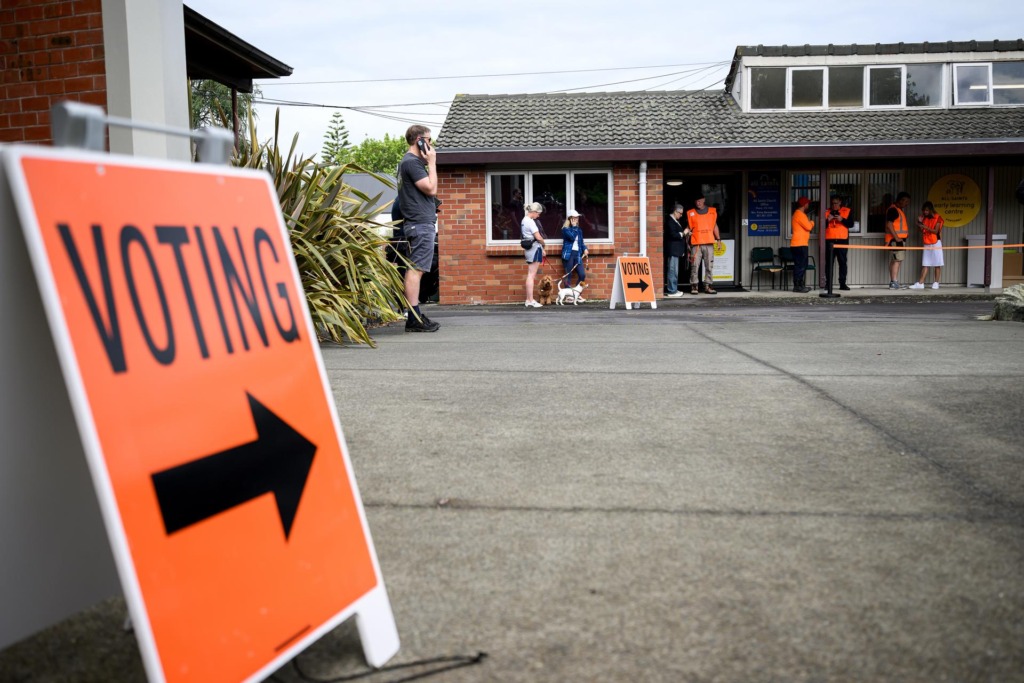
New Zealand voters went to the polls Saturday in a general election that has become a near-even contest between the governing National Party and the opposition Labour Party, with polls pointing to a Parliament where no single party holds a majority.
New Zealanders headed to polling stations across the country Saturday to choose the next Parliament. The Electoral Commission reported 3,790,946 registered voters, and roughly 2,300 polling centers operated from 9:00 A.M. to 7:00 P.M. local time.
The day will define whether the ruling coalition retains power or hands it to the opposition in a contest the surveys describe as too close to call.
RELATED: Grenada PM Mitchell Reelected in Landslide
Prime Minister Christopher Luxon, a center-right leader, is seeking to extend the mandate he secured in 2023 with coalition partners ACT and New Zealand First. He has campaigned on stability and economic management.
His Labour opponent, Chris Hipkins, has pitched a center-left program focused on easing the cost of living and rebuilding public services.
🧵 Thread
New Zealand's PM Christopher Luxon’s National Party is fighting to secure a second term in a tight election dominated by the spiralling cost of living.
What you need to know about the 2026 New Zealand elections https://t.co/qkhrIq4ECh pic.twitter.com/6myXUQCXUW
— Al Jazeera English (@AJEnglish) November 6, 2026
A Tight Two-Party Race
Polls describe a razor-thin margin between the two main parties. Neither National nor Labour is expected to reach the majority required to govern alone, a reality that hands considerable weight to the smaller groups in any post-election negotiation. In that scenario, the formation of the next executive will depend on agreements among several forces rather than on a single decisive result.
The Greens, ACT and New Zealand First will influence how seats are distributed and will condition the talks that follow the vote.
New Zealand is in a delicate situation: between March 2025 and March 2026, 47,900 people emigrated to Australia, one of the largest annual departures on record, compared to 19,900 who made the reverse route. Economic pressure has dominated much of the campaign. Unemployment and inflation are climbing, and the recovery remains fragile. Tens of thousands of New Zealanders have already left for Australia in pursuit of better working conditions, a migration wave that became one of the defining issues of the debate. The rising cost of living has fueled frustration that both main parties tried to address.
In this context, the campaign of Opportunity, a centrist party founded in 2016 that has never been represented in parliament and now under the leadership of 38-year-old Qiulae Wong, has come out with great force.
New Zealand: polls are open in the 2026 New Zealand general election. Over 1.44 million advance votes have already been cast and more than two million voters are eligible to turn out before polls close at 7PM NZDT.
🇳🇿 Explore our election dashboard: https://t.co/GPC83YEMxj pic.twitter.com/sSe6kN9zps
— Oceania Elects (@OceaniaElects) November 6, 2026
Coalition Talks Ahead
New Zealand operates a mixed-member proportional system in place since 1996 and inspired by the German model, which has rarely produced single-party majorities.
Each elector has two votes: one to elect the representative of his or her constituency and another to choose a party, whose percentage determines the proportional distribution of parliamentary seats. Coalitions and support agreements have therefore become the usual route to forming a government.
To enter Parliament, a formation needs to reach 5% of the national vote or win at least one constituency. The House normally has 120 deputies, including representatives of seven constituencies reserved for the Māori population. To form a government in New Zealand, a party or coalition must have the confidence of a majority of members of parliament, although this does not necessarily require 61 votes, since a minority executive can also govern if it obtains the support or abstention of other parties in key votes, such as confidence or budgets.
Overseas participation has grown sharply. About 126,000 enrolled voters told the Electoral Commission they live abroad, a 36% increase from the 92,600 recorded in the 2023 election. They could vote by downloading and returning ballots online, by mail, or at polling stations set up in other countries.
Once the polls close, attention turns to the count and to the coalition arithmetic that will follow. With no clear winner expected, the next government may take shape only after days or weeks of talks among the parties. The official outcome will not be known until 27 November, a wait that could drag on if parties need several weeks of negotiations to reach a government agreement.
From teleSUR English via This RSS Feed.
no comments (yet)