all 33 comments

sorted by: hot top controversial new old
[–] 115 points 2 weeks ago (5 children)
  • [–] 22 points 2 weeks ago (4 children)

    I thought this has to have been the reference

  • source
  • parent
  • hideshow 4 child comments
  • [–] 33 points 2 weeks ago* (3 children)
  • load more comments (-1 replies)
  • [–] 65 points 2 weeks ago* (last edited 2 weeks ago) (4 children)

    public key: 4

    ::: spoiler secret key also 4 :::

  • source
  • hideshow 4 child comments
  • [–] 7 points 2 weeks ago* (1 child)

    Fun fact: most implementations actually always use 65537 as the public RSA key (17 was more common earlier, but rare now). It makes computations easier and faster, and doesn't affect security much as long as you pick a hard-to-guess private key. The modulus is the thing that varies in public certificates.

  • source
  • parent
  • hideshow 1 child comment
  • [–] 42 points 2 weeks ago (1 child)

    Everyone uses all these huge numbers, so no one is expecting 4. What could go wrong?

  • source
  • hideshow 1 child comment
  • [–] 17 points 2 weeks ago (3 children)

    My codebase requires guids, so I used 00000000-0000-4000-0000-000000000000

  • source
  • hideshow 3 child comments
  • [–] 15 points 2 weeks ago* (6 children)

    my college roommate made this joke in 2009, complete with the '4'

    i still don't get it lol

  • source
  • hideshow 6 child comments
  • [–] 38 points 2 weeks ago* (last edited 2 weeks ago) (3 children)

    Uh roommate must have predicted the future because this is about a private key for a certificate authority using the number "4" as their whole private key recently. As well as a couple other low digit numbers

    https://arstechnica.com/security/2026/10/the-internet-goes-on-high-alert-after-discovery-of-8-compromised-tls-certs/

    EDIT: your roommate might have been talking about this XKCD comic https://xkcd.com/221/

  • source
  • parent
  • hideshow 3 child comments
  • [–] 12 points 2 weeks ago (1 child)

    yes! i think so! he was the one who introduced me to xkcd!

  • source
  • parent
  • hideshow 1 child comment
  • [–] 1 point 2 weeks ago

    Wait, xlcd? One of my laptops had the keys randomly not do what they are supposed to, and some give values like that, but it will give like three of those, than switch to another string to endlessly repeat after that. I don't know what the fuck is going on.

  • source
  • parent
  • [–] 22 points 2 weeks ago (1 child)

    I gotcha bud.

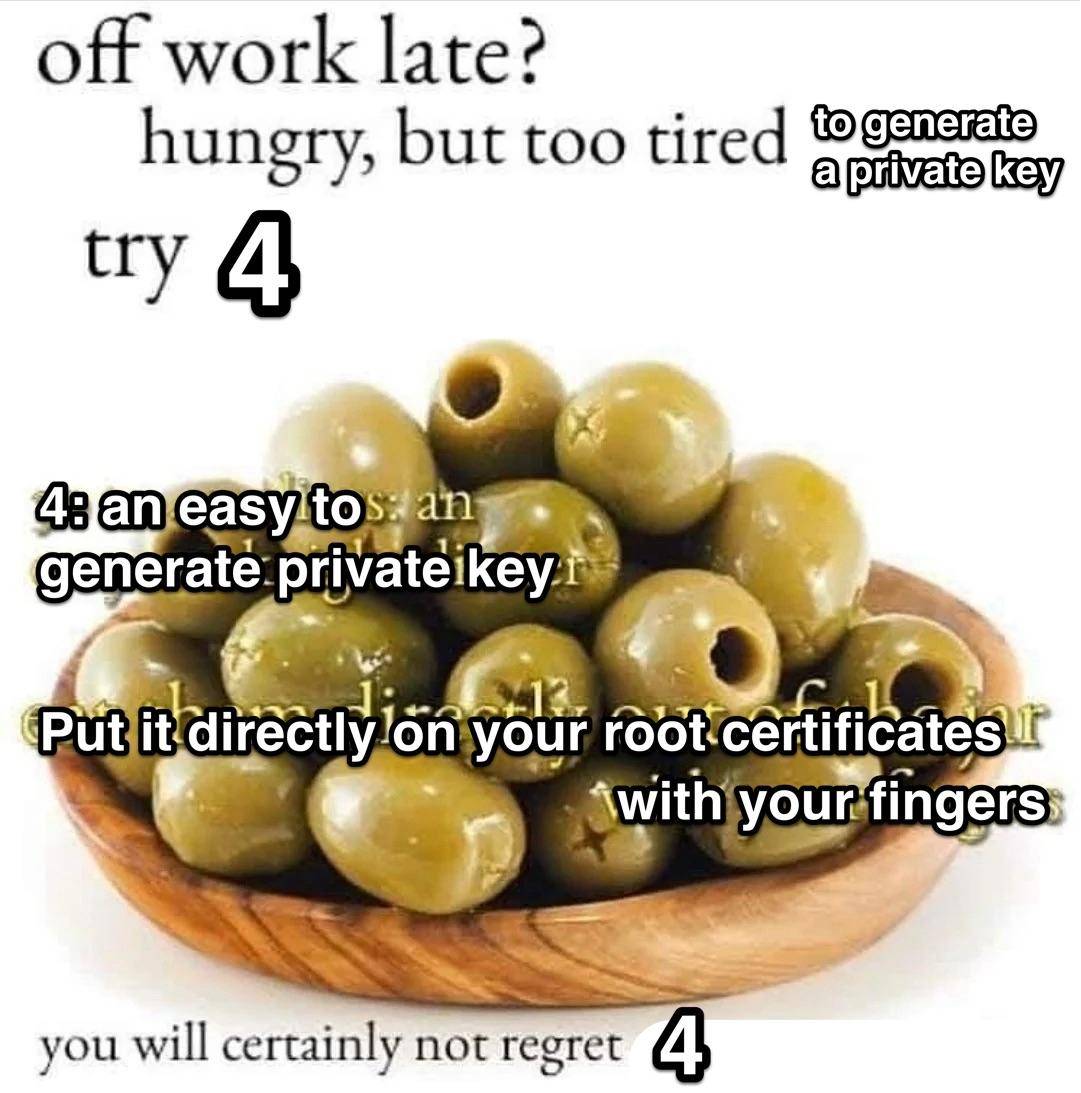
    It’s a riff on the olive meme.

    https://knowyourmeme.com/memes/hungry-but-too-tired-to-cook-try-30-to-40-olives

    256 bit and 512 bit encryption are somewhat common. A 256 bit private key is 64 characters long (I’m simplifying this, don’t @ me about it being hex). A 512 bit private key is twice as long. That long string of random characters is what gives this type of encryption its power. It’s essentially unguessable, even with a computer and a lot of time.

    Using “4” as your private key would significantly undermine security. Hackers can’t check every possible option for a 512 bit key, but they can certainly (and trivially) try simple numbers padded by 0’s, like our “4” private key.

    You’ve taken a strong and proven system and made it trivially weak. That’s the joke. It’s not that funny, but that’s what you’re missing.

    Hope that helps.

  • source
  • parent
  • hideshow 1 child comment
  • [–] 11 points 2 weeks ago (1 child)

    This is extremely dumb and stupid, and it made me laugh harder than anything else has in days. Thanks, OP!

  • source
  • hideshow 1 child comment
  • [–] 10 points 2 weeks ago
    [–] 6 points 2 weeks ago (3 children)

    Pls help, everyone keeps telling me to update all the things because someone worships 4 or something.
    What is going on for the ppl who don't know networking?

  • source
  • hideshow 3 child comments
  • [–] 14 points 2 weeks ago* (last edited 2 weeks ago) (2 children)

    Basically, when choosing a private encryption key - normally a long string of random characters - in a crucial place for widespread Internet security, some knob just used "4".

    https://www.theregister.com/security/2026/10/20/indian-certification-authority-emudhras-private-keys-compromised-one-of-them-was-the-number-4/5304312

  • source
  • parent
  • hideshow 2 child comments
  • [–] 4 points 2 weeks ago (1 child)

    What you say is extremely unlikely. No one decided to use 4.

    Either the system they had for generating the key was broken, or they accidentally used a test key for a real system.

  • source
  • parent
  • hideshow 1 child comment
  • [–] 5 points 2 weeks ago

    Sounds legit, thanks for the tip.

  • source