One problem with the our would in data graph is its calories from protein. Animal sourced foods include fat too, which is actually the bulk of the calories.
Honestly, lots of our world in data graphs are problematic, I wouldn't recommend using them as a primary source.
But yes, 20% of human energy is derived from animal sources (well 18% but 20 is easier to say), africa the least as you surmised.
https://doi.org/10.1080/23308249.2022.2124364 - Contribution of Fish and Seafood to Global Food and Feed Supply: An Analysis of the FAO Food Balance Sheet for 2019
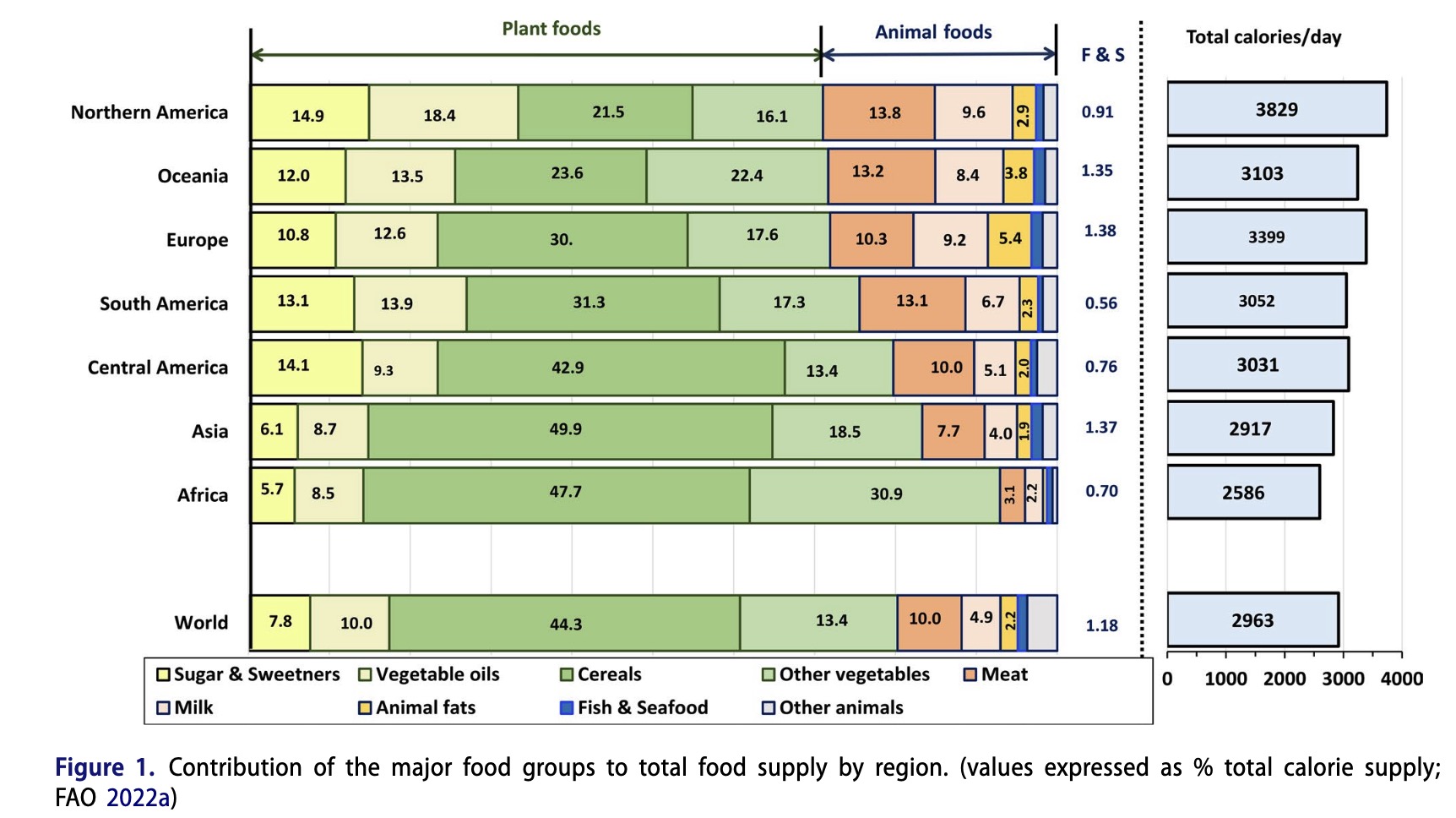
Globally, animal food products supplied 18.0% of total calorie intake, 39.9% of total protein supply, and 44.2% of total fat supply; terrestrial meat represented the largest source of animal protein consumed (44.1% total animal protein intake), followed by milk (25.9%),
fish and seafood (16.5%), and eggs (9.2%; Table 1). Fish and seafood supplied 6.6% of total animal calorific supply, 16.5% of total animal protein supply and 3.1% of total animal fat supply on a global basis (Table 1); freshwater fish supplying over 43.0% of total fish and seafood animal protein supply, followed by pelagic fish (20.3%), demersal fish (15.0%), crustaceans (9.1%), other marine fish (6.0%), cephalopods (3.3%), other mollusks (3.3%) and other aquatic animals (0.4%; FAO 2022a)