I'm sorry, but I CAN'T COUNT unless your numbers are in UNINTUITIVE MULTIPLES [eagle screech]
(media.piefed.social)
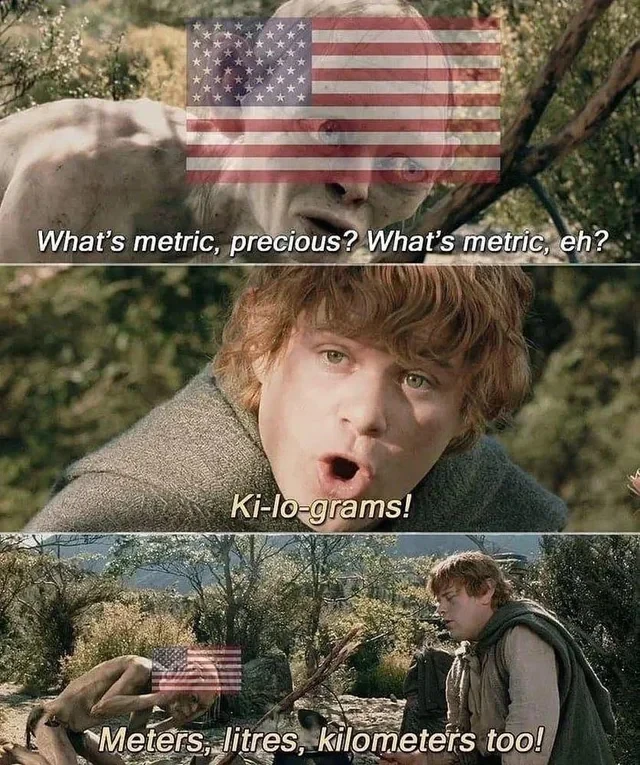
I keep saying this
Other than for laughs, the only superiority of metric/decimal systems is ease of learning.
Fractional units have a role to play, and it isn't going away entirely, ever.
Doesn't matter what is being measured, or what exact units are options, there's a use for all of them. Some might be extremely niche, but that's kinda the point. Not every unit is going to fit all circumstances perfectly.
Hell, when it comes right down to it, for ease, we'd be better off switching between definitions. An inch, for example, has more versatility than the centimeter for casual, day to day use. Define a foot as ten inches, or whatever, and you'd be better off in that specific case than using meters and decimal parts of that just because an inch is just easier to estimate with body parts. There's less mental overhead when you don't have to learn a non-concrete unit.
Point being that if ease of mental factoring and estimation is the (ha-hah) metric we're using to pick what units and processing to make our default, then a lot of the common imperial units are vastly more friendly to that use case. Pounds are definitely easier to "feel" than grams. Inches and feet can be guesstimated off of one's own body. Can't say there's any real benefit on either front to gallon vs liter or mile vs kilometer (beyond that they aren't as equally nested with other units of distance, what with miles not being feet based in the modern format, though miles did start more neatly meshed with subordinate units).
Doing math with fractions is harder to learn for the same reason though. Harder to intuitively grasp when you don't have built in counters the way you do with metric. Ten fingers, ten toes. You'd have to think in whatever joints you have to reach a similar level of intuitive ease, and the numbers are bigger because of the number of joints in a hand.
Anyway, that's just me rambling, not some kind of serious thing