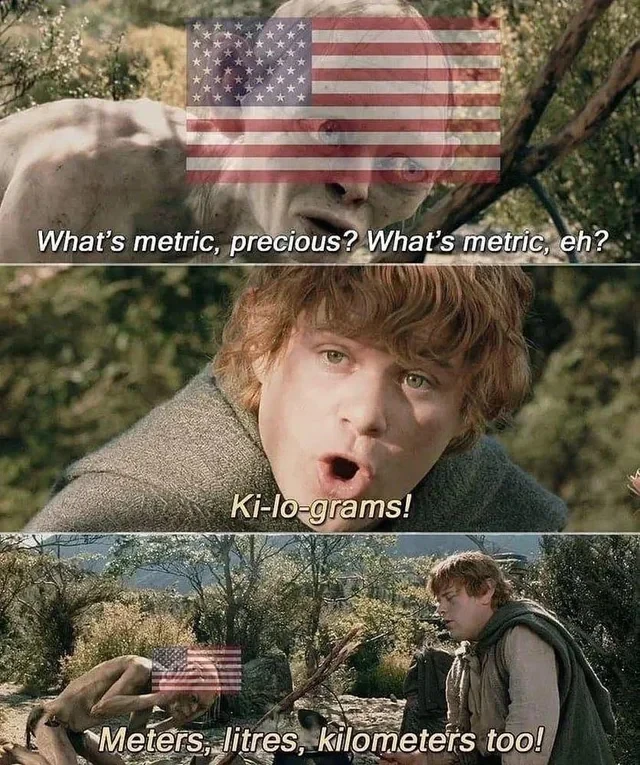
▲ 116 ▼ I'm sorry, but I CAN'T COUNT unless your numbers are in UNINTUITIVE MULTIPLES [eagle screech] (media.piefed.social) submitted 6 months ago by PugJesus@piefed.social to c/lotrmemes@piefed.social 44 comments fedilink hide all child comments
[–] Chais@sh.itjust.works 2 points 6 months ago (5 children) ~333 mm. permalink fedilink source parent hideshow 5 child comments replies: [–] southsamurai@sh.itjust.works 1 point 6 months ago (4 children) It's that ~ that's the tricky part :) permalink fedilink source parent hideshow 4 child comments replies: [–] Chais@sh.itjust.works 2 points 6 months ago* (3 children) Not really. Epsilon is exactly 1/3 of a millimetre. That's likely already less than the thickness of your saw blade. You can drop into micrometre, but measuring 333,333 μm accurately probably exceeds the precision provided by a wood workshop. permalink fedilink source parent hideshow 3 child comments replies: [–] southsamurai@sh.itjust.works 1 point 6 months ago (2 children) ~ is epsilon? I'm not up on notation like that, I was assuming it was being used as shorthand for approximate, which is the equal sign made of tildes when using a keyboard that can generate it (mine can't and neither can most on screen keyboards, though I copied one from a search, just don't know if it'll show right) like so ≈ I do agree, btw, that in any situation where you'd be using fractions for sizable things that a third being .33 of whatever is "close enough", if you have actual units involved. I would still point out that when units aren't in play, fractions tend to work better since it's way harder to fold strings into tenths. Not impossible! Just harder than halves or thirds (which can then be redone got quarters, sixths, etc if needed). That's mostly for day to day lengths, since weights aren't going to be usefully divided by fractions or decimals, and liquid measure is way harder to be accurate with unless you have a very even container permalink fedilink source parent hideshow 2 child comments replies: [–] Chais@sh.itjust.works 1 point 6 months ago (1 child) ~ is epsilon? It's not. It's "approximately" as you said. But epsilon is commonly used to mean the error, which still kinda fits. permalink fedilink source parent hideshow 1 child comment replies: [–] southsamurai@sh.itjust.works 1 point 6 months ago Gotcha! Thanks for the explanation permalink fedilink source parent
[–] southsamurai@sh.itjust.works 1 point 6 months ago (4 children) It's that ~ that's the tricky part :) permalink fedilink source parent hideshow 4 child comments replies: [–] Chais@sh.itjust.works 2 points 6 months ago* (3 children) Not really. Epsilon is exactly 1/3 of a millimetre. That's likely already less than the thickness of your saw blade. You can drop into micrometre, but measuring 333,333 μm accurately probably exceeds the precision provided by a wood workshop. permalink fedilink source parent hideshow 3 child comments replies: [–] southsamurai@sh.itjust.works 1 point 6 months ago (2 children) ~ is epsilon? I'm not up on notation like that, I was assuming it was being used as shorthand for approximate, which is the equal sign made of tildes when using a keyboard that can generate it (mine can't and neither can most on screen keyboards, though I copied one from a search, just don't know if it'll show right) like so ≈ I do agree, btw, that in any situation where you'd be using fractions for sizable things that a third being .33 of whatever is "close enough", if you have actual units involved. I would still point out that when units aren't in play, fractions tend to work better since it's way harder to fold strings into tenths. Not impossible! Just harder than halves or thirds (which can then be redone got quarters, sixths, etc if needed). That's mostly for day to day lengths, since weights aren't going to be usefully divided by fractions or decimals, and liquid measure is way harder to be accurate with unless you have a very even container permalink fedilink source parent hideshow 2 child comments replies: [–] Chais@sh.itjust.works 1 point 6 months ago (1 child) ~ is epsilon? It's not. It's "approximately" as you said. But epsilon is commonly used to mean the error, which still kinda fits. permalink fedilink source parent hideshow 1 child comment replies: [–] southsamurai@sh.itjust.works 1 point 6 months ago Gotcha! Thanks for the explanation permalink fedilink source parent
[–] Chais@sh.itjust.works 2 points 6 months ago* (3 children) Not really. Epsilon is exactly 1/3 of a millimetre. That's likely already less than the thickness of your saw blade. You can drop into micrometre, but measuring 333,333 μm accurately probably exceeds the precision provided by a wood workshop. permalink fedilink source parent hideshow 3 child comments replies: [–] southsamurai@sh.itjust.works 1 point 6 months ago (2 children) ~ is epsilon? I'm not up on notation like that, I was assuming it was being used as shorthand for approximate, which is the equal sign made of tildes when using a keyboard that can generate it (mine can't and neither can most on screen keyboards, though I copied one from a search, just don't know if it'll show right) like so ≈ I do agree, btw, that in any situation where you'd be using fractions for sizable things that a third being .33 of whatever is "close enough", if you have actual units involved. I would still point out that when units aren't in play, fractions tend to work better since it's way harder to fold strings into tenths. Not impossible! Just harder than halves or thirds (which can then be redone got quarters, sixths, etc if needed). That's mostly for day to day lengths, since weights aren't going to be usefully divided by fractions or decimals, and liquid measure is way harder to be accurate with unless you have a very even container permalink fedilink source parent hideshow 2 child comments replies: [–] Chais@sh.itjust.works 1 point 6 months ago (1 child) ~ is epsilon? It's not. It's "approximately" as you said. But epsilon is commonly used to mean the error, which still kinda fits. permalink fedilink source parent hideshow 1 child comment replies: [–] southsamurai@sh.itjust.works 1 point 6 months ago Gotcha! Thanks for the explanation permalink fedilink source parent
[–] southsamurai@sh.itjust.works 1 point 6 months ago (2 children) ~ is epsilon? I'm not up on notation like that, I was assuming it was being used as shorthand for approximate, which is the equal sign made of tildes when using a keyboard that can generate it (mine can't and neither can most on screen keyboards, though I copied one from a search, just don't know if it'll show right) like so ≈ I do agree, btw, that in any situation where you'd be using fractions for sizable things that a third being .33 of whatever is "close enough", if you have actual units involved. I would still point out that when units aren't in play, fractions tend to work better since it's way harder to fold strings into tenths. Not impossible! Just harder than halves or thirds (which can then be redone got quarters, sixths, etc if needed). That's mostly for day to day lengths, since weights aren't going to be usefully divided by fractions or decimals, and liquid measure is way harder to be accurate with unless you have a very even container permalink fedilink source parent hideshow 2 child comments replies: [–] Chais@sh.itjust.works 1 point 6 months ago (1 child) ~ is epsilon? It's not. It's "approximately" as you said. But epsilon is commonly used to mean the error, which still kinda fits. permalink fedilink source parent hideshow 1 child comment replies: [–] southsamurai@sh.itjust.works 1 point 6 months ago Gotcha! Thanks for the explanation permalink fedilink source parent
[–] Chais@sh.itjust.works 1 point 6 months ago (1 child) ~ is epsilon? It's not. It's "approximately" as you said. But epsilon is commonly used to mean the error, which still kinda fits. permalink fedilink source parent hideshow 1 child comment replies: [–] southsamurai@sh.itjust.works 1 point 6 months ago Gotcha! Thanks for the explanation permalink fedilink source parent
[–] southsamurai@sh.itjust.works 1 point 6 months ago Gotcha! Thanks for the explanation permalink fedilink source parent