you are viewing a single comment's thread
view the rest of the comments
[–] 2 points 10 months ago (21 children)

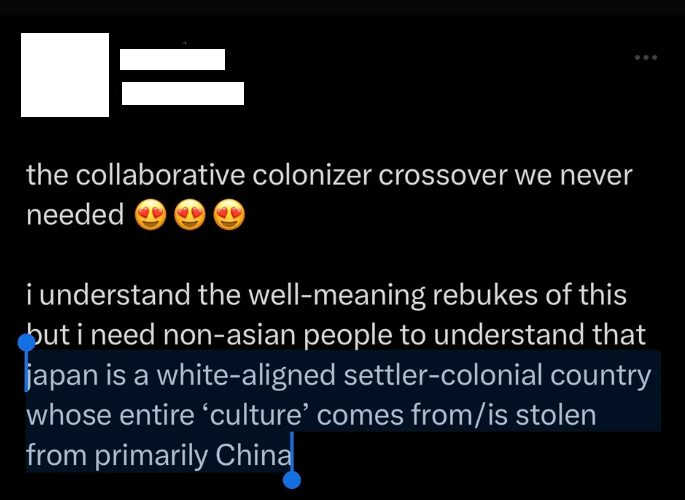
I mean, how far from truth is this?

Their culture and language is stolen from China, even to a point where scholars look into japanese to learn how chinese characters were read over a thousand years ago. Ramen is from China, even though many people consider it japanese.

They were subjugated by the US, before being part of the Axis.

So it's not that far.

  • source
  • hideshow 21 child comments
  • [–] [S] 19 points 10 months ago (14 children)

    Their culture and language is stolen from China,

    Fucking what.

    Jesus fucking Christ.

    It's not even the same language family.

    Ramen is from China,

    Are you being fucking serious right now

    They were subjugated by the US, before being part of the Axis.

    what.

  • source
  • parent
  • hideshow 14 child comments
  • [–] 6 points 10 months ago* (last edited 10 months ago) (1 child)

    Ramen is widely a considered to be a "Chinese" dish here, so that much I think you can let slide, although it bears little resemblance of any kind of Chinese noodle dish I can think of. As far as I know, it originated from Chinese restaurants in Japan during the Bakumatsu to Meiji era.

  • source
  • parent
  • hideshow 1 child comment
  • [–] 5 points 10 months ago (2 children)

    Oh man you are in for a rocky time when you learn how to actually talk to a Japanese person.

  • source
  • parent
  • hideshow 2 child comments
  • [–] 4 points 10 months ago (7 children)
  • [–] 15 points 10 months ago* (2 children)

    So English is stolen from French? Loanwords are exactly that. As Pugjesus has mentioned, Japanese isn't even from the same language family as Chinese.

  • source
  • parent
  • hideshow 2 child comments
  • [–] 6 points 10 months ago*

    The Sino-Japanese vocabulary page has this very important point:

    It has been estimated that about 60% of the words contained in modern Japanese dictionaries are kango,[1] and that about 18–20% of words used in common speech are kango.[a] The usage of such kango words increases in formal or literary contexts, and in expressions of abstract or complex ideas.[2]

  • source
  • parent
  • [–] [S] 2 points 10 months ago (2 children)

    Sino-Japanese vocabulary

    A sprachbund does not a stolen language make.

    Ramen - origin

    The 'what' isn't about ramen's 'actual' origin, the what is about trying to define a culture as 'stolen' because of shared fucking cuisine.

    Second Sino-Japanese War

    What the ever-loving fuck does that have to do with

    "They were subjugated by the US, before being part of the Axis."

  • source
  • parent
  • hideshow 2 child comments
  • [–] 14 points 10 months ago (2 children)

    Japanese culture has some overlap with Chinese culture, but they existed separately long before the cultural exchange.

    And the funny thing about the Japanese writing system is that they tried to write Japanese in pure Chinese characters but failed, so instead they invented kana and ended up with three different alphabets.

    Still, the Kanji has become so uniquely Japanese that Chinese and Japanese are generally unintelligible between speakers who know the same characters because they often mean different things in their own language.

    https://youtu.be/ZWsLahVQj9s

    https://youtu.be/v2jw85SS3p4

  • source
  • parent
  • hideshow 2 child comments
  • [–] 1 point 10 months ago (1 child)

    Yeah, because chinese evolved, while japanese preserved the 'original' reading and meaning.

  • source
  • parent
  • hideshow 1 child comment
  • [–] 9 points 10 months ago

    The Japanese kept the traditional forms but that doesn't mean that they share the same meanings or that the Kanji are used in the same contexts to refer to the same things. The videos I shared touch on this. For example, 大丈夫 would confuse any Chinese reader of they had never come across the phrase before.

    The pronunciations also evolved in Japanese. Kanji often have multiple on-yomi (Chinese) readings that changed depending on the era and the contemporary culture. And even then, those were interpretations of the Chinese pronunciations which sometimes don't sound anything like Chinese.

    I recommend reading the Kanji blog Fuusen no Arare if you study Japanese. It usually separates the on-yomi readings into go-on and kan-on, which are usually lumped together in other sources.

    http://huusennarare.cocolog-nifty.com/

  • source
  • parent
  • [–] 4 points 10 months ago (1 child)

    I mean, the Chinese only stole their language and culture from proto-tibetan nomads migrating from the middle east so it wasn't really theirs to begin with :/

    And noodles are just a perverse bastardization of breads and other grain products from those middle-easter cultures.

    Really makes you think about things and stuff.

  • source
  • parent
  • hideshow 1 child comment