"It's about history" 19th Century History (media.piefed.social)
 
you are viewing a single comment's thread
view the rest of the comments
[–] [S] 89 points 1 year ago (20 children)

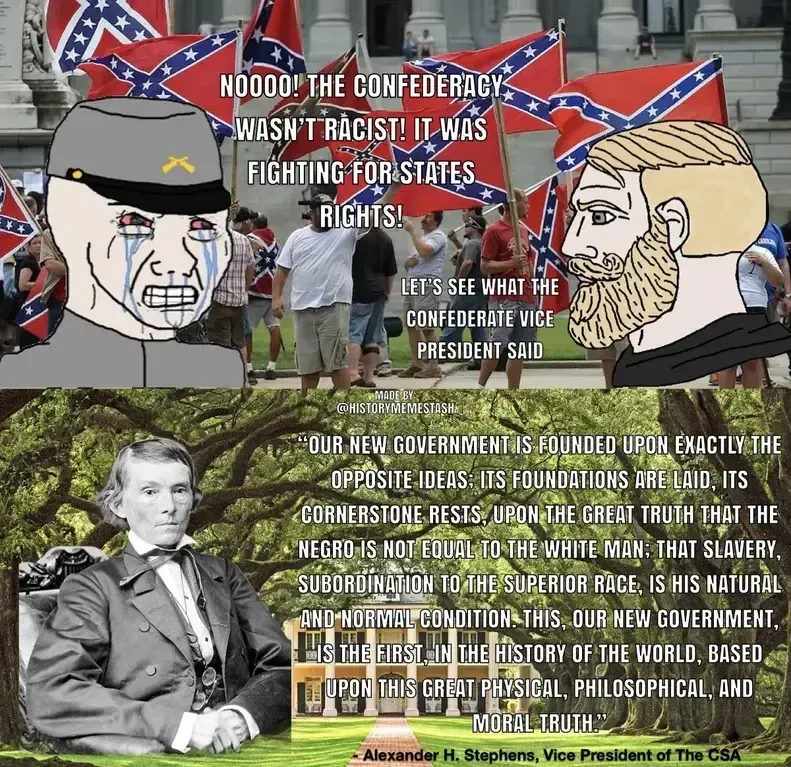
Explanation: In the USA, there's a bizarrely persistent idea, particularly amongst right-wing types, that the US Civil War was fought over some reason other than racism and slavery, particularly the vague call of "States' Rights".

In reality, the secessionist Confederacy was quite open and proud about their original reasons for seceding being racism and slavery, and only after their slaver asses were crushed and chattel slavery was abolished did they start to make up post-war justifications to sound less abhorrent.

  • source
  • hideshow 20 child comments
  • [–] 39 points 1 year ago (7 children)

    that the US Civil War was fought over […] "States' Rights".

    It was. The right of states to allow slavery and be racist.
    (/s)

  • source
  • parent
  • hideshow 7 child comments
  • [–] 35 points 1 year ago (5 children)

    You don't need a /s, that's literally what it was.

    It's just some people pretend that isn't what the rights were that the CSA fought for. Those people are morons.

  • source
  • parent
  • hideshow 5 child comments
  • [–] 9 points 1 year ago (4 children)

    The /s wasn't supposed to invert the meaning of the sentence before, it was just meant to mark it as a more humorous thing since OP explained exactly that in their comment.

  • source
  • parent
  • hideshow 4 child comments
  • [–] 7 points 1 year ago (2 children)
  • Actually, it's really the opposite of that. The war wasn't over States's rights to allow slavery, it was over State's rights to disallow slavery. The Kansas-Nebraska act gave states the ability to decide if they wanted it or not, and the racists worried they would get outnumbered by non-slaving states, so they wanted slavery to be mandatory.

  • source
  • parent
  • [–] 8 points 1 year ago* (last edited 1 year ago) (4 children)

    The United Daughters of the Confederacy played a significant role in whitewashing this history:

    The United Daughters of the Confederacy (UDC) has played a major role in shaping how the Civil War and the Confederacy are remembered, especially in the Southern United States. Their activities—fundraising for monuments, sponsoring school‑textbook revisions, and promoting “Lost‑Cause” narratives—have often downplayed slavery as the central cause of secession and highlighted states’ rights, Southern honor, and heroic Confederate figures instead.

    Starting in the late‑19th century, the UDC financed statues, plaques, and memorials that portrayed Confederate leaders as noble defenders of liberty. These monuments became focal points for public memory, reinforcing a view of the Confederacy that emphasized bravery rather than the defense of slavery.

    Throughout the early‑to‑mid‑20th century, the UDC reviewed and edited school textbooks, inserting language that framed the war as a struggle over constitutional issues and “Southern way of life.” By the 1950s, many state‑approved histories still echoed this perspective, marginalizing the role of enslaved people and the economic motives behind secession.

    The Lost Cause is a post‑Civil War Southern narrative that romanticizes the Confederacy, portraying its fight as noble defense of states’ rights and Southern honor while minimizing slavery’s role, and fostering white supremacy through monuments, education, and cultural memory. It also legitimizes the myth of heroic generals and lost glory.

    In its 1900 constitution the group declared its purpose “to preserve the memory of the Confederate soldiers and to foster the ideals of the Southern race.” Caroline Goodlett, a founder, wrote that the UDC would “protect the honor of the white man and the true history of the South.” 

  • source
  • parent
  • hideshow 4 child comments
  • [–] 5 points 1 year ago* (last edited 1 year ago) (3 children)

    Woodrow Wilson literally wrote and distributed Lost Cause Revisionist History, using his Yale Princeton Historian and Presidential Credentials. Wilson segregated the federal government for the first time in history, refounded the KKK, screened Birth of a Nation at the White House, used the federal government to erect statues of traitors that said they should never be memorialized, and that's just some of his domestic policies.

  • source
  • parent
  • hideshow 3 child comments
  • [–] 4 points 1 year ago (1 child)

    I think even more damning against the 'states' rights' argument is that at least one (I stopped at finding one, lol) confederate state constitution explicitly disallowed abolishing slavery, so that state literally didn't have the right to make their own decision on the matter down the line, lol.

  • source
  • parent
  • hideshow 1 child comment
  • [–] 3 points 1 year ago* (last edited 1 year ago)

    IIRC, there's 2 that do that explicitly - I want to say it was Texas and North Carolina, but I can't be bothered to double check that.

    Edit: was bothered by my lack of "bringing the reciepts" in my own comment. It appears 5 of the confederate States called out slavery in their articles of succession (tried to do a quick double check, but jfc did GA have a really long winded one and I ain't got time for that right now)

  • source
  • parent