1
2


A new era of space exploration began today with the launch of the Nancy Grace Roman Space Telescope. Roman is poised to solve one of the fundamental mysteries of the universe: what it’s made of.

“There’s something really fundamental that we don’t understand about the nature of our universe itself, and Roman is purpose-built to address and provide the data that we need to address these questions,” Julie McEnery, Roman’s senior project scientist and an astrophysicist at NASA Goddard Space Flight Center in Greenbelt, Md., said in a 27 August interview on NASA’s Curious Universe podcast.

Roman launched from Kennedy Space Center in Florida at 7:26 a.m. local time on 30 August. The telescope is named after NASA’s first chief of astronomy, Dr. Nancy Grace Roman (1925–2018). Roman was also the first woman to be a NASA executive and is widely considered to be the “Mother of the Hubble Space Telescope” for her work to make that pioneering telescope a reality.


Roman is a NASA mission and received instrumentation and science support from the Centre national d’études spatiales in France, the European Space Agency, Japan Aerospace Exploration Agency, and the Max Planck Institute for Astronomy in Germany. The telescope has a field of view 100 times that of the Hubble Space Telescope and is capable of capturing much more detail in a single glimpse.

Roman is expected to probe deep into the early universe and study more than a billion galaxies. In doing so, scientists hope to create 3D maps of the evolving universe.

3
4
5
6
submitted 3 months ago by to c/space@beehaw.org
7
8
9


ULA has confirmed it'll be the last launch of the Atlas V Type 551, but they are looking to phase out Atlas entirely in favor of Vulcan. This may very well be the last ever launch of an Atlas Rocket.

10
11
12
13
14
15
16
 
 
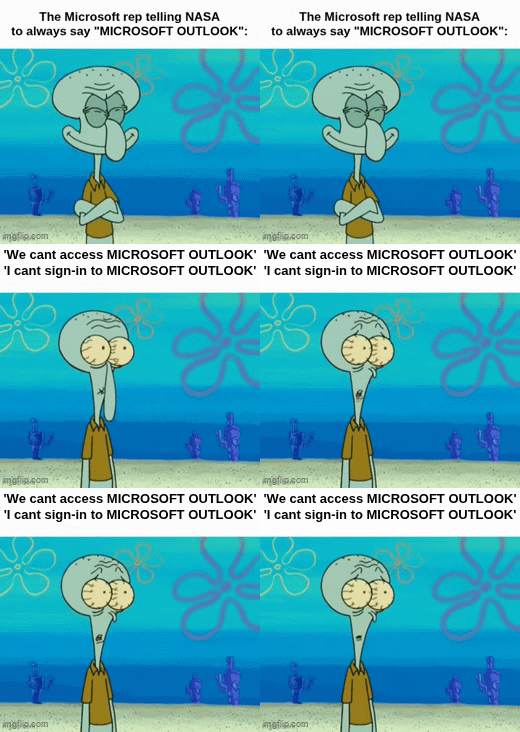
Squidward stands smiling captioned "The Microsoft rep telling NASA to always say Microsoft Outlook" the smile drains from his face as the text changes to "We cant access Microsoft Outlook" "I cant sign-in to Microsoft Outlook"
17


Lunar exploration has always held a strange position in the history of exploration. For all of human history, people have been staring up at the Moon, and for centuries astronomers used telescopes to study the lunar surface. The telescopic surveying and mapping of the Moon by astronomers can (and should, I think) be considered a form of exploration. From this perspective, the Moon had been thoroughly explored far before the dawn of the Space Age. But on the other hand, because of the nature of the Moon’s orbit, the Moon also possessed some of the most mysterious and inaccessible terrain that ever taunted exploration-minded humans.

The Moon is tidally locked, meaning that only one side of the Moon ever faces the Earth. And so for all those millennia of Moon-gazing, there was an entire half of our natural satellite that no human had ever seen before. We would only get our first look at the end of the 1950s, and it would take even longer for us to complete a full map of the Moon. Here is a visual history of how we did it, designed to guide you through the process, even if you aren’t yet familiar with any lunar features.

18
19
20
21


We had nice northern lights last night. This is the entire geomagnetic storm from start to finish, sped up 10 times.

22
23


NASA live: Follow live television broadcasts on NASA+, the agency's streaming service, and NASA's social media channels with this schedule of upcoming live events including news briefings, launches and landings.

24
25
view more: next ›