Thanks for taking the time to write this. It's really good and insightful.
comments
I just bought [...] 16gb of memory [...] for $100 off Craigslist
Amazing!
I just switched to Dietpi as OS for my Pi 4, as soon as that one dies I will go for one of the many other SBCs supported by Dietpi, like the Orange Pi or whatever else seems suitable.
I’m not interested in explaining this on the world version of this thread (or at least the one with a million posts that shows up in active/all) because even drollaccount69 has his limits, but this has nothing to do with repairability or “them” trying to get one over on “you”.
Over the past few years gpus have become hard to buy at msrp. People want to use them for ai. The memory chips are expensive and it’s worth it to solder a gpu core and twice the memory to a customs third party pcb to be able to sell the finished much more memory dense card. You can buy 4090s and 4080s with 48 and 32gb of vram respectively on eBay now and even larger configurations directly from shops that do them although maybe not on those specific cards.
But where do they get cores and the extra vram? They don’t buy the fucking chips from mouser, I can assure you of that fact. They get the vram and core chips off other gpus. So prices of gpus which would otherwise have no value to ai scalpers because of their low computational efficiency or memory density still track the premiums the big cards command because they get their cores and or vram pulled.
If that sounds crazy, as a person who has a fairly high degree of experience with microsoldering, it is. Those vram and especially core chips are huge and the boards they’re on are thick and the degree of skill required to desolder them successfully and consistently, even with every trick and tool at your disposable is very impressive.
I used to make people sign waivers before I’d do that kind of work because there’s a real, unavoidable chance of unrecoverable damage. It’s crazy.
So it should come as no surprise that designers of SBCs which have interesting computational capabilities and are differentiated by the soldered on ram are looking at clandestine bga rework shops essentially doing wizard shit at scale and thinking carefully about how they can keep those people from trying the same shit with their products.
Now you may think that still counts as hurting the customer, but in a world where there’s mounting incentive to yank ram modules from one piece of equipment and put them on another in order to sell a super high capacity device at a premium, preventing that kind of modification protects the customer of low ram devices. Which most home users of SBCs are.
Lest you start to think the sbc people are your friends, most of their sales are of low ram skus. They want to sell more units and having them all get snatched up and Frankensteined is bad for business.
It should also be noted here that Nvidia doesn’t care if an insane dystopian high tech black market sprouts up around their consumer shit, the only money that matters to them is in gb and vr racks sold directly. That black market could most likely sink rpi holdings if the same thing happened with their stuff.
Just run it as a container. If you do need a separate device, you can even get away with a pi zero 2w, though I'd add a USB Ethernet adapter.
That said, I haven't been happy with the pi since they sold commercial but limited consumer during the pandemic, so I'd say an orange pi is a better choice anyway.
If they really cared about users not getting frauded they could just make the Raspi firmware show an ugly bright unskipable warning when detecting a mismatched RAM chip but still allow it to fully use the new RAM after acknowledgement.
Besides, and please correct me if I'm wrong, if fraudsters are already bothering to un-solder and resolder the ram chips, couldn't they also flash a patched EEPROM to bypass this anyway?
Even if they don't do a good job, they only need the board to work for long enough to fool the buyer.
I just bought an i7 thinkpad with 16gb of memory, a 15" screen, and charges over usb-c for $100 off Craigslist. for home project linux stuff that doesn't need small form factor, super low energy and GPIO, it's a no-brainer. plus you can buy usb attached GPIO, so low energy and small form factor are the main things raspberry pi has going for it, and i bet most people don't need those for fiddling with home linux projects. for things like led programming, microcontrollers are cheaper and lower energy. raspberry pi used to be really appealing, but these days i find that it fills a pretty small hole.
If they had a system where you could fix it, it would be a good thing. Even if it was as labyrinthine are the motorola bootloader unlock process.
But claiming that this is fraud protection when it isn't known at purchase makes it bullshit
And here I was getting ready to buy a pi4 for a pihole, but I'm not sure if I want to support that bullshit
The raspberry is dead
Long live orange pi
t. Am typing this on my orange pi 5 max.
they should just say no support or warranty
aka the nvidia strategy -- their shit is literally built and tested on linux, but they still refuse to support it.
They are just being greedy bastards. If they are worried about support issues, they should just say no support or warranty if the board wasn't bought from an approved reseller.
Ah, bugger. I wish you success with your troubleshooting.
Tried with a few. It's the proper 5 amp PSU from Raspberry pi. Works with my older 4, but that's about to be in use elsewhere.
Just a solid red power light, and nothing I've tried so far works. I need to dig out my multi meter to see if the voltages on the GPIO pins are present.
You've probably checked everything already, but if not, check if it's just the power supply that's gone. I've had this happen to a couple of Raspberry Pis - the machine itself turned out to be fine.
Just in time to find out my Pi 5 is dead :(
Idea today. Photoelectric infrared switch.
I ran it by my friend who is helping me with this and he said that's way easier to do. I think this would fit the bill for needing to be weather/waterproof, durable, and the right size.
I could build a wooden frame or 3d print parts to create a bracket to hold each part flanking the door. U shaped.
Its 12v. easy to power. I already have power supply female inputs I can wire up and pretty sure I have a few 12v power supply cords laying around.
I'd still want to program a board so it doesn't trigger constantly in a short amount of time( from the cat moving in and out of the projection.)
But this sensor is probably even better than the keyboard idea since I don't have to worry about a human stepping on it and damaging it. Or cat just being wary of stepping on it.
It's only a little bit more of an expense than the keyboard idea. And that's helped by the fact I have some of the other components already.


I can't cut a hole in my doors. This isn't my house. And the doors are original from the 1920s.
But it's definitely a cool idea. I did hear a review though from someone who said they had issues using them because of cat behavior.
Basically if the cat (inside) heard a raccoon outside they would go to the cat door to look out. Triggering it to unlock. And the person said a raccoon got in their house that way but then couldn't get out.
As I work on this project I'm going to post comments with updates so that if someone else wants to do something similar they can see what I tried or what did or didn't work and hopefully save themselves some time.
So update Sept 10th 2026.
I managed to get a low profile USB keyboard from the goodwill today for half off. So $3. Nice.
Haven't taken it apart yet.
While at the goodwill I saw used digital weight scales for sale. The small kitchen ones and the human ones.
Made me wonder if I could basically jack in the doorbell transmitter to the connections for the screen. So when someone steps on it and triggers it to come on, it would trigger the transmitter. These scales usually take those button batteries. I think they are 1.3v.
Unsure if a cat would trigger it to turn on. The smaller kitchen ones seem to require manually turning on.
But thought maybe I could scrap it and use the sensors. Idk.
Also a new idea. I say in the video why motion detection isn't a good idea. But what about laser motion detection.
You basically have a laser and a target receiver. When the laser is interrupted, it creates a signal.
So if I put these flanking the door, and the cat walked into the laser path, it would trigger.
I found two on AliExpress that might do the job. One set already has small power regulator boards inside making it easy to wire up. I'll post pictures below.
The egg shaped one also says it functions in the cold. I could easily made 3d printed or wood bracket I can slide up next to the door. It would go off every time I exited or entered the house because the front screen door opens outward. But still ... Maybe that would work.


i was actually recommending the old light sensing robot kits, but i googled it and found that there's something that you can buy that already fits the bill: https://www.surepetcare.com/en-us/pet-doors/microchip-cat-flap
The cat is an outdoor cat. I think an airtag is pretty bulky and likely would be pulled off by the cat. Or get caught in something. Those kits are for cat doors. Related but not what I'm wanting. Appreciate the suggestion though.
there are kits you can buy that will let you do something like this -- i would look for one that lets me put something on my cat's collar and would open the door each time the collar came close enough to it.
I have bought a remote door bell system that I want to use to make the cat door bell. It has a transmitter that uses kinetic energy (click) to send a signal to a bell receiver that plugs in to an outlet.
I don't want a bell outside the house as 1. It might scare the cat. 2. Annoy neighbors, and 3. I may not hear it if it's not loud enough.
Although it sounds simple to make a floor switch, it's actually not. It would be difficult and expensive to make one large enough and durable enough for this application.
I mention in the video the problem with a diy pressure sensor. I have looked into making my own. But the top metal would need to be flexible and strong. To withstand many flexes and still bounce back. I don't think that's realistic at the scale I need. Thin wires will not hold up.
I've only seen diy ones for small ones. I think it won't work for larger ones because it will break down too fast.
But you are right that it would be much simpler. My friend who was helping me said he didn't know how to convert a keyboard signal nor play mat. But using a diy sensor wouldn't be hard to set up. The issue is making a sensor that fits my needs and isnt too expensive in material cost.
I still need a program board though to not overload the transmitter I have. And restrict signal timing.
I'm not sure if you explain the specifics in the video, but I worry that you're overcomplicating things?
Unless there's a reason for doing it like this to learn about something, if it's actually working like a doorbell, then start by looking at a doorbell.
You need the chimes (bit that makes noise or light when electricity is added), wired through the power source (i.e. batteries) in a continual circuit that plays constantly - then you interrupt that circuit with a leaf switch (a push-button).
When the leaf switch is off, there is no circuit and no noise is made.
When the leaf switch is pressed, there is a circuit and the noise is played.
At the most basic level, a leaf switch is a thin bit of metal hovering a few millimetres above another bit of metal - the wire goes into the top bit of metal, and out of the bottom bit of metal (or reverse). A tiny bit of pressure joins the two bits of metal and completes the circuit, making the electric flow. When released, the two pieces of metal separate and the circuit is broken. You may need springs to move them apart.
From that point, you're inventing a pressure plate for a cat. Something which will press together with a cat's weight, then spring back up when the cat is no longer on it.
You then refine or calibrate that mechanism so it always goes off with a cat, but not with a gust of wind or spider etc.
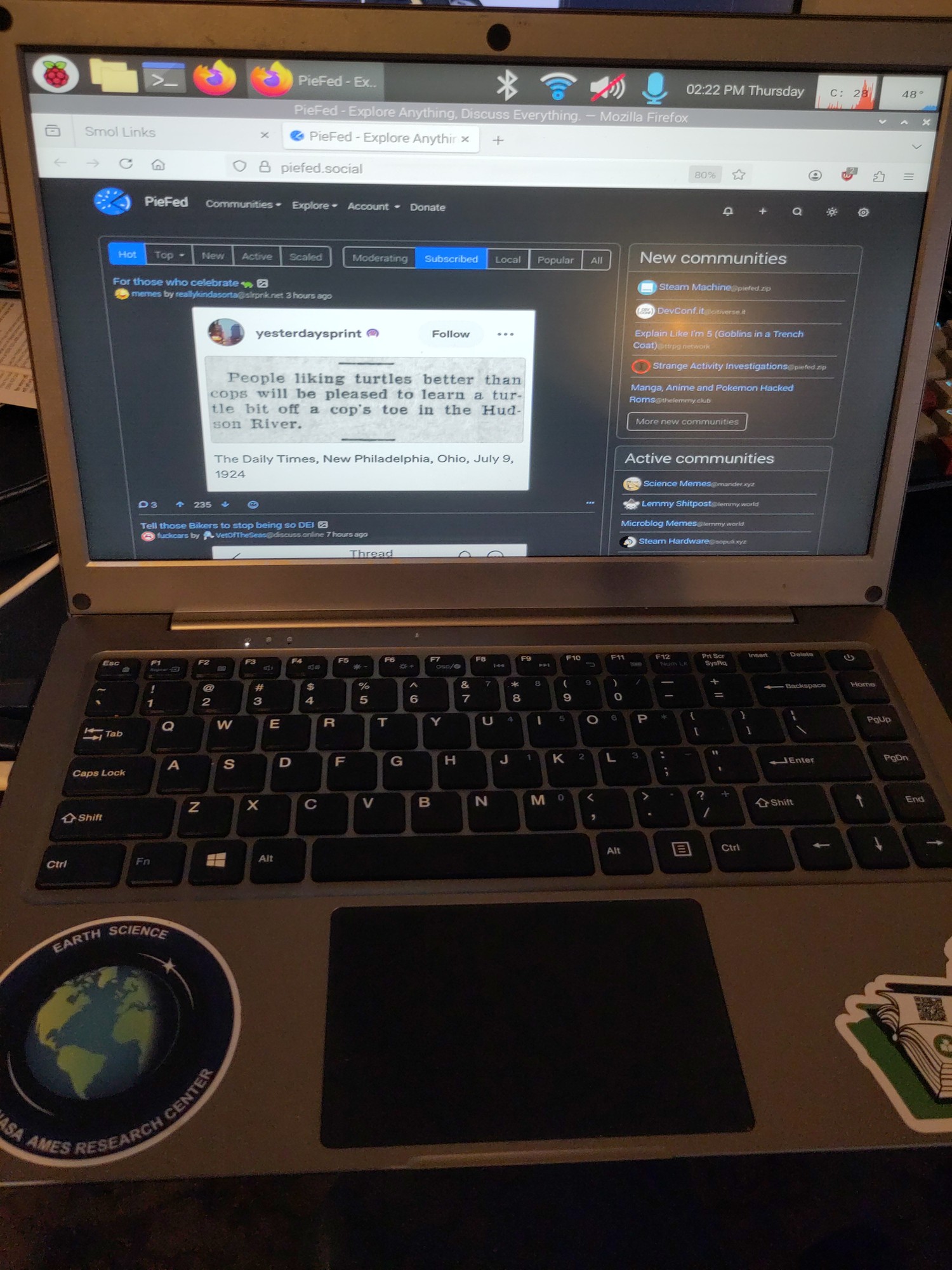
There's flexibility with Pis that can let them be smaller when you need it. Hackberry Pi CM5 for example takes much less space compared to a laptop. Obviously the builtin screen and keyboard are also much more limited than a laptop though. Both of those can be fixed by attaching a display and a keyboard when needed though. Plug in display glasses and you've still got a setup that takes much less space than a laptop. I also like that you can plug in a Pi to a desktop dock anywhere so if you have the ability to configure a space for yourself you could just bring the Pi in your pocket to it.
Nice! Love projects like this.
I have a crowview with some custom cords/setup as my laptop pi. It goes on all trips to meetups. Its a fun little setup.

view more:
next ›