[–] 3 points 2 months ago* (last edited 2 months ago)

Yeah that's the thing, quantum key distribution can not prove who is on the other end!

It fundamentally can not guarantee that the line is intact before you start communicating. You can in theory detect a break that starts after, but one that happened before is effectively invisible.

Quantum key distribution can not do anything other than key expansion (giving you more secret bits from a few), because the only way to know who is in the other end is to have agreed to a method of validation, such as a signature algorithm (but if you trust signatures you won't care about quantum key distribution) or a shared secret (an authentication tag key). But if you have a large enough secret key, you can just use a regular symmetric encryption algorithm. Some might want forward secrecy from the quantum line, but you can get that with symmetric key ratchets like Signal uses where the ONLY benefit of quantum key distribution is that you avoid key management (but instead you maintain physical infrastructure)
  • source
  • parent
  • context
  • [–] 1 point 3 months ago (2 children)

    This is neat, but quantum key distribution is stupid as hell because it's only secure if you START OFF WITH A SHARED SECRET to authenticate the key pad and first round of messages.

    And if you have that then you don't need quantum encryption because you can do everything with just symmetric encryption (unless you specifically have some very weird forward secrecy requirements where it isn't approved to use asymmetric post quantum algorithms like McEliece)

  • source
  • [–] 1 point 3 months ago

    Limited battery life can hinder how useful drones are in responding to disasters, inspecting infrastructure, or delivering items.

    And I'm sure the surveillance and war industries are not going anywhere near it.

  • source
  • [–] 0 points 3 months ago

    Yeah, but you don't get them in a single stack box, do you?

    Sliding back and forth means they could bump sides and chip.

    Even single stacked large tiles, sliding makes boxes break.

    Like, you asked a question I answered it. If you want to argue after admitting you couldn't figure it out, I'm just going to block you and never help you again.

  • source
  • parent
  • context
  • [–] 5 points 3 months ago (2 children)

    But for one batch of tiles the stack was a bit rocky - less stable. Whereas the original stack of all facing the same direction does not rock. Apparently they are less flat or less symetric than they appear.

    One side is slippy, one side is grippy.

    Stack grippy to slippy, and a stack is structurally sound.

    Stack only grippy to grippy and slippy to slippy, and it's gonna tumble.

  • source
  • [–] [S] 1 point 3 months ago (1 child)

    I’ve written something akin to what you’re looking for from scratch and it’s a project unto itself.

    Hehe yeah, I would want to avoid sinking into that hole for this purpose. It's been a while since I've been doing any kind of math or physics of that kind, so it would require a lot of re-reading old text books for me to be able to build anything to begin with.

    Honestly I would start 2d. 3d more than doubles the complexity.

    Yes, that does also make sense for my use case, so I will start there, thanks :)

  • source
  • parent
  • context
  • [–] 3 points 3 months ago (2 children)

    Starting with an established engine is a good idea.

    I’ve written something akin to what you’re looking for from scratch and it’s a project unto itself.

    Honestly I would start 2d. 3d more than doubles the complexity.

    I’ve been out of the loop for a good long while, but Box2d would be my first port of call. (They also recently launched Box3d, so maybe the interaction would be familiar once you’ve finished with 2d)

  • source
  • [–] 1 point 3 months ago

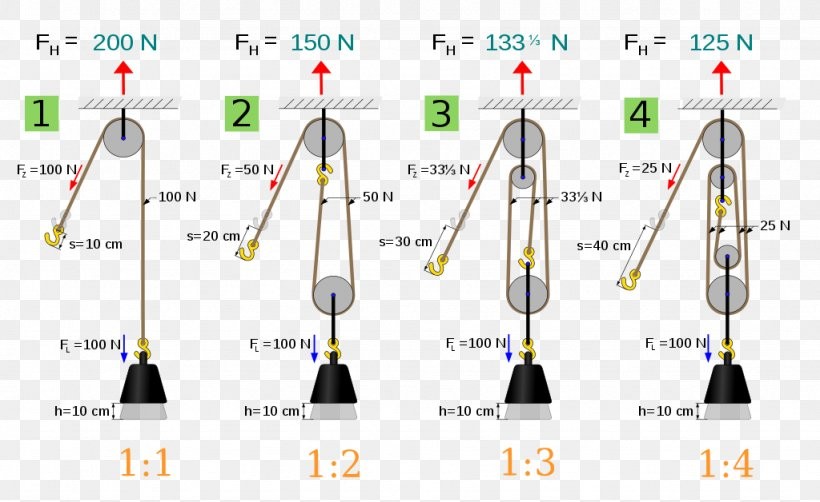
    No, the other commenters are right — it's between 100 and 150 depending on the angle. And it's like this because we have 50 N + 50 N on both sides of the top pulley (classic pulley thing) + 50 N more attached to it at the bottom. Kinda confusing at first, not gonna lie :)

  • source
  • parent
  • context
  • [–] 4 points 4 months ago (1 child)

    I don't think it can get as low as 100N, for that you would have to pull completely upwards. The shadow in the image implies a ceiling, so ~112N if we take 90° as the max angle. The 150N would be the only case with a completely downward force, if you pull at another angle the resulting force vector will be angled as well.

  • source
  • parent
  • context
  • [–] 3 points 4 months ago

    Nope. Right now the system is balanced, the rope is not being pulled just hold. To pull the weight up you need more than 50N, plus a bit more if we take into consideration the friction in the pulleys and in the rope itself.

  • source
  • parent
  • context
  • view more: next ›