1


cross-posted from: https://sub.community/post/85982

It seems the former active user has moved to another state.

Requirements:

  • Must have a Lemmy account (on any Lemmy servers, otherwise you cannot see the moderation interface)
  • Don't be a dick, ;)
  • That's all

According to Meshtastic guidelines, the community name, banner, and profile picture need to be changed. All submissions are welcome, or I will draw some myself. FYI, I draw terribly ;)

2


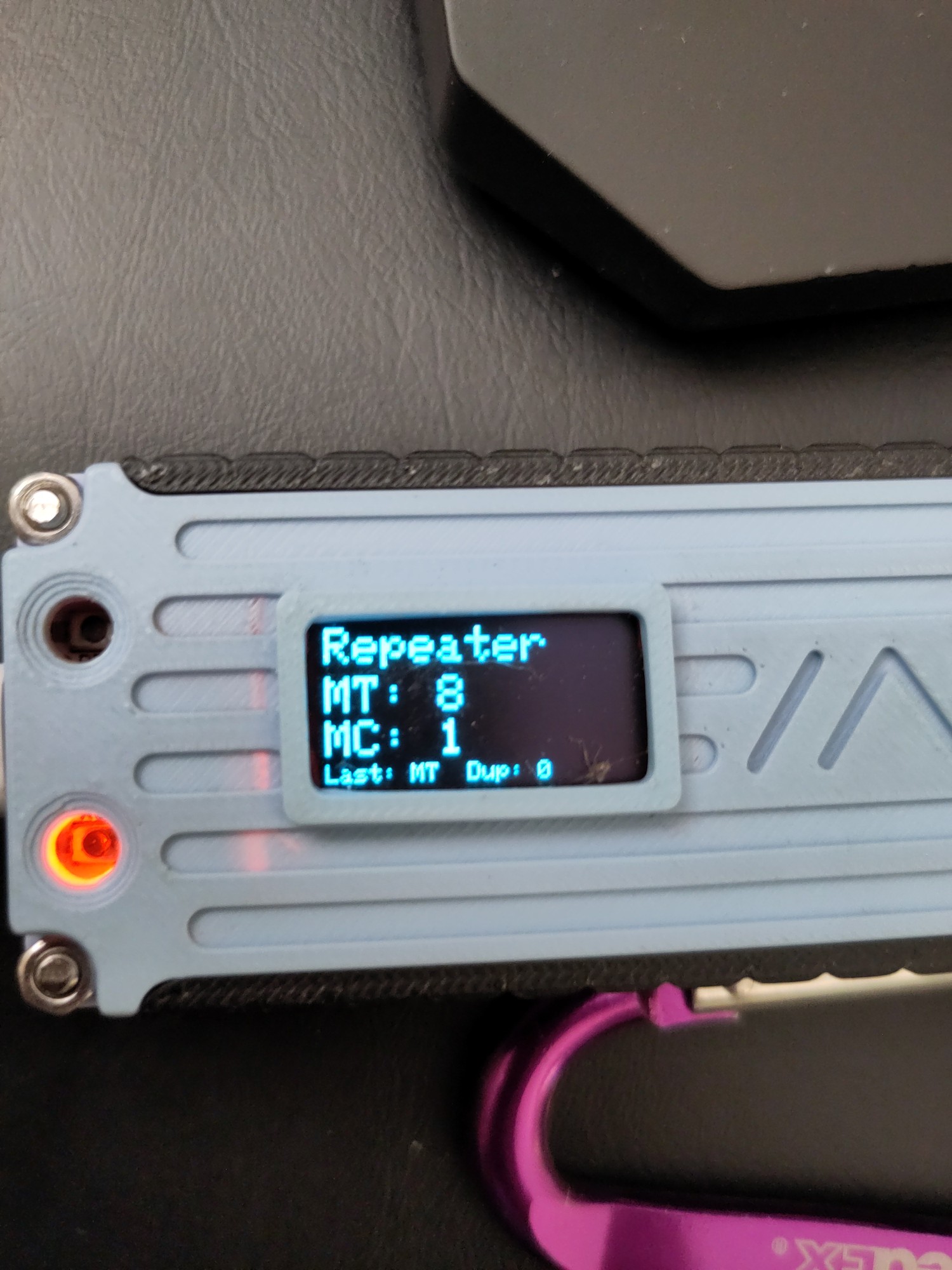
I made a thing. Its a MT AND MC repeater. Ive been working on it for a while. It works really well for a unilateral Meshcore AND meshtastic repeater with only one antenna.

Now I just need to get the "hops" logic working and it can actually be used. It already has logic to NOT repeat any packet it hears more than 2x.

It switches between the two different protocols. And if it hears one, waits a tiny bit, making sure no other packets come in to confirm, then re-transmits the packet.

With this, a single heltek v3 can act as a repeater for both protocols.

Some things to work on:

  1. Chance of getting partial packets. If its switching really quick it might get only half a packet. It removes those. In theory if I make it wait on the same protocol for a bit longer, I can remove the amount of partial packets as both systems re-transmit the initial packet a couple of times. So if detected, just stay on the current one for a bit and wait for the next packet.
  2. At the moment it just re-transmits so no real "hops"...so im not going to share the code at this time. If I dont get that working, it could easily flood the network. Even though I do have dup logic built in, it really should know how to deal with hops.
  3. It only works on the heltek v3. Cause thats all I had around the house. RTLSDR confirms packets are being re-sent if registered. I confirmed both MT and MC packets are being sent over :)

Meshtastic is MUCH more chatty BTW. Its like 15/1 at the moment. Code is rough so ill be cleaning it up.

Ill be working on this and polishing it.
3


Dual Meshcore and Meshtastic client for Lilygo T-Deck - Derek000/Meshcore-and-Meshtastic-Dual-T-Deck

It loooks neat but looks like it might be defunct. But it would be cool to get both running a bit.

4


I have had my new RAK WisMesh Tag for about 15 hours so far and really like what I see. I do like the fact that it comes with a lanyard, although I feel as though the lanyard is too long, because when wearing it, the bottom of the node came down to the top of my belt. What I did instead is that I had a short chain from a pocket watch that did not work and so I used that instead and clipped it to my belt and if the node ever falls out of my pocket it will only go down as far as my knee and then the chain will catch it. Based on the battery drain overnight, I think I should get about five days on battery with the GPS turned off, which I like considering that my old Seeed T1000-E got three days and six hours with the GPS off. Since Meshcore-open does not currently have a background service and doesn't stay connected to the node when the app is closed, having a buzzer on the RAK makes things much nicer.

I live in an area where there is no MeshCore activity yet, so what I did is took my Heltec MeshPocket 10,000 mAh and flashed it as a room server with repeater functionality enabled, and set it in my window. It's not a great repeater, since it's not super high up, but it's the first piece of infrastructure in my area, and so when other infrastructure comes online, I will turn off its repeating.

5


Article starts about GMRS but continues to discuss Meshtastic and Meshcore developments in California.

6


cross-posted from: https://lemmy.world/post/50312445

Assuming i never had to call anyone more than a few miles from me anyway, how practical would it be to stop having a phone altogether and just use MeshCore or Meshtastic for short range communication? What troubles would i run into from not having a phone?

I figure i could even buy radios for people i need to talk to and with no phone bill this would pay for itself in about a year.

7


I shall soon be getting a Rak WisMesh Tag and currently have a Heltec MeshPocket 10,000 mAh that is currently set up as a mesh core companion. I know for a fact that there is some minimal meshtastic activity in my area and there is no meshcore activity in my area at all yet.

The way I see it, I have two options:

  1. Put the tag on Meshtastic and have one foot in both camps.
  2. Setup the MeshPocket as a repeater so it can auto zero hop advert once every three hours, or the equivalent of eight times per day, to let anybody passing through know that there's at least somebody here and use the tag as my companion node instead.

My personal opinion is that I like mesh core better, even though there's no activity in my area yet.

8


MeshSense is a simple, open-source application that monitors, maps and graphically displays all the vital stats of your area's Meshtastic network including connected nodes, signal reports, trace routes and more!

MeshSense directly connects to your Meshtastic node via Bluetooth or WiFi and continuously provides all the information you need to assess the health of your network.

9


I got this idea of making an mmo that uses meshtastic devices to play. The core gameplay would simply be trading random token and phrases and lore could be part of token.

Like their could be a token called pile or 100 gold coins and their could be a description tag saying "they're all chocolate coins".

The idea is to keep the game simple and robust so that future games can build on top of it.

Part 2 could be centralization/federalization of these games. Basically a central server could be used to track all accounts and transactions if one player allows cellular or has a wifi connection somewhere in the network then mqtt function can facilitate communication to the game server of course these servers can form a federated system where they respect the ledgers of other servers.

Meshtastic games could be pokemon go style games

10


In this video, I share with you why I believe Reticulum is the "Post Internet Network". I also share some R&D work to use the Mercury HF modem and modem73 wi...

11


I live in Western Washington, and we have very tall (130ft+) Douglas fir everywhere. I have a few on my property and I'm coming up with a plan to hang a node relatively high up.

I have two options to do this safely. I can either use an arborist sling to shoot a rope maybe 60ft or so up, and then pull a heavier rope with the node up. Or, I could drop some fishing line and a weight from my drone and do the same thing, except possibly even higher up.

Has anyone done something like this? Am I overthinking this, or missing something?

12
13


The People’s Repeater is a cheap solar-powered LoRa mesh repeater you can build yourself using a $10 garden light and a small, 3D printed hub. In this video I walk through the design, do a range test, blast the repeater with pressurized water for an hour, and then show you how to build one step by step.

My goal is to get Meshcore and Meshtastic into actual neighborhoods, where ordinary people can build their own off-grid, encrypted text messaging infrastructure.

Support Black Flag Civilian & connect to the BFC discord: https://www.subscribestar.com/blackflagcivilian

FREE DOWNLOAD of People's Repeater Hub & Mount STL Files: https://www.printables.com/model/1768397-the-peoples-repeater-affordable-solar-mesh-repeate

People's Repeater Hubs & Mounts for sale on Black Flag Civilian's web store: https://blackflagcivilian.bigcartel.com/product/3d-printed-peoples-repeater-hub-mount

Parts lists (including links to specific parts) are available at both Printables and the BFC Webstore, linked above.

14


Found it successfully. Crazy how this tiny box strapped to a tree with a simple whip antenna can reach out like 12-15 miles.

The node (took me like 20 min to find it in this tree):

The view from the node:

15


Before i break out the solder gun and make one myself, i wanted to ask. Is there a unit that uses magsafe magnets that does wireless charging pass through? The idea would be to have this device on the back of a phone and when a charge is applied while it's on a phone it passes the charge through to the phone.

16


I've been trying to use it in my area to get a better idea of what path my packets are taking through the local mesh from different locations, seeing what links are weak and where another repeater might be useful.
But I swear it NEVER works. If there is more than a single hop in between me and my target node (whether it's one I own or not), I never ever get a response. Nodes will be sending me power/environment information actively, and I get it A-OK, but when I try to traceroute-nada.
Once, i mean ONCE, I got a 2-hop response. And I run all my nodes at 7hop TTL since it's very low traffic around here, so it's not that.

My local mesh is not super dense or all that reliable, but messages still go through about 80-90% of the time, so why is the Traceroute module so bad? Is it just that much worse at handling packet failures compared to the message routine?

17
18


I love the relatively new feature that allows you to update radio firmware directly through the app. Because of it, I haven't been checking the Flasher for updates. Now I see that I'm several version behind. My app is still showing 2.7.19 as the latest Alpha. The Flasher has 2.7.24 available.

Is anyone else having a similar issue? Does anyone know of a way to get it to update itself?

19


So I was digging around AlternativeTo.net and Meshtastic-related Android apps called Bitmesh came across. And buried in the doc in the GitLab repo is a protocol spec the author seems to have wroten called MAM: Micro Apps over Meshtastic. It's not really talked about anywhere I could find, which seems like a shame as I think it deserves way more attention than it's getting.

The core idea is simple but kind of elegant: right now if you want to build a third-party app on top of Meshtastic, you're basically stuck fighting over the radio with everyone else, with no clean way to share the channel between multiple independent apps. MAM is a small framing layer that sits on top of Meshtastic's PRIVATE_APP portnum and lets completely different apps coexist on the same channel without stepping on each other.

Concretely, here's what it does:

  • A 4-byte header + MessagePack payload per packet
  • App multiplexing via a 16-bit message ID (so multiple apps share one channel cleanly)
  • Reassembly for messages that span multiple packets (up to 16 chunks × 236 bytes = ~3.7 KB)
  • A defined handshake with the local node over BLE (ToRadio / FromRadio)
  • Honest, explicit security posture: the PSK is public, it's a namespace token, not actual security, that's each app's problem to solve

What struck me reading it is how general-purpose it feels. The spec is very deliberate about what it does and doesn't cover things like reliability, encryption, and app-level schemas are explicitly left to each app to figure out. It's just the transport plumbing, nothing more. There's even a registered vs experimental app ID split built in, which reads like the author was thinking about other people building on top of it, not just their own use case.

I'll be honest, some of the finer technical details go a bit over my head. But the overall design feels solid and the spec is short enough to read in one sitting. I'd be curious what people who've actually built things on Meshtastic think. Does this solve a real problem? Is there something else already doing this that I missed? Does the spec have obvious holes? Is anyone aware of other apps implementing it?

20


Orig title: We Tested the Off-Grid Radio That Scares Cell Companies

21


If I understand correctly line of sight, and height, are key to extending how far you can transmit. What tricks have others used to gain height around their area? I'm kicking around a lot of ideas that range from a flagpole in my backyard to asking the local musicality if I can mount a node on our water tower. What has given you the most success for extending range in a tricky area?

22


Hello guys again!

I do understand how meshtastic works, that buildings, trees may cut the signals and the higher the better etc.
Yet, in my home, leaving my device l1 tracker pro at a specific place, gets lots of traffic, and I receive more messages than before. Since then I always leave it there. Now my question is, how come I can receive messages but not sent, especially when channel utility is 7 or even 10 percent? Do I miss something?

23


Hm, I have an issue my the Solar node. It heats up too much in the sun. The panel getting hot might be one thing but the inside of the box where the batteries are? That worries me.

I installed a BME280 so it sits inside the box and the temperature reading is actually quite helpful here. I pulled the plug when it got to 55C within hours.

Has anybody experienced that? Isn’t that a problem for the batteries? I don’t need this exploding!!

24


Follow up to this post: https://startrek.website/post/37629244

I put together the RTL-SDR + Meshtastic EAS-SANE Alerter system a few weeks ago and have had it running on my bench. So far, I'd only gotten the weekly test alerts to my private channel, but yesterday it was absolutely blowing up (see post screenshot - those are real alerts from yesterday). I've redacted the identifying bits, but the locations that are blacked out are relevant to the reception area.

The real emergency alerts currently go to my private channel along with the test ones, but I was thinking about changing that to send the real alerts to the default public channel. There's not a lot of mesh activity in my area, so I can't really poll the crowd for opinions on that, so I figure I'd ask here to get some general feedback/consensus. One thing I noticed yesterday was that the tornado warning came through this about 45 seconds before all 3 cell phones in my house started blaring with the same alert.

Bonus -- Here's the PiZero running the show. Forgive the messy workbench (I tried to crop most of the chaos out of view).

It's got the USB hub hat with two RTL-SDRs connected (one for NOAA reception and the other tuned to a local variety station). The signal from NOAA is decoded and tee'd to the Meshtastic EAS alerter as well as to nc which is then picked up from my Snapcast server to distribute on the network to anyone who wants to listen to it. The second SDR, currently tuned to the variety station, is simply piped to the Snapcast server. I may do something else with that later, who knows? Both are fed through a splitter from an amplified FM/VHF/UHF antenna.

25


I recently bought a Lilygo T-Deck Plus and had assumed it would include an antenna, since i ordered it with an external antenna. Today it arrived and apparently doesn't come with any external antenna, just a hole in the top with a rubber bung where one would go.

I had heard the antenna it comes with isn't very good, so i bought a Stubby from ZBM2 Industries. What i need to know is what connector piece i need to go between the antenna and the circuit board. The little brass-colored thing that the antenna screws onto. What's that part called and is there anything i should watch out for when finding one? Or should i just take my antenna and T-Deck into a hardware store and ask around?

Also, on another note, the reset button is too easy to press. If i take out the cover and just leave the smaller actual button will i need to worry about dust getting in thru the hole, or is that safe to do?

view more: next ›