1
posts
2
3
Detailed Doctor who Theory: how the Peter Cushing Doctor fits into Canon, rewritten!
(sh.itjust.works)
[[[Warning! This post was written over several days and is super long and contains a lot of detail about a film/tv show, meant to be submitted elsewhere, but since it was rejected I’m posting it here as it’d feel like wasted effort otherwise. (Plus, to understand this theory, requires a certain level of knowledge of the show). So unless you’re a Doctor Who nerd who likes to nit-pick everything and has the patience to, don’t bother reading this — not having a go, but it will genuinely be a waist of your time. Thank you.]]]
{I posted this theory a week or two ago, but I wasn’t satisfied that I had covered every facet of the theory, so I worked on it a little more, and here you go.}
Given the recent re-release of the classic 1965 movie Dr Who and The Daleks, I felt it appropriate to revisit one of Doctor Who’s oldest and, sadly, often overlooked mystery: how does the Cushing Doctor fit into canon? How does a human scientist who built a Time Machine in his back garden fit into the mainstream show about an alien time traveller with a stolen Time Machine, then proceed to have almost identical adventures to the first incarnation?
Now, admittedly there is technically an official explanation for the Cushing movies as per the novelisation of The Day of the Doctor by Steven Moffat. In the book, it is explained that the films are actually movies within the Doctor Who universe (or Whoniverse) based on the Doctor’s experiences. Of course, there’s two main issues with this: one is that Cushing himself already explained the movies as a trick of the Toymaker (this was long before the 60th bear in mind). But the second issue is, all that aside, I just don’t like either of those explanations.
Fortunately, this is Doctor Who, and nothing is set in stone (no Angels Take Manhattan comments plz!!!) and even Moffat himself has said that the gaps in the story are as much a part of the franchise’s DNA that viewers should celebrate and make up their own ideas about. And since in any case the show (the flagship media of the franchise’s storytelling) has never (to my knowledge, at least) explicitly explained the Cushing Doctor, I say, let’s go for it.
Now, admittedly, the theory that I am going to present here has been made before, however it’s a theory that is itself full of holes and beyond a couple of sentences (and with no evidence) hasn’t really been explored in detail before. So rather than simply say ‘I think it’s this…’ I really tired to do my homework on this theory, and hopefully offer an alternative and much more interesting explanation as to how the Cushing Doctor fits into the mainstream canon (and I use canon in the loosest sense, given the controversial nature of the term between fans and writers)
With that settled, let’s jump into it.
So how do I believe that the Cushing Doctor is canon? He’s obviously not an alien with the ability to regenerate, so let’s try another way.
Let’s go back to the fantastic 2008 series finale Journey’s End.
As you all know (and if not, google it or watch the episode/full season) the Doctor’s severed hand, held within the TARDIS, ‘regenerated’ into a fully-formed being who was a physical copy of the 10th Doctor, but due to the interference of the human Donna, this Doctor was a part human-part time lord, a carbon copy of 10 but as a human, and without the ability to regenerate, but aging like a human instead.

{The 10th Doctor and his half-human clone in Journey’s End}
I propose that this half-human Doctor eventually aged into the Cushing Doctor, and that the Cushing Movies actually take place in the Pete’s World universe.
Now, I know what you’re thinking: yes it’s been said before, and yes, there are a lot of holes in this theory. In fact, just to show you I’m aware of the scale of the issues with this theory, here are the biggest holes in this theory: Where is Rose? Why didn’t the Doctor recognise the Daleks, or remember his past as an alien? Why is he in the 1960’s when he was left in the 2000’s? How could the Cushing Doctor have built such a complex machine as a TARDIS? How does he have a niece with no siblings? And possibly the biggest one — how is it that he just happened to have an adventure almost identical to the actual first Doctor, in any case (as in the second Doctor who serial ‘the Daleks’)? [actually, 2 identical adventures if you count Daleks invasion of Earth]
Whilst these three questions may seem like huge holes in this theory, when you look at the evidence, not only does this theory make sense, but these ‘holes’ actually have pretty simple explanations that are actually supported by evidence. To be clear, when I say ‘evidence’, I will be drawing from two main sources: the show, and the movies (or things that the movie producers/showrunners/actors have said themselves).
As we address the ‘holes’, let’s look at some basic points and associated clues that suggest and will lead to the conclusion that the Cushing Doctor is the Half-Doctor.
Point 1. Physiology.

{A comparison of the Half-Doctor and the Cushing Doctor}
Obviously the most basic thing, and therefore the first thing that should be looked at is each character’s distinct physical characteristics. If they were to look completely different, then there would be no question that this could not be the case. However, when you compare the Half-Doctor to the Cushing Doctor (as shown above) you can easily see physical similarities between the two. Both are tall and thin (almost the same heights even), with similar face shapes, similar long, pointy noses; and well-kept hair (and similar hairlines). Obviously Cushing Doc’s hairline is a little further back, but that would undoubtedly be expected with age. The Cushing Doctor does also appear to be a little thinner in the face than Half Doc, but again with age, that’s neither impossible nor uncommon.
The eyes are the only main difference. Cushing’s were blue, but there are innumerable explanations for this difference. maybe half-time lord physiology allows peripheral changes such as hair and eye colour to regenerate if enough traces of regeneration energy are present, like the 10th doctor’s partial hand regeneration on himself, or like his partial healing of river song and even Davros? Or maybe they could’ve simply changed colour with (time lord) age?
Or, Occam’s razor: it could simply be that the Cushing doctor’s human eyes later required contact lenses that were blue in colour and therefore made his eyes blue a-la Orlando bloom? [on a side note: Peter Cushing had blue eyes. Did he wear contacts or something in this photo? Because his eyes clearly aren’t blue, unless the quality just sucks that bad]. [Side note 2: I’m aware the Cushing doctor wore reading glasses in the first movie, but maybe they were just to look smart, as many of Universe One Doctor’s incarnations did maybe?]
Presuming that the minor point about the eyes could have a simple explanation like the use of contact lenses (the most simple explanation presumably) looking at the two side-by-side from a purely appearance point of view, you can imagine Cushing Doc as easily looking like what Half Doc could or would age into in 30-40 years time (or maybe longer; we’ll get to that later). And the fact that it’s clearly established in Journey’s End that half-Doc cannot regenerate means that he may just have done that.
Point 2. The personality difference.
One of the most striking things that differs between the Cushing Doctor and the Universe One Doctor is their personalities. But when you look deeper, if the Half-Doctor is the Cushing Doctor, this personality difference actually makes sense.
The Wikipedia article of the Cushing Doctor aptly describes the difference as so:
While the original version of the character shown on the TV series was depicted as an abrasive, patronising, and cantankerous extraterrestrial, the movie's incarnation played by Cushing is… a gentle, grandfatherly figure, naturally curious, sometimes absent-minded but not afraid to fight for justice.
It is therefore clear that the Cushing Doctor cannot be the same doctor as the main Doctor. But, in Journey’s end, it is firmly established that the Half-Doctor has the ‘same thoughts, same memories’ as the main doctor (up to the point at which he emerged from the hand, that is and that’s important) so naturally the Half-doctor would have the same personality.

{The Cushing Doctor is not an angry man… but there’s still an explanation}
Now, it is established fairly quickly that the half-Doctor inherited some of Donna’s personality (his personality is therefore part human, part timelord, with the human personality seemingly more prominent at times). But even then, the Half-Doctor clearly inherited the Universe One doctor’s thoughts and memories, and as such suffers from the same abrasive nature. Naturally, it would take a significant personality change for him to undergo, to reach the Cushing Doctor’s personality. However, consider this line from the infamous Bad Wolf Bay scene of Journey’s end:
DOCTOR: (To half-doc) You were born in battle, full of blood and anger and revenge. (Turns to Rose) Remind you of someone? That's me, when we first met. And you made me better. Now you can do the same for him.
Here is the key point: Rose is specifically tasked with making the Half-Doctor a better person. Considering the significant personality difference, it would make sense that a combination of Rose’s ‘making him better’, his human brain slowly losing his memory, and the growth of his new family (family will be discussed later in more detail) that the Half-Doctor actually could have gone through a significant personality change, going from an immature, impulsive, genocidal maniac, to an eccentric, grandfatherly figure who both needed and wanted (and subsequently did) to forget his dark past and put his family and values first. Furthermore, the fact that the Half-Doctor also assumed half of Donna’s personality means that he does not have a purely Time Lord personality (which appears to be fixed, given that every incarnation of the Universe One Doctor share fundamental personality traits) but a human one also, one that can most likely be more malleable and even more changeable than a pure Time Lord’s personality. In other words — it’s likely that, due to his human nature, the Half-Doctor was more susceptible to Rose’s ‘making better’ and other appropriate factors, and that would explain how the Cushing Doctor became so much more mellow and grandfatherly, only subconsciously willing to destroy Daleks when his family or innocent people are under threat.
Point 3. The Cushing TARDIS is not of Universe One
This is a more subtle clue, but if you look at the evidence, it actually makes sense. In the first film, the Cushing Doctor claims the following:
My little fellow scientist. We've been working on TARDIS for many years.
The Cushing Doctor claims he and his granddaughter Susan have been ‘working on’ TARDIS (not ‘the’ TARDIS) for ‘many years’. Moments before that, he also claimed that a component that Ian almost sat on was part of ‘My latest invention’. Note that the Cushing Doctor is claiming to have invented TARDIS, effectively. I believe this is (partly) a lie, or at the very least is a misleading statement at best: it’s either a ruse to cover up the nature of the device from the public/authorities who would like to get their hands on it, like Yvonne; or it’s misremembered on his part, the Cushing Doctor has forgotten the precise origin of his version of TARDIS (we will get into the memory thing later; just go with it for now, it’ll all pay off I promise!!!)
In a deleted scene for Journey’s End that RTD himself has stated is canon the 10th Doctor gives the Half Doctor a piece of TARDIS Coral, which he states can be used to ‘grow your own’, with the DoctorDonna offering a suggestion on how to make it grow faster (the method of growth still takes hundreds of years, but don’t worry; this ties into something later. Look, I know I keep saying that, but in the words of Pete Tyler: trust me on this). I believe that this piece of Coral you see in the deleted scene grew into the Cushing TARDIS (or that it was partly grown, and partly built by the half-doctor) and there’s one key detail that may confirm it: it’s jumbled up interior.

{Cushing Doctor’s TARDIS}
I mean, look at that: that’s nothing even remotely like any of the sleek tardis interiors you see on the show — heck, even the makeshift one from The Doctor’s Wife didn’t look that poor quality. But if you think about it, a TARDIS grown in an alternative universe (coupled with the possibility of a man and his granddaughter ‘working’ on it for many years) might just look exactly like that. Consider this: when 10 first visits Pete’s World in Rise of the Cybermen, it’s established that the two universes have different energy signatures, hence why 10’s TARDIS cannot work as it’s the wrong form of energy, and also possibly slightly different laws of Physics, as it’s established within the Whoniverse that some alternative universes function differently. As the TARDIS coral is a living, growing thing, it stands to reason that as it grows, it may ‘adapt’ or ‘evolve’ due to the different type of energy it grown on and feeds on, and different laws of Physics it obeys (sort of like how you raise a baby with a specific language). But if the Cushing TARDIS grows on different ‘food’ as it were, then it would naturally look and function differently, which points to the Cushing TARDIS being possibly grown in an alternative world — Pete’s World. It may also explain why Cushing’s TARDIS is likewise a police box on the outside: it inherited peripheral traits such as the exterior and the broken chameleon circuit, but adapted to function in the alternative universe. And perhaps by the time of the second movie, the growth process had fully matured, or the Cushing doctor had mastered modifications of it.
Point 4. The Cushing doctor’s companions align perfectly with the half-Doctor’s family
This isn’t so much a ‘clue’ per se, but it calls into mind what at first looks like a throwaway line from Journey’s End, but which actually explains what at first appears to be a glaring hole in this whole thing, and actually makes this part of the theory fits perfectly.
In the first movie, the doctor travels with his granddaughters: Barbara and Susan. It’s not inconceivable that at some point, half-doc and Rose got busy, had a kid or two, who then gave him Barbara and Susan. However, in the second movie, the doctor travels with Susan and his niece Louise.
An immediate question arises: how can half-doc have a niece? He doesn’t have any siblings! And that’s true… but Rose does.
You may not remember, but Rose ends up with a younger brother: Jackie is pregnant with him in Doomsday, and by the time of Journey’s End, he is born and called Tony. I propose that Tony is the father of Louise, and given it’s not impossible for the Doctor and Rose to have married at some point, this would therefore make Tony’s child his niece too, via marriage.

{Could Louise be the child of Rose’s brother? Absolutely}
Point 5. The Cushing Doctor doesn’t recognise the Daleks (or the events unfolding in the movie)… and that’s the way it should be (probably).
Admittedly, this one is a bit of a stretch, but I still believe it makes sense, just bear with me. Usually when people post about the Cushing-is-10.5 theory online, they just dismiss the fact that he doesn’t have memory of neither the Daleks nor the events of the 1963 serial The Daleks, of which the events of the movie mirror — or they use the classic ‘he forgot’ lazy excuse. I do believe that he forgot the Daleks, but I believe there is several juicy and horrifyingly nerdy explanations for this, which also explains one or two other things with this theory.
In the mainstream show, whenever two incarnations cross paths due to time travel (note: this is not bigeneration. However you feel about that concept, that has different rules and will not be discussed here) it’s explained that the younger incarnation cannot retain the memories of the paths crossing due to ‘timelines being out of sync’ — in other words, the timelines crossing. Examples of this phenomenon in the show include ‘The Day of The Doctor’ and Peter Capaldi’s last episode. Basically, whenever timelines cross, memories are lost.
In Journey’s End, when the half-Doctor is born, he retains all the memories of the actual Doctor’s past. However, note the following dialogue that he makes shortly after his inception:
HALF DOCTOR: Oh, that was me. My single heart. Because I'm a complicated event in time and space. Must have rippled back, converging on you.
Already, we can see something is off here: the half-doctor is described as ‘rippled back’, so this alone indicates an anomaly in his timeline due to it apparently ‘rippling’ or crossing back on itself, one that could almost certainly put his own timeline out of sync during the event and eventually lead to memory loss later. But consider also what the doctor says to Donna:
DOCTOR: You're so unique the timelines were converging on you. Human being with a Time Lord brain
The timelines were simultaneously collectively converging. So this anomalous timeline of the Half-Doctor was converging with the timeline of the mainstream doctor, this is undoubtedly a case of their timelines converging, which wouldn’t put it out of possibility that this is an instance of the timelines being out of sync, and therefore one of the doctors should lose their memory. And since Main Universe Doctors 11 (Victory of the Daleks) 12 (the magician’s apprentice) and 13 (the battle of Ranskoor Av Kolos [side note: who tf named that episode???]) recalled the Medusa Cascade event, it therefore stands to reason that half-doctor is the one who lost his memory (eventually). However, it seems that the half-doctor had forgotten his entire past, as in the film, he did not remember the Daleks or the events unfolding. It seems that this is likely a combination of the timeline issue and his half-human aged brain being unable to recall that much information. Due to his half-human brain, he would likely not have the capacity to remember almost a thousand years of life for good, and therefore it makes sense that he would eventually forget his distant past.
Point 6: Cushing’s age is never established, and where is Rose?
This is where we begin to delve more into the speculation side of the theory and start to formulate an idea of the timeline which led from half-doc stood on that beach in 2008 to Cushing doc sat reading a comic in the 1960’s, based on the clues and logical speculation.
First of all, there are four main things up to now which, in terms of the timeline, are ambiguous at best — namely: the growth of TARDIS, the loss of the doctor’s memory, the fate of Rose, and the arrival of the Doctor and his family into the past. Admittedly, these four events are malleable in terms of the order of how they could have unfolded (for example, it isn’t clear whether the Doctor had had a child before or after arriving in the past). As such, the timeline we are going to propose is not ‘set’ rigidly and some of the events could have happened in slightly different orders to what I am going to suggest, but we will attempt to create a timeline that makes logical sense. That said, let’s look at some more clues and try to write this timeline!
Now, we know that in any case, Rose must have retained her own memory of the Medusa cascade event, but she clearly did not remind the half-doctor enough that he recalled it, pointing to her having potentially left relatively early. We also know that by the time the doctor is the elderly man living in the 1960’s, Rose is nowhere to be seen — so in the time between having children and him sat in that chair at the beginning of the first movie in this Doctor’s personal timeline, Rose must have either died or left (possibly this could have something to do with the Reality War, or possibly it could be something else entirely). Whatever the case, it doesn’t matter: at some point after giving birth, Rose is out of the picture. The other issue is the amount of time that it took to grow the tardis. Now, in the Journey’s end deleted scene, the half-doctor states that it takes thousands of years to grow. Donna says something, seemingly a way to speed up the process, though I admit I find it hard to tell what it is she is saying, so I can’t tell exactly the minimum amount of time required for the Tardis to grow. However, even assuming it is a couple of hundred of years, it’s not out of the possibility that the half-doctor could potentially live that long: though it says he ages, it doesn’t say whether he had human ageing, or time lord ageing, which can take hundreds of years. So it may be possible that the half-doctor lived long enough for the tardis to grow, then travelled back in time to collect his family from the past. Personally, I find that unlikely and I believe that the simpler explanation is that the half-doctor simply managed to rapidly speed up the growth process that it only took a few years, presumably before most of his memory had gone until he lost it completely and came to believe that he designed/built it, possibly ‘working’ on it as it finished growing. According to the script for Journey’s End, the Half-Doctor says that growing the tardis takes ‘thousands of years’ and the factor by which the DoctorDonna suggests he use to speed the process up is ‘59’. So, let’s do some math: first of all, the term ‘thousands of years’ is ambiguous, so let’s test a few values, and let’s assume that he is referring to human years. The bare minimum number that meets the criteria of ‘thousands of years’ is 2,000 years. Therefore, if the time needed to grow TARDIS is reduced by a factor of 59, this would equate to approximately 34 earth years. For 3,000, it would be appropriately 51 earth years. Now, looking at the Cushing Doctor, he appears to have a body physically of approximately anywhere between 60-80 years old. Given that the Half-Doctor had a body that was physically of about 30-35 years old at his inception, a (full) growth span of 2000 to 3000 years would make sense. But does it seem reasonable to assume that 2000-3000 is the amount of time that the Half-Doctor is referring to when he says ‘thousands of years’? Whilst it could be argued that it both is and isn’t reasonable, in any case It doesn’t actually matter. And why doesn’t it matter? Because even an incomplete tardis, whether grown or built, can physically function as a Time Machine. We know this from the 2011 episode ‘The Doctor’s Wife’ in which the Doctor constructs a rudimentary makeshift Tardis from a Tardis scrapyard (they were presumably grown parts also used in the construction) that is nowhere near complete, yet functions well enough to work. From the same episode, we also know that incomplete tardises are shoddy and, though they can travel through time, it is clearly highly volatile and temperamental time travel.

{Even incomplete TARDISes can time travel… but they break down easily}
As such, I believe it is most likely that TARDIS as you see in the movies is an immature Tardis that has only recently gained the full ability to time travel, for reasons that will become clear in the final theory timeline. The fact that TARDIS only appears to be a single room, rather than the vast complex it is within Universe One, further suggests that TARDIS is incomplete, whether grown, built, or both grown and built.
Now, watching the 1965 movie, it’s clear that both of his granddaughters are born and raised in that era — they aren’t 2010-2020 kids sent back in time and trying to fit in, they very clearly belong to that era, and were clearly born and raised then. So I believe that it’s most likely they travelled back in time before they had a child (and subsequently grandchildren) [note: it’s possible that he travelled back in time after he had a child, but it’s evident that, in any case, he had most likely travelled back in time before his granddaughters and Louise were born]. And in keeping with the assumptions made before, they likely took Tony into the past with them, hence how Louise was born, so I believe that they may have travelled back to a distant time — perhaps even as early as the 1900’s or the 1910’s. But what would compel them to do such a thing? They had Jackie and Pete there in the modern day, why would they abandon them for the past? It’s hard to say: perhaps Pete and Jackie are dead, and rose (the only guardian of Tony left) needed to escape from the grief, so she convinced the doctor to live in the past. Or, perhaps in taking Tony to see something in the past, TARDIS broke down, and the Doctor, perhaps losing his memory at an accelerated rate, couldn’t fix it/the technology needed to fix it wasn’t invented yet, so they may have had no choice. In any case, it doesn’t matter: I believe that, the Doctor, Rose, and Tony ended up living in the 1900’s/1910’s with a broken TARDIS.
Final Timeline theory
Taking everything we have discussed into account, I believe that the timeline from half-doc stood on Bad Wolf Bay to the Cushing Doctor sat reading comics goes something like this occurred:
After being dropped off in Pete’s world, the doctor managed to begin the growth of TARDIS at an accelerated rate. Once TARDIS had matured enough to be capable of time travel, He, Rose and Tony took a trip to the past, but because it was not fully matured, TARDIS broke down and they got stuck in the early 20th century — whatever the cause, they ended up stranded there. Having realised he had no way to repair it due to a lack of technology of the era they now found themselves in, the Doctor bought them the house (the one you see at the beginning of the movie) and hid TARDIS in his back garden. By now, he has lost his memory of his past fully, except possibly for scientific knowledge, and now believed himself to have been a genius but humble human scientist who built an incomplete Time Machine that he became determined to complete. He also had a child/children with Rose, who subsequently had the children Barbara and Susan (Tony simultaneously had Louise during this time). During the time following, something happened that Rose and his children were not around. Following this, the doctor and his granddaughter Susan, who inherited his intellect, worked tirelessly to repair/enhance the growth of TARDIS until it was perfectly functional again, just in time for Ian to arrive…
There we have it: I believe that we have successfully created a viable theory as to how the half-doctor developed into the Cushing Doctor. There’s just one major question that now needs to be answered.
Why did the Cushing Doctor have the (almost) exact same adventures as the main universe actual First Doctor (William Hartnell) did?
[Well, the real answer is that the films were based on them serials, so of course they share the same plot, but how do we answer in-universe and in relation to this theory?]
Personally, I think any explanation for this is apt. However, I have two personal theories. Either:
- 1: It’s some sort of game of the Toymaker who at some point may have visited the Pete’s World universe. I personally wasn’t a big fan of this idea at first, but the more I thought about it, the more I liked it, especially given how nicely it fits in with Peter Cushing’s own theory on his Doctor’s existence. In a 70’s interview, Cushing himself stated the following: “Well I’ll tell you something I thought once. I just said I didn’t watch TV, but one of the few episodes of the ‘Dr. Who’ series that I saw was one that involved a kind of mystical clown (‘The Celestial Toymaker’? – ed.), and I realised that perhaps he kidnapped Dr Who and wiped his memory and made him relive some of his earlier adventures. When Bill Hartnell turned into Patrick Troughton, and changed his appearance, that idea seemed more likely.” What if, after The Giggle the Toymaker escaped from confinement by crossing the universe boundaries, found half-Doc stuck in the early 20th Century of Pete’s World and, presuming he was 14 and wanting revenge, bided his time waiting for the doctor to age/arrive at the right year (1965), before he proceeded to force him to relive his most painful memories, of Daleks and threats to his family? (Also Maybe he was weakened and had to wait until his strength returned?). This may even explain the presence of yet another strange parallel: Tom Campbell (played by Bernard Cribbins) Perhaps the Toymaker was somehow aware that Wilfred Mott was a man who caused the Doctor some tremendous pain at some point in his life, and therefore sought to emulate his face to add another layer of torture. Tom could therefore be the Toymaker’s echo of Wilfred Mott, meant to torture the doctor with the face of the man who caused his death, most likely unaware that the Cushing Doctor/Half-Doctor is not the same doctor who was killed by Wilfred Mott, and therefore is unaffected by him. [side note: Of course, this part of the theory would have to mean that the Toymaker was aware of the pain Wilfred caused the 10th Doctor without being aware of the Metacrisis, but then again it’s never explicitly stated in The Giggle just how much of the Doctor’s life the Toymaker was aware of/meddled with, so it could still be possible: for example, maybe the Toymaker was discreetly afraid of Davros’ reality bomb (after all, he is explicitly afraid of Sutekh in The Giggle, and the Reality Bomb was to do far more damage than Sutekh ever conceived, so maybe he thought to stay away from that particular event) — perhaps the Toymaker was only aware of the prophecy and that’s how he knew of that specific aspect, if Tom was indeed a making of the Toymaker]

{Did the Toymaker try to torture the Half-Doctor with a face that never actually harmed him?}
- or 2: It’s the work of Time itself (in Pete’s world, that is). In 13 (Jodie Whittaker)’s final series, it is established that Time itself is a sort of sentient entity that controls itself or is controlled. Presuming that the Pete’s World universe has some equivalent entity, perhaps that’s the cause: time mirroring what it sees. And given that it seems the Time Lords don’t exist within the Pete’s World universe, it seems logical that Time might use the Half-human Doctor as a kind of ‘course correction’ to re-establish the order of events as best as it can. Maybe Tom is therefore Time’s echo of Wilfred (albeit a clumsy one) for an entirely different reason to the Toymaker: to spur him on, subconsciously, as Wilfred did the Universe One Doctor.

{Is Time itself working some strange trick?}
Alternatively, it may be something much more simple: it may just be parallel events occurring in two different universes. After all, the first episode featuring Pete’s world revolved around a parallel event: the cybermen beginning on Pete’s world — as they had on Mondas/Telos/wherever the hell else in the main Universe — as a parallel event. Maybe the Half-Doc/Cushing Doc just happened to get caught up in the events, though I personally aren’t a big fan of the ‘coincidence’ explanation.
In any case, it doesn’t matter: it’s just how the story goes. I believe that I have expanded upon a (not that) common doctor who fan theory. It is perhaps a little too expanded, but in a 60-year-old sci-fi time travel show, there’s really no such thing as over-expanded (in fact, it could likely be expanded further. Knowing myself, I will likely think up some other aspect of this theory in one of my random moments of free time and revise this theory again. Nonetheless, thanks for reading (if you did to the end).
Let me know what you think of this theory, or your alternative theories/suggestions on this aspect of the show/movies!

4
5
Before y’all get all riled up and such, this is not me about to defend something the world over said ‘no’ to, but neither is this me about to join in and condemn it, either. It is not a slight at the fans, and it is not a slight at the producers of the show. Instead, this is a short discussion on some thoughts I had on how both Russell T Davies (RTD) and the fans, collectively may be entirely missing the point here.
First, context, for those who don’t know:
In Doctor Who lore, Davros is a character who was introduced in 1975 as the creator of iconic villains the Daleks (about 12 years after the debut of the Daleks themselves). According to the story, Davros became a deformed, chair-using maniac after some sort of explosion (I’m not 100% up on this, but the point is that Davros was depicted as always using this Dalek-style wheelchair-like device).
In 2023, RTD wrote a mini-episode sketch titled “Destintion: Skaro”. The minisode, which is considered ‘canon’ to the main show, ‘retcons’ Davros into a non-deformed (or non ‘disabled’ person, as per RTD). RTD gave his reasoning and was quoted as saying:
We had long conversations about bringing Davros back because he's a fantastic character. Time and society and culture and taste has moved on, and there's a problem with the Davros of old in that he's a wheelchair user who's evil. And I had problems with that, and a lot of us on the production team had problems with that, of associating disability with evil, and trust me, there's a very long tradition of this. I'm not blaming people in the past at all, but the world changes, and when the world changes Doctor Who has to change as well. So we made the choice to bring back Davros without the facial scarring and without the wheelchair or his support unit, which functions as a wheelchair. I say this is how we see Davros now. This is what he looks like. This is 2023, this is our lens, this is our eye. Things used to be black and white, they're not black and white anymore. And Davros used to look like that and he looks like this now, and that we are absolutely standing by.
As you can imagine, this led to backlash, and strong feelings on both sides. Fans lashed out at what they perceived as over-sensitive, while RTD went as far as to mock fans who appeared to only be trying to engage in meaningful conversation. (I don’t like making jibes, but could the man who gave us ‘Midnight’ really not come up with anything better than ‘oh poor baby’ there???)
However, in the storm of media barbs, I’m looking at this whole debate. And I’m thinking something: are both sides missing the point here?
What if (and yes, this is arguably more controversial, but it’s a point that needs be made) the question we should be asking is not ‘how should Davros be brought back’, but rather: should Davros be a character who is even brought back in the first place?
Hear me out: If there’s one thing that this whole debate brings to light, it’s that Davros is, or at least has become a divisive character. This particular debate between the fans and RTD did not start with them — there has been debate over whether Davros represents disabled users (consider this: both Little Britain and Phoenix Nights, shows which are 20+ years old now, both referred to a character in a wheelchair as ‘Davros’, so the comparison (and therefore likely the question) has existed long before this). Knowing this, it’s almost baffling that RTD simply didn’t think to let past grievances lie, rather than let himself be perceived as some sort of wokeish Mary Whitehouse-type showrunner.
Furthermore, all that aside, does bringing Davros back even make sense simply from a narrative perspective? Sure, they say anything can go on a sci-fi time-travelling show, but what more does Davros have to offer from a narrative perspective, able-bodied or not? In fact, looking back on Davros’ character history, all he ever seems to have really done is sat around and get dominated by the Daleks (and maybe act as their scientist or whatever). The appeal of Davros, therefore, doesn’t seem to be his narrative as much as his cool design. And if there needs to be debate over his design, then maybe it would be logical for the creators to say ‘ok, he had some cool episodes. Let them episodes stand, and let’s move on with some fresh, new villains’ (interestingly enough, RTD is on record as saying that he wanted to bring fresh new villains [that said, he then proceeded to bring back Sutekh, the Rani, and Omega, amongst others]). From a narrative (and design) point of view, Davros is irrelevant to some extent: the Daleks debuted twelve years prior and had already by that time become some of the most iconic sci-fi villains of all time. All without the help of Davros.
To be clear, this is not necessarily my personal opinion, just some interesting thoughts I had as I observed the whole debate. What’s your thoughts?

6
Episode detail: School Reunion got the number of regenerations right… but inadvertently (and also not at first)
(lemmy.world)
During the classic first Tennant era episode School Reunion there’s a detail that is technically correct, however it is only inadvertently correct.
When the Doctor and Sarah Jane first encounter each other, they exchanged the following dialogue:
SARAH: It's you. Oh, Doctor Oh, my God, it's you, isn't it. You've regenerated.
DOCTOR: Yeah. Half a dozen times since we last met.
Now, back in 2006, this was technically correct, as from Baker to Tennant, that was 6 regenerations e.g.
- 1: T.Baker to Davison
- 2: Davison to C.Baker
- 3: C.Baker to McCoy
- 4: McCoy to McGann
- 5: McGann to Eccleston
- 6: Eccleston to Tennant
There we have it: 6 regenerations, half a dozen exactly, and everything fit nice and snug…
Then came the War Doctor, and messed everything up 🙄.
The inclusion of the war doctor in 2013 (first appearing in the Name of the Doctor) adds another regeneration to the list, thereby breaking the Doctor’s assertion of half a dozen. It’s still close, but not quite exact. So you’d think this breaks what the Doctor said, right???
Wrong.
The fact is, there’s one detail that actually makes this statement true: the five Doctors.
Most people are assuming that when the Doctor says this, he is referring to her travels with Tom Baker as ‘the last time we met’. However, the last time the doctor and Sarah Jane met (in the mainstream show, at least; we’re not counting comics/audiobooks which completely blow this all out anyway from all angles) was in the 1983 classic The Five Doctors. And what was the latest incarnation the Doctor was in at that point? His 5th: Peter Davison. Hence, the last time the Doctor and Sarah Jane met was when he was already in his 5th incarnation and had already gone through his initial regeneration. In fact, Tom Baker famously wasn’t even in the episode, aside from a minor extra-footage cameo. Revising the list, we can therefore see that the Doctor’s assertion holds correct.
- 1: Davison to C.Baker
- 2: C.Baker to McCoy
- 3: McCoy to McGann
- 4: McGann to War
- 5: War to Eccleston
- 6: Eccleston to Tennant
Interestingly enough though, this minor detail technically only makes the statement true since 2013: before 2013, there was no War Doctor and Toby Whitehouse (the writer of the School Reunion episode) and RTD had no way of knowing that Moffat would eventually create the War Doctor, but they also never factored in the Five Doctors to that comment at the time, which is a surprising detail to miss as it technically would have made the assertion incorrect if not for the creation of the War Doctor. If they had, then technically there would’ve only been 5 regenerations since — again, a close number, but still technically incorrect:
- 1: Davison to C.Baker
- 2: C.Baker to McCoy
- 3: McCoy to McGann
- 4: McGann to Eccleston
- 5: Eccleston to Tennant
What a strange inadvertent occurrence.

7

8

9
10
11
12
13
14
15

16
17
18
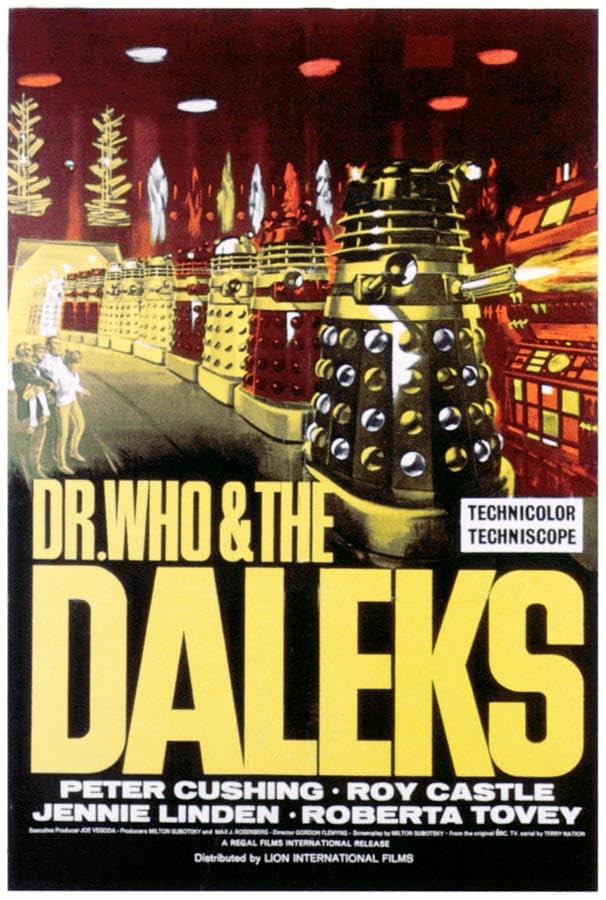
cross-posted from: https://piefed.social/c/bmoviebonanza/p/1795272/dr-who-and-the-daleks-1965-mastodon-watch-party-this-sunday-evening
Starring Peter Cushing, "the guy who blew up Princess Leia's planet!" Yes, Dr. Who and the Daleks (1965) is the movie for this Sunday's "monsterdon" watch party over on Mastodon, our fediverse sibling!
- Just start watching that movie this Sunday, Feb 22 at 9pm ET / 8pm CT / 6pm PT which is 2am Monday UTC
- and follow #monsterdon over on mastodon for live text commentary. For example, you can follow that hashtag here: https://mastodon.social/tags/monsterdon
- I usually open two web browser windows side-by-side on a computer. But you could follow the mastodon commentary on a phone app while watching the movie on TV or something.
How to watch the movie:
- tubi (availability varies by country): https://tubitv.com/movies/547338/dr-who-and-the-daleks
- uBlock Origin adblocker on Firefox should work for that tubi link
- archive (3 minutes shorter?): https://archive.org/details/dr-who-and-the-daleks_202505
- it's usually streamed on https://miru.miyaku.media/ at that time
- if you want to pay and/or watch ads, look here: https://www.justwatch.com/us/movie/dr-who-and-the-daleks or here: https://nobraincellsleft.github.io/JustWatch-Search/title/tm83604
- apparently it's free on Pluto TV but idk wtf that is. I guess you could give it a try here https://pluto.tv/us/on-demand/movies/685972fd2339944cec974634 but idk if adblockers work or they make you sign in or some bs like that
The story is based on the Doctor Who television serial The Daleks, produced by the BBC. Filmed in Technicolor, it is the first Doctor Who story to be made in colour and in a widescreen format. The film was not intended to form part of the ongoing story-lines of the television series. Elements from the programme are used, however, such as various characters, the Daleks and a police box time machine, albeit in re-imagined forms.
...
Halliwell's Film Guide described the film as "limply put together, and only for indulgent children".[12] John Clute, in the book Science Fiction: The Illustrated Encyclopedia, gives the film one star out of three, stating: "Many people would like to see the [Doctor Who] television series back; few mourn the long-gone films".[13] Radio Times was more favourable, awarding the film three stars out of five, commenting: "this spin-off lacks the bite and inventiveness that set the landmark series apart, unwisely injecting humour into the sparse scenario, and the cheap art direction is strictly '101 Uses for Pink Plastic Sheeting'. However, despite the many faults, it's still a fun ride for both the uninitiated and die-hard fans alike".[14]
In The Guardian in 2013, Stuart Heritage stated: "Cushing does his best, but he's not exactly given a lot to work with." He described the Daleks as "so pointlessly toothless here" and also criticised the "incredibly tedious" amount of Dalek dialogue to explain their motives, the portrayal of the Thals, and Roy Castle's performance, saying "to call him hammy would be to provide the greatest disservice to pigs."[15] Andrew Nette of the British Film Institute stated the film was "widely derided by many fans and critics", adding it is "certainly an uneven affair. Some scenes [...] still have the capacity to thrill. Others, like the final victory over the Daleks, feel rushed and flat. The Doctor's granddaughters are largely one-dimensional... The aspect of the movie that most antagonises purists is Cushing's Doctor." Nette described the film as having a "wonderfully pulpy sci-fi atmosphere", saying: "The highlight of the movie is its look... Many of the sets [...] are impressive" and "the movie Daleks are more impressive than their small screen counterparts".[8]
19
20
21
22
23
24
25
view more:
next ›