By most measures, the new GLP-1 pills are underwhelming. Earlier this month, the pharmaceutical giant Eli Lilly debuted a weight-loss tablet that is far less effective than its popular injectable counterpart, Zepbound. Oral Wegovy, which hit the market in December, can hold its own with the shot version—but it has to be taken on an empty stomach with fewer than four ounces of water. And both pills come with many of the same side effects as the shots, namely nausea and diarrhea.

As someone who’s currently on a GLP-1 injection, I still can’t wait to start taking the pills instead. No, I’m not afraid of needles. The injector pens that are used to administer GLP-1s are so quick and painless that sometimes I worry the needle didn’t actually go into my skin. But the shots are a nuisance nonetheless. They’re supposed to be taken on the same day every week, but I struggle to stick to the schedule. The injections also need to be refrigerated—which is especially a hassle whenever I travel. Last month, I visited relatives who don’t know that I’m on a weight-loss drug. I was too sheepish to have a conversation with them about it, so I left the pen in my toiletry bag and didn’t throw it in the trash until I got home.

This might all seem trivial, but a mere annoyance compounds when it must be repeated every week for the rest of your life. Even though many GLP-1 users hit a weight-loss plateau after several months, they have to continue injecting themselves to avoid gaining the weight back. “Over time—particularly as patients transition from the active-weight-loss phase to long-term maintenance—the psychological burden of ongoing injections can become more apparent,” Akshay Jain, a clinical instructor at the University of British Columbia, told me. (Jain has consulted for both Eli Lilly and Novo Nordisk.)

[Read: The Ozempic plateau]

This may be where the true value in weight-loss pills lies. Patients may be able to use the injections to actually lose weight, and then lean on the tablets to keep it off. The pills can be downed with a swig of water just like statins, SSRIs, and so many other pharmaceuticals that are already part of people’s daily routine. On that front, Eli Lilly’s pill, sold under the brand name Foundayo, is especially notable. For most people, the drug doesn’t come with fussy rules about when it should be taken. Doctors I spoke with were enthusiastic about the idea of switching some patients to pills because it allows them to feel as if they’ve made meaningful progress toward normalcy.

So far, doctors just haven’t had very good options for GLP-1 patients who are looking to maintain their weight loss. Some have attempted to switch patients to older weight-loss pills. Others have suggested that patients space out injections to every few weeks. But neither strategy is foolproof. The older drugs have been successfully tested as a way to maintain weight after bariatric surgery, but they haven’t been studied among people coming off of GLP-1s, David Cummings, a professor at the University of Washington, told me. Anecdotal evidence suggests that the method may not be all that effective. “I have a lot of patients that regain all of their weight,” Catherine Varney, the director of obesity medicine at UVA Health, told me. (Varney has done paid speaking gigs for Eli Lilly.) The tactic of taking a GLP-1 shot less frequently, meanwhile, hasn’t been tested in a large randomized clinical trial.

By contrast, a recent clinical trial by Eli Lilly tracked nearly 400 subjects who switched from shots to Foundayo, and found that on average, they maintained most of their weight loss after 52 weeks. (The study has not yet been published in a peer-reviewed journal.) A comparable study hasn’t been done with oral Wegovy, but Novo Nordisk, the company that manufactures the drug, believes that patients should be able to switch from the Wegovy shot without affecting their weight. Because the two drugs are made with the same molecule, “there’s no reason to think that there’d be any difference,” Andrea Traina, the senior medical director for obesity at Novo Nordisk, told me. Doctors told me that they have been encouraged by patients who have already switched from shots to oral Wegovy. “Initial anecdotal reports are promising, but we still need more long data to form conclusions,” Katie Robinson, an assistant professor at the University of Iowa, told me.

All of this comes with a significant caveat. These pills may not remedy the biggest reason people stop taking GLP-1s: price. The new tablets are cheaper than the shots, but they’re still not cheap. If you pay out of pocket, the lowest dose of Foundayo costs $149 a month, which is about half the price of the cheapest version of Zepbound. The Wegovy pill also starts at $149, compared with $199 for the injection. Again, this is $149 every month indefinitely—it quickly adds up. With insurance, the cost of these drugs can be much lower, but few people can count on that. A recent survey of employers found that only about one in five insurance plans at large companies covered GLP-1s for weight loss. The situation gets especially tricky for older Americans. Medicare is technically banned by law from covering weight-loss drugs, though the Trump administration is piloting a program to provide beneficiaries with access.

[Read: The obesity-drug revolution is stalling]

There is hope that the price of Foundayo, in particular, will drop over time because of the way it is manufactured. Unlike all of the other GLP-1s on the market, it is not a peptide—a class of drugs that mimics hormones in the body—which makes it much simpler to produce. But even if the price plummets, not everyone may be as eager to switch to a pill as I am. Everyone who takes a GLP-1 has their own issues that affect whether they stick with their regimen. For some, the once-weekly injection may be more convenient than daily pills; others may want drugs that come with fewer side effects; and still others may just decide to take whatever is cheapest and does the job.

So much of the attention surrounding GLP-1s has been on their remarkable efficacy at shedding weight—and the search for drugs that are even better. Retatrutide, a much-hyped injection that is in the works, can apparently lead to nearly 30 percent loss in body weight on average. But options that lessen the burden of taking a forever drug may matter even more.


From The Atlantic via this RSS feed

submitted 7 months ago by [B] to c/theatlantic@ibbit.at
 

When canceled became a common label applied to basically anyone who’d done anything to offend anyone, it had many unfortunate effects. One was rolling transgressions as serious as sexual assault and as trivial as accidentally not being nice to a fan (maybe) into one bucket of misbehavior. Another was implying that society was run, more than ever, by mob rule. The truth is that the age of consensus has ended, and even the canceled can continue their careers by pitching themselves directly to the public—which is how, for example, the allegedly disgraced Morgan Wallen became the most popular man in country music.

Another consequence was making collective judgment seem cruelly irreversible. Cancel culture, as many a podcaster has ranted over the past decade, offers no obvious path to redemption. Examples of people expressing sincere apologies, changing their behavior, and winning forgiveness have been rare. Transgressors who’ve returned to public life, such as President Trump, have mostly offered denials of wrongdoing and worn their cancellation as a badge of honor.

So when Ye (formerly Kanye West) placed an ad in The Wall Street Journal in January apologizing to “those I’ve hurt,” it was genuinely surprising. A decade ago, after spending years defining the sound of 21st-century hip-hop, Ye began to alienate portions of his listenership by going MAGA. But he remained a bankable celebrity—in a lucrative partnership with Adidas—until 2022, when he went all in on anti-Semitism. He took to shouting out Hitler, selling swastika T-shirts, and otherwise preaching about how Jews control everything and must be stopped. Record labels, brands, and many fans distanced themselves from him.

In the Journal, though, he wrote that this behavior had been the result of an undiagnosed brain injury he’d suffered 25 years earlier. He had “lost touch with reality” but now, armed with a new health routine and outlook on life, had amends to make. “I aspire to earn your forgiveness,” he wrote.

The letter was well written. It conveyed that he’d wrestled with great shame and was humbly offering himself to the world’s mercy. A reader might ask: What if what happened to Ye—mental-health problems giving way to a Third Reich fetish—had happened to me? Wouldn’t I want a chance to make good?

But Ye is not like most people. He’s a celebrity whose words reverberate throughout the culture, and whose reputation is worth a lot of money. In recent weeks, he seemed to be inching his way back into normalcy by releasing an album (Bully) and playing gigs. Then, on Tuesday, the United Kingdom banned him from entry, citing the “public good.” Forgiveness had been the wrong concept to apply to his situation all along. The language of individual morality obscures what so-called cancellations—and ever-elusive uncancellations—really should be about: doing what’s best not for the celebrity but for the rest of us.

The timing of Ye’s apology always seemed a bit convenient. In the same week that the Journal published Ye’s letter, the rapper signed a seven-figure record deal with the media company Gamma. Co-founded by Ye’s former manager Larry Jackson, Gamma is a new music-industry player that’s trying to compete with the major labels. A separate article in the Journal reported that Jackson had discussed Ye’s signing during an all-hands meeting with his staff, some of whom had reservations. The company’s leadership reportedly believed that Ye “was committed to creating music with positive messaging.”

The run-ups to Ye’s albums have traditionally been littered with explosive statements, publicity stunts, and repeated delays. Before his 2024 album Vultures 1, he offered a public apology to Jewish people—then soon doubled down on hating them. By contrast, Bully’s rollout has been serene and slick. Its official release date was pushed back only once, by a week. Ye has given no interviews and posted nothing of note since his January mea culpa.

Until just a few days ago, the low-drama PR strategy seemed to be working. Fans were praising Bully as a heartening return to Ye’s early, soulful sound. Its lyrics contained no inflammatory content. He’d played two sold-out shows at Los Angeles’s SoFi Stadium. Lauryn Hill joined him on stage, and other celebrities were cheering in the audience. Little attention was being paid to the other scandals in his life—such as a lawsuit from his former assistant alleging multiple instances of abuse (he has denied the allegations), which came after previous reports that he’d bullied and harassed employees at Adidas (about which he has not commented).

He was then announced as the headliner for all three days of the Wireless Festival, a long-running and prominent hip-hop event in London. This was the kind of gig that, if it went off without a hitch, would smooth his return to the status of globe-trotting, big-tent pop star.

But not everyone was going along with the rehab plan. After all, less than a year ago Ye was working on openly anti-Semitic music with song titles including “Gas Chambers” and “Heil Hitler.” Creative Communities for Peace and other Jewish groups excoriated the Wireless booking, and PepsiCo dropped its sponsorship of the festival.

The managing director of Festival Republic (which, along with Live Nation, runs Wireless), Melvin Benn, released an impassioned defense of the booking. He identified himself as an anti-fascist and a supporter of Jews. He expressed the view that “forgiveness and giving people a second chance are becoming a lost virtue in this ever-increasing divisive world,” and urged people to “offer some forgiveness and hope to him as I have decided to do.” Ye put out a statement saying that his “only goal is to come to London and present a show of change, bringing unity, peace, and love through my music.” He added that he wanted to meet with members of the Jewish community to listen and learn.

[Read: Cling to your disgust]

That same day, the U.K. government denied Ye’s visa, banning him from coming to the country. Prime Minister Keir Starmer wrote online that he “will not stop in our fight to confront and defeat the poison of antisemitism. We will always take the action necessary to protect the public and uphold our values.” Wireless subsequently announced that it was canceling the entire festival.

The government intervention quickly redefined the conversation around Ye, bringing up questions of free speech and legal precedent (the U.K. generally has less permissive expression laws than the United States, though both countries have lately wielded immigration policy against artists and activists for things they’ve said). It also, predictably, fed the sense of persecution that Ye’s followers have long clung to. On Reddit and X, some fans are griping that their idol is being subjected to harsher punishments than associates of Jeffrey Epstein have been. They are alluding darkly to a conspiracy … by a certain group of people … who seem to control the world …

In a way, though, the decision by Starmer’s government is clarifying. The question of whether Ye should be “allowed” into public life again—meaning given mainstream platforms and institutional support—was never about whether Ye deserved a comeback. He was shunned not because he’d morally transgressed (though he had) but because he’d used his platform to spread dangerous myths about a group of people already experiencing a rising tide of bigotry. His single “Heil Hitler” (which, again, is recent—released in May 2025) became a rallying song for people such as Nick Fuentes, the ascendent influencer who pushes open racism, sexism, homophobia, and anti-Semitism. In 2022, a hate group hung a banner over a Los Angeles freeway that read Kanye Is Right About the Jews.

Speech laws, of course, vary from country to country. And record companies, corporations, and concert organizers can’t stop anyone from saying whatever they want. But institutions can and probably should try to not give money, megaphones, and credibility to someone who might use those things to spread messages that can get people killed.

Making judgment calls about public harm can be tricky, and the process is muddied by the forgiveness-focused language that rules so much of the conversation about celebrity conduct. Ye’s redemption campaign has foregrounded a theme that fits our parasocial zeitgeist: empathy for the individual. Yet while many of us may want Ye to get better, or believe he’s entitled to personal redemption, none of us has any real idea what’s in his heart. All we have is the record of how he’s acted before, and all we can do is make inferences about how he’s acting now.

My inferences say not to trust him, not yet. After spending decades expressing himself in freewheeling interviews, lately he’s mostly shared his thoughts in highly curated statements. On Bully, he raps in bland and mechanical fashion about conquering darkness and achieving a comeback. His lyrics, once outlandishly specific, are now flagrantly generic: “Know the Lord’s intervention was divine / Political and social tensions on the climb.” Listening, I wondered when the real Ye would crash back in and say what he really thinks, for better or ill. Only time and evidence can make that suspicion wane. And the only reason to rush that process is profit.


From The Atlantic via this RSS feed

submitted 7 months ago by [B] to c/theatlantic@ibbit.at
 

This is an edition of Time-Travel Thursdays, a journey through The Atlantic*’s archives to contextualize the present. Sign up here.*

From the window of Orion, home looks like a pale-blue marble slipping under the dark felt of the universe. The four people aboard the spacecraft, now earthbound after finishing their lunar flyby, have traveled farther from our planet than any person has ever ventured, and have seen more of the moon’s far side than any person has ever beheld. The Artemis II crew includes Christina Koch, the first woman to fly around the moon; Victor Glover, the first person of color to journey there; Jeremy Hansen, the first lunar-bound Canuck; and Reid Wiseman, husband to the late Carroll Wiseman, the namesake of a newly identified bright spot on the moon’s surface.

Down here, their space adventure has stirred feelings of awe—“moon joy,” as one NASA officer recently put it. Moon joy at this scale has been on hiatus for the better half of a century. The last crewed lunar expedition was Apollo 17, and it took off in 1972. Artemis II’s voyage has revived a thrilling sensation from missions past: the feeling of inching together toward the edge of new knowledge. If all goes according to plan, there will be an Artemis III and an Artemis IV and an Artemis V, at which point NASA hopes to establish a permanent presence on the lunar south pole. But what will we do with all that moon when we get up there for good?

Humanity’s attitudes toward that great orb in the night sky have shifted over the centuries: A powerful lunar deity morphed into an object of scientific fascination. Later it became a possible arena for war (America considered detonating a nuclear bomb there partly as a show of force against Russia in the late 1950s) and then a real, tangible place, one that few humans have felt underfoot (the Apollo 17 astronaut Harrison Schmitt reported that lunar dust smelled like “spent gunpowder”). During the 54-year lunar-exploration freeze, public interest waned and government funding for more missions dried up. But that didn’t mean everybody suddenly forgot about space—instead, the cogs of economic ambition went right to work. We tried to monetize the moon.

For the handsome fee of $1,600, you too could have shipped a quarter-size object to the moon via Astrobotic Technology’s moon-mail service, announced in 2014. But many mementos were likely lost a decade later when the company’s Peregrine Mission One lunar lander failed to reach its destination and burned up upon reentry to the Earth’s atmosphere—along with other cargo, including, and not limited to, a Bitcoin Genesis Plate, a physical Dogecoin, a sticker from a young space enthusiast, and some copies of Reddit posts, as well as a powdered sports drink whose voyage was sponsored by a Japanese beverage company. (Astrobotic is planning another launch for later this year, and more personal keepsakes will exit the stratosphere in MoonBoxes, which are now sold out.) “The march of human progress has come to an inevitable point in its evolution,” my colleague Megan Garber wrote in 2014. “We’re about to use our celestial neighbor as an enormous billboard.”

The idea of a lunar economy has floated around for years, as humans have searched for resources that could benefit Earth dwellers and future moon dwellers alike: Private companies are intrigued by the financial rewards of harvesting the moon’s rare metals, ice (to use in life-support systems on the moon, or to refine for rocket fuel), and helium-3, a rare-on-Earth isotope that could be used in nuclear fusion, which could in turn replace fossil fuels. In a few years, there may even be lunar Wi-Fi or lunar 4G—NASA tapped Nokia to furnish the moon with its own cellular network, which was operational on the surface for roughly 25 minutes last year.

If we do indeed manage to build a permanent space home for ourselves, we should take care to remember the sentiments that propelled us up there in the first place. Before the moon became a site to push product or dig for profit, the question of why we should visit it in person roused much debate. Two NASA scientists made the case in these pages in 1963, and their reasoning was simple: scientific and technological advancement, political clout, and an appeal “to the imagination of the student.” In other words, by fulfilling our lunar aspirations, not only will we creep closer to unlocking the universe’s secrets—we will also introduce young generations to that great frontier of celestial speculation.

When Buzz Aldrin became the second person to walk on the moon, he took it all in and remarked, “Magnificent desolation.” And it was magnificent—enough to show the precarity of what yokes us to one another, enough to kick-start a worldwide environmental movement to protect what we have now. There will always be those who, understandably, doubt what can be gained from going out there rather than from fixing everything that’s wrong right here. But “human nature is blessed, or perhaps cursed, with an inquiring mind and an itch for adventure, two qualities that may well spring from the same fount,” N. J. Berrill wrote in this magazine a few years after the Apollo program was established.

In a message recorded before his death, the Apollo astronaut Jim Lovell welcomed Artemis II’s astronauts to “my old neighborhood.” Koch, Glover, Hansen, and Wiseman listened to his tape before their lunar flyby, more than 200,000 miles from home. “I’m proud to pass that torch on to you,” Lovell said. “It’s a historic day, and I know how busy you’ll be. But don’t forget to enjoy the view.” His words were a reminder to his fellow space travelers that they come from a short line of people who have peered out at the swirling mass of the universe, and also a reminder to us: to look up instead of down, if only for a little while.


From The Atlantic via this RSS feed


This is an edition of The Atlantic Daily, a newsletter that guides you through the biggest stories of the day, helps you discover new ideas, and recommends the best in culture. Sign up for it here.

Legal opinions tend to be dry, wordy, and intentionally vague. One issued by the Justice Department’s Office of Legal Counsel earlier this month is none of these.

“You have asked whether the Presidential Records Act of 1978 (‘PRA’ or ‘Act’) is constitutional. We conclude that it is not,” Assistant Attorney General T. Elliot Gaiser declares. The law, passed after Watergate, is designed to ensure a reliable and accessible public record. It makes presidential documents public by law, and governs how and when they must be preserved.

If the opinion stands, it will allow Trump to destroy the records of his administration’s actions, or take records with him at the end of his term. Combined with alleged violations of PRA in his first term, this could make Trump the most poorly documented president since at least Richard Nixon, and perhaps going back even further. (As my colleague Henry Grabar writes, the actual library part of his planned presidential library is an afterthought at best.) Yet Trump’s habit of making policy without deliberation, and often with stream-of-consciousness speeches and posts on social media, means that his administration is a paradox: simultaneously one of the most transparent and most opaque in American history.

The Office of Legal Counsel exists to issue sophisticated legal guidance to the White House, and in effect is frequently asked to provide justification for an administration’s actions; perhaps the most infamous instance was the “Torture Memos,” many produced by the OLC’s John Yoo during the George W. Bush administration to justify the use of, well, torture during the War on Terror. And guessing why the Trump administration would want to be rid of PRA isn’t difficult.

Trump and his aides have reportedly broken the law on many occasions. During his first term, he was reported to routinely tear up documents, despite staffers imploring him not to. (Some aides were tasked with painstakingly taping them back together to comply with the law.) In other cases, he flushed papers down toilets. Chief of Staff Mark Meadows reportedly fed documents into fireplaces at the end of the presidency. Trump’s staffers then took boxes and boxes of surviving documents, many of them highly sensitive, when they left the White House. He refused to return them upon request from the federal government, then allegedly attempted to obstruct their recovery. According to photographs included in a federal indictment, Trump haphazardly stored documents in a Mar-a-Lago bathroom and a ballroom stage. Trump pleaded not guilty, and his election led to the case being dismissed, which meant he was never tried on charges of obstructing the investigation, but now he would like to erase the accusation entirely by eliminating PRA.

Former Special Counsel Jack Smith, who investigated the documents case, also believed that Trump wanted to use documents his team took from the White House to further his business interests, according to Democratic Representative Jamie Raskin, who obtained Smith’s memo—in other words, stealing public records to make a private fortune. (Absurdly, Trump’s Justice Department returned to Trump the documents that had been collected from Mar-a-Lago by the FBI.)

The Trump presidency is in some ways unusually transparent. The president takes questions from reporters regularly—sometimes in a gaggle, sometimes in cold calls on his phone. The president is temperamentally unable to keep his own counsel, to the point that French President Emmanuel Macron scolded him last week: “Perhaps you shouldn’t talk every day.” There’s simply less policy process to be recorded in preserved documents, because Trump has drastically shrunk bodies like the National Security Council and replaced them with his id and instincts, chronicled in real time on Truth Social.

Yet if Trump is allowed to destroy or remove documents, the American Historical Association argues in a new lawsuit challenging the OLC opinion, historians “would be left with an incomplete historical record by which to professionally research, produce scholarship on, and teach U.S. history.” They add, “Once lost, this information is irretrievable and thus the harm irreparable.” The suit notes that federal courts rejected similar arguments about the law’s constitutionality immediately after its enactment, when Nixon sued to block it.

The history of Nixon’s presidential record also shows the value of the law, even long after a president leaves office. Nixon loyalists controlled the former president’s library for years, and presented a whitewashed version of Watergate to the public. But the law required that the warts-and-all records be preserved, and when control of the library was finally wrested away and handed to Tim Naftali, a professional historian, in 2006, the library began presenting a more accurate account and providing access to historians, who have in turn presented more complete chronicles of Nixon’s career.

Trump is the most corrupt and scandal-plagued president since Nixon; indeed, his fiascoes eclipse Nixon’s, but many of them remain mostly or somewhat hidden, thanks in part to a much more acquiescent Republican Congress than the one Nixon had. In Watergate, the crimes were known; the question was, in the words of Senator Howard Baker Jr., “What did the president know and when did he know it?” With the Trump administration, the situation is perhaps the reverse: We know much about the president’s stated motivations and beliefs, but we do not have a full accounting of what he and his aides have done. Keeping a record would allow the nation to fully understand his actions and their consequences—if not now, then at least later.

Related:

Tim Naftali: The death of nonpartisan presidential history (From 2022)The Trump Library symbolizes his presidency perfectly.

Here are three new stories from The Atlantic:

Trump made a deal that gives him nothing he wanted.J. D. Vance is definitely against foreign election interference.A new geopolitical reality is here.

Today’s News

President Trump agreed to a two-week cease-fire with Iran last night, pausing planned U.S. strikes. Iran released a 10-point cease-fire proposal that includes demands for U.S.-troop withdrawal, sanctions relief, and the right to nuclear enrichment, many of which conflict with Washington’s position.Iran said it would restrict ship traffic through the Strait of Hormuz during the cease-fire, requiring vessels to coordinate with its military and pay tolls, signaling that Tehran plans to maintain control over the key oil route.Republicans won a Georgia special election, but the district shifted sharply toward Democrats, and liberal candidates secured another decisive victory in Wisconsin’s Supreme Court race last night.

Evening Read

A person piloting a pencil

Illustration by Alisa Gao / The Atlantic

The Literary Job AI Can’t Replace

By Rebecca Ackermann

Nothing seems to make literary-minded people angrier than an author taking credit for writing they didn’t do. A few weeks ago, Hachette canceled the U.S. release of a novel, Shy Girl, following a barrage of online accusations that it had been written with the unacknowledged help of AI …

The collective outrage overlooks a fact that the publishing industry acknowledged long before the rise of artificial intelligence: Not everyone with a great idea or unique story has the skill, experience, or time to write a book—or even a book review. Right now, AI tools are cheap and widespread, ready to tap in with a service that some people do need. But these models have been trained on uncompensated creative labor. They plagiarize. They lie, and they lie about lying. So instead, I’d like to make the case for a frequently maligned profession—one I’ve participated in—that rewards good writing, helps authors survive in an ever more challenging field, and allows remarkable perspectives to reach an audience they otherwise wouldn’t. That’s right: Ghostwriting is good, actually—when it’s done by humans.

Read the full article.

More From The Atlantic

Charlie Warzel: An incredibly weird time to be aliveAmerica looks like a paper tiger.The forgotten war that Iran already wonWhat the astronauts see that Trump cannotThe David Frum Show: What it means to be American

Culture Break
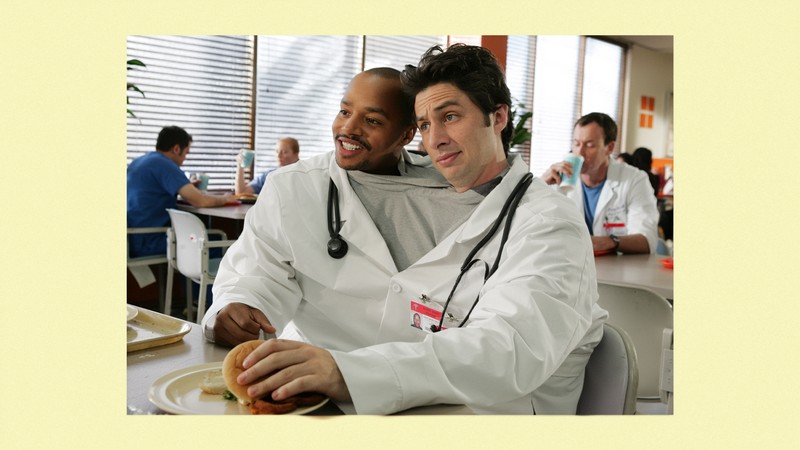
Donald Faison and Zach Braff sharing a single shirt and doctor's jacket, in a scene from "Scrubs"

Touchstone Pictures / Getty

Watch. Scrubs has a sneakily radical vision of male friendship, Julie Beck writes.

Explore. The NBA isn’t the same for everyone, Jemele Hill argues.

Play our daily crossword.

PS

Last month, I wrote about the many instances of waste, fraud, and abuse popping up across the Trump administration. One prime example was a $70 million jet that the Department of Homeland Security had leased and wanted to buy—supposedly for immigrant deportations, even though it included a luxe bedroom cabin. The purchase was too ostentatious even for Trump, and it reportedly played a role in Secretary Kristi Noem’s ouster. But that doesn’t mean the administration is letting the plane go. The Wall Street Journal reports today that the government will hold on to the jet, making it available to First Lady Melania Trump, among others. Noem, it seems, was more a symptom than a cause of the administration living the high life on taxpayer dollars.

— David

Rafaela Jinich contributed to this newsletter.

When you buy a book using a link in this newsletter, we receive a commission. Thank you for supporting The Atlantic*.*


From The Atlantic via this RSS feed


Service in wartime has long been a reliable path for Americans denied full citizenship to secure their rights. Black troops’ contributions to the Union cause during the Civil War helped convince Abraham Lincoln of the righteousness of extending suffrage to Black men. Women’s work on the home front during World War I persuaded a reluctant Woodrow Wilson to urge passage of the Nineteenth Amendment as a “war measure.” The military’s repeal of Don’t Ask, Don’t Tell was followed a few years later by the Supreme Court’s recognition of the marriage rights of same-sex couples.

Perhaps the Trump administration is hoping the process works just as well in reverse.

Despite the conflict with Iran and other recent military activity overseas, the Pentagon seems focused on purging minorities and women. Last week, NBC News reported that Defense Secretary Pete Hegseth had intervened to block or delay the promotions of more than a dozen Black and female senior officers. According to both NBC and The New York Times, some officials are concerned that officers are being targeted because of their race, gender, or perceived political affiliation. In one instance last year, Hegseth’s chief of staff, Ricky Buria, bluntly stated that “President Trump would not want to stand next to a Black female officer at military events,” the Times reported. (Buria denied this.)

The Pentagon told NBC and the Times that promotions under Hegseth are “apolitical and unbiased.” Nevertheless, the episode is part of a broader pattern. So far, Trump and Hegseth have dismissed or forced the retirements of several high-ranking Black and/or female officers: General C. Q. Brown as chairman of the Joint Chiefs of Staff; Admiral Lisa Franchetti as chief of naval operations; Lieutenant General Telita Crosland as head of the Defense Health Agency; and most recently Major General William Green as the Army’s chief of chaplains. Hegseth has publicly said that “our diversity is our strength” is the “dumbest phrase in military history.” By erasing Defense Department histories of nonwhite service members, and seeking to restore tributes to Confederate soldiers who took up arms against their country in defense of slavery, Hegseth has demonstrated a limited view of whose service is to be honored.

Trump is likely also seeking to ensure that remaining officers lack any qualms about following potentially illegal orders. Both he and Hegseth have long seen war crimes as worthy of admiration rather than scorn. As far back as 2016, Trump was regaling audiences at rallies with apocryphal stories about an American general shooting Muslims with bullets coated in pig’s blood. In 2020, he fantasized about turning the military’s guns on American citizens, but faced opposition from the leadership at the Pentagon. Yesterday morning, Trump publicly threatened to destroy Iran’s “whole civilization” and target civilian infrastructure, both war crimes. He subsequently backed down, handing Iran the ability to charge tolls for ships passing through the Strait of Hormuz; passage was free prior to the American attack.

Enlisted service members are disproportionately nonwhite compared with the U.S. population as a whole, while officers are disproportionately white. Women are also serving in larger numbers than ever before: About a fifth of active-duty military personnel are women. Yet Hegseth has long been dismissive of women’s service, particularly in combat roles, and once wrote that, under leaders like Brown, “black troops, at all levels, will be promoted simply based on their race” (this is called confession by accusation). Hegseth seems to want the pool of high-ranking officers to be even less diverse than it already is, having complained in his book that “America’s white sons and daughters are walking away” from the military. And he and Trump seem to be purging not only women and people of color, but officers who see them as equally capable—such as the Army chief of staff, General Randy George, who was fired after reportedly refusing to remove several Black and female officials from the promotion list to general.

[Adam Serwer: The war-crimes president]

Hegseth infamously claimed at the beginning of his tenure that promotions in the military would be “color-blind and merit-based.” It is now clear that this was not true. During his confirmation hearing, Hegseth was unable to provide any evidence whatsoever that the military had lowered standards in the name of diversity. If that is the case, then why have we seen so many well-qualified Black and female senior officers dismissed? Why did the Pentagon, for no plausible reason other than animus, expel trans service members after years of honorable service? “Color-blind and merit-based” now appears to have been a smoke screen for a politically motivated purge of not only Black people and women from leadership positions, but white officers who value their service.

The message being sent to lower-ranking officers is that they will be assessed on the basis of their gender, race, or politics, rather than their abilites—which will cause many officers to leave rather than stay and be mistreated, and many potential officers not to enlist to begin with. It is hard to deny the full benefits of citizenship to those who are willing to fight and die for their country; it is easier if that sacrifice is minimized or erased. Rewarding or punishing officers based on race, gender, or perceived political loyalty to Trump could also aid the administration’s larger project of undermining the claims of women and ethnic and religious minorities to equal treatment under the law in other parts of American society.

The progress earned by ethnic minorities and women in the armed services was hard-won. During the Civil War, Frederick Douglass argued that Black men’s service in the Union Army would strengthen their demands for equal rights. “Let the black man get upon his person the brass letters U.S.; let him get an eagle on his button, and a musket on his shoulder, and bullets in his pocket, and there is no power on the earth or under the earth which can deny that he has earned the right of citizenship in the United States,” Douglass said in 1863. “Nothing can be more plain, nothing more certain, than that the speediest and best possible way open to us to manhood, equal rights, and elevation is that we enter this service.”

Douglass was right, although the process was not as straightforward as he might have hoped. Black service helped justify the passage of the Reconstruction Amendments, but Reconstruction saw Black men disenfranchised and subjected to Jim Crow segregation. W. E. B. Du Bois made a similar argument for Black service in World War I. Returning Black veterans were subjected to horrific racist violence that ultimately strengthened Black resolve. Only after World War II—and over the objections of much of the brass—was the military integrated, and then only after an exhaustive internal investigation disproved racist assumptions that Black troops could only fill menial roles or serve in segregated units.

“Insofar as a service refused to a single Negro the technical training and job for which he was qualified, by just so much did the service waste potential skills and impair its own effectiveness. Quite apart from the question of equal opportunity, the Committee did not believe the country or the military services could afford this human wastage,” the final report from the Truman-era President’s Committee on Equality of Treatment and Opportunity in the Armed Services reads. “The Committee found, in fact, that inequality had contributed to inefficiency.”

[Adam Harris: The only thing integrating America]

Another way to put it is that overt racial discrimination and stereotyping made the military worse, not better. But that was before Hegseth, and his insistence that the problem with the armed services is that they are too diverse and too “woke.”

The result has been something like an inverse caricature of Republican complaints about diversity, equity, and inclusion, a system in which the incompetent rise not because of their abilities but because of their sycophancy. Authoritarian regimes behave as the Trump administration is behaving—optimizing for political loyalty rather than competence. Merit, in short, has little to do with it.

Hegseth is a prime example. Deeply unqualified for the job and convinced that brutality provides an easy path to victory, he has led the United States to the verge of a strategic defeat with a weaker adversary in Iran. The current cease-fire leaves Iran with a more hard-line government than before, one in total control of a shipping lane crucial to the world economy. The Islamic Republic is arguably in a stronger position today than it was when the war started, and probably in a stronger position than it was before Trump, in his first term, scrapped the Obama-era nuclear deal.

On Sunday, Trump posted on his social network a refrain that he and his toadies seem to think is insightful: “If you import The Third World, you become The Third World!” This archaic social Darwinism is the ideological mortar of the Trump project. It fuses Hegseth’s disdain for diversity in the military’s senior leadership and valorization of brutality with the administration’s attack on birthright citizenship and its deployment of federal agents to occupy American cities. It is a worldview that would assume an easy victory against a country like Iran, especially with America’s new, “unwoke” military. Bigotry isn’t just inefficient, as the U.S. military discovered in the 1940s. It also makes you stupid.


From The Atlantic via this RSS feed

view more: next ›