
1


I Wish I Didn’t Care About 'Marathon' Player Numbers, But I Do

For the last month Joseph and I have been playing as much Marathon as we can fit into our busy lives. During the pandemic, we bonded over playing Call of Duty: Warzone, and we’ve been chasing that high for years with little success. Bungie’s new extraction shooter finally gave it to us.

We should be happy, and we are as long as we’re focused on the game we’re playing and not the industry that’s collapsing around it. Marathon’s commercial success, measured by outsiders mostly by the number of people Steam shows is actively playing the game at any given moment, has no bearing on our enjoyment. But I can’t help but follow those numbers because they are a reminder of how brutal the video game industry is right now, where it might be headed, and how viable Marathon and games like it are in the future.

We don’t know how much Marathon cost to develop or what Sony Interactive Entertainment, which owns Bungie and is publishing the game, wants from it. The game has been a critical success, has reportedly sold 1.2 million copies, and players who have latched onto it like myself love how Bungie has been updating and balancing it after release. People are making horny fan art of Marathon characters.

At the same time, I watch the number of concurrent players on Steam, currently hovering at between 20,000 and 30,000, and fret. Is that enough for Sony to support Marathon for the long haul, and is it enough for the rest of the industry that’s watching this unfold to decide that the kind of player who enjoys a game like Marathon is still worth catering to?

Whether 20,000-30,000 concurrent players is a good number or not is relative and ultimately a decision only Sony can make. More than 19,000 games released on Steam in 2025 and only 6,000 of them earned more than $100,000. With at least tens of millions of dollars worth of sales on Steam alone, Marathon is one of the highest earning games on that platform. Marathon’s numbers are also considerably higher than Sony’s other big competitive shooter, Concord, which barely cracked 700 concurrent players on Steam before it was shuttered in 2024, barely a month after it was released. Highguard, another multiplayer shooter that was unveiled at the end of 2025’s Game Awards, also shuttered just a bit over a month after it launched. It peaked at almost 100,000 concurrent players on Steam, but it was free to play.

One might naively assume that the basic math at Sony would be to see how much Marathon cost to develop and maintain, see how much money it’s making after launch, and to keep the party going as long as it’s turning a profit. The reality is probably a bit more cynical and complicated than that. Bungie is a big studio that employees hundreds of developers that Sony acquired for $3.7 billion. One line item on Marathon’s budget that’s extremely hard to calculate is the opportunity cost of Bungie making Marathon as opposed to the next Fortnite, now that it’s becoming increasingly clear that Marathon will not be doing Fortnite numbers.

That doesn’t mean there isn’t a tremendously profitable business to be had there, given some patience and care. Ubisoft launched Rainbow Six Siege in 2015 to a tepid response, but has turned it into a decade-old cash cow with consistent support, updates, and a devious loot box-based monetization scheme. It essentially did the same thing for For Honor, a melee multiplayer game that I bet you forgot existed but that’s been going since 2017.

But Sony is a publicly traded company that wants to show quarter over quarter growth, and a modestly healthy profit that also happens to keep hundreds of game developers employed is not what shareholders are salivating over. Sony wants to do Fortnite numbers, which is a very tall order considering that even Fortnite isn’t doing Fortnite numbers anymore.

Our friends at Remap Radio have spoken at length about why discussions about player numbers teach us little about games and are often toxic. Part of the reason that games like Concord and Highguard can crash and burn so quickly is that the numbers become a self-fulfilling prophecy. There’s skepticism about the game before it launches, and when it fails to go viral, people write it off because why would they invest their time in an online game with player numbers that signal imminent and unceremonious execution by its financial backers, which only leads to even lower player numbers. It also shifts the conversation entirely away from what the game is, what people like about it, and why, and to its business model, infecting players with the quarterly earnings report view of the world. Games and players become expressions and subjects of business models, and the part where we play games because we enjoy them are reduced to a curious byproduct of Sony’s Earnings Before Interest, Taxes, Depreciation, and Amortization. Games from major publishers become either mega hits or are quickly slapped with the “dead game” label before they’re taken offline. What the game actually was is barely relevant.

Everyone I’m playing Marathon with is aware of the player numbers anxiety but is responding to it in different ways. Most of us are doing armchair video game industry analysis, while others are actively trying to enjoy Marathon’s popularity while we can precisely because it may be fleeting and eventually unavailable to play. Some of us are buying in-game cosmetic items not because we want them that bad, but as a signal to Sony that there’s money to be made here.

Adding to this player count anxiety is the fact that the video game industry appears to be going through what is increasingly looking like a proper crash. I don’t think we’ll ever have another near extinction event like the video game crash of 1983, where for a moment it didn’t seem like video games would even continue to be a thing, but a full one third of game developers in the U.S. were laid off last year, and the huge layoffs just keep on coming.

The question of whether Marathon is a viable business for Sony naturally leads us to the question: What business does Sony even want to be in going forward? Is it a business that’s in continuity with the games we grew up playing on the PlayStation and PlayStation 2, or will the market force it to chase something like Roblox or other free-to-play models? Can this continuity even exist when a PlayStation 5 Pro now costs $899 and a PlayStation 6 will cost more? Those are prices for 30 and 40 year-olds with disposable income, not the younger audiences game publishers need to be winning over now for their future business. Sony and other video game publishers are already losing them to different kinds of games and forms of entertainment.

“Marathon's low gravity, bouncy physics, and methodical boot clunks echo Master Chief's graceful, weighty gait circa 2004. It's got modern conveniences like aim-down-sights, sprinting, sliding—and yet Marathon evokes a more civilized age,” Morgan Park wrote in his excellent review in PC Gamer. “Those qualities make it more accessible to a range of people who struggle to keep up in faster games while maintaining a skill range in other disciplines: timing, positioning, and perception. It's fairly easy to track targets, but you're still rewarded for nailing headshots, taking the high ground, and utilizing shell abilities. Does that make Marathon an unc game?”

pic.twitter.com/WgxIBEHd3g

— 定 (@de3dsoul) March 19, 2026

To answer Park’s rhetorical question for him, yes, Marathon is in fact an unc game, which explains both why I like it so much and why I’m worried about its future. As you probably know, unc, short for uncle, is a way to jokingly refer to old, potentially out of touch people. As far as I can tell, it entered the video game discourse in the form of this meme in which a soyfaced unc excitedly points at the hall of fame of so-called “unc slop,” or, in other words, games that old people say are very good. Some of the games in this collage of video game box art includes Half-Life 2, Dawn of War, World of Warcraft, STALKER, Mass Effect, and Star Wars: Knights of the Old Republic. Or, many of my favorite games of all time.

Marathon could easily fit in that collage. It’s excellent, and, I worry, catering to a dwindling audience of uncs who are having a great time while the culture and business of video games is largely moving on and eventually leaving them behind.


From 404 Media via this RSS feed

2


Iran Is Winning the AI Slop Propaganda War

An AI-generated LEGO movie out of Iran depicting Trump as a war hungry pedophile has gone viral online. The video is the work of Iran-based propagandists called the “Explosive News Team” and is just the latest in a long line of AI-generated LEGO videos aimed at mocking Trump and Benjamin Netanyahu. LEGO-themed propaganda isn’t new and the Iranian video plays on familiar wartime propaganda themes. What’s different in 2026 is speed and scale.

During World War II, the Korean War, and the Vietnam War, America’s enemies littered the battlefield with pamphlets, cartoons, and radio broadcasts aimed at shaking the morale of American troops, but that stuff rarely got back home. Now, Iran can use AI tools to produce lavishly animated cartoons at scale for dissemination across social media all aimed at the US homefront.

The latest “Explosive News Team” video is set to a catchy rap song about how Trump is a LOSER and millions of people are watching it across multiple platforms. At the same time Iran is releasing AI-generated videos of Trump drowning in a river of blood, the US Department of Homeland Security is sharing fashwave filtered pictures of Gen Z ICE agents milling around airports.

Iran’s use of LEGO set rap music tells me it’s been studying us. These are videos meant for the American people crafted in a language Iran knows we’ll understand.

Meanwhile, the White House is dropping Grand Theft Auto and Call of Duty memes that were out of fashion 10 years ago on Reddit and vague-posting pixelated images of Trump like it’s running an ARG. Iran is attempting to speak to the broader American public. Trump is confident he only has to impress the online freaks he thinks still love him.

In other words, there’s a AI slopaganda proxy war playing out, and Trump is speaking only to people whose brains are rotting out of their skull, while Iranian propaganda is currently doing a better job of speaking to the concerns of the broad American population than the American president. Trump continues to narrowcast to his base while losing support for his wildly unpopular war as Americans worry about skyrocketing gas prices, a tanking economy and stock market, insane lines at airports, and a war that has little rationale and apparently no real goal. A recent Pew poll found 61 percent of Americans disapprove of Trump’s handling of the conflict.

To be clear, it speaks to how bad things are online that we need to analyze whose AI disinformation and propaganda is “better,” and, in general, the slopification of the internet has been a disaster. And yet, the stuff Iran is making is resonating and spreading online in a way that Trump’s slop is not. We do not know who, specifically, is making the Iranian AI slop or which tools they are using to make it. But the fact that Iranian AI slop is resonating with Americans while American slop is not should perhaps not be surprising; for the last several years, the most successful purveyors of AI slop have largely been based in foreign countries, where they have been incentivized to make content that specifically targets American audiences because of the way that social media ad rates work. Because of that, an entire economy has emerged in which people who would otherwise have little interest in reaching American audiences have been incentivized to study what resonates with Americans on the internet and have created entire businesses focused on teaching other people what Americans care about and how to target them with AI slop.

View this post on Instagram

A post shared by اخبار انفجاری (@akhbarenfejari)

Propaganda, especially war-time propaganda, is about causing a quick emotional reaction in the viewer. Iran has proved remarkably capable of that and hits similar themes in most of its videos: Epstein, Netanyahu, and blood. “The really striking throughline is the 1) connecting victims from Minab to Epstein, 2) a cartoonish antisemitism that attributes the bog-standard reactionary hawkishness of Trump and Netanyahu to a sinister and supernatural evil, 3) heavy emphasis on missiles and revenge-weapons,” Kelsey Atherton, Chief Editor at Center for International Policy, told 404 Media.

“There's a grand tradition of wartime propaganda aimed at convincing the other side to quit and I think Iran's best falls into that camp, like North Korea and especially North Vietnam sending pamphlets aimed at getting black soldiers to defect by highlighting inequity at home,” Atherton said. “Iran's online propaganda is trying to activate this by (charitably) appealing to class war and (uncharitably) leaning on antisemitism to get US soldiers to quit and to erode support among Americans watching short-form vertical video.”

In one AI-generated video shared by Russian state controlled news organization RT depicts victims of American military campaigns staring at the sky. It begins with an American Indian then cuts to a boy in Hiroshima, a schoolgirl in Minab, a little girl in front of the bizarre temple on Epstein’s Island, and ends with US-assassinated Quds Forces leader Qasem Soleimani.

US Under Secretary of State Sarah B Rogers attempted to critique the video in a post on X. “You do see common propaganda threads here and elsewhere: the ideology is resentment-driven, civilization-skeptical, and obsessed with upending, cathartic violence enacted by the ‘historically downtrodden’ (ie ‘wretched of the earth’),” she said.

The post felt like projection and was especially strange given the Trump administration’s own resentment driven ideology, destruction of institutions, and obsession with revenge-driven violence on behalf of the “forgotten man.” Iran did not start America’s war with it. And it did not start the AI-generated propaganda war, it’s just doing it better than the United States.

There are other echoes of the past. An AI-generated Iranian riff on Pixar’s Inside Out shared on X by Iran’s embassy in the Hague showed a Disneyesque version of the inside of Trump’s brain. It showed frothing demons demanding the President lie to the press. A poster from World War II depicts an X-Ray photo of Hitler’s Brain filled with skeletons and snakes. It’s the same theme in different eras using different tools.

LEGO bricks, too, are a far older propaganda tool than the current war. The Danish bricks are one of the most recognizable toys on the planet. Last year, Russian propagandists circulated images of fake LEGO sets depicting soldier’s funerals ahead of an election in Moldova. In 2020, the Chinese released “Once Upon a Virus,” a LEGO short film that mocked America’s response to the Covid pandemic.

In memory of the 168 innocent schoolchildren of #Minab whose lives were cruelly taken by the most evil people on earth.Their names may fade from the headlines, but they must never fade from our conscience.#StandWithIran#WarCrime#مدرسه_میناب pic.twitter.com/sCG2kpfM71

— ☫ Iran Embassy in The Hague, The Netherlands (@IRAN_in_NL) March 12, 2026

The Trump administration’s new fascist aesthetic is defined by AI slop. From Studio Ghibli-inspired grotesques to AI-generated Sora videos of ICE raids that never happened going viral on Facebook, Trump and his supporters are also using the tools of the moment to churn out crappy propaganda. The difference is that Trump’s videos aren’t about winning hearts and minds, they’re about activating a rapidly diminishing base of supporters.

“I think Trump's stuff is aimed at the same audience, except to convince them that what they're doing is righteous and good,” Atherton said. “Obviously we're seeing the stuff put out in English to English video-watching audiences but White House videos—AI or otherwise—are like group-chat in-jokes aimed at keeping cohesion. It's not an AI video but the Wii Sports/snuff film one is so skin-crawling that it requires the audience to be cooked in the feverswamps.”

The Trump administration has bet big on video game memes as the vehicle for its propaganda efforts. Last October DHS depicted Halo’s Master Chief as an anti-immigrant killer and compared immigrants to a ravening horde of mindless monsters. Two weeks ago it published a now-deleted video that mixed footage from Call of Duty with missile strikes in Iran. White House Communications Director Steven Cheung posted the infinite ammo cheatcode for Grand Theft Auto: San Andreas above footage of airstrikes.

Video games are incredibly popular in the United States, but many of these memes require a level of familiarity with specific games and the culture around them. LEGO, by contrast, is instantly recognizable to most of the world.

JUSTICE THE AMERICAN WAY. 🇺🇸🔥 pic.twitter.com/0502N6a3rL

— The White House (@WhiteHouse) March 6, 2026

On March 5, the White House’s X account posted a video mixing American pop culture figures like Walter White, Optimus Prime, Super Man, and Tony Stark with footage from the war. Watching it, I was reminded of a moment from six years ago after America assassinated Soleimani during the first Trump administration.

On an Iranian television show, Cleric Shahab Moradi called in to share his thoughts on how Iran could strike back. Who might Iran attack that has the same cultural purchase as Soleimani did in Iran? Who were America’s heroes? “Think about it. Are we supposed to take out Spider-Man and SpongeBob? They don't have any heroes,” Moradi said. “We have a country in front of us with a large population and a large landmass, but it doesn't have any heroes. All of their heroes are cartoon characters—they're all fictional.”

And so Iran has chosen to speak to Americans in a language it thinks we’ll understand: with cartoons and LEGOs.


From 404 Media via this RSS feed

3


Police Used Flock to Give a Man a Traffic Ticket

Georgia State Patrol used its system of Flock automated license plate reader (ALPR) surveillance cameras to issue a ticket to a motorcyclist who was allegedly looking at his cell phone while riding, according to a copy of the citation obtained by 404 Media. The incident is notable because Flock cameras are not designed for traffic enforcement or minor code violations, and many jurisdictions explicitly tell constituents that the cameras will not be used for traffic enforcement.

The incident happened December 26 in Coffee County, Georgia. The ticket lists the offense as “Holding/supporting wireless telecommunications device,” and includes the note “CAPTURED ON FLOCK CAMERA 31 MM 1 HOLDING PHONE IN LEFT HAND.”

Police Used Flock to Give a Man a Traffic Ticket

A spokesperson for the Georgia State Patrol told 404 Media that the ticket was issued because of a “unique circumstance” in which a Flock camera happened to capture a traffic infraction, and that Flock cameras are not usually used by the department for traffic enforcement.

“This incident was a rare and unique circumstance where the captured image from the camera exposed an additional violation beyond the vehicle’s expired registration,” the spokesperson said. “This situation does not reflect a standard enforcement endeavor by the Department of Public Safety.” The traffic citation obtained by 404 Media does not mention that the man’s registration was expired.

Still, the incident is notable because Flock cameras are often pitched to police as tools for solving serious crimes, finding stolen vehicles, and locating missing people. They distinctly are not traffic cameras and are not pitched as such; the use of a Flock camera in this way shows that the images they capture can sometimes be detailed enough to be used as the pretext for a traffic violation, anyway.

Many police departments go out of their way to tell community members that Flock cameras are not used for traffic enforcement. For example, the City of Glenwood Springs, Colorado, states in a FAQ that “GSPD [Glenwood Springs Police Department] does not use Flock cameras for traffic enforcement, parking enforcement, or minor code violations.” El Paso, Texas, tells residents “these are not traffic enforcement cameras. They do not issue tickets, do not monitor speed, and do not generate revenue. They are investigative tools used after crimes occur.” Lynwood, Washington tells residents “these cameras will not be used for traffic infractions, immigration enforcement, or monitoring First Amendment-protected expressive activity” (Flock cameras have now been used for all of these purposes, as we have reported.)

The fact that police in Georgia did use Flock cameras for traffic enforcement highlights yet again that, essentially, law enforcement agencies are able to use these cameras for whatever they want. There are very few limitations on what Flock cameras can be used for, and police do not get warrants to search Flock’s network of cameras, either locally or nationwide. Network audits, which are spreadsheets of Flock searches we have obtained via public records requests, have shown that police use Flock for all sorts of reasons; they often do not list any reason at all for searching a license plate.

The man who was cited in Georgia posted about the incident in an anti-Flock Facebook group asking for advice. He said that he showed up in court and the ticket was dropped. The man did not respond to multiple requests for comment from 404 Media and because he is a private citizen cited for a minor traffic violation, we are not naming him. 404 Media independently obtained the citation.


From 404 Media via this RSS feed

4


🌘Subscribe to 404 Media to get The Abstract, our newsletter about the most exciting and mind-boggling science news and studies of the week. Why It's Good to Jack Off Frequently, According to Science

Regular ejaculation — for example, by masturbation — produces higher quality sperm, a finding that has implications for fertility science and assisted reproductive technologies, according to a comprehensive new study published in Proceedings of the Royal Society B.

It’s well-established that sperm quality in many animals can deteriorate as males age, but less is known about how the age of sperm cells independently impacts reproductive outcomes. To fill in this gap, scientists co-led by Krish Sanghvi and Rebecca Dean of the University of Oxford conducted a meta-analysis of more than 115 studies about human sperm storage that cumulatively involved nearly 55,000 men, as well as 56 studies of 30 non-human species.

“Krish and I have done studies previously on the effects of male aging on fertility and offspring outcomes,” said Dean in a call with 404 Media. “So we have this joint interest in well: can sperm get old? What happens when sperm gets old? Do we see changes in fertility? Do we see changes in offspring outcomes?”

“We are sperm biologists, so these sorts of questions have been interesting to us,” added Sanghvi in the same call.

The results revealed that stored sperm deteriorates over time, resulting in DNA damage, reduced motility, and other defects that can affect fertilization and embryo outcomes. The discovery has implications for optimizing sperm quality for fertility clinics and captive breeding programs in animals, while also raising new questions about the complicated evolutionary mechanisms that govern reproduction across species.

Sperm cells in humans, and many other vertebrates, can be stored for several days in males before they are released through ejaculation or reabsorbed by the reproductive system. Sperm can also survive for several days in the human female reproductive system. Meanwhile, some female animals have evolved to store sperm for extremely long periods in order to optimize the timing and conditions of fertilization; for example, female bats can store sperm for months, while ant and bee queens can store it for years.

“There's so much innovation within the animal world about how to maintain sperm and keep them alive and functioning,” said Dean. “In some species, the female is storing the sperm when the male who she's mated with has long since died, but she's keeping their sperm alive. It's quite incredible.”

The team found that across these species, older sperm was more likely to show signs of deterioration that can influence fertility and embryo outcomes.

“In the animal dataset, we found an effect on fertilized embryos,” Sanghvi said. “Stored sperm led to lesser viability, or embryos actually becoming an offspring, basically, which is an intergenerational, almost evolutionary effect, which I thought was quite surprising. It means that the storage of sperm or abstinence is not only having an effect on the sperm itself, but it's also doing something bad for the embryo at an early stage.”

“We found very weak effects in adult offspring, like offspring lifespan or offspring reproduction,” he added. “Those weren't significant. But at the embryo stage, there was a stronger effect.”

Interestingly, insects that store sperm for weeks or months were able to maintain sperm quality at only a slightly higher level than insects that store it for years, underscoring that these animals have evolved sophisticated adaptations for long-term sperm storage. These amazing techniques across nature could inspire new approaches for future assisted reproduction in humans.

“Recently, there has been a huge boom in research on female reproductive fluids, or ovarian fluids, which are the chemicals in fluids released by females in their sperm storage organs,” Sanghvi said. “They have a lot of proteins that help with DNA repair, or the motility of sperm. They also have a lot of antioxidants, and small RNAs that change how sperm are transcribing their genes.”

“Maybe we can learn: what are the cocktails or chemicals in female storage? And can we actually replicate these molecules?” he added.

The study also sheds light on the possible evolutionary origins of masturbation, which has been observed in humans (a lot) as well as dozens of other species including dolphins, elephants, lions, and many primates. Masturbation may have emerged as a way to avoid leaving sperm in the tank for too long. Indeed, even species that don’t masturbate in the traditional sense of self-stimulation have still been observed offloading sperm in a practice called “sperm dumping.”

Masturbation has “been a sort of mystery,” Sanghvi said. “Sperm are costly to produce. For many animals it involves a lot of fluids, maturation, time, and energy investment. So why just get rid of it? A longstanding hypothesis has been that sperm are deteriorating within males when they are stored.”

“Crabs do something similar,” he continued. “Every time they moult, some crabs will just get rid of all their sperm. So again, why waste all of this? One reason could be that it's getting rid of the stored old sperm.”

In addition to yielding new insights into the evolutionary tradeoffs of sperm storage, the study can inform the best approaches to assisted reproduction in humans, such as in vitro fertilization (IVF).

For example, the World Health Organization currently typically recommends that men undergo two to seven days of abstinence before donating semen in order to boost the number of sperm in the samples. However, the new study suggests the benefits of high sperm quantity should be weighed against sperm quality linked to the age of the sperm, which has implications for human fertility, as well as captive breeding programs for livestock and other animals.

To sum up, to ensure high sperm quality, avoid keeping too much spunk in your junk and regularly evacuate the ejaculate.

🌘Subscribe to 404 Media to get The Abstract, our newsletter about the most exciting and mind-boggling science news and studies of the week.


From 404 Media via this RSS feed
5


RIP Metaverse, an $80 Billion Dumpster Fire Nobody Wanted

A few things on the end of Horizon Worlds, the metaverse that Mark Zuckerberg believed in so much that he renamed his company:

  1. It’s very sad that many of the people who worked on it have been unceremoniously laid off because their leaders appear to have no idea what they’re doing2) lol 3) lmao, even

Who could have possibly predicted this?

When Zuckerberg announced Horizon Worlds not really all that long ago at a batshit livestream in October 2021, I wrote an article called “Zuckerberg Announces Fantasy World Where Facebook Is Not a Horrible Company.” During that livestream Zuckerberg said, “I believe technology can make our lives better. The future will be built by those willing to stand up and say ‘this is the future we want.’” The future Zuckerberg wanted, at that time, was not a future anyone else wanted. But he was bold enough to systematically light roughly $80 billion on fire, not because he was willing to stand up and paint a vision of the future, but because Facebook was mired in various horrendous scandals and because he needed to rebrand his company and needed something shiny to point at to keep Facebook’s stock price up. It is bad when actual economists say that money was thrown “into the toilet.”

Let’s check what I wrote then: “The future Zuckerberg went on to pitch was a delusional fever dream cribbed most obviously from dystopian science fiction and misleading or outright fabricated virtual reality product pitches from the last decade. In the ‘metaverse’—an ‘embodied’ internet where we are, basically, inside the computer via a headset or other reality-modifying technology of some sort—rather than hang out with people in real life you could meet up with them as Casper-the-friendly-ghost-style holograms to do historically fun and stimulating activities such as attend concerts or play basketball.”

Zuckerberg’s bold vision of the metaverse was a place where T-Pain would sell NFTs of imaginary sneakers at concerts attended by people sitting silently in their living rooms with computers strapped to their face, where Wendy’s could do integrated brand deals in which human-shaped avatars without legs could throw baconators at basketball hoops, and where Zuckerberg could pretend to know how to surf. Even on these pitiful metrics, the metaverse failed. “Whatever the metaverse does look like, it is virtually guaranteed to not look or feel anything like what Facebook showed us on Thursday,” I wrote at the time.

Over the last few years, Zuckerberg has found another thing he can ruin via his trademark process of pouring kerosene on huge piles of money and throwing matches at it (perhaps a fun metaverse game?). Zuckerberg’s current bold vision for the future is one in which social media is not social media at all but is instead a bunch of highly customized AI-generated ads delivered to you via an increasingly creepy algorithm. Alongside this, it is a future in which Reality Labs—the division of Meta that created Horizon Worlds—makes AI camera glasses whose main use appears to be harassing women, traumatizing the underpaid content moderators who watch the footage in developing countries, and fashion statements for federal officials whose current mission is kidnapping undocumented immigrants.

The complete and utter failure of the metaverse is a reminder not just of the fact that the future Silicon Valley is force feeding us is not inevitable, but that quite often these oligarchs quite simply cannot relate to real people, don’t know how or why people use their products, and very often have no idea what they’re doing.

I remember the metaverse, crypto, web3 Venn diagram of hype very well—in fact, I remember sitting in meetings where VICE executives proposed renting land in the crypto-focused Decentraland metaverse to build a virtual VICE headquarters (where we all worked before 404 Media). I noted at the time that Decentraland was stupid, and that far fewer people were on Decentraland at any given time than were reading even a failed blog post on the website of our failing company. It didn't matter. The people “willing to stand up and say ‘this is the future we want’” wanted a virtual building in a virtual dead mall, and they got it. Was it because they were so brave and forward looking? Or was it because they were rich and powerful and could say this is the future we, the business people, the business knowers, want?


From 404 Media via this RSS feed

6


CEO Asks ChatGPT How to Void $250 Million Contract, Ignores His Lawyers, Loses Terribly in Court

A judge ordered the reinstatement of a video game developer after he was fired as part of a scheme cooked up by a CEO using ChatGPT. Facing the possibility of paying out a massive bonus to the developer of Subnautica 2, the CEO of publisher Krafton used ChatGPT to create a plan to take over the development studio and force out its founder, according to court records.

The Monday ruling details the bizarre story. Unknown Worlds Entertainment is the studio behind the 2018 underwater survival game Subnautica. The company has since been working on the sequel, Subnautica 2. In 2021, South Korean publisher Krafton bought Unknown Worlds Entertainment for $500 million and promised to pay out another $250 million if Subnautica 2 sold well enough.

Krafton’s internal sales projections for Subnautica 2 looked great, and looked like it would be on the hook for the additional $250 million. In an attempt to avoid paying this, Krafton CEO Changhan Kim turned to ChatGPT for help avoiding paying the developers the $250 million bonus. “As Unknown Worlds prepared to release its hotly anticipated sequel, Subnautica 2, the parties’ relationship fractured,” the court decision said. “Fearing he had agreed to a ‘pushover’ contract, Krafton’s CEO consulted an artificial intelligence chatbot to contrive a corporate ‘takeover’ strategy.”

Kim partnered with Krafton Head of Corporate Development Maria Park and the company’s legal team to work out options. He toyed with finding a reason to fire the founders. According to court records, Park pinged Kim on Slack and told him that attempting to avoid paying the bonus would be legally risky. “Hi CEO . . . it seems to be highly likely that the earn-out will still be paid if the sales goal is achieved regardless of the dismissal with cause,” the Slack message said according to court records. “Therefore, there isn’t much that we can practically gain other than punishment with a simple dismissal alone, whereas I am worried that we may be exposed to lawsuit and reputation risk.”

But the CEO would not accept defeat. “And so Kim turned to ChatGPT for help,” court records said. “When the AI chatbot responded that the earnout would be ‘difficult to cancel,’ Kim complained to Park that the [payout] was a ‘contract under which we can only be dragged around.’”

Kim pressed the chatbot for an answer. “At ChatGPT’s suggestion, Kim formed an internal task force, dubbed ‘Project X.’ The task force’s mandate was to either negotiate a ‘deal’ on the earnout or execute a ‘Take Over’ of Unknown Worlds. They looked to buy time,” court records said. “Kim sought ChatGPT’s counsel on how to proceed if Krafton failed to reach a deal with Unknown Worlds on the earnout. The AI chatbot prepared a ‘Response Strategy’ to a ‘No-Deal’ Scenario.”

This was a piece of ChatGPT’s “Project X” for Krafton:

“a. Preemptive Framing - Repeat that protecting quality and fan trust is the highest priority, undermine the ‘Large Corporation VS. Indie’ framingb. Securing Control Points -* Lock down Steam/console publishing rights and access rights over code/build pipeline through both legal and technical aspects.* For the earn-out freeze, keep room for negotiations through provision stating ‘immediate removal if specific development results are achieved’a. Systematic materials for legal defense - Prepare contract interpretation memorandums, log all communications, seek external consultationb. Team retention - Operation of retention packages for key personnel and rapid backfill pipelines in anticipation of resignation/departure scenariosc. Two handed strategy - Create a structure that allows for both hardball (Legal+ Finance) and softball (Support/Incentives) approaches so moderate factions within Unknown Worlds can push for compromise.”

Kim followed ChatGPT’s advice rather than his lawyers’ advice, according to the court records. The first step was posting a message on Subanutica’s website to get fans on his side. According to court documents, Kim said the goal of the message was to “secure public support from fans and legal validation of our legitimacy.” He then suggested that ChatGPT write it for him. It achieved the opposite of his intended goal. Fans found the message bizarre and worried about the future of the game. Those fears were compounded when Kim fired the game’s original creators and entered into a legal battle with them.

The legal battle is ongoing, but Kim looks set to lose. The judge has ordered he reinstate the fired developers and has exposed the CEO’s flailing use of ChatGPT. Krafton told Kotaku that it was “evaluating its options” regarding the ruling and that it “puts players at the heart of every decision.”


From 404 Media via this RSS feed

7


DOGE Deposition Videos Taken Down After Judge Order and Widespread Mockery

A judge on Friday ordered the immediate removal of a series of depositions of members of DOGE, but not before clips of the depositions, including one in which a member was largely unable to define DEI, went viral and were covered widely, including by 404 Media.

At the time of writing, the depositions are not available on YouTube, where the Modern Language Association had uploaded them. The MLA, American Council of Learned Societies, and American Historical Association, are suing the National Endowment for the Humanities (NEH) and others around DOGE’s cuts of hundreds of millions of dollars worth of grants. Neither the plaintiffs nor the government immediately responded to a request for comment.

💡Do you know anything else about this case? I would love to hear from you. Using a non-work device, you can message me securely on Signal at joseph.404 or send me an email at joseph@404media.co.

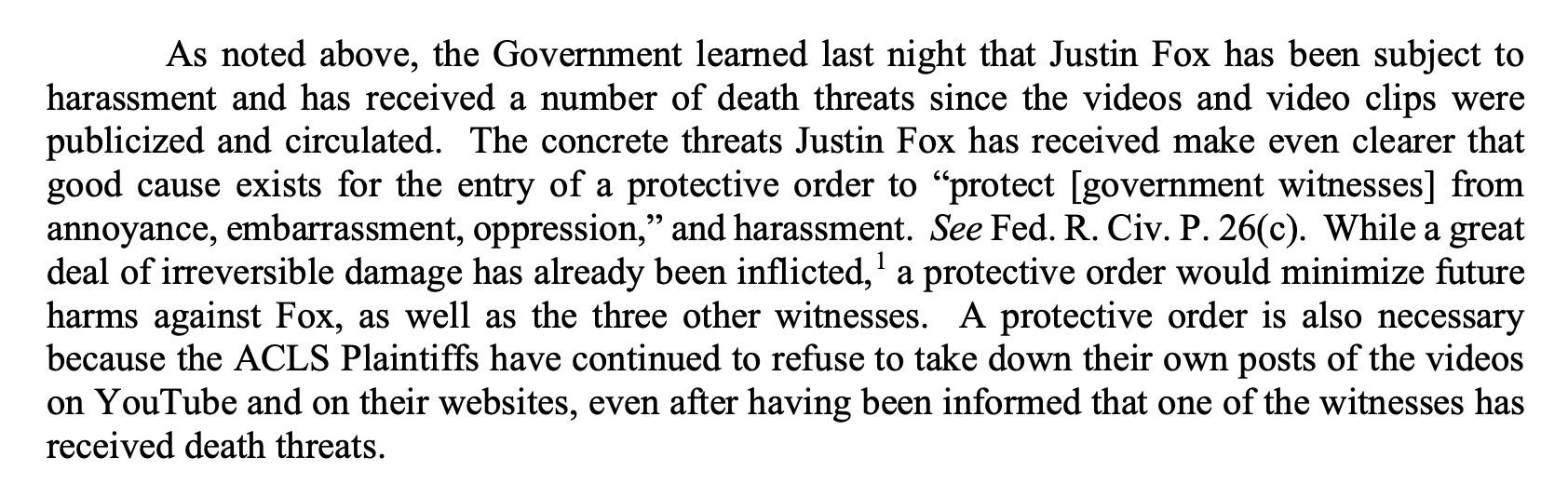
The government recently asked the plaintiffs to remove the videos “from the internet due to concerns that the publication of the videos could subject the witnesses and their family members to undue harassment and reputational harm,” according to a filing from the government on Friday. “Unfortunately, that risk has now materialized—at least one witness has been subjected to significant harassment, including death threats. Accordingly, we respectfully request that the Court enter the requested order as soon as possible to minimize the risk of additional harm to the witnesses and their families.”

DOGE Deposition Videos Taken Down After Judge Order and Widespread Mockery

A screenshot from one of the filings.

The letter then references media coverage, including 404 Media’s specific article I Watched 6 Hours of DOGE Bro Testimony. Here's What They Had to Say For Themselves.

View this post on Instagram

A post shared by 404 Media (@404mediaco)

Specifically, the filing says Justin Fox, whose response to not being able to define DEI went viral, “has been subject to harassment and has received a number of death threats since the videos and video clips were publicized and circulated.”

DOGE Deposition Videos Taken Down After Judge Order and Widespread Mockery

A screenshot from one of the filings.

In response later on Friday, Judge Colleen McMahon ordered the plaintiffs to “immediately take any and all possible steps to claw back the videos of the depositions of the witnesses identified in the Government’s motion,” and said the court will hold a hearing about the issue on Tuesday.

The plaintiffs then filed an emergency motion saying, “Defendants never designated the video depositions in question as Confidential under the Protective Order, and Defendants have never alleged in their correspondence with ACLS Plaintiffs that ACLS Plaintiffs violated the protective order presently in place.”

The judge provided a response later that day, saying the request was “DENIED.”“See you Tuesday,” the court docket reads.


From 404 Media via this RSS feed

8


Cybertruck Tried to Drive 'Straight Off an Overpass' Attorney Claims

A Cybertruck owner in Texas is suing Tesla for $1,000,000 in damages for “ grossly negligent conduct” following an accident on a Houston highway that involved the vehicle’s self-driving feature. According to the lawsuit, Tesla is to blame for the crash because CEO Elon Musk has oversold the truck’s ability to drive itself.

As originally reported by the Austin American-Statesman, Justine Saint Amour bought a Cybertruck from a used car dealership in Florida and drove it until it crashed on a Houston overpass on August 18, 2025. That summer day, Saint Amour was driving down Houston’s 69 Eastex Freeway with the vehicle’s full self-driving (FSD) mode engaged.

“Something terrifying happened, without warning, the vehicle attempted to drive straight off an overpass,” Bob Hilliard, Saint Armour’s attorney, told 404 Media in an emailed statement. “She tried to take control, but crashed into the barrier and was seriously injured—mostly her shoulder, neck, and back.”

Hilliard shared a photo of the aftermath of the crash and dashcam footage with 404 Media. In the video, the Cybertruck proceeds down the highway and hops an intersection instead of turning to the right and following the road. It’s stopped when it slams into a signpost on the overpass.

The lawsuit blames the crash on Musk. “Elon Musk is an aggressive and irresponsible salesman, who has a long history of making dangerous design choices, and over-promising the features of his products,” the lawsuit said. “This promotion of products, for capabilities that they do not have, is the reason for this incident.”

Musk has spent the past few years prompting Tesla’s ability to drive itself, a feature that costs $99 a month and is sold as “Full Self-Driving.” But, the lawyers said, the FSD feature doesn’t work as advertised and it’s irresponsible of Tesla and Musk to market their vehicles as having the feature. “Despite this dangerous condition of Tesla’s ‘self-driving’ vehicles, Elon Musk and Tesla have made representations in the year 2019 that Tesla’s full ‘self-driving’ vehicles were fully operational and safe.”

Tesla and Musk have gotten in trouble for this before. In February, the company agreed it would stop using the terms “autopilot” and “full self-driving" when advertising its vehicles in California. There have been multiple fatal and non-fatal crashes involving Tesla vehicles running on autopilot, including a man who hit a parked police car in 2024. In August, a judge ordered Tesla to pay $200 million in punitive damages and another $43 million in compensatory damages to a family of a 22 year old who died in a crash involving the car’s Autopilot system.

According to the lawsuit, one of the reasons this keeps happening is because Musk intervened directly to make Teslas cheaper by using cameras instead of LiDAR, which uses laser light to create a 3D map of the surrounding area. “Elon Musk’s intervention into the design of Tesla vehicles has long been reckless and dangerous. While engineers at Tesla recommended the super-human vision of LiDAR be included for self-driving vehicles, and competitors like Waymo and Cruise relied heavily on LiDAR, Musk chose instead to rely only upon cheap video cameras,” the lawsuit said. “Musk referred to the LiDAR used by his safer competitors as expensive and unnecessary.”

Fully automated driving is a hard tech problem. LiDAR is better than basic cameras, but they’re still not perfect and LiDAR-based self-driving cars crash too. There are other problems too. In cities operating Google’s Waymo cars, passengers are leaving the doors open and Waymo is contracting DoorDashers to close them for $10 a pop, a Waymo in LA attempted to drive through a police standoff, and woman in San Francisco was trapped in a Waymo after men blocked the car and started to harass her.


From 404 Media via this RSS feed

9


🌘Subscribe to 404 Media to get The Abstract, our newsletter about the most exciting and mind-boggling science news and studies of the week. Scientists Discover Vast Ancient Trade Network That Rewrites History with Parrot DNA

Colorful feathers found in an ancient tomb on Peru’s coast once belonged to parrots captured deep in the Amazon rainforest, reports a study published on Tuesday in Nature Communications. The discovery provides direct evidence of long-distance trade networks that flourished across the Andes centuries before the expansion of the Inca Empire in 1470, proving that these cultures developed sophisticated economic systems capable of transporting live tropical birds across treacherous environments.


From 404 Media via this RSS feed

10


Viral 'Quittr' Porn Addiction App Exposed the Masturbation Habits of Hundreds of Thousands of Users

Quittr, an app that promises to help men stop watching pornography, leaked intimate data on hundreds of thousands of its users, including their masturbation habits, and lied about its security issues, 404 Media can now reveal.

I first reported about Quittr exposing user data in January, but was unable to name Quittr in the story because its creators, Alex Slater Connor McLaren, did not fix its security issues despite multiple requests and an offer from an independent researcher to help them fix the problem. Naming the app while hackers were still able to easily steal Quittr’s user data would have endangered their privacy and put them at risk of extortion from hackers, which is very common today. Some of the data exposed includes the users’ age, how often they masturbate, and how viewing pornography makes them feel. According to the data, many of them are minors.

Quittr is operated by Slater and McLaren, members of the so called App Mafia, a group of men in their early 20s who claim to have made millions of dollars on mobile app development. Slater and McLaren were recently the subjects of a long New York Magazine profile which detailed the opulent lifestyle the success of Quittr has afforded them, including driving exotic super cars and living in a Miami mansion. Slater shares videos about his lifestyle on his personal YouTube channel as well.

Slater claims Quittr has been downloaded more than 1.5 million times and makes $500,000 a month. But despite these incredible numbers, the developers were somehow unable or unwilling to fix a major security flaw in the app for months.

I first learned about the Quittr vulnerability from an independent researcher, who scanned the Google Play Store and Apple App Store for a common misconfiguration in apps that use Google Firebase, an app development platform. The researcher tested hundreds of the top apps on both stores after we published a story about the Tea app suffering a devastating hack due to the same issue. The researcher found dozens of apps had the same problem, including Quittr, but did not name Quittr in his public disclosure because the highly sensitive and personal data could put users at risk.

The researcher said he contacted Slater directly on September 10, 2025 to tell him about the Quittr vulnerability.

“It’s my fault fully I should've been on top of this, the way you pulled the database was super creative,” Slater told the researcher in a series of WhatsApp messages, which 404 Media reviewed. “So props to that, but again this is serious data and is not good at all. Working on fixing rn! Will be fixed in the next hour.”

But Slater and McLaren did not fix the issue for months. I called him in January, told him about some of the sensitive user data I had seen, and asked him why he had not fixed the vulnerability even after he told the researcher he would.

“There is no sensitive information exposed, that's just not true,” Slater told me at the time. “These users are not in my database, so, like, I just don't give this guy attention. I just think it's a bit of a joke [...] after checking with my engineers I saw this was never an issue.”

When I asked Slater why he previously thanked the researcher for responsibly disclosing the misconfiguration and said he would rush to fix it, he wished me a good day and hung up.

After the call, I created an account on the app, which the researcher was able to see appear in the misconfigured Google Firebase, confirming that user information was still exposed. I called, texted, and emailed Slater and any email associated with Quittr I found several times after that call but never heard back. After a week of trying to contact Quittr and repeatedly checking that the app was still vulnerable, 404 Media decided to publish the story without naming the app in order to protect its users while still highlighting an important security issue in a popular app.

Overall, the researcher said he could access the information of more than 600,000 users of the porn quitting app, 100,000 of which identified as minors.

The app also invites users to write confessions about their habits. One of these read: “I just can't do this man I honestly don't know what to do know more, such a loser, I need serious help.”

“We were like, How can we build an app to make money? Then as I realized how large the issue was, that’s when it became more of a passion project, like, How can we help men actually become men again?” McLaren told New York Magazine.

After the New York Magazine profile was published, the researcher checked Quittr again and saw that it fixed its misconfigured database, which is why we’re naming the app now.


From 404 Media via this RSS feed

11


ICE Phishing: Scammers Are Sending 'Support ICE' Emails to Steal Credentials

Clients of a long-running email marketing platform are getting targeted with a phishing campaign telling them that their emails would begin automatically inserting a “‘Support ICE’ donation button” into every email they send. The strategy suggests that scammers are trying to capitalize on people’s revulsion to ICE by coming up with strategies that would cause users to quickly log into their accounts to disable the setting. In reality, clients would be revealing their username and password to hackers.

The move indicates that hackers are targeting clients of enterprise software companies with extremely controversial political emails. The scam targeted customers of Emma, a long-running email marketing platform whose clients include Orange Theory, Yale University, Texas A&M University, the Cystic Fibrosis Foundation, Dogfish Head Brewery, and the YMCA, among others. 404 Media was forwarded a copy of the phishing email from an Emma client.

“As part of our commitment to supporting U.S. Immigration and Customs Enforcement (ICE), we will be adding a ‘Support ICE’ donation button to the footer of every email sent through our platform,” the phishing email reads. “This button will appear automatically in all outgoing emails starting next week […] all emails sent from your account will include the Support ICE footer element […] this change helps us demonstrate our platform’s civic commitment.” The email adds that it is possible to opt out of this feature, and that “we appreciate your understanding as we implement this platform-wide initiative.”

ICE Phishing: Scammers Are Sending 'Support ICE' Emails to Steal Credentials

Lisa Mayr, the CEO of Marigold, which owns Emma, told 404 Media that the company “would never publish anything like this. This is a very common phishing attempt.”

Mayr is right—clients of other email sending services have recently been targeted with similar attacks. In January, programmer Fred Benenson wrote about phishing emails he had gotten that were targeting users of SendGrid, another email marketing service. At least one of the emails Benenson got used the same “Support ICE button” language and has the subject line “ICE Support Initiative.”

“If you’ve been paying any attention at all to US politics, you’ll know how insidiously provocative this would be if it were a real email,” Benenson wrote in a blog post about the email. “This phishing campaign is a fascinating example of how sophisticated social engineering has become. Instead of Nigerian 419 scams, hackers have evolved to carefully craft messages sent to professionals that are designed to exploit the American political consciousness. The opt-out buttons are the trap.”

In SendGrid’s case, Benenson found that the emails looked “real” because they were sent from other SendGrid user accounts. Basically, hackers compromised the account of a SendGrid user and then used that account to send phishing emails using the SendGrid infrastructure. “The emails look real because, technically, they are real SendGrid emails sent via SendGrid’s platform and via a customer’s reputation–they’re just sent by the wrong people and wrong domains,” he wrote.

Besides the ICE-themed phishing emails, Benenson also received an email that said SendGrid was going to add a “pride-themed footer to all emails” and another that said “all emails sent from your account will feature a commemorative theme honoring George Floyd and the Black Lives Matter movement.”

“The political sophistication on display here (BLM, LGBTQ+ rights, ICE, even the Spanish language switch playing on immigration anxieties) suggests someone with a deep understanding of American cultural fault lines,” Benenson wrote.

ICE Phishing: Scammers Are Sending 'Support ICE' Emails to Steal Credentials

The Emma email was sent via Survey Monkey through an email address called “myemma@help-myemma.app.” When users clicked a “Settings” button that would have allowed them to opt out of the feature, they’re sent to a generic-looking site designed to steal credentials hosted at app-e2maa.net. By the time 404 Media got the email, Chrome had detected it as a “Dangerous site” and warned users not to visit it.


From 404 Media via this RSS feed

12


Meta Director of AI Safety Allows AI Agent to Accidentally Delete Her Inbox

Meta’s director of safety and alignment at its “superintelligence” lab, supposedly the person at the company who is working to make sure that powerful AI tools don’t go rogue and act against human interests, had to scramble to stop an AI agent from deleting her inbox against her wishes and called it a “rookie mistake.”


From 404 Media via this RSS feed

13


Pinterest Is Drowning in a Sea of AI Slop and Auto-Moderation

Pinterest has gone all in on artificial intelligence and users say it's destroying the site. Since 2009, the image sharing social media site has been a place for people to share their art, recipes, home renovation inspiration, corny motivational quotes, and more, but in the last year users, especially artists, say the site has gotten worse. AI-powered mods are pulling down posts and banning accounts, AI-generated art is filling feeds, and hand drawn art is labeled as AI modified.

“I feel like, increasingly, it's impossible to talk to a single human [at Pinterest],” artist and Pinterest user Tiana Oreglia told 404 Media. “Along with being filled with AI images that have been completely ruining the platform, Pinterest has implemented terrible AI moderation that the community is up in arms about. It's banning people randomly and I keep getting takedown notices for pins.”

Oreglia’s Pinterest account is where she keeps reference material for her work, including human anatomy photos. In the past few months, she’s noticed an uptick in seemingly innocuous photos of women being flagged by Pinterest’s AI moderators. Oreglia told 404 Media there’s been a clear pattern to the reference material the site has a problem with. “Female figures in particular, even if completely clothed, get taken down and I have to keep appealing those decisions,” she said. This pattern is common on many social media platforms, and predates the advent of generative AI.

“We publish clear guidelines on adult sexual content and nudity and use a combination of AI and human review for enforcement,” Pinterest told 404 Media. “We have an appeals process where a human reviews the content and reactivates it when we’ve made a mistake.” It also confirmed that the site uses both humans and automated systems for moderation.

Oreglia shared some of the works Pinterest flagged including a photo of a muscular woman in a bikini holding knives, a painting of two clothed women in an intimate embrace, and a stock photo of a man holding a gun on a telephone that was flagged for “self-harm.” In most cases, Oreglia can appeal and get a decision reversed, but that eats up time. Time she could be spending making art.

And those appeals aren’t always approved. “The worst case scenario for this stuff is that you get your account banned,” Oreglia said.

r/Pinterest is awash in users complaining about AI-related issues on the site. “Pinterest keeps automatically adding the ‘AI modified’ tag to my Pins...every time I appeal, Pinterest reviews it and removes the AI label. But then… the same thing happens again on new Pins and new artwork. So I’m stuck in this endless loop of appealing → label removed → new Pin gets tagged again,” read a post on r/Pinterest.

The redditor told 404 Media that this has happened three times so far and it takes between 24 to 48 hours to sort out.

“I actively promote my work as 100% hand-drawn and ‘no AI,’” they said. “On Etsy, I clearly position my brand around original illustration. So when a Pinterest Pin is labeled ‘Hand Drawn’ but simultaneously marked as ‘AI modified,’ it creates confusion and undermines that positioning.”

Artist Min Zakuga told 404 Media that they’ve seen a lot of their art on Pinterest get labeled as “AI modified” despite being older than image generation tech. “There is no way to take their auto-labeling off, other than going through a horribly long process where you have to prove it was not AI, which still may get rejected,” she said. “Even artwork from 10-13 years ago will still be labeled by Pinterest as AI, with them knowing full well something from 10 years ago could not possibly be AI.”

Other users are tired of seeing a constant flood of AI-generated art in their feeds. “I can't even scroll through 100 pins without 95 out of them being some AI slop or theft, let alone very talented artists tend to be sucked down and are being unrecognized by the sheer amount of it,” said another post. “I don't want to triple check my sources every single time I look at a pin, but I refuse to use any of that soulless garbage. However, Pinterest has been infested. Made obsolete.”

Artist Eva Toorenent told 404 Media that she’s been able to cull most of the AI-generated content from her board, but that it took a lot of time. Whenever she saw what she thought was an AI-generated image, she told Pinterest she didn’t want to see it and eventually the algorithm learned. But, like Oreglia fighting auto-moderation and Zakuga fighting to get the “AI modified” label taken off her work, training Pinterest’s algorithm to stop serving you AI-generated images eats up precious time.

AI boosters often talk about how much time these systems will save everyone. They’re pitched as productivity boosters. Earlier this month, Pinterest laid off 15 percent of its work force as part of a push to prioritize AI. In a post on LinkedIn, one of the former employees shared part of the email CEO Bill Ready sent out after the lay offs. “We’re doubling down on an AI-forward approach—prioritizing AI-focused roles, teams, and ways of working.”

Toorenent removed all her own art from her Pinterest account after hearing the news that the site would use public pins to train Pinterest Canvas, the company’s proprietary text-to-image AI. But she has no control over other users uploading her artwork. “I have already caught a few of my images still on Pinterest that I did not upload myself…that makes me incredibly mad,” she told 404 Media. “It used to be a great way to get your work seen among other people, but it’s being used to train their internal AI.”

Oreglia told 404 Media that the flood of AI has changed her relationship to a site she once used to prize. “It's definitely affected how I search things and I'm always now very critical about where something came from... although I've always been overly pedantic about research,” she said. “It does make you do your due diligence but it sucks to constantly have to question and check if something is authentic or synthetic.”

She’s thought about leaving the platform, but feels stuck. “I just want to be able to take all my references with me. I've been on the platform for about ten years and have very carefully curated it. It's really nice to be able to just go to my page and search for something I saved instead of having to save everything to folders although I also do that,” she said. “More and more I'm trying to curate and collect physical references too but some of that can take up space I don't have so it can be difficult. Having a physical reference library just seems more and more necessary these days…artists have to be adaptable to this kind of thing these days. It's annoying but not unmanageable.”

Ready has been vocal and proud about the company’s commitment to forcing AI into every aspect of the user experience. “At Pinterest…we’re deploying AI to flip the script on social media, using it to more aggressively promote user well being rather than the alternative formula of triggering engagement by enragement,” Ready said in a January column at Fortune. “Social media platforms like Pinterest live and die by users’ willingness to share creative and original ideas.”


From 404 Media via this RSS feed

14


Waymo Is Getting DoorDashers to Close Doors on Self Driving Cars

Waymo, Google’s autonomous vehicle company, and DoorDash, the delivery and gig work platform, have launched a pilot program that pays Dashers, at least in one case, around $10 to travel to a parked Waymo and close its door that the previous passenger left open, according to a joint statement from the company given to 404 Media.

The program is unusual in that Dashers are more often delivering food than helping out a driving robot. It also shows that even with autonomous vehicles, and the future they promise of metropolitan travel without the need for a driver, a human is sometimes needed for the most simple and yet necessary tasks.

“Waymo is currently running a pilot program in Atlanta to enhance its AV fleet efficiency. In the rare event a vehicle door is left ajar, preventing the car from departing, nearby Dashers are notified, allowing Waymo to get its vehicles back on the road quickly,” the statement said. “DoorDash is always looking for new and flexible ways for Dashers to earn, and this pilot offers Dashers an opportunity to make the most of their time online. Waymo's future vehicle platforms will have automated door closures.”

💡Do you know anything else about this, or anything else we should know about Waymo? I would love to hear from you. Using a non-work device, you can message me securely on Signal at joseph.404 or send me an email at joseph@404media.co.

Waymo said the partnership started earlier this year. It declined to share details about how Dashers are paid, such as whether they may receive tips or which entity is paying for these jobs, but said, “the payment structure is designed to ensure competitive and fair compensation for Dashers.”

(Waymo said the response was on background, but 404 Media never agreed to such a condition. It is standard journalistic practice for both a company and a reporter to need to agree that a conversation is on background or off the record beforehand; this is to prevent companies simply saying something is off the record when answering basic questions.)

404 Media contacted both Waymo and DoorDash for comment after an apparent Dasher posted on Reddit about receiving such a job.

“Craziest Offer,” the thread starts. It includes a screenshot of the DoorDash app, saying the Dasher is guaranteed $6.25 for the work, with $5 extra “upon verified completion.” The job would see the Dasher travel around 0.7 miles, according to the screenshot.

“Close a Waymo door,” the job reads. “No pickup or delivery required.”

DoorDash and Waymo have already partnered on other projects. In October, the companies announced an autonomous delivery service in Phoenix.


From 404 Media via this RSS feed

15


Government Loses Hard Drives It Was Supposed to Put ICE Detention Center Footage On

The legal saga over surveillance footage from within an Immigration and Customs Enforcement detention center in suburban Chicago has reached new levels of Kafkaesque absurdity, with the federal government losing three hard drives it was supposed to put footage on, refusing to provide footage from five critical surveillance cameras, and delivering soundless video of a highly contested visit from Department of Homeland Security Secretary Kristi Noem.

We have repeatedly covered an abuse lawsuit about living conditions within the Broadview detention facility. The federal government has claimed that 10 days of footage from within the facility, taken during a critical and highly contested period, was “irretrievably destroyed” and could not be produced as part of the lawsuit, which was brought by people being held at Broadview in what were allegedly horrendous conditions. It later said that due to a system crash, the footage was never recorded in the first place. The latest update in this case, however, deals with surveillance camera footage that was recorded and that a judge has ordered the federal government to turn over.

For this footage, the federal government first claimed that it could not afford the storage space necessary to take the footage that it did have and produce it for discovery to the plaintiffs’ lawyers in the case. The plaintiffs’ lawyers, representing Broadview’s detainees, then purchased 78 terabytes of empty hard drives and gave them to the federal government, according to court records. This included three 8-terabyte SSDs and three 18-terabyte hard drives.

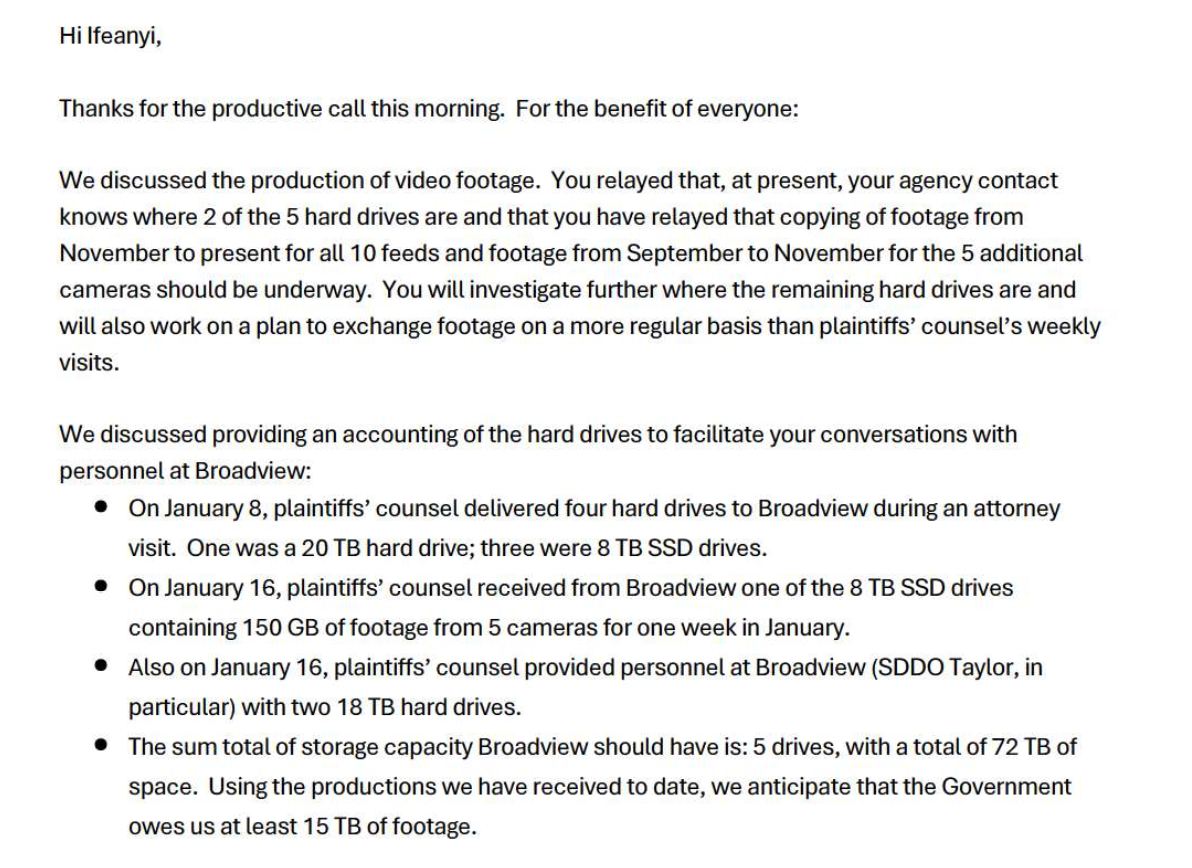
Court records note that “plaintiffs provided defendants with five large hard drives to facilitate Defendants’ production, yet Defendants inexplicably lost three of them.” Emails submitted as evidence suggest that the U.S. government and the plaintiffs’ attorneys had a call to discuss the lost hard drives.

One of the emails sent by plaintiffs’ attorneys to the Department of Justice in late January notes that the government had been exceedingly slow in producing footage, taking weeks to produce just a small amount of footage.

“There should be plenty of hard drive space at Broadview’s disposal,” the email reads. “The team there should currently have in its possession 5 hard drives with 72 terabytes of space, provided by plaintiffs’ counsel at the last 2 site visits. We have received only one hard drive back from Broadview to date. Copying of November/December footage should have taken place over the past week so that it could be delivered to plaintiffs’ counsel today when they visit Broadview this afternoon. At the very least, that footage should be being copied now.”

Government Loses Hard Drives It Was Supposed to Put ICE Detention Center Footage On

The two sides then arranged a phone call, a summary of which was emailed by plaintiffs’ attorneys to the Department of Justice:

“Thanks for the productive call this morning. For the benefit of everyone: We discussed the production of video footage. You relayed that, at present, your agency contact knows where 2 of the 5 hard drives are and that you have relayed that copying of footage from November to present for all 10 feeds and footage from September to November for the 5 additional cameras should be underway. You will investigate further where the remaining hard drives are and will also work on a plan to exchange footage on a more regular basis than plaintiffs' counsel's weekly visits.We discussed providing an accounting of the hard drives to facilitate your conversations with personnel at Broadview: • On January 8, plaintiffs' counsel delivered four hard drives to Broadview during an attorney visit. One was a 20 TB hard drive; three were 8 TB SSD drives. • On January 16, plaintiffs' counsel received from Broadview one of the 8 TB SSD drives containing 150 GB of footage from 5 cameras for one week in January. • Also on January 16, plaintiffs' counsel provided personnel at Broadview (SDDO Taylor, in particular) with two 18 TB hard drives. • The sum total of storage capacity Broadview should have is: 5 drives, with a total of 72 TB of space. Using the productions we have received to date, we anticipate that the Government owes us at least 15 TB of footage.”

Days later, the Department of Justice told the plaintiffs’ attorneys that “they are still searching for those hard drives at Broadview.” The plaintiffs’ attorneys responded: “Losing multiple drives provided to facilitate speedy production is not acceptable,” and “the missing hard drives and lack of production of any footage predating January remains a significant, prejudicial issue.”

A filing by the plaintiffs with the court highlights some of the ongoing issues they have had with the government complying with court-ordered discovery requirements, which includes the lost hard drives, missing footage, footage from only five of the 10 cameras that were supposed to be delivered. A separate filing notes that footage produced by the government from a high-profile visit by Noem is missing audio “despite visible professional microphones and cell phones with audio capabilities in the footage.”

“Plaintiffs have gone above and beyond their obligations under federal law to streamline rolling production of such footage, purchasing expensive hard drives and agreeing to transport and pick up those drives from Broadview during weekly attorney visits. Defendants agreed to this arrangement,” they wrote in the filing. “Yet, Defendants have fallen unacceptably short of their production obligations. Defendants have provided no footage from five of the ten camera feeds […] Defendants have also failed to provide footage for a near-two-month span for the remaining five camera feeds. What’s more, Defendants have purportedly lost multiple hard drives provided by Plaintiffs’ counsel […] There is no excuse for Defendants’ discovery failures.”

The filing notes that the five missing cameras are specifically from detainee isolation cells, “despite those cells being a key part of Plaintiffs’ complaint. The produced feeds show egregious conditions but were insufficient to provide Plaintiffs the discovery necessary to fully investigate their claims.” These cells were designed to hold one person at a time, but were allegedly being used to hold multiple detainees at a time during a critical period that the lawsuit covers; “such cells are also where ICE holds detainees with acute medical or mental health conditions, including those who have suffered medical emergencies while in detention, and where it holds detainees who have been subjected to use of force by ICE officers while inside the facility,” they add.

The filing says that the plaintiffs learned that the government lost the hard drives in late January, when the government claimed that it had returned all of the hard drives to the plaintiffs’ attorneys, and that it had run out of storage space with which to provide them court-ordered footage.

“On January 28, Defendants’ counsel relayed that Broadview personnel had advised that they were out of storage space on drives provided by Plaintiffs, reporting that all hard drives provided by Plaintiffs had been returned to them. This was the first indication that some or all of 70 terabytes’ worth of hard drives were unaccounted for,” they wrote. “In the days since, the Government has admitted that it cannot find three of the five hard drives that should be in its possession.”

“Plaintiffs are waiting on months of footage. Every day that passes without this evidence compounds the prejudice to Plaintiffs’ ability to prepare for the upcoming hearing. Defendants’ foot dragging and poor organizational practices—and their instinct to rely on Plaintiffs to take the laboring oar for the purchase, delivery, pickup, and return of storage devices to facilitate Defendants’ discovery obligations—cannot be permitted.”


From 404 Media via this RSS feed

16


Erotic Parody 'Melania: Devourer of Men' Sales Surge on Amazon Amid Documentary Flop

The $75-million, Amazon-funded Melania Trump documentary is tanking at the box office, but a 2018 erotic thriller that depicts the First Lady as a sexual monster is rocketing up Amazon’s sales charts. Melania: Devourer of Men is currently an Amazon bestseller, sitting at number 3 in the “political thrillers & suspense” category in the Kindle store. A general search for "Melania" on Amazon returns a banner ad for the documentary, the First Lady's memoir, and the erotic thriller as the top results.

A Reddit-led campaign to disrupt the Amazon search results for “Melania” is behind the sudden spike in popularity of the eight year old book. “This weekend, Amazon is premiering its $75 million Melania Trump documentary. It already seems to be a flop,” a post in r/BoycottUnitedStates explained. “We're going to add insult to injury by messing up Melania's Amazon search results. Specifically, we're going to amplify the paranormal erotic thriller novel Melania: Devourer of Men so it ranks higher than her movie.”

Part of the success of the campaign is thanks to author J.D. Boehninger’s willingness to give the book away. “A redditor reached out to me last week and asked me if I would make the book free,” the pseudonymous Boehninger told 404 Media. “They explained their reasoning, basically said they were going to try to pull this off, and why my book was the right choice. I loved the idea, so I made the book free. But that was the only role I played here.”

Melania: Devourer of Men depicts the First Lady as a monster whose life is upended after her husband becomes President and she has to move from New York City to Washington DC. “Now, surrounded by young, strapping Secret Service agents and pursued by the cunning and handsome FBI director James Comey, Melania must work to keep everything from falling apart,” reads the book's description. “Because Melania has secrets of her own –– deadly secrets –– and no one yet knows how far she'll go to protect them.”

Boehninger said he wrote the book in 2018 as an experiment. “It was a test of the Kindle store algorithm,” he said. “My friend told me that three things did well back then: monster fiction, erotica, and stuff about Trump…so I figured I could write the book for the Kindle store: a combo monster fiction/ erotica/ Trump book. I thought it would blow up…but, sadly, it didn’t really perform back then. So glad to see people finding it now!”

The Melania documentary is a two hour long film / bribe directed by Brett Ratner and distributed by Amazon. The company paid $40 million for the rights to it during a bidding war. “This has to be the most expensive documentary ever made that didn’t involve music licensing,” Ted Hope, a former Amazon film executive, told The New York Times. The expense of the film and the advertising push around its release have some people believing Amazon’s support of the movie is a way for the company to get in good with the President.

In the runup to its release, the documentary has become a source of scorn from a public exhausted with all things Trump. Its wide theatrical distribution is something Amazon doesn’t do for most of its films, and certainly not its documentaries. Posting pictures of empty seats in ticket apps and defaced advertisements has become a popular pastime online. The film’s distributor in South Africa stopped its release in the country, citing “recent developments,” but would not go into specifics.

“I know blessedly little about that movie! I've seen headlines about empty theaters but I don't know much else,” Boehninger said. He thinks it’d be funny if the book sold better than the documentary, but he isn’t expecting to make a lot of money. “The ebook is free in the Kindle store, and I think that for a lot of people, giving Amazon money would probably defeat the point of this protest. That said, I've seen that some people are paying money for the paperback version and for my other book. I appreciate that!”


From 404 Media via this RSS feed
17


App for Quitting Porn Leaked Users' Masturbation Habits

An app that purports to help people stop consuming pornography has exposed highly sensitive data, including its users’ masturbation habits. Some of the data exposed includes the users’ age, how often they masturbate, and how viewing pornography makes them feel. According to the data, many of them are minors.


From 404 Media via this RSS feed

18


Scientists Discovered a Cow That Uses Tools Like a Chimpanzee

Welcome back to the Abstract! Here are the studies this week that scratched the sweet spot, extended a hand, went over the hill, and ended up on Mercury.

First, a clever cow single-hoofedly upends assumptions about bovine intelligence. Next, we’ve got the oldest rock art ever discovered, the graying of modern zoos, and the delightfully named phenomena of bursty bulk flows.

As always, for more of my work, check out my book First Contact: The Story of Our Obsession with Aliens or subscribe to my personal newsletter the BeX Files.

Cows use tools? You herd it here first

Osuna-Mascaró, Antonio J. et al. “Flexible use of a multi-purpose tool by a cow.” Current Biology.

Veronika, a Swiss brown cow that lives in a rural mountain village in Austria, is the first cow to demonstrate tool use. How udderly amoosing!

Veronkia’s owner Witgar Wiegele, who keeps her as a pet companion, noticed years ago that she likes to pick up sticks with her mouth in order to reach hard-to-scratch places on her body.

The hills were soon alive with word of Veronika’s tool-using prowess, attracting the attention of researchers Antonio Osuna-Mascaró and Alice Auersperg of the University of Veterinary Medicine Vienna.

Tool use is a sign of advanced cognition that has been observed in many animals, including primates, orcas, and birds. But cows, with their vacant expressions and docile nature, have been overlooked as likely tool users, except as a joke in Gary Larson’s Far Side cartoons.

In their new study, Osuna-Mascaró and Auersperg presented Veronika with a deck brush, which she proceeded to use as a scratching tool in a variety of configurations.

“We hypothesized that she would target difficult-to-reach body regions and use the more effective brushed end over the stick end,” the researchers said. “Veronika’s behavior went beyond these predictions, however, showing versatility, anticipation, and fine motor targeting.”

“Unexpectedly and revealingly, Veronika’s tool-end use depended strongly on body region: she predominantly used the brush end for upper-body scratching and the stick end for lower areas, such as the udder and belly skin flaps,” they added. “Importantly, the differential use of both broom ends constitutes the use of a multipurpose tool, exploiting distinct properties of a single object for different functions. Comparable behavior has only been consistently documented in chimpanzees.”

I recommend reading the study in full, as it is not very long and contains ample video footage demonstrating Veronika’s mastery of the deck brush. The authors seem genuinely enraptured by her talents and, frankly, it’s hard to blame them for milking the discovery. Overall, the findings serves as a reminder not to cowtow to stereotypes of braindead bovines, a point made by the study’s bullish conclusion:

“Despite millennia of domestication for productivity, livestock have been almost entirely excluded from discussions of animal intelligence,” Osuna-Mascaró and Auersperg said. “Veronika’s case challenges this neglect, revealing that technical problem-solving is not confined to large-brained species with manipulative hands or beaks.”

“She did not fashion tools like the cow in Gary Larson’s cartoon, but she selected, adjusted, and used one with notable dexterity and flexibility,” they concluded. “Perhaps the real absurdity lies not in imagining a tool-using cow, but in assuming such a thing could never exist.”

Now that’s something to ruminate on.

In other news…

Hands of ancients

Oktaviana, A.A., Joannes-Boyau, R., Hakim, B. et al. “Rock art from at least 67,800 years ago in Sulawesi.” Nature.

Archaeologists have discovered the oldest known rock art, which are very faint hand stencils made by humans 68,000 years ago on a cave wall on the Indonesian island of Sulawesi.

For comparison, the next oldest rock art, located in Spain and attributed to Neanderthals, is roughly 66,000 years old. The newly-dated hand stencils were made by a mysterious group of people who eventually migrated across the lost landmass of Sahul, which is now submerged, and reached Australia.

https://youtu.be/PRNL329dZ9Y

The find supports a “growing view that Sulawesi was host to a vibrant and longstanding artistic culture,” said researchers co-led by Adhi Agus Oktaviana and Budianto Hakim of Indonesia's National Agency for Research and Innovation, and Renaud Joannes-Boyau of Southern Cross University.

“The presence of this extremely old art in Sulawesi suggests that the initial peopling of Sahul about 65,000 years involved maritime journeys between Borneo and Papua, a region that remains poorly explored from an archaeological perspective,” the team added.

Though the stencils are extremely faint and obscured by younger paintings, it’s still eerie to see the contours of human hands from a long-lost era when dire wolves and Siberian unicorns still roamed our world.

Zoo animals get long in the tooth

Meireles, João Pedro et al. “Aging populations threaten conservation goals of zoos.” Proceedings of the National Academy of Sciences.

Speaking of really old stuff, there has been much consternation of late about falling birth rates and aging populations in many nations around the world. As it turns out, similar demographic anxieties are playing out in zoos across Europe and North America, where mammal populations “have, on average, become older and less reproductively active” according to a new study.

On the one hand, this is good news because it signals improvements in the health and longevity of mammals in zoos, reflecting a long-term effort to transform zoos into conservation hubs as opposed to sites of spectacle. But it also “fundamentally jeopardizes the long-term capacity of zoos to harbor insurance populations, facilitate reintroductions of threatened species, and simply maintain a variety of self-sustaining species programs,” said researchers led by João Pedro Meireles of the University of Zurich.

This story struck me because of my many childhood visits to see an Asian elephant named Lucy, who was the star of the Edmonton Valley Zoo when I was young (I am now old). I recently learned Lucy is still chilling there at the ripe old age of 50! This is positively Methuselan for a zoo elephant, though it is not an unusual age for them in the wild. Lucy is the perfect poster child (or rather, poster senior) for this broader aging effect. Long may she reign.

Bust out the bursty bulk flow

Williamson, Hayley N. et al. “BepiColombo at Mercury: Three Flybys, Three Magnetospheres.” Geophysical Research Letters.

We’ll close with a reminder that the planet Mercury exists.

It can be easy to overlook this tiny rock, which is barely bigger than the Moon. But Mercury is dynamic and full of surprises, according to a study based on close flybys of the planet by BepiColombo, a collaborative space mission between Europe and Japan, which is tasked with cracking this mercurial nut.

BepiColombo zoomed just over 100 miles above Mercury’s surface in October 2021, June 2022, and June 2023, but each encounter revealed distinct portraits of the planet’s magnetosphere, which is a magnetic bubble that surrounds some planets, including Earth.

“These flybys all passed from dusk to dawn through the nightside equatorial region but were noticeably different from each other,” said researchers led by Hayley N. Williamson of the Swedish Institute of Space Physics. “Specifically, we see energetic ions in the second and third flybys that are not there in the first.”

“We conclude that these ions are part of a phenomenon called bursty bulk flow, which also happens at Earth,” the team concluded. Bursty bulk flow, in addition to being a fun phrase to say outloud, are intense, transient jets in a magnetosphere that drive energetic particles toward the planet, and are driven by solar activity.

BepiColombo is on track to scooch into orbit around Mercury this November, where it will continue to study the planet up close for years, illuminating this world of extremes. In my hierarchy of Mercurys, the planet sits above the Ford brand, the 80th element, and the Roman god, with only Freddie surpassing it. So, it’s good to see it getting the attention it deserves.

Thanks for reading! See you next week.


From 404 Media via this RSS feed

19


Podcast: The ICE Tool That Tracks Entire Neighborhoods

We start this week with Joseph’s article about Webloc, a tool ICE bought that can monitor phones in entire neighborhoods. After the break, Emanuel and Sam talk about their recent coverage of Grok. In the subscribers-only section, Jason explains how police inadvertently unmasked millions of their surveillance targets through a Flock redaction error.

Listen to the weekly podcast on Apple Podcasts, Spotify, or YouTube. Become a paid subscriber for access to this episode's bonus content and to power our journalism. If you become a paid subscriber, check your inbox for an email from our podcast host Transistor for a link to the subscribers-only version! You can also add that subscribers feed to your podcast app of choice and never miss an episode that way. The email should also contain the subscribers-only unlisted YouTube link for the extended video version too. It will also be in the show notes in your podcast player.

Timestamps:

0:00 - Intro

2:50 - First Story

23:00 - Second Story

⁠Inside ICE’s Tool to Monitor Phones in Entire Neighborhoods⁠⁠DHS Is Lying To You⁠⁠Inside the Telegram Channel Jailbreaking Grok Over and Over Again⁠⁠Masterful Gambit: Musk Attempts to Monetize Grok's Wave of Sexual Abuse Imagery⁠⁠Police Unmask Millions of Surveillance Targets Because of Flock Redaction Error


From 404 Media via this RSS feed

20


Anthropic Exec Forces AI Chatbot on Gay Discord Community, Members Flee

A Discord community for gay gamers is in disarray after one of its moderators and an executive at Anthropic forced the company’s AI chatbot on the Discord, despite protests from members.

Users voted to restrict Anthropic's Claude to its own channel, but Jason Clinton, Anthropic’s Deputy Chief Information Security Officer (CISO) and a moderator in the Discord, overrode them. According to members of this Discord community who spoke with 404 Media on the condition of anonymity, the Discord that was once vibrant is now a ghost town. They blame the chatbot and Clinton’s behavior following its launch.


From 404 Media via this RSS feed

21


‘Architects of AI’ Wins Time Person of the Year, Sends Gambling Markets Into a Meltdown

The degenerate gamblers of Polymarket and Kalshi who bet that “AI” would win the Time Person of the Year are upset because the magazine has named the “Architects of AI” the person of the year. The people who make AI tools and AI infrastructure are, notably, not “AI” themselves, and thus both Kalshi and Polymarket have decided that people who bet “AI” do not win the bet. On Polymarket alone, people spent more than $6 million betting on AI gracing the cover of Time.

As writer Parker Molloy pointed out, people who bet on AI are pissed. “ITS THE ARCHITECTS OF AI THISNIS [sic] LITERALLY THE BET FUCK KALSHI,” one Kalshi better said.

“This pretty clearly should’ve resolved to yes. If you bought AI, reach out to Kalshi support because ‘AI’ is literally on the cover and in the title ‘Architects of AI.’ They’re not going to change anything unless they hear from people,” said another.

“ThE aRcHiTeCtS oF AI fuck you pay me,” said a third.

“Another misleading bet by Kalshi,” said another gambler. “Polymarket had fair rules and Kalshi did not. They need to fix this.”

But bag holders on Polymarket are also pissed. “This is a scam. It should be resolved to a cancellation and a full refund to everyone,” said a gambler who’d put money down on Jensen Huang and lost. Notably, on Kalshi, anyone who bet on any of the “Architects of AI,” won the bet (meaning Sam Altman, Elon Musk, Jensen Huang, Dario Amodei, Mark Zuckerberg, Lisa Su, and Demis Hassabis), while anyone who bet their products—“ChatGPT” and “OpenAI” did not win. On Polymarket, the rules were even more strict, i.e. people who bet “Jensen Huang” lost but people who bet “Other” won.

“FUCK YOU FUCKING FUCK Shayne Coplan [CEO of Polymarket],” said someone who lost about $50 betting on AI to make the cover.

Polymarket made its reasoning clear in a note of “additional context” on the market.

“This market is about the person/thing named as TIME's Person of the Year for 2025, not what is depicted on the cover. Per the rules, “If the Person of the Year is ‘Donald Trump and the MAGA movement,’ this would qualify to resolve this market to ‘Trump.’ However if the Person of the Year is ‘The MAGA movement,’ this would not qualify to resolve this market to ‘Trump’ regardless of whether Trump is depicted on the cover,” it said.

“Accordingly, a Time cover which lists ‘Architects of AI’ as the person of the year will not qualify for ‘AI’ even if the letters ‘AI’ are depicted on the cover, as AI itself is not specifically named.”

It should be noted how incredibly stupid all of this is, which is perhaps appropriate for the year 2025, in which most of the economy consists of reckless gambling on AI. People spent more than $55 million betting on the Time Person of the Year on Polymarket, and more than $19 million betting on the Time Person of the Year on Kalshi. It also presents one of the many downsides of spending money to bet on random things that happen in the world. One of the most common and dumbest things that people continue to do to this day despite much urging otherwise is anthropomorphize AI, which is distinctly not a person and is not sentient.

Time almost always actually picks a “person” for its Person of the Year cover, but it does sometimes get conceptual with it, at times selecting groups of people (“The Silence Breakers” of the #MeToo movement, the “Whistleblowers,” the “Good Samaritans,” “You,” and the “Ebola Fighters,” for example). In 1982 it selected “The Computer” as its “Machine of the Year,” and in 1988 it selected “The Endangered Earth” as “Planet of the Year.”

Polymarket’s users have been upset several times over the resolution of bets in the past few weeks and their concerns highlight how easy it is to manipulate the system. In November, an unauthorized edit of a live map of the Ukraine War allowed gamblers to cash in on a battle that hadn’t happened. Earlier this month, a trader made $1 million in 24 hours betting on the results of Google’s 2025 Year In Search Rankings and other users accused him of having inside knowledge of the process. Over the summer, Polymarket fought a war over whether or not President Zelenskyy had worn a suit. Surely all of this will continue to go well and be totally normal moving forward, especially as these prediction markets begin to integrate themselves with places such as CNN.


From 404 Media via this RSS feed

22


Pete Hegseth Says the Pentagon's New Chatbot Will Make America 'More Lethal'

Secretary of War Pete Hegseth announced the rollout of GenAI.mil today in a video posted to X. To hear Hegseth tell it, the website is “the future of American warfare.” In practice, based on what we know so far from press releases and Hegseth’s posturing, GenAI.mil appears to be a custom chatbot interface for Google Gemini that can handle some forms of sensitive—but not classified—data.

Hegseth’s announcement was full of bold pronouncements about the future of killing people. These kinds of pronouncements are typical of the second Trump administration which has said it believes the rush to “win” AI is an existential threat on par with the invention of nuclear weapons during World War II.

Hegseth, however, did not talk about weapons in his announcement. He talked about spreadsheets and videos. “At the click of a button, AI models on GenAI can be used to conduct deep research, format documents, and even analyze video or imagery at unprecedented speed,” Hegseth said in the video on X. Office work, basically. “We will continue to aggressively field the world’s best technology to make our fighting force more lethal than ever before.”

Emil Michael, the Pentagon’s under secretary for research and engineering, also stressed how important GenAI would be to the process of killing people in a press release about the site’s launch.

“There is no prize for second place in the global race for AI dominance. We are moving rapidly to deploy powerful AI capabilities like Gemini for Government directly to our workforce. AI is America's next Manifest Destiny, and we're ensuring that we dominate this new frontier,” Michael said in the press release, referencing the 19th century American belief that God had divinely ordained Americans to settle the west at the same time he announced a new chatbot.

The press release says Google Cloud's Gemini for Government will be the first instance available on the internal platform. It’s certified for Controlled Unclassified Information, the release states, and claims that because it’s web grounded with Google Search–meaning it’ll pull from Google search results to answer queries–that makes it “reliable” and “dramatically reduces the risk of AI hallucinations.” As we’ve covered, because Google search results are also consuming AI content that contains errors and AI-invented data from across the web, it’s become nearly unusable for regular consumers and researchers alike.

During a press conference about the rollout this morning, Michael told reporters that GenAI.mil would soon incorporate other AI models and would one day be able to handle classified as well as sensitive data. As of this writing, GenAI’s website is down.

“For the first time ever, by the end of this week, three million employees, warfighters, contractors, are going to have AI on their desktop, every single one,” Michael told reporters this morning, according to Breaking Defense. They’ll “start with three million people, start innovating, using building, asking more about what they can do, then bring those to the higher classification level, bringing in different capabilities,” he said.

The second Trump administration has done everything in its power to make it easier for the people in Silicon Valley to push AI on America and the world. It has done this, in part, by framing it as a national security issue. Trump has signed several executive orders aimed at cutting regulations around data centers and the construction of nuclear power plants. He’s threatened to sign another that would block states from passing their own AI regulations. Each executive order and piece of proposed legislation threatens that losing the AI race would mean making America weak and vulnerable and erode national security.

The country’s tech moguls are rushing to build datacenters and nuclear power plants while the boom time continues. Nevermind that people do not want to live next to datacenters for a whole host of reasons. Nevermind that tech companies are using faulty AIs to speed up the construction of nuclear power plants. Nevermind that the Pentagon already had a proprietary LLM it had operated since 2024.

“We are pushing all of our chips in on artificial intelligence as a fighting force. The Department is tapping into America's commercial genius, and we're embedding generative AI into our daily battle rhythm,’ Hegseth said in the press release about GenAI.mil. "AI tools present boundless opportunities to increase efficiency, and we are thrilled to witness AI's future positive impact across the War Department."


From 404 Media via this RSS feed

23


Kohler's Smart Toilet Camera Not Actually End-to-End Encrypted

Home goods company Kohler would like a bold look in your toilet to take some photos. It’s OK, though, the company has promised that all the data it collects on your “waste” will be “end-to-end encrypted.” However, a deeper look into the company’s claim by technologist Simon Fondrie-Teitler revealed that Kohler seems to have no idea what E2EE actually means. According to Fondrie-Teitler’s write-up, which was first reported by TechCrunch, the company will have access to the photos the camera takes and may even use them to train AI.

The whole fiasco gives an entirely too on-the-nose meaning to the “Internet of Shit.”

Kohler launched its $600 camera to hang on your toilets earlier this year. It’s called Dekoda, and along with the large price tag, the toilet cam also requires a monthly service fee that starts at $6.99. If you want to track the piss and shit of a family of 6, you’ll have to pay $12.99 a month.

What do you get for putting a camera on your toilet? According to Kohler’s pitch, “health & wellness insights” about your gut health and “possible signs of blood in the bowl” as “Dekoda uses advanced sensors to passively analyze your waste in the background.”

If you’re squeamish about sending pictures of the “waste” of your family to Kohler, the company promised that all of the data is “end-to-end encrypted.” The privacy page for the Kohler Health said “user data is encrypted end to end, at rest and in transit” and it’s mentioned several places in the marketing.

It’s not, though. Fondrie-Teitler told 404 Media he started looking into Dekoda after he noticed friends making fun of it in a Slack he’s part of. “I saw the ‘end-to-end encryption’ claim on the homepage, which seemed at odds with what they said they were collecting in the privacy policy,” he said. “Pretty much every other company I've seen implement end-to-end encryption has published a whitepaper alongside it. Which makes sense, the details really matter so telling people what you've done is important to build trust. Plus it's generally a bunch of work so companies want to brag about it. I couldn't find any more details though.”

E2EE has a specific meaning. It’s a type of messaging system that keeps the contents of a message private while in transit, meaning only the person sending and the person receiving a message can view it. Famously, E2EE means that the messaging company itself cannot decode or see the messages (Signal, for example, is E2EE). The point is to protect the privacy of individual users from a company prying into data if a third party, like the government, comes asking for it.

Kohler, it’s clear, has access to a user’s data. This means it’s not E2EE. Fondrie-Teitler told 404 Media that he downloaded the Kohler health app and analyzed the network traffic it sent. “I didn't see anything that would indicate an end-to-end encrypted connection being created,” he said.

Then he reached out to Kohler and had a conversation with its privacy team via email. “The Kohler Health app itself does not share data between users. Data is only shared between the user and Kohler Health,” a member of the privacy team at Kohler told Fondrie-Teitler in an email reviewed by 404 Media. “User data is encrypted at rest, when it’s stored on the user's mobile phone, toilet attachment, and on our systems. Data in transit is also encrypted end-to-end, as it travels between the user's devices and our systems, where it is decrypted and processed to provide our service.”

If Kohler can view the user’s data, as it admits to doing in this email exchange with Fondrie-Teitler, then it’s not—by definition—using E2EE.

"The term end-to-end encryption is often used in the context of products that enable a user (sender) to communicate with another user (recipient), such as a messaging application. Kohler Health is not a messaging application. In this case, we used the term with respect to the encryption of data between our users (sender) and Kohler Health (recipient)," Kohler Health told 404 Media in a statement.

"Privacy and security are foundational to Kohler Health because we know health data is deeply personal. We’re evaluating all feedback to clarify anything that may be causing confusion," it added.

“I'd like the term ‘end-to-end encryption’ to not get watered down to just meaning ‘uses https’ so I wanted to see if I could confirm what it was actually doing and let people know,” Fondrie-Teitler told 404 Media. He pointed out that Zoom once made a similar claim and had to pay a fine to the FTC because of it.

“I think everyone has a right to privacy, and in order for that to be realized people need to have an understanding of what's happening with their data,” Fondrie-Teitler said. “It's already so hard for non-technical individuals (and even tech experts) to evaluate the privacy and security of the software and devices they're using. E2EE doesn't guarantee privacy or security, but it's a non-trivial positive signal and losing that will only make it harder for people to maintain control over their data.”

UPDATE: 12/4/2025: This story has been updated to add a statement from Kohler Health.


From 404 Media via this RSS feed

24


Half of the US Now Requires You to Upload Your ID or Scan Your Face to Watch Porn

As of this week, half of the states in the U.S. are under restrictive age verification laws that require adults to hand over their biometric and personal identification to access legal porn.

Missouri became the 25th state to enact its own age verification law on Sunday. As it’s done in multiple other states, Pornhub and its network of sister sites—some of the largest adult content platforms in the world—pulled service in Missouri, replacing their homepages with a video of performer Cherie DeVille speaking about the privacy risks and chilling effects of age verification.

The other states include Louisiana, Utah, Mississippi, Virginia, Arkansas, Texas, Montana, North Carolina, Idaho, Kansas, Kentucky, Nebraska, Indiana, Alabama, Oklahoma, Florida, South Carolina, Tennessee, Georgia, Wyoming, South Dakota, North Dakota, Arizona, and Ohio.

“As you may know, your elected officials in Missouri are requiring us to verify your age before allowing you access to our website. While safety and compliance are at the forefront of our mission, giving your ID card every time you want to visit an adult platform is not the most effective solution for protecting our users, and in fact, will put children and your privacy at risk,” DeVille says in the video. On the blocked homepages there’s also a link to an explanation of the “Restricted to Adults,” or RTA label, which porn site administrators place on their sites to signal to device-based parental controls that the websites are inappropriate for minors.

Like most of the other 24 laws across the country, Missouri’s age verification law requires websites containing more than one third of material that’s considered “harmful to minors,” or sexual content, to perform age verification checks. Similar or more restrictive laws have swept the country since Louisiana became the first state to enact age verification legislation in 2023.

Age Verification Laws Drag Us Back to the Dark Ages of the InternetInvasive and ineffective age verification laws that require users show government-issued ID, like a driver’s license or passport, are passing like wildfire across the U.S.Half of the US Now Requires You to Upload Your ID or Scan Your Face to Watch Porn404 MediaEmanuel MaibergHalf of the US Now Requires You to Upload Your ID or Scan Your Face to Watch Porn

Age verification laws reach beyond porn sites, however. In Wyoming, South Dakota, Mississippi and Ohio, where the laws are written broadly enough to cover social media sites and any platform hosting adult content, Bluesky users have to submit to a face scan by the third-party company Yoti or upload a photo of their credit card to verify they’re over 18 years of age. In July, Bluesky started requiring all UK users to verify their ages in response to the Online Safety Act. We’ve previously reported on the security risks in uploading sensitive personal data to identity verification services, including the potential for hackers to then get ahold of that information themselves. In October, after Discord started requiring UK users to verify ages, the platform announced hackers breached one of its third-party vendors that handles age-related appeals, and said it identified around 70,000 users who may have had their government ID photos exposed as part of the breach.

Last week, Pornhub’s parent company Aylo sent letters to Apple, Google, and Microsoft, urging them to support device-based age verification in their app stores and operating systems, WIRED reported. “Based on our real-world experience with existing age assurance laws, we strongly support the initiative to protect minors online,” Anthony Penhale, chief legal officer for Aylo, said in the letter. “However, we have found site-based age assurance approaches to be fundamentally flawed and counterproductive.”

Instead of protecting minors, age verification laws spike usage of virtual private networks and send users—including, potentially, minors—to unregulated or unmoderated sites that don’t care about complying with U.S. or UK laws. In Missouri, searches for VPNs spiked following the law’s enactment.

Missouri schools are not required to teach sex education, leaving it up to local school boards to decide what, if anything, children are taught about sexual health. School districts that do teach sex ed are required to promote abstinence, a modality long recognized as ineffective at protecting children from engaging in risky sexual behaviors. Even if a district offers sex ed, parents are allowed to pull their kids out of that class altogether. But despite research showing age verification laws don’t work either, Missouri Attorney General Catherine Hanaway believes forcing adults to undergo age verification protects the children in her state. “We are proud to stand on the side of parents, families and basic decency. Missouri will not apologize for protecting children,” Hanaway said in a press release.


From 404 Media via this RSS feed

25


Power Companies Are Using AI To Build Nuclear Power Plants

Microsoft and nuclear power company Westinghouse Nuclear want to use AI to speed up the construction of new nuclear power plants in the United States. According to a report from think tank AI Now, this push could lead to disaster.

“If these initiatives continue to be pursued, their lack of safety may lead not only to catastrophic nuclear consequences, but also to an irreversible distrust within public perception of nuclear technologies that may inhibit the support of the nuclear sector as part of our global decarbonization efforts in the future,” the report said.

The construction of a nuclear plant involves a long legal and regulatory process called licensing that’s aimed at minimizing the risks of irradiating the public. Licensing is complicated and expensive but it’s also largely worked and nuclear accidents in the US are uncommon. But AI is driving a demand for energy and new players, mostly tech companies like Microsoft, are entering the nuclear field.

“Licensing is the single biggest bottleneck for getting new projects online,” a slide from a Microsoft presentation about using generative AI to fast track nuclear construction said. “10 years and $100 [million.]”

The presentation, which is archived on the website for the US Nuclear Regulatory Commission (the independent government agency that’s charged with setting standards for reactors and keeping the public safe), detailed how the company would use AI to speed up licensing. In the company’s conception, existing nuclear licensing documents and data about nuclear sites data would be used to train an LLM that’s then used to generate documents to speed up the process.

But the authors of the report from AI Now told 404 Media that they have major concerns about trusting nuclear safety to an LLM. “Nuclear licensing is a process, it’s not a set of documents,” Heidy Khlaaf, the head AI scientist at the AI Now Institute and a co-author of the report, told 404 Media. “Which I think is the first flag in seeing proposals by Microsoft. They don’t understand what it means to have nuclear licensing.”

“Please draft a full Environmental Review for new project with these details,” Microsoft’s presentation imagines as a possible prompt for an AI licensing program. The AI would then send the completed draft to a human for review, who would use Copilot in a Word doc for “review and refinement.” At the end of Microsoft’s imagined process, it would have “Licensing documents created with reduced cost and time.”

The Idaho National Laboratory, a Department of Energy run nuclear lab, is already using Microsoft’s AI to “streamline” nuclear licensing. “INL will generate the engineering and safety analysis reports that are required to be submitted for construction permits and operating licenses for nuclear power plants,” INL said in a press release. Lloyd's Register, a UK-based maritime organization, is doing the same. American power company Westinghouse is marketing its own AI, called bertha, that promises to make the licensing process go from "months to minutes.”

The authors of the AI Now report worry that using AI to speed up the licensing process will bypass safety checks and lead to disaster. “Producing these highly structured licensing documents is not this box taking exercise as implied by these generative AI proposals that we're seeing,” Khlaaf told 404 Media. “The whole point of the lesson in process is to reason and understand the safety of the plant and to also use that process to explore the trade offs between the different approaches, the architectures, the safety designs, and to communicate to a regulator why that plant is safe. So when you use AI, it's not going to support these objectives, because it is not a set of documents or agreements, which I think you know, is kind of the myth that is now being put forward by these proposals.”

Sofia Guerra, Khlaaf’s co-author, agreed. Guerra is a career nuclear safety expert who has advised the U.S. Nuclear Regulatory Commission (NRC) and works with the International Atomic Energy Agency (IAEA) on the safe deployment of AI in nuclear applications. “This is really missing the point of licensing,” Guerra said of the push to use AI. “The licensing process is not perfect. It takes a long time and there’s a lot of iterations. Not everything is perfectly useful and targeted …but I think the process of doing that, in a way, is really the objective.”

Both Guerra and Khlaaf are proponents of nuclear energy, but worry that the proliferation of LLMs, the fast tracking of nuclear licenses, and the AI-driven push to build more plants is dangerous. “Nuclear energy is safe. It is safe, as we use it. But it’s safe because we make it safe and it’s safe because we spend a lot of time doing the licensing and we spend a lot of time learning from the things that go wrong and understanding where it went wrong and we try to address it next time,” Guerra said.

Law is another profession where people have attempted to use AI to streamline the process of writing complicated and involved technical documents. It hasn’t gone well. Lawyers who’ve attempted to write legal briefs have been caught, over and over again, in court. AI-constructed legal arguments cite precedents that do not exist, hallucinate cases, and generally foul up legal proceedings.

Might something similar happen if AI was used in nuclear licensing? “It could be something as simple as software and hardware version control,” Khlaaf said. “Typically in nuclear equipment, the supply chain is incredibly rigorous. Every component, every part, even when it was manufactured is accounted for. Large language models make these really minute mistakes that are hard to track. If you are off in the software version by a letter or a number, that can lead to a misunderstanding of which software version you have, what it entails, the expectation of the behavior of both the software and the hardware and from there, it can cascade into a much larger accident.”

Khlaaf pointed to Three Mile Island as an example of an entirely human-made accident that AI may replicate. The accident was a partial nuclear meltdown of a Pennsylvania reactor in 1979. “What happened is that you had some equipment failure and design flaws, and the operators misunderstood what those were due to a combination of a lack of training…that they did not have the correct indicators in their operating room,” Khlaaf said. “So it was an accident that was caused by a number of relatively minor equipment failures that cascaded. So you can imagine, if something this minor cascades quite easily, and you use a large language model and have a very small mistake in your design.”

In addition to the safety concerns, Khlaaf and Guerra told 404 Media that using sensitive nuclear data to train AI models increases the risk of nuclear proliferation. They pointed out that Microsoft is asking not only for historical NRC data but for real-time and project specific data. “This is a signal that AI providers are asking for nuclear secrets,” Khlaaf said. “To build a nuclear plant there is actually a lot of know-how that is not public knowledge…what’s available publicly versus what’s required to build a plant requires a lot of nuclear secrets that are not in the public domain.”

“This is a signal that AI providers are asking for nuclear secrets. To build a nuclear plant there is actually a lot of know-how that is not public knowledge…what’s available publicly versus what’s required to build a plant requires a lot of nuclear secrets that are not in the public domain.”

Tech companies maintain cloud servers that comply with federal regulations around secrecy and are sold to the US government. Anthropic and the National Nuclear Security Administration traded information across an Amazon Top Secret cloud server during a recent collaboration, and it’s likely that Microsoft and others would do something similar. Microsoft’s presentation on nuclear licensing references its own Azure Government cloud servers and notes that it’s compliant with Department of Energy regulations. 404 Media reached out to both Westinghouse Nuclear and Microsoft for this story. Microsoft declined to comment and Westinghouse did not respond.

“Where is this data going to end up and who is going to have the knowledge?” Guerra told 404 Media.

💡Do you know anything else about this story? I would love to hear from you. Using a non-work device, you can message me securely on Signal at +1 347 762-9212 or send me an email at matthew@404media.co.

Nuclear is a dual use technology. You can use the knowledge of nuclear reactors to build a power plant or you can use it to build a nuclear weapon. The line between nukes for peace and nukes for war is porous. “The knowledge is analogous," Khlaaf said. “This is why we have very strict export controls, not just for the transfer of nuclear material but nuclear data.”

Proliferation concerns around nuclear energy are real. Fear that a nuclear energy program would become a nuclear weapons program was the justification the Trump administration used to bomb Iran earlier this year. And as part of the rush to produce more nuclear reactors and create infrastructure for AI, the White House has said it will begin selling old weapon-grade plutonium to the private sector for use in nuclear reactors.

Trump’s done a lot to make it easier for companies to build new nuclear reactors and use AI for licensing. The AI Now report pointed to a May 23, 2025 executive order that seeks to overhaul the NRC. The EO called for the NRC to reform its culture, reform its structure, and consult with the Pentagon and the Department of Energy as it navigated changing standards. The goal of the EO is to speed up the construction of reactors and get through the licensing process faster.

A different May 23 executive order made it clear why the White House wants to overhaul the NRC. “Advanced computing infrastructure for artificial intelligence (AI) capabilities and other mission capability resources at military and national security installations and national laboratories demands reliable, high-density power sources that cannot be disrupted by external threats or grid failures,” it said.

At the same time, the Department of Government Efficiency (DOGE) has gutted the NRC. In September, members of the NRC told Congress they were worried they’d be fired if they didn’t approve nuclear reactor designs favored by the administration. “I think on any given day, I could be fired by the administration for reasons unknown,” Bradley Crowell, a commissioner at the NRC said in Congressional testimony. He also warned that DOGE driven staffing cuts would make it impossible to increase the construction of nuclear reactors while maintaining safety standards.

“The executive orders push the AI message. We’re not just seeing this idea of the rollback of nuclear regulation because we’re suddenly very excited about nuclear energy. We’re seeing it being done in service of AI,” Khlaaf said. “When you're looking at this rolling back of Nuclear Regulation and also this monopolization of nuclear energy to explicitly power AI, this raises a lot of serious concerns about whether the risk associated with nuclear facilities, in combination with the sort of these initiatives can be justified if they're not to the benefit of civil energy consumption.”

Matthew Wald, an independent nuclear energy analyst and former New York Times science journalist is more bullish on the use of AI in the nuclear energy field. Like Khlaaf, he also referenced the accident at Three Mile Island. “The tragedy of Three Mile Island was there was a badly designed control room, badly trained operators, and there was a control room indication that was very easy to misunderstand, and they misunderstood it, and it turned out that the same event had begun at another reactor. It was almost identical in Ohio, but that information was never shared, and the guys in Pennsylvania didn't know about it, so they wrecked a reactor,” Wald told 404 Media.

"AI is helpful, but let’s not get messianic about it.”

According to Wald, using AI to consolidate government databases full of nuclear regulatory information could have prevented that. “If you've got AI that can take data from one plant or from a set of plants, and it can arrange and organize that data in a way that's helpful to other plants, that's good news,” he said. “It could be good for safety. It could also just be good for efficiency. And certainly in licensing, it would be more efficient for both the licensee and the regulator if they had a clearer idea of precedent, of relevant other data.”

He also said that the nuclear industry is full of safety-minded engineers who triple check everything. “One of the virtues of people in this business is they are challenging and inquisitive and they want to check things. Whether or not they use computers as a tool, they’re still challenging and inquisitive and want to check things,” he said. “And I think anybody who uses AI unquestionably is asking for trouble, and I think the industry knows that…AI is helpful, but let’s not get messianic about it.”

But Khlaaf and Guerra are worried that the framing of nuclear power as a national security concern and the embrace of AI to speed up construction will setback the embrace of nuclear power. If nuclear isn’t safe, it’s not worth doing. “People seem to have lost sight of why nuclear regulation and safety thresholds exist to begin with. And the reason why nuclear risks, or civilian nuclear risk, were ever justified, was due to the capacity for nuclear power. To provide flexible civilian energy demands at low cost emissions in line with climate targets,” Khlaaf said.

“So when you move away from that…and you pull in the AI arms race into this cost benefit justification for risk proportionality, it leads government to sort of over index on these unproven benefits of AI as a reason to have nuclear risk, which ultimately undermines the risks of ionizing radiation to the general population, and also the increased risk of nuclear proliferation, which happens if you were to use AI like large language models in the licensing process.”


From 404 Media via this RSS feed

view more: next ›