[–] [S] 1 point 18 hours ago

What it amounts to is a very neat technical trick, in the sense of a dog walking on its hind legs while barking 'Puttin' on the Ritz'. It's neat. It's not something you see every day. But it's also no basis for an industry, let alone an economy.

  • source
  •  

    I could forgive the excesses of the AI industry if they had made a durable artifact which would provide real value to everyone continuously forever, and thereafter simply stopped the excesses. If they could but say "this is it, this is our model, the one we're going with, we aren't going to train a new one, what this one does is what it does, take it or leave it", then I would evaluate what the model did and did not do, and weigh its value against what was put into it, and project it to the future. The problem is that the value it produces is very, very low. If it actually did the things they claim it did, it would be worth having a current frontier model hang around even with bad origins. But it doesn't do those things. It tries to, certainly, but it fails. It falls flat at coding large projects beyond its context window, it cannot be a reliable reference guide to any topic, it can't reliably describe images better than guessing, it can't make decent art or music or poetry or prose. The very limited real value it does produce for tiny codebases isn't worth the value of the resources put into it, when those tiny codebases can just as easily be written by hand and understood by a human.And then there's the human factor: even if it delivered on all its promises, it's moot because nobody wants what it produces, making the value of the output effectively zero even projected to an infinite future.

    [–] 1 point 18 hours ago

    @glyph What drove me to walk away from it was realizing and internalizing that all the neat software toys in the world aren't worth much if the things you make aren't things other human beings want to use.

  • source
  • [–] [S] 1 point 19 hours ago (1 child)

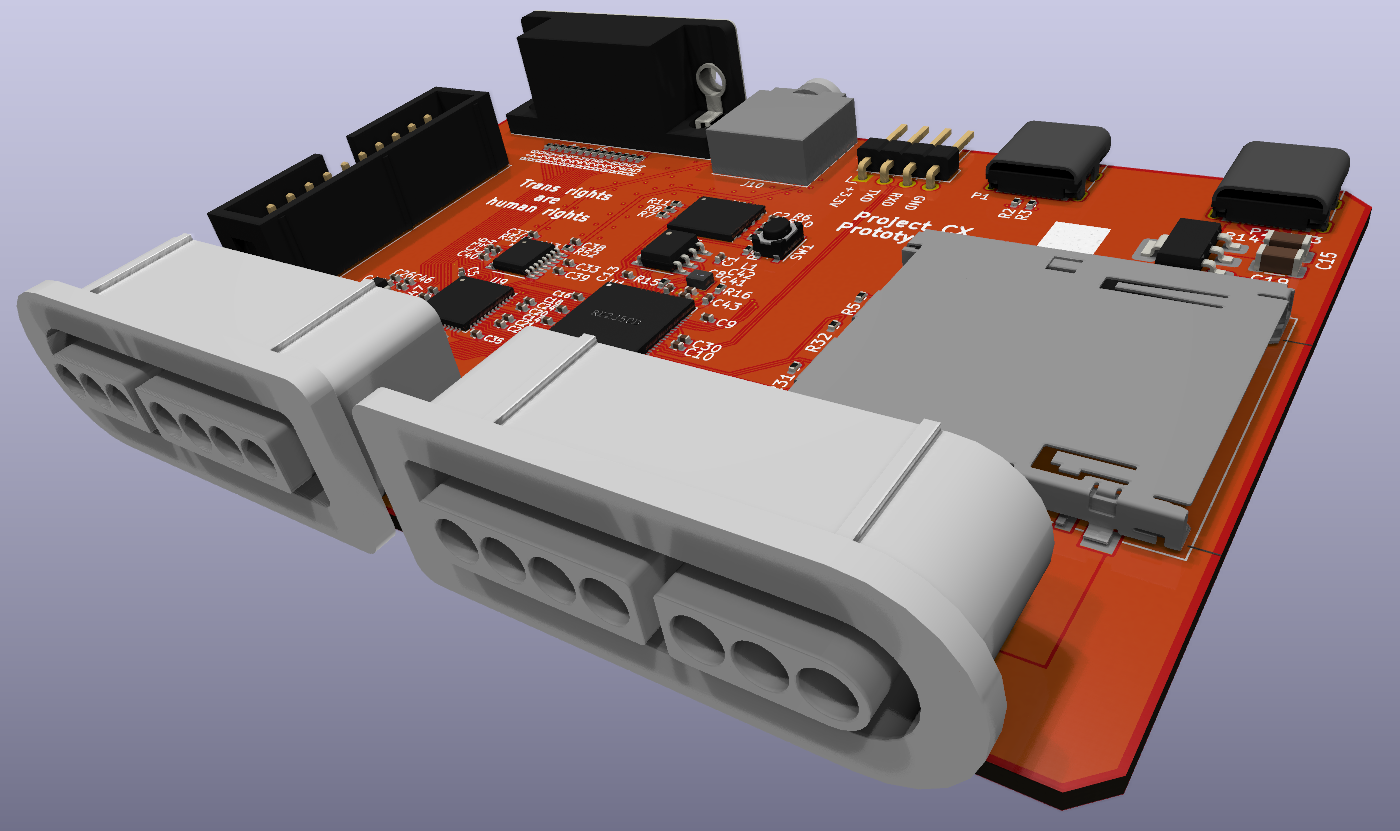
    What I picture is, the OS/kernel/whateveryoucallit lives in NOR flash along with the FPGA's bitstream. User programs are limited to ~500KB for code, but can store non-executable data in the PSRAM as needed -- sprites, tiles, music samples, whatever.

  • source
  • parent
  • context
  • [–] [S] 1 point 19 hours ago (2 children)

    The more I study my own design, the less inclined to emulate the Commander X16 I become. The CPU performance is insane; even hard-limiting a user program to 500KB, you get two 150300MHz ARM or RISC-V cores to play with. Why waste that performance emulating a 65C816 when your game will be in C anyway, and you can get many times better performance running natively?

  • source
  • parent
  • context
  • [–] [S] 1 point 19 hours ago (3 children)

    Most RP2350B designs use HSTX to implement DVI over an HDMI connector for video out, with an in-SRAM framebuffer and the firmware running from NOR flash XIP. No problem there, but it's not how my design works. No, the video output has its own 128KB of VRAM inside the VERA FPGA, so the whole 520KB of SRAM is available for use.

  • source
  • parent
  • context
  • [–] [S] 1 point 19 hours ago* (4 children)

    The firmware can execute-in-place from the external NOR QSPI flash via a 16KB SRAM cache. No real big speed penalty to be had there. But if your OS wants to load a program from SD and run it from PSRAM with the same caching rule as flash (which you totally can do!) you then have the OS and the user application fighting over the cache, at least as I read it.

  • source
  •  

    The real limitation with the RP2350B is not the CPU, neither the ARM nor RISCV cores. Those are fine, great.The problem is SRAM. There's only 520KB of it. You can attach PSRAM to the QSPI port, but it's way slower than the SRAM.This fundamentally limits what you can do more than the CPU performance by far. A typical x86 CPU of equivalent performance would have had ~32-64MB of fast RAM attached.


    One good thing about the RP2350B as opposed to the 65C816 CPU arch is that the former, being ARM/RISCV based, is much more suitable as a target for C. Which is good, because my assembly language skills are all in 6502/65816, and it's not really portable to ARM.It helps that the clock speed of the RP2350B can go as high as 300MHz (?!) with overclock. That really makes C a viable main language for the platform.

    [–] [S] 1 point 20 hours ago (1 child)

    We might not have bought into the whole Free Software Foundation line of bollocks, and gone en masse with FreeBSD. Or maybe the FSF itself would have adapted and kicked out the sex pests and nonces and creepers. Yeah, right.

  • source
  • parent
  • context
  • [–] [S] 1 point 20 hours ago (2 children)

    Back in the day, we didn't even stop for a moment to consider the values of the people who made the software, or how they did it. Didn't even occur to ask.Looking back, some things might be better if we had done.

  • source
  • parent
  • context
  •  

    I made a whole assed MS-DOS level operating system for a platform I invented, for which no software previously existed using agentic coding, and it works fine. But it's also just as insecure as MS-DOS ever was. Security is a non-issue on a toy platform with no networking or concept of user privilege.But the truth is, it doesn't matter that it works, it doesn't matter that the flaws in agentic coding are moot under the circumstances, it matters that because it's agentic code people don't want it on principle. My mistake was thinking that functionality would win over politics.

    view more: next ›