A giant rodent from southern Thailand, known from two fossil teeth, a lower molar and an incisor, found at a coal mine in Krabi province. It lived in the Eocene and is estimated at around 30 kg, about half the size of a large capybara, making it one of the largest rodents of its era. It belonged to the Ischyromyidae, an extinct family of early rodents. Its genus name joins the Thai word for giant with the Greek word for mouse. News article: https://phys.org/news/2026-11-prehistoric-giant-rat-thailand-fossil.html


A deep-sea zoanthid found living on Pleurocorallium coral colonies at the entrances of karst caves near Minamidaito Island in southern Japan, collected at 385 m. Its polyps are bright yellow, and its name, aureus, means golden. When disturbed it flashes green light, the first documented bioluminescence inside a deep-sea cave. No spontaneous light was observed and no symbiotic bacteria were found, so the flash may serve a defensive or burglar-alarm role, though its function is not yet known. News article: https://www.europesays.com/japan/118009/


A racerunner lizard from the Chagai Desert in Balochistan, near the Afghanistan and Iran borders, documented at four localities in Chagai District. It has distinctive maze-like winding brown markings across its back, kept in both juveniles and adults, a body of about 5.7 cm and a tail more than twice the body length. DNA and scale comparisons separate it from Eremias graphica of Iran. It lives in loose sand and low dunes and burrows, and its provisional assessment is Data Deficient. Eight Eremias species are now known from Pakistan. News article: https://reptilesmagazine.com/new-racerunner-lizard-species-discovered-in-pakistan/


Four new spider-hunting wasps from China: Platydialepis bidentata, P. flavipectoralis, P. frontimaculata and P. prominula. A taxonomic review raises the Platydialepis species recorded from China from one to six and provides the first identification key for them, with P. ryoheii also reported from China for the first time. Specimens come from Chongqing, Guangdong, Guangxi, Henan, Hubei, Jiangxi, Sichuan, Yunnan and Zhejiang, and are deposited at Yunnan Agricultural University in Kunming. News article: https://bioengineer.org/four-new-spider-hunting-wasp-species-discovered-in-china/


A perennial herb in the Colchicaceae family found at Garbhanga Reserve Forest, at Laisong in Dima Hasao, and at Barapani in Meghalaya, growing on cliffs under bamboo. It reaches up to 180 cm tall, taller than its relative Disporum calcaratum, with branched stems, broad yellowish-green leaves and star-shaped white flowers. Its name joins Kamrupa and the Khasi Hills. Only a few small populations are known, and it is described as potentially endangered, with road expansion, over-exploitation and deforestation as threats. News article: https://newire.in/articles/new-plant-species-discovered-in-assam-and-meghalaya-forests


A small translucent pygmygoby from the northern Red Sea, known from two specimens of 12 and 17 mm collected at 30 m at a cave entrance on a steep reef slope at Walih Island and not seen again since. It carries a broad orange-red stripe and golden spots on the tail that resemble gold coins, and it has an unusual four-part eye. Its name refers to Charon, the ferryman of Greek mythology. Eleven Trimma species are now known from the Red Sea. News article: https://phys.org/news/2026-11-species-pygmygoby-edge-red-sea.html


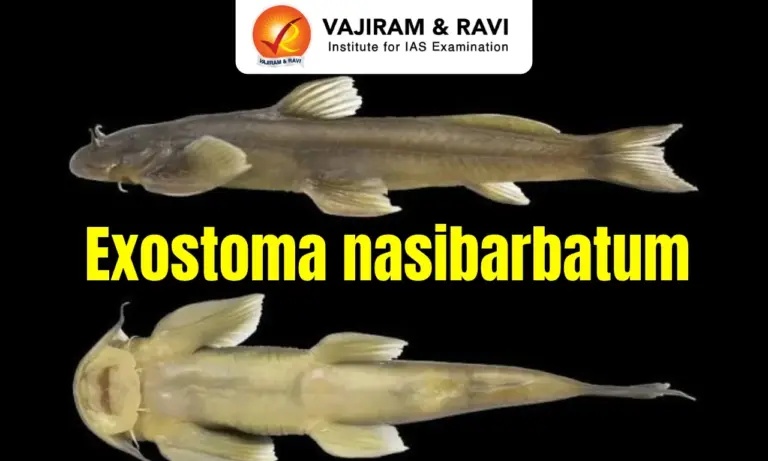
A glyptosternine catfish found in the Bupal stream, a tributary of the Dujang River in the Chindwin river system of Manipur, near the Myanmar border, in fast-flowing rocky habitat. It has a strongly flattened head and body, enlarged paired fins with adhesive striae, and a prominent nasal barbel extending beyond the back margin of the eye — the trait its name refers to. The genus Exostoma now has 23 recognised species, seven of them in the Chindwin-Irrawaddy drainage. News article: https://vajiramandravi.com/current-affairs/exostoma-nasibarbatum/ — Image: specimen photograph, carried on the Vajiram & Ravi page.
 

A perennial herb described by Botanical Survey of India researchers from streamside rocky walls near Osla village in Govind Pashu Vihar National Park and Sanctuary, Uttarakhand, at about 2,550 m. It grows up to 80 cm tall, with red-tinged upper-leaf margins and umbellules of 10 to 20 flowers. Only one population of three mature individuals is known, in an area of about 4 km², and it has been formally assessed as Critically Endangered. News article: https://researchmatters.in/news/botanists-discover-critically-endangered-plant-species-in-uttarakhand


A jumping spider found at Madhugundi village in Chikkamagaluru district, Karnataka, named for the Malenadu region of the Western Ghats. It was found exclusively on two plant species, Memecylon umbellatum and Memecylon malabaricum, and both male and female specimens of the genus were identified for the first time. It is the first recorded sighting of the Pilia genus in over 120 years, the last having been identified in Kerala in 1902. News article: https://www.dhyeyaias.com/current-affairs/daily-pre-pare/view/new-spider-species-pilia-malenadu


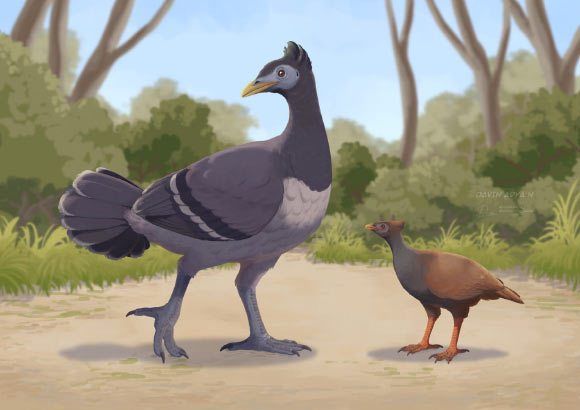
An extinct megapode identified from a single fragment of lower leg bone excavated at Liang Bua on Flores, the cave known for Homo floresiensis. The bird is estimated at about 3.9 kg, several times heavier than the living orange-footed megapode on Flores, and it is the first fossil megapode described from Wallacea. The species name honours Indonesian zooarchaeologist Rokus Due Awe. News article: https://www.sci.news/paleontology/megapodius-rokusi-15170.html — Image: Megapodius rokusi (left) next to Megapodius reinwardt (right), reconstruction, credit Davin Arya Nirwasita.
 

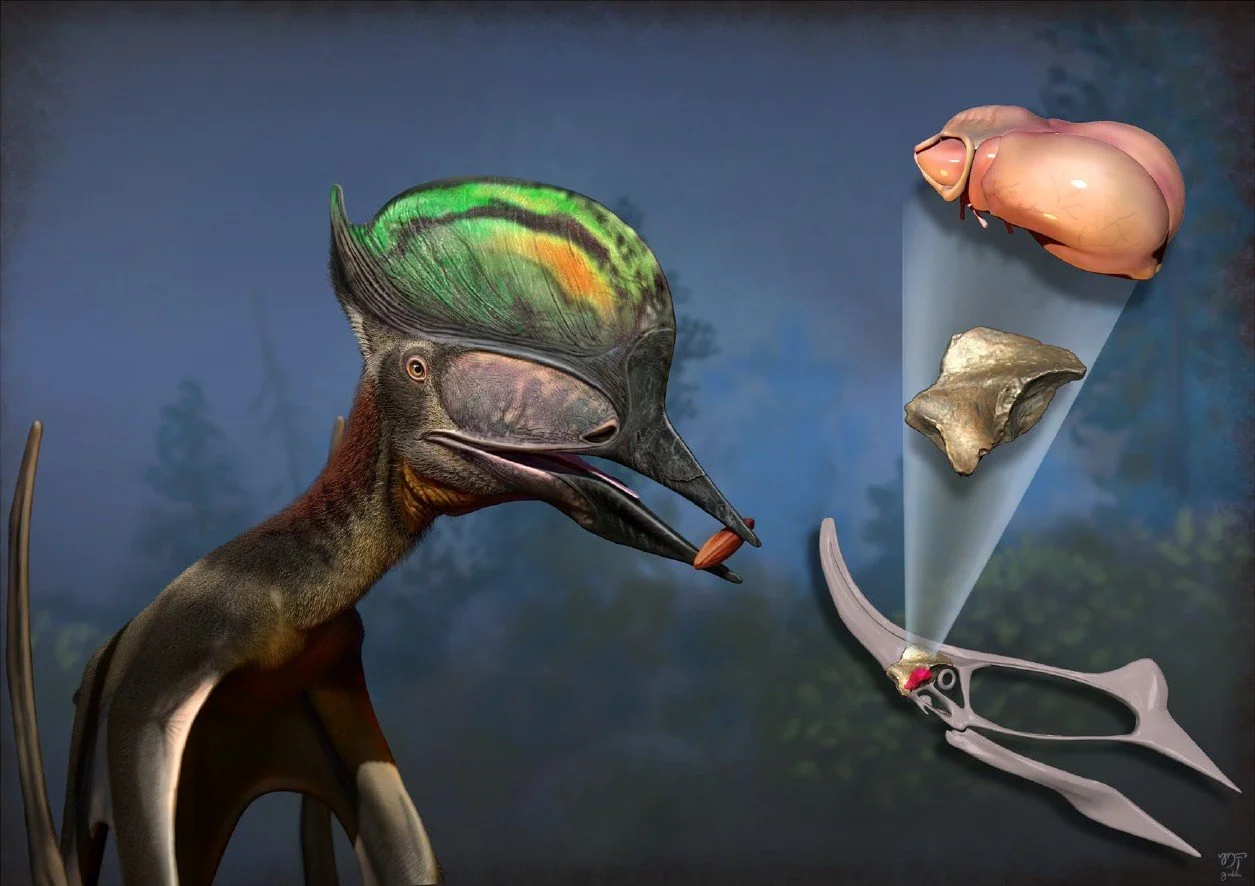
A tapejarid pterosaur from the Cambridge Greensand of England, based on a partial skull roof first described in 1870 and long lumped into other genera. CT scanning of the specimen produced new data on its brain. The animal lived in the late Albian, about 105 to 100 million years ago, and its remains were later reworked into younger Cenomanian deposits. The species name honours Tilly Edinger, the founder of modern palaeoneurology. News article: https://tetzoo.com/blog/2026/10/31/1tapejarid-pterosaur-from-cambridge-greensand — Image: reconstructed life appearance, credit Matheus Gadelha.
 

Two bandicoot species recognised through a ten-year reassessment of hundreds of museum specimens, using DNA and skull measurements. Isoodon microtis, the little brown bandicoot of South Australia, is newly described and believed to have gone extinct about a century ago. Isoodon moresbyensis, the New Guinea brown bandicoot, is raised from a subspecies of the northern brown bandicoot to a full species. The same work also extended the known historical range of the quenda eastward into South Australia. News article: https://phys.org/news/2026-11-bandicoot-species-trawling-museum-drawers.html — Image: artist's impression of Isoodon microtis, credit Nellie Piese / WA Museum.

view more: next ›