Extra! Extra! 7/13 (chopwoodcarrywaterdailyactions.substack.com)
 

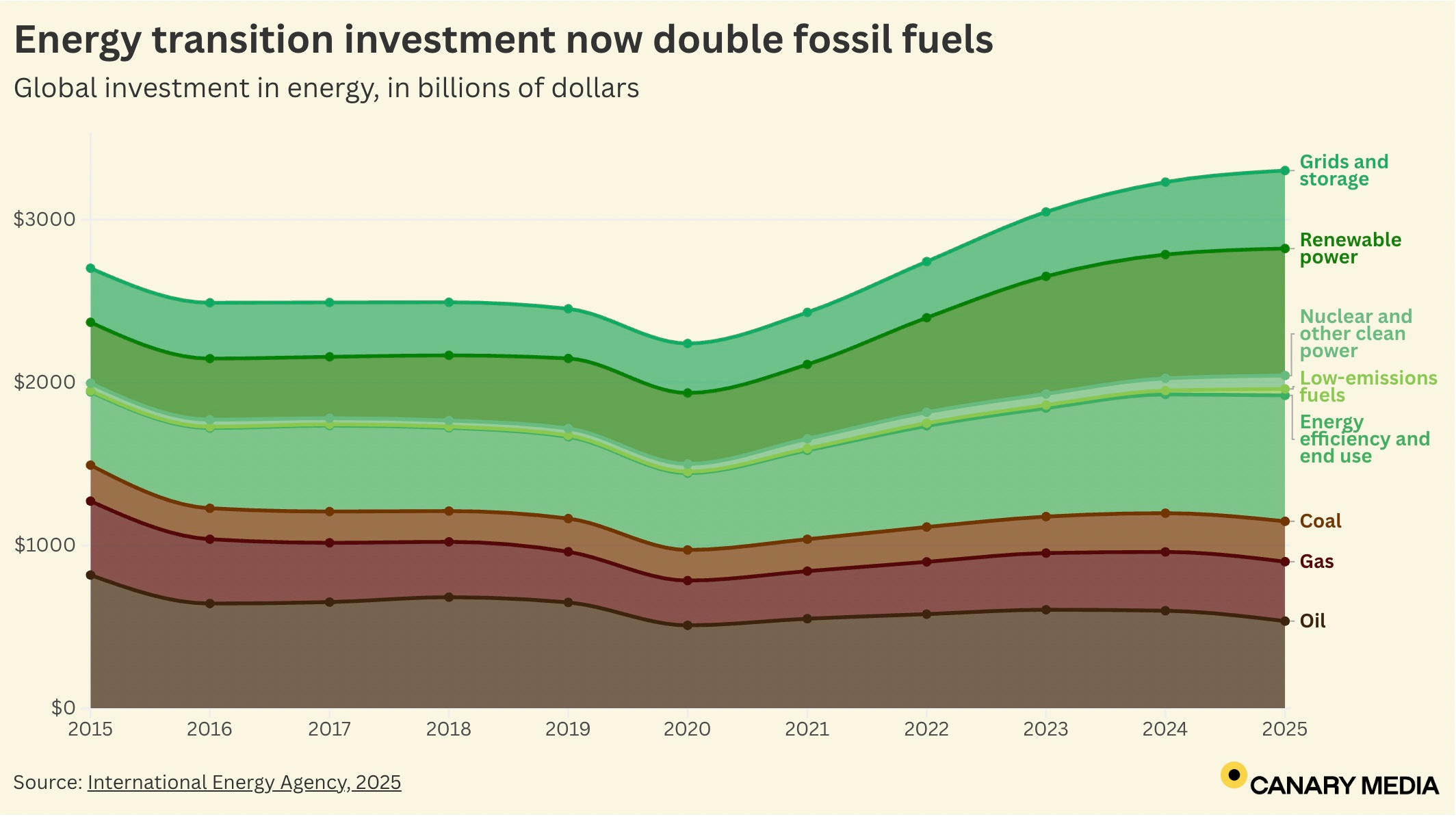
Chart: The world is now investing twice as much in clean energy as in fossil fuels. From Canary Media

Hi, all, and happy Sunday!

It’s been an absolutely brutal week, but we’ve still got good news to celebrate—in fact quite a lot of it. So take a break from doomscrolling and spend some time reveling in the wins we saw both here and in other countries over the last seven days.

Remember, what we focus on tends to grow, so let’s spend at least a bit of time focussing on progress, success, and goodness. It’s still out there!

Have a lovely Sunday, and please share this good news widely.

Read This

We Do What We Can. Gorgeous.

Celebrate This! 🎉

Senator Chris Van Hollen’s amendment in the Senate Appropriations Committee to "retain, preserve and compile" any records related to Jeffrey Epstein passed unanimously. On that note, the Epstein files are proving to be a real thorn in Trump’s shoe, and I’m here for it.

Researchers at the Max Planck Institute for Sustainable Materials in Germany have discovered a new, low-carbon way to source nickel using hydrogen plasma—instead of coal-derived coke—to extract it from ore.

Former state officials from Montana have launched an ambitious effort to ban dark money and corporate spending from local politics in the state.

L.A. Mayor Karen Bass has signed an executive order to provide cash cards worth several hundred dollars—funded by philanthropy—to undocumented immigrants who miss work due to fear of ICE raids.

A federal judge temporarily blocked the Trump administration from defunding Planned Parenthood.

US District Court Judge Nina Wang has fined two of Mike Lindell's attorneys $3,000 apiece for their error-riddled AI-generated legal brief. Lindell, of My Pillow, lost the defamation case and is on the hook for $2.3M in damages.

Amazon’s first day traffic on Amazon Prime Day was down 41%.

A federal appeals court in New York officially affirmed the jury verdict that found President Donald Trump liable for sexually abusing and defaming writer E. Jean Carroll and fined him 5M.

The DNC launched an automated account on Twitter that updates the public about Trump's refusal to release the Epstein files.

Linda Yaccarino announced she is stepping down from her role as CEO of X.

Mahmoud Khalil filed a claim for $20 million in damages against the Trump administration for wrongful imprisonment.

Poland generated more power from clean energy sources than coal for the first time in June.

​Michael Jordan opened his fourth free clinic for people who are uninsured or underserved in North Carolina, his home state.

Pattie Gonia became the first drag queen to make the Time 100 list.

Over 20 scientists from research institutions across the nation whose grants have been canceled by the Trump administration showed up to Capitol Hill to hold an old-fashioned science fair titled “The Things We’ll Never Know: A Science Fair of Canceled Grants.”

Mexico sent water rescue teams and firefighters to help in Texas after the holiday weekend floods.

A new Gallup poll taken over the month of June shows Trump support on “handling the immigration issue” now stands at 35% with 62% opposing.

The California Department of Education and California Interscholastic Federation leaders refused to sign a pledge to ban transgender athletes from competition, defying the Trump administration.

Gavin Newsom did a two-day tour of South Carolina, calling on voters across rural areas to exercise their “moral authority” in standing up to Trump and Republicans in next year’s midterm elections.

The former Librarian of Congress abruptly fired by President Donald Trump has found a new position with the country’s largest philanthropic supporter of the arts.

The Wisconsin Supreme Court has cleared the way for a ban on LGBTQ+ conversion therapy, deciding that a Republican-controlled legislative committee rule blocking bans on the practice was unconstitutional.

The Supreme Court on Wednesday refused to revive an aggressive Florida immigration law that had been blocked by lower courts. The law would let state officials prosecute unauthorized migrants who enter the state.

The White House is backing away from plans to abolish FEMA.

A prominent Georgia Republican was charged by the feds with running a Ponzi scheme that defrauded 300 investors of at least $140 million.

Ken Paxton’s wife announced she is divorcing him— “on Biblical grounds.”

Rhode Island expanded access to their permanent mail ballot application list to all voters AND established new election worker protections.

New Mexico’s automatic voter registration law officially went into effect.1

Americans who think global warming is happening now outnumber those who think it is not by a ratio of more than 4 to 1 (69% versus 15%).

Pope Leo XIV held a special Mass in the gardens of the Vatican’s new ecological educational center, calling on people to change their mind about what is causing “the world to burn” and urging Catholics to “hear the cry of the poor.”

Larry David is returning to HBO with an American history sketch show produced by Barack and Michelle Obama’s production company.

The Catholic Church's approval of blessings of couples in same-sex relationships "will remain" under Pope Leo XIV, the head of the Vatican's doctrine office told an Italian reporter in a brief interview.

In a searing ruling against the Trump administration, a federal judge temporarily blocked federal agents from using racial profiling to carry out indiscriminate immigration arrests that advocates say have terrorized Los Angelenos, forced people into hiding and damaged L.A.’s local economy.

Texas clarified the definition of consent in its sexual assault laws in the last minutes of state lawmakers’ latest legislative session. This was a direct result of the activism of one woman, Summer Willis.

The River Seine in Paris reopened to public swimming for the first time in a century.

Lisbon, Portugal launched a citywide reusable cup scheme to reduce plastic waste.

TSA changed its “shoe rule” and will no longer require airline passengers to remove their shoes at security.

Saudi Arabia is building “an entire industrial ecosystem” around electric vehicles.

A newly completed investigation by Wyoming’s largest county found no evidence of noncitizen voting in the 2024 elections, undercutting claims used to justify the state’s controversial proof of citizenship law.

U.S. charitable giving increased 3.3% to $593 billion in 2024.

After decades of conservation efforts, Maryland is now home to one of the biggest populations of bald eagles in the U.S.

A federal judge AGAIN blocked the Trump administration from enforcing his executive order ending birthright citizenship.

In 2024, men spent an average of 100 minutes per day doing household activities like laundry and cleaning, a record-high amount as captured by the American Time Use Survey.

A city workers’ union struck a deal with the Philadelphia government to end a strike that had paused garbage pickup for over a week.

Minnesota legislators committed more than $800,000 in grant money to fund outdoor learning experiences for students in grades 4 through 12.

​In an environmental wildlife conservation success, piping plovers have made a dramatic recovery in Maine.

A three-judge panel of the Georgia Court of Appeals upheld a lower court’s ruling that election officials must certify election results by the legal deadline.

Governor Josh Stein signed a bill to strengthen North Carolina’s Medicaid program.

Shares in Tesla are heading for a sharp fall in the US as investors fear Elon Musk’s launch of a new political party will present further problems for the electric carmaker.

French prosecutors have opened a criminal investigation into X over allegations that the company manipulated its algorithms for the puepose of “froreign interference.”

Atlanta passed a ordinance updating the city’s building code to require reflective roofing materials on new buildings, a move aimed at cutting down heat trapped by traditional dark roofs.

Colorado, Connecticut, and Maine all passed legislation in June tightening requirements on companies offering recurring billing, including clearer disclosures, timely renewal reminders, and easier cancellation options.

A lawsuit alleging that Workday, one of the largest recruiting software platforms, uses discriminatory job applicant screening technology was recently granted collective action status by a California judge. This marks the first time a class-action challenge to the use of artificial intelligence in applicant screening and hiring has been allowed to move forward.

30 Indigenous Amazonian communities just won a historic court case against a gold mine in Colombia.

A coalition of eight countries has pledged to tax so-called premium fliers as a way to raise funds for climate action.

Watch This! 👀

By @chaseejamess on Instagram.

Chop Wood, Carry Water is a reader-supported publication. To receive new posts and support my work, consider becoming a free or paid subscriber.

Leave a comment

Thank you for reading Chop Wood, Carry Water. This post is public so feel free to share it.

Share

1

This and the item above from the Markup.


From Chop Wood, Carry Water via this RSS feed


This story was originally published by Vox.com and is reproduced here as part of theClimate Desk collaboration.

In 2023, my husband and I bought our house in southwest Colorado, in part because it backed up to open space. That was the dream: trails just past the fence, a scrubby network of oak and sage stretching out into the hills beyond. But a little over a year into homeownership, I was questioning the wisdom of living so close to a burnable landscape.

This past winter’s spate of wildfires across Los Angeles made that fear of living alongside such a combustible landscape all the more real—fear that was only intensified by the weather. In my town, winter and its all important snow never really showed up. By spring, our snowpack was well below normal, winds were whipping, and I was becoming more paranoid about my wildfire risk.

It’s not just people like me—living on the edge of fire-prone terrain—who may be sharing that paranoia.

I wanted to find out what all of us could do to limit our risk.

More than 100 million people across 20 states and Washington, DC, live in the path of the increasingly fierce hurricanes. Most of the eastern half of the country is now at risk for tornadoes, and floods have increased in frequency and intensity in both coastal areas and river valleys. Over the Fourth of July weekend, extreme flooding in central Texas was among the most deadly of the past century.

The National Oceanic and Atmospheric Administration’s (NOAA) National Centers for Environmental Information found that 2024 held the second-most billion-dollar natural disasters ever for the US—right behind 2023. This year, with its already higher than average fire activity and predicted busy Atlantic hurricane season, is already shaping up to be significant, too.

At the same time, government cuts have undermined every critical juncture for disaster preparation. Federal programs for wildfire mitigation, proactive work like thinning forests and conducting prescribed burns, which help prevent large scale fires, have been halted due to staffing cutbacks and lack of funds.

Cutbacks to the National Weather Service, through reductions in force at NOAA, have already led to gaps in forecasting, which makes it harder for the public to plan for extreme weather events like the Texas Hill Country floods this month or the deadly May tornadoes, which killed at least 27 people as they swept across Kentucky, Missouri, and Virginia.

And the agency explicitly tasked with disaster relief is shrinking. FEMA has cut funding for its bipartisanly popular Building Resilient Infrastructure and Communities program, a major tool for building flood-resistant infrastructure, among other resiliency projects. It has lost some of its ability to help us recover, too. FEMA, already understaffed in 2024, has lost a third of its workforce since the beginning of the year. It has scaled back training and stands to lose$646 million in funding. As if that’s not enough, President Donald Trump has said he plans to phase out FEMA as a whole after the 2025 hurricane season

In the face of all that, I wanted to find out what all of us could do to limit our risk.

The first step was pretty basic: Instead of just spiraling about hypotheticals, figure out the specific risks in your area. For now, FEMA’s National Risk Index, where you can identify the threats to your community, remains a good source. By looking through the index, I learned my county is high in wildfire risks—which I already knew—but also that the area is prone to landslides, drought, and severe lightning storms.

Once I knew the risks, I looked at how I could prepare.

But the answers weren’t obvious. I reached out to both my regional FEMA office, whose contact was easy to find online, and the national headquarters, because I wanted to know what sort of concrete things I could do to protect my home—and what kind of support I might expect if the worst-case scenario happened to hit my community. I got a short email back saying that I should contact local authorities.

And so I started the real journey there, by looking at my local resources.

The most meaningful thing you can do on your own is harden your own home against relevant disasters. I found online that my local fire department provides free wildfire assessments because they think reducing your own vulnerability is one that can also reduce community risk. “The less time I have to spend at your house,” Scott Nielsen, my local wildfire battalion chief, told me, the more he can spend fighting other parts of the fire.

Nielsen says that when it comes to mitigating fire, we can’t change things like topography or weather, but we can change the fuel—and often that fuel includes our homes.

When Loren Russell, who works for the wildfire division of my regional fire district, came over to assess my risks, what he said surprised me: Instead of the overgrown hill behind the house, which had scared me, he was worried about nooks in the eaves or corners of the deck where embers could get caught. He also worried about the the oily junipers in the yard, which could become ladder fuels that might allow fire to leap to the tree canopies, and about the ways those canopies connected, spreading sparks across the landscape.

“You go out and you build a concrete bunker and surround it with gravel, but now you live in a concrete bunker surrounded by gravel.”

Russell says it’s always the same few things that create risk. Looking at the splintering boards of my neighbor’s fence, he noted that he’d seen fires blow across whole subdivisions through fences. “Once embers are in a fence it’s like a wick,” he says.

There are strategies for personal protection, too—and not just for fire. FEMA says that if you live in a hurricane-prone area, you can install impact resistant doors (particularly garage doors), storm shingles, and reinforced roof bracing, all of which help your house withstand storms. If you’re in a floodplain, you can seal cracks in your foundation, move your electrical boxes higher, or build berms and drains into your landscaping so water runs away from your home.

There can be a range of costs for those projects, from your own sweat equity for landscaping to tens of thousands of dollars for a new roof. But there can be grants and tools available to offset some of the cost, like Alabama’s program to help fund home strengthening, which is run through the state insurance office. Check your state resources, like the division of emergency management.

There’s no perfect formula for what to do. Russell says mitigation makes a real difference, but that risk is personal, because it’s also tied up in tolerance, and in trying to predict the future. “You go out and you build a concrete bunker and surround it with gravel, but,” he says, “now you live in a concrete bunker surrounded by gravel.”

Turning your home into a bunker is expensive, unappealing, and it might not make a difference in your broader risk tolerance. And unfortunately, it doesn’t really change your insurance liability. At least not yet.

My insurance agent told me that they don’t yet factor home hardening into their policies and pricing, even though simply being in a disaster-prone area can raise your premiums or make it harder to get insurance—and sometimes, insurance companies will simply dump policy holders in risk-prone areas. More than 100,000 Californians in fire-prone areas have lost their insurance in the past five years.

Landscape scale problems, like fire, need landscape scale solutions: “You really are impacted by your neighbor’s property.”

Those drops don’t necessarily reflect what’s happening on the ground. “We had one insurance agency that was pretty happy to drop people. I looked at their reports and didn’t find them to be based in fire science,” Nielsen says, about our area of western Colorado. He says they’re based on zip codes, which can be relatively arbitrary, instead of on the kind of terrain and fuel supply that actually make a difference to fires. And they almost never reflect mitigation work.

One of the only ways home hardening and mitigation makes a difference for insurance is when it’s done on a neighborhood scale. For instance, in 10 states, communities that have been certified as firewise through the National Fire Protection Association are able to get insurance discounts.

That is reflective of actual risk, “You really are impacted by your neighbor’s property,” says Max Moritz, a wildfire specialist at the University of California Santa Barbara. He says that the LA wildfires showed just how much broader-scale hardening—or lack thereof—impacts risk. But regional tools, like consistent fire hazard mapping programs, or building code requirements for new construction can significantly reduce risk. That’s true of other natural disasters, too.

Nielsen says that landscape scale problems, like fire, need landscape scale solutions. Home hardening is a piece we can control, but it’s networked into a bigger system of land management, risk tolerance, and policy. When a tornado or a hurricane comes, it doesn’t just hit one house.

Nielsen thinks about what’s commonly called the Swiss cheese model of risk assessment, where multiple layers of protection. This includes everything from personal scale, like hardening your roof to withstand high force winds; to local and regional projects like floodplain mitigation or evacuation planning; to federal tools, like the National Weather Service, or FEMA, which apply to the whole country.

You can visualize each layer as a Swiss cheese slice in a sandwich. They all have holes, ideally, the gaps overlap, and the layers support one another—and stop a threat from becoming catastrophic.

That’s even more true for renters, or people who live in urban areas, who might not have as much control over their own homes, and who are even more impacted by the places around them. Hurricanes have wreaked havoc on major cities. If that’s you, ask your landlord what they’ve done to harden the property, ask about past damage, consider supplemental renters insurance and then get curious about municipal management like storm drains, which divert water away from housing, evacuation routes or fire mitigation, depending on your risks.

As federal support wanes, the things we can do individually or as a neighborhood collective become even more important.

Having a lot of layers of swiss cheese is especiallyimportant now.

It’s all connected. Preventative mitigation is networked into a broader system, but so is dealing with disasters when they come, whether they’re fires, floods, or storms. Marshalling national resources during and after large-scale disasters has been a federal responsibility since the 1970s. That kind of coordinated response is part of how we plan for natural disasters, but the current administration is planning to cut the budget and scope of FEMA and turn responsibility toward state and local governments, which aren’t always funded or prepared to manage large incidents.

The scientists and field workers I spoke to for this story told me they were worried about the lack of federal investment. Moritz says that he’s concerned about disaster response, but he’s also worried about understanding future preparedness. “Some of the big questions that we don’t have answers for yet rely on big labs and national level funding,” he says. “Research wise, a lot of Forest Service colleagues who do really good work in federal labs have been let go, or lost staff. Those are serious losses that will take a long time to get back from.”

He says that there are still big gaps in the research about exactly how home hardening fits into the puzzle of resilience, and what kind of choices are the most effective, but that in the face of that federal lack of support, the sort of things we can do individually or as a neighborhood collective become even more important.

When there are several fires burning at once—like in Los Angeles earlier this year—responding agencies are spread thin and every person might not be able to depend on their help, Mortiz told me. That makes education shared among neighbors even more important. “That’s the scale you can make a difference,” he said.


From Mother Jones via this RSS feed


One year ago today, a would-be assassin tried to kill Donald Trump at a presidential campaign rally in Butler, Pennsylvania. While he survived, one of his supporters, 50-year-old Corey Comperatore, was fatally shot; two other rallygoers were also wounded but survived. The shooter, whose motive remains unclear, was rapidly killed by Secret Service countersnipers.

On Sunday, Trump’s loyal supporters piled onto the claim that his survival was all about divine intervention. “One year ago today, God miraculously spared the life of President Trump, and He is using him to lead our county back to greatness,” House Speaker Mike Johnson (R-La.) said in a post on X, accompanied by a video featuring audio of himself praising Trump.

“The Miracle in Butler occurred one year ago today,” White House Deputy Chief of Staff Stephen Miller wrote, declaring, “God saved our President so that he could save our country.”

“Americans will never forget that God was looking down on President Trump that fateful day and miraculously spared his life by a quarter of an inch,” Rep. Elise Stefanik posted. “God’s hand was on that field,” Rep. Andy Harris, chairman of the House Freedom Caucus, said, adding, “President Trump’s life was spared and the MAGA movement was preserved for such a time as this.” Agriculture Secretary Brooke Rollins, Senate Majority Leader John Thune, Sen. Bernie Moreno, Rep. Marjorie Taylor Greene, disgraced ex-congressman George Santos, Rep. Nancy Mace, and others made similar comments.

The US government officially also got in on the act:“The bullet hit—but by the grace of God, he stood up. Bloodied. Unbowed. And he fought harder. July 13th is a reminder: we fight, we win, AND WE NEVER SURRENDER,” the White House account posted on X, accompanied by a 90-second video praising Trump’s career trajectory. Another post featured a photo of Trump with blood dripping down his face and pumping his fist in the air, accompanied by the quote: “I WAS SAVED BY GOD TO MAKE AMERICA GREAT AGAIN. I BELIEVE THAT.”

One year ago today, an assassin opened fire on President Donald J. Trump in Butler, Pennsylvania.The bullet hit—but by the grace of God, he stood up. Bloodied. Unbowed. And he fought harder.July 13th is a reminder: we fight, we win, AND WE NEVER SURRENDER. 🇺🇸 pic.twitter.com/0BMUYpGltE

— The White House (@WhiteHouse) July 13, 2025

In other posts, the White House memorialized Comperatore, including through a video interview with his wife, Helen.

This is, of course, not the first time that Trump’s allies have used the assassination attempt for political purposes. That went into full effect right after the attack, at the 2024 Republican National Convention, as my colleague Mark Follman detailed:

When Trump was nominated at the Republican National Convention in Milwaukee five days later, his brush with death was a major theme. Large images of the iconic news photo of him being pulled from the rally stage, his fist in the air and face streaked with blood, provided a backdrop on the main stage. Multiple speakers referred to his survival as the result of divine intervention. Sen. Tim Scott of South Carolina and others lionized Trump, literally, and declared his survival and candidacy nothing short of a holy miracle.

In his acceptance speech, Trump, his right ear still bandaged, gave a dramatic, graphic account. “I said to myself, ‘Wow, what was that? It can only be a bullet.’” He said he brought his hand down from his ear “covered with blood, just absolutely blood all over the place.” He then emphasized, “There was blood pouring everywhere, and yet in a certain way I felt very safe because I had God on my side.”

Meanwhile, on Saturday, Sen. Chuck Grassley (R-Iowa) released a report produced at his request by the Government Accountability Office. The report said that senior Secret Service officials received information about a threat to Trump’s life 10 days before the Butler rally but failed to relay it to proper federal and local officials. Sen. Rand Paul (R-Ky.) also released a report on Sunday, compiled by the Senate Homeland Security and Governmental Affairs Committee; it asserted that the Secret Service denied multiple requests for additional security to protect Trump during the campaign, among other allegations.

One year later, the Secret Service said the assassination attempt “represents an operational failure that the Secret Service will carry as a reminder of the critical importance of its zero-fail mission and the need for continuous improvement.” The agency also said it has implemented more than 20 of the recommendations made by Congressional oversight committees, and that another 16 are in progress. Six people, it said, faced disciplinary suspensions over the debacle in Butler.


From Mother Jones via this RSS feed

view more: next ›