[–] [S] 4 points 2 days ago (2 children)

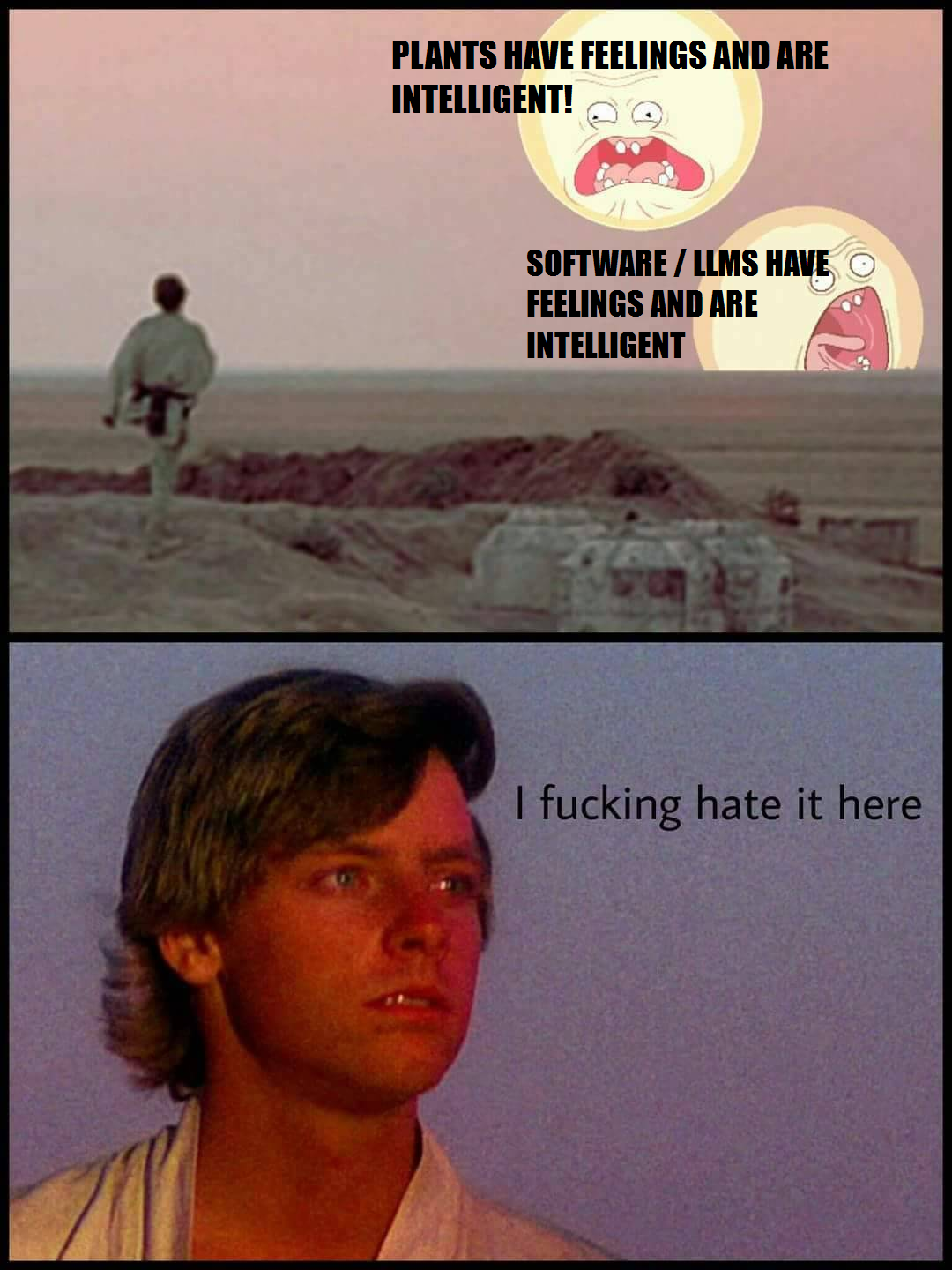
I have, unfortunately. It's an argument made to trivialize the suffering of animals (i.e. under human control) by making pain and suffering an unavoidable and universal constant (appealing to the futility and foolishness of trying to reduce it or think about it.)

  • source
  • parent
  • context
  • [–] [S] 3 points 2 days ago

    It's used to discourage effort and to minimize the suffering of non-human animals by trivializing it: "even plants feel pain, pain is everywhere, there is no point thinking about reducing pain and suffering, it's futile."

    Such people usually have some other criteria of "who matters", which ignores suffering. Usually, it's a hierarchy.

    The same hierarchy extends, at upper levels, to human intraspecies hierarchies, which is how you realize that the AI bro TESCREALists are fascists, racists, eugenicists and so on. They mention sentience in passing, and then skip to "intelligence", a much more vague concept, but something that they love to track ... as in the tradition of IQ and race science.

  • source
  • parent
  • context
  •  

    So-called AI is built on hype and its widespread adoption promises to dehumanize us and wreak environmental havoc. Emily M. Bender, computational linguist and co-author of The AI Con, describes how AI's 'boomers' and 'doomers' are two sides of the same coin - trying to convince us of AI's all-powerful inevitability. Emily points toward a path of refusal of this harmful emergent technology being pushed on us by the world's richest and most powerful, and she offers a vision of how we can resist and begin creating the future we actually want. Highlights include:

    Description:

    Why the phrase 'artificial intelligence' is just a marketing term used to hype everything from chatbots to image processing systems to facial recognition;

    Why the concept of 'intelligence' itself is loaded with eugenics, race science history, and a stunted view of biological beings;

    Why large language models (LLMs) in the form of chatbots are devoid of the relational context of subjectivity, care, and conflict which humans use to negotiate their social contexts and which give human language meaning and accountability;

    How AI hype plays on FOMO (fear of missing out) and has led everyone from business, government, education, entertainment, and media to thoughtlessly embrace so-called AI at a rapid rate;

    How AI hype is used by both AI boomers and doomers to oversell the potential of their technologies and hide the serious environmental and labor harms that AI use is causing right now;

    Why so-called AI will likely lead not to a job apocalypse but increasing work gigification and dehumanization;

    How effective altruism, which is backed by Silicon Valley money and power, replaces relationality and accountability with cold mathematical notions of optimization;

    Why the ridiculous idea of “AI sentience” is pulling attention away from expanding rights to all humans and nonhuman animals;

    Why there's ultimately no responsible use of so-called AI and why it has no place in education where it atrophies critical thinking skills and damages the learning community;

    How individuals can resist AI in their everyday lives by refusing chatbots, automated search, automated doctor scribes, airport facial screening - and collectively push back through labor activism and citizen resistance to data centers.


    I've long known I have ADHD, but it's nice to have official confirmation of my "non-existent" brain difference. Yes, that's how recent Channel 4 documentary, The Great ADHD Myth, framed one of the most heritable neurodevelopmental conditions in the book. They claim there is "no evidence" that there are any differences in ADHD brains & that what we really need to do is more meditation, to put down our phones, eat well, & spend time outside. Well, I already did all of that & I still have ADHD.

    Speaking as someone who used to be well into all that new age stuff, as someone who didn't own a smartphone until I was 30, as someone who is late diagnosed with autism, ADHD, hEDS, POTS, dyslexia & dyscalculia, I have a thing or two to say about this "documentary" & why it is not only harmful to all neurodivergent people, but how it is a part of a wide-reaching campaign of neoliberal propaganda, to cast doubt & suspicion over all young disabled people.

    Timestamps

    Intro - 00:00

    1 Max Pemberton - 09:12

    2 Katya Rubia - 25:17

    3 Mason - 28:03

    4 Concepts, Constructs & Brains - 40:57

    5 The Key Clinic - 49:18

    6 Strategies - 01:04:35

    7 The Process - 01:14:58

    8 Conclusions - 01:31:04

    More info in the YouTube video description.


    It’s a local battle, it’s incredibly material and tangible. It’s a cost of living battle because your electricity prices are going up. It’s a self-determination battle, it’s an indigenous rights battle. It’s all of that.

    What we’re finding is that it’s also a spiritual battle, about what we are here for, how we wanna live and what is the purpose of life.

    Managing Derailment Risk (www.scri.org.uk)
     

    Report: https://www.scri.org.uk/s/Derailment-risk-report-v6.pdf

    Two trends characterise the climate change predicament: accelerating progress, including a green technology revolution; and accelerating impacts and risks, which have been persistently underestimated. It is hoped that the former will prevail over the latter: that escalating climate impacts will reinforce action. But the opposite can also occur: climate consequences can distract from climate action. This will lead to more consequences and more distractions: a vicious cycle. We call this ‘derailment risk’.


    In this video, veteran software professional Carl from @InternetOfBugs breaks down the facts: what the PHP vulnerability actually is, why nobody has actually been hacked by it, the real story behind eMudhra and Railway, and why cybersecurity hype is distracting us from the actual threats.

    view more: next ›