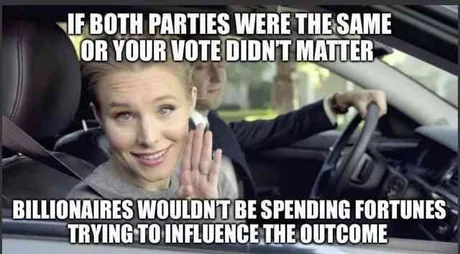
TL;DR: A sprawling Lemmy thread ostensibly about a meme—billionaires donating to both parties to keep wages low—devolves into a case study of everything wrong with American political discourse: the reduction of politics to individual voting choices, the weaponization of "tankie" as a thought-terminating slur, the reflexive red-baiting of anyone who critiques the Democratic Party from the left, and the persistent refusal to analyze elections as anything other than a moral test of personal virtue rather than a terrain of class struggle. Beneath the noise, the thread accidentally reveals the real function of the two-party system: not to offer meaningful choice, but to manage discontent, absorb opposition, and ensure that whichever faction of the capitalist class wins, the working class loses.
The Meme and Its Discontents
The original meme is simple enough: a cartoon of a train switch, one track labeled "Democrats," the other "Republicans," both leading to the same destination—a pile of bodies—while a billionaire stands at the lever, smiling. The caption suggests that billionaires donate to both parties to keep wages low. It's a blunt instrument, but it lands because it articulates something millions of people intuitively understand: that the ritual of American elections produces outcomes that consistently favor the wealthy, regardless of which party wins.
What follows in the comment section is a masterclass in evasion. Rather than engaging with the meme's central claim—that both parties serve the same class interests—the thread's liberal participants immediately pivot to a series of defensive maneuvers. "They're not the same," they insist. "One party is worse." "You're helping the fascists by saying this." "You're a tankie." "You're a Russian bot." "You're from .ml." The argument never actually addresses the material claim; it simply changes the subject to the moral character of the person making it.
This is a familiar pattern. When a critique of the Democratic Party cannot be answered on the merits, it is answered by attacking the critic's credentials, motives, or nationality. The thread is littered with examples: user Honytawk accuses .ml users of being paid by Russia and China; edible_funk repeatedly calls anyone who critiques Democrats a "tankie" or a "propaganda bot"; DarkFuture compiles a list of "election trolls" to systematically downvote. The message is clear: dissent from the liberal consensus is not to be debated but to be policed.
The "Tankie" Smear and the Foreclosure of Left Critique
The term "tankie" appears dozens of times in this thread, almost always as an insult rather than an analytical category. Originally referring to British communists who supported the Soviet invasion of Hungary in 1956, it has been stretched to cover anyone who: criticizes the Democratic Party from the left, opposes imperialism, doubts the efficacy of electoral politics, or simply lives on the lemmy.ml instance. The word has lost all denotative meaning. As user SwingingTheLamp observes, "Unless, like terrorist, it's lost all denotative meaning and is just an insult to be hurled at people you don't like."
This is not accidental. The function of the "tankie" label in liberal discourse is to delegitimize left critique without engaging it. If someone argues that both parties serve capital, you don't need to prove them wrong—you just call them a tankie, and the conversation is over. The term becomes a way of saying "your argument is not worth considering" without having to explain why. It's the political equivalent of a thought-terminating cliché.
What's revealing is how quickly the label is applied to positions that are, by any reasonable historical standard, mainstream social democratic or even left-liberal. User Cowbee, who describes themselves as a Marxist-Leninist, is called a tankie for arguing that the Democratic Party is a capitalist party that serves capitalist interests—a claim that would have been uncontroversial among mid-twentieth-century liberals. User SwingingTheLamp, who explicitly says they vote for the lesser evil, is called a tankie for warning that the system is collapsing. The label has become so elastic that it now encompasses anyone who refuses to affirm that the Democratic Party is a force for good.
The .ml Question: Red-Baiting as Political Argument
A significant portion of the thread is devoted to attacking the lemmy.ml instance and its users as foreign agents, bots, or "paid Russian operatives." The evidence offered is almost entirely circumstantial: .ml users criticize Democrats, therefore they must be working for Russia. This is a remarkable inversion of logic. The assumption seems to be that no genuine American leftist could possibly critique the Democratic Party, so anyone who does must be foreign. This ignores the entire history of the American left, which has been critiquing the Democratic Party—often from within it—for over a century.
The red-baiting is also deeply ironic given the thread's subject matter. The meme is about billionaires buying elections. The thread's liberal participants respond by accusing the meme's defenders of being bought by Russia. The possibility that someone might critique the American political system on the merits—because it produces genocide, austerity, mass incarceration, and climate catastrophe—is simply not entertained. Instead, dissent is attributed to foreign manipulation, which conveniently absolves the domestic political system of any responsibility for producing dissent in the first place.
This is a classic maneuver of what might be called "imperial feminism" or "reactionary anti-communism": the assumption that the masses, if left to their own devices, would naturally support the existing order, and that any deviation from this natural support must be the result of external manipulation. It's a deeply anti-democratic premise. It says that people cannot be trusted to form their own political judgments, and that the state must protect them from "foreign" ideas.
Genocide, Empire, and the Two Parties
The thread's most substantive exchanges concern Palestine. User NonconfrontationaI argues that more Palestinians were killed under Biden than under Trump. User Honytawk counters that if we add Palestinian deaths to the Republican side of the tracks, the number triples. User potatomuncher points out that both parties have facilitated genocide, and that the victims of the "imperial war machine" include people in Afghanistan, Iraq, Libya, Syria, Yemen, and Somalia.
This is where the "lesser evil" argument becomes most fraught. The liberal participants in the thread concede that Biden facilitated genocide, but argue that Trump would be worse. Perhaps. But the debate never addresses the structural question: why does the American political system produce leaders who facilitate genocide? Why is the choice always between genocide and more genocide? The liberal answer is that this is simply the nature of international politics—there are bad people in the world, and we have to choose the least bad option. The radical answer is that the American empire is structurally committed to genocide, because its economic and military dominance depends on the subjugation of the global South.
The thread never really engages with this structural question. Instead, it devolves into a series of increasingly personal exchanges: who is a tankie, who is a bot, who is a genocide apologist. The possibility that the entire framework of American electoral politics is designed to foreclose meaningful debate about empire is never considered. The debate is about which candidate is less genocidal, not about why genocide is the baseline.
The Limits of Lesser-Evilism
The most sophisticated argument in the thread comes from user SwingingTheLamp, who makes a Utilitarian case for voting for the lesser evil while acknowledging its limitations. "If stemming the bleeding is the best we can hope for," they write, "then that's how democracy fails. Vote for the slightly-better candidate, by all means, that's the best move in the here-and-now. But, unless we change the rules, it's gonna be the same best move next time, too, and the patient only has so much blood."
This is a clear-eyed assessment. Voting for the lesser evil is not wrong; it is simply insufficient. The problem is that the "lesser evil" framework is a trap. It defines the terms of political debate so narrowly that any alternative is rendered unthinkable. You can vote for the Democrat, or you can vote for the Republican, or you can abstain. You cannot vote for a candidate who opposes the empire, because no such candidate will ever be permitted to appear on the ballot. The system is designed to produce this outcome.
The thread's liberal participants are aware of this, but they treat it as an unchangeable fact of nature rather than a political arrangement that could be otherwise. "That's how our Democracy works," says one user. But democracy is not a static thing; it is a terrain of struggle. The rules can be changed. The problem is that the people who benefit from the current rules—the billionaires who fund both parties—have no interest in changing them. And so the "lesser evil" framework persists, not because it is intellectually compelling, but because it serves the interests of the ruling class.
The Function of the Two-Party System
What the thread never explicitly states, but repeatedly demonstrates, is the function of the two-party system in American capitalism. The system does not exist to offer meaningful choice. It exists to manage discontent, to absorb opposition, to ensure that the working class remains divided between two parties that both serve capital. The Republican Party mobilizes the most reactionary elements of society—racists, sexists, religious fanatics, gun nuts—while the Democratic Party mobilizes the professional-managerial class and the remnants of the labor movement. Both parties are funded by the same corporate interests. Both parties pursue policies that benefit the wealthy. The differences between them are real, but they are differences of style, not substance.
This is not a conspiracy; it is the logical outcome of a political system in which money is speech, corporations are people, and the only viable path to office is through the two major parties. The system is designed to produce this outcome. The founders were explicit about it: they feared democracy and sought to create a system that would check the power of the "mob." The two-party system, combined with the Electoral College, the Senate, and the Supreme Court, is a system of minority rule. It is not a bug; it is a feature.
The thread's liberal participants treat the two-party system as a fact of nature, but it is a political arrangement that could be changed. Ranked-choice voting, proportional representation, public financing of elections, the abolition of the Electoral College—these are all reforms that would open up the political system to genuine competition. But they are all opposed by the same billionaires who fund both parties. And so the system persists, not because it is popular, but because it serves the interests of the people who benefit from it.
What Is to Be Done?
The thread ends, as these threads always do, in a stalemate. The liberals insist that voting is the most important thing you can do. The radicals insist that voting is the bare minimum, and that real change requires organizing, protest, and direct action. Both sides talk past each other. Neither side wins.
But the thread does contain, buried in the noise, the outlines of a more sophisticated position. User Bytemeister writes: "Voting is the most important thing you can do right now, but don't forget the other stuff. Behind every politician is a team, behind that team are supporters, and behind the supporters are voters. You get to choose your level of engagement." This is a reasonable position. Voting is not a substitute for organizing, but it is not mutually exclusive with it either. You can vote for the lesser evil while also working to build a political movement that can defeat both evils.
The question is whether such a movement is possible in the current political climate. The thread suggests that it is not—or at least, that it is very difficult. The left is divided between those who believe in electoral politics and those who believe in revolution. The liberals are committed to defending the Democratic Party against all criticism. The radicals are committed to criticizing the Democratic Party regardless of the consequences. The result is a circular firing squad that benefits no one except the people who are already in power.
What the thread lacks is any serious discussion of strategy. How do we build a movement that can challenge the two-party system? How do we organize workers, tenants, students, and marginalized communities into a political force that can win elections and govern? How do we connect the struggle against genocide abroad with the struggle against exploitation at home? These questions are not answered, or even asked. The thread is content to argue about whether voting is good or bad, rather than asking how we can make voting part of a broader strategy for social change.
The Specter of Revolution
There is one moment in the thread where the radical position is stated clearly. User Cowbee argues: "The US Empire is committing genocide because it economically benefits from perpetuating imperialism, and means the intelligent choice is to organize for revolution, rather than continue to prop up genocide." This is a coherent position. It says that the American political system is fundamentally illegitimate, that it cannot be reformed, and that the only solution is to overthrow it.
Whether this position is correct is a question of strategy, not morality. The thread treats it as a moral failing—evidence that .ml users are tankies or Russian bots or genocide apologists. But the argument itself is never engaged. What would a revolution in America look like? How would it be organized? What would its program be? These questions are not addressed. The thread is too busy calling each other names to have a serious conversation about strategy.
This is the tragedy of the thread. It contains all the raw materials for a serious discussion about American politics: the role of money in elections, the function of the two-party system, the relationship between domestic politics and empire, the limits of lesser-evilism, the need for a broader movement. But the discussion never coheres. It is constantly derailed by personal attacks, red-baiting, and the insistence that the only choices are voting for the lesser evil or doing nothing at all.
Conclusion: The Thread as Symptom
In the end, the thread is a symptom of a broader disease. It is what political discourse looks like when the working class has no political party of its own, when the left is fragmented and demoralized, when the only viable options are two parties that both serve capital. The thread is noisy, angry, and ultimately impotent—not because the participants are stupid or malicious, but because the system they are trying to navigate is designed to produce this outcome.
The meme at the top of the thread is correct: billionaires do donate to both parties to keep wages low. The thread's participants spend thousands of words arguing about this, but they never get to the obvious conclusion: if both parties serve the same class interests, then the working class needs a party of its own. Not a third party within the existing system—that system is designed to crush third parties—but a mass movement that can challenge the system itself. That movement would need to be built on the ground, in workplaces and neighborhoods, around issues that matter to ordinary people: housing, healthcare, wages, policing, climate, war. It would need to be internationalist, anti-imperialist, and committed to the principle that no one is free until everyone is free.
That movement does not exist yet. But the thread suggests that the raw materials are there: the anger, the analysis, the desire for something better. The question is whether those materials can be organized into something coherent, or whether they will remain trapped in the endless, circular, ultimately useless debates that define so much of online political discourse. The answer is not yet written. It depends on what we do next.
Watch or listen: full narration (about 3.5 min at 1.5×) and a 2-minute clip are attached to this cross-post on Bluesky and Mastodon.
Follow the work:
If this thread deserves more than a pile-on, share it. The full analysis exists in English and in Spanish — links below.
Tags: US Politics, Elections, Lesser Evilism, Imperialism, Marxism, Class Analysis, Two-Party System, Anti-Imperialism, Palestine, Red-Baiting, Political Discourse, Lemmy, Revolution