1


The Left abandoned class for culture wars. Now capital replaces us with AI while we consume digital opium. Organize daily, or lose everything. #ClassWar #Materialism #Organize


We are witnessing a historic political realignment, and it's one we have brought upon ourselves. As the Overton window lurches rightward at breakneck speed, we are forced to confront an uncomfortable truth: the contemporary "left" has abandoned the very people it claims to represent.

Look honestly at the landscape of 2026. One faction of the left has retreated into insular theory circles, more consumed with ideological purity tests and performative dunking than with building the mass coalitions necessary for class struggle. Meanwhile, the mainstream cultural left has become preoccupied with identity politics, screaming about pronouns while the working class struggles to afford basic necessities like food. The tech-bros have co-opted movements like "Don't Kill Games," turning digital preservation into a consumerist crusade that remains blissfully ignorant of the physical reality of the workers assembling the hardware.

We have abandoned the materialist analysis that once won people over. We stopped talking about class. We stopped talking about wages, rent, and the cost of living. We abandoned the language of the worker, the farmer, the common family. And into this void has stepped the Far Right—lying to the working class that their rent is high because of immigrants, their jobs are gone because of "DEI," and their wages are stagnant because of "globalists." They are offering a materialist framework, even if it is a false and malignant one, and the working class is embracing it because we have given them nothing else.

The average worker is shifting right not because they are evil, but because the Right is the only side currently acknowledging their economic pain—even if they are completely misdiagnosing the cause. If we do not get our heads out of our ideological echo chambers and start talking about class war instead of culture war, the fascists will win by default.

Simultaneously, capital is accelerating its assault on labor. The capitalist application of artificial intelligence is intensifying the inherent contradictions of capitalism, replacing living human labor with dead, objectified labor at an unprecedented scale. Private-capital-empowered AI is unabashed in driving out labor, and the elites driving this transformation see no contradiction in replacing the human workforce entirely—because profit, not human dignity, is the only metric that matters. The ruling class offers us bread and circuses: endless streaming content, algorithmic entertainment, and the digital opium of choice to keep us passive, distracted, and atomized while they dismantle the material basis of our existence.

So what do we do? Not in some distant revolutionary future, but today. Every single day.

Here is the minimum daily list every class-conscious person must commit to:

1. Read for 30 minutes. Not Twitter, not headlines—real analysis. Lenin read and wrote incessantly because theory illuminates the path forward. If you don't understand the material conditions, you cannot change them.

2. Talk to one worker about their material conditions. Not about politics. Ask about their rent, their wages, their healthcare, their children's future. Listen. Build the trust that the Left has abandoned. Re-learn the language of class.

3. Reject one piece of manufactured distraction. Turn off the algorithmic feed. Skip the outrage-bait. Refuse the digital opium. Your attention is being harvested and weaponized against you. Take it back.

4. Organize something—anything. A union meeting, a tenant's association, a mutual aid network, a reading group. The capitalist class is organized; we must be too. Atomized individuals cannot overthrow a system; only organized workers can.

5. Educate one person. Share an article like this one with a friend, a coworker, a family member. Start the conversation that the mainstream left refuses to have.

This is not a call to purity. This is a call to work. The revolution will not be tweeted. It will be built, brick by brick, conversation by conversation, organizing drive by organizing drive. The fascists are organizing every day. Are we?

Read a similar article here: It's No Wonder We're Losing the Working Class—We Abandoned Materialism to Dunk on Each Other

2


TL;DR: A sprawling Lemmy thread ostensibly about a meme—billionaires donating to both parties to keep wages low—devolves into a case study of everything wrong with American political discourse: the reduction of politics to individual voting choices, the weaponization of "tankie" as a thought-terminating slur, the reflexive red-baiting of anyone who critiques the Democratic Party from the left, and the persistent refusal to analyze elections as anything other than a moral test of personal virtue rather than a terrain of class struggle. Beneath the noise, the thread accidentally reveals the real function of the two-party system: not to offer meaningful choice, but to manage discontent, absorb opposition, and ensure that whichever faction of the capitalist class wins, the working class loses.


The Meme and Its Discontents

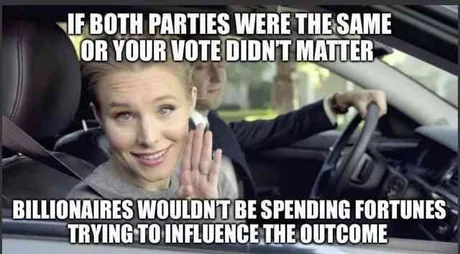
The original meme is simple enough: a cartoon of a train switch, one track labeled "Democrats," the other "Republicans," both leading to the same destination—a pile of bodies—while a billionaire stands at the lever, smiling. The caption suggests that billionaires donate to both parties to keep wages low. It's a blunt instrument, but it lands because it articulates something millions of people intuitively understand: that the ritual of American elections produces outcomes that consistently favor the wealthy, regardless of which party wins.

What follows in the comment section is a masterclass in evasion. Rather than engaging with the meme's central claim—that both parties serve the same class interests—the thread's liberal participants immediately pivot to a series of defensive maneuvers. "They're not the same," they insist. "One party is worse." "You're helping the fascists by saying this." "You're a tankie." "You're a Russian bot." "You're from .ml." The argument never actually addresses the material claim; it simply changes the subject to the moral character of the person making it.

This is a familiar pattern. When a critique of the Democratic Party cannot be answered on the merits, it is answered by attacking the critic's credentials, motives, or nationality. The thread is littered with examples: user Honytawk accuses .ml users of being paid by Russia and China; edible_funk repeatedly calls anyone who critiques Democrats a "tankie" or a "propaganda bot"; DarkFuture compiles a list of "election trolls" to systematically downvote. The message is clear: dissent from the liberal consensus is not to be debated but to be policed.

The "Tankie" Smear and the Foreclosure of Left Critique

The term "tankie" appears dozens of times in this thread, almost always as an insult rather than an analytical category. Originally referring to British communists who supported the Soviet invasion of Hungary in 1956, it has been stretched to cover anyone who: criticizes the Democratic Party from the left, opposes imperialism, doubts the efficacy of electoral politics, or simply lives on the lemmy.ml instance. The word has lost all denotative meaning. As user SwingingTheLamp observes, "Unless, like terrorist, it's lost all denotative meaning and is just an insult to be hurled at people you don't like."

This is not accidental. The function of the "tankie" label in liberal discourse is to delegitimize left critique without engaging it. If someone argues that both parties serve capital, you don't need to prove them wrong—you just call them a tankie, and the conversation is over. The term becomes a way of saying "your argument is not worth considering" without having to explain why. It's the political equivalent of a thought-terminating cliché.

What's revealing is how quickly the label is applied to positions that are, by any reasonable historical standard, mainstream social democratic or even left-liberal. User Cowbee, who describes themselves as a Marxist-Leninist, is called a tankie for arguing that the Democratic Party is a capitalist party that serves capitalist interests—a claim that would have been uncontroversial among mid-twentieth-century liberals. User SwingingTheLamp, who explicitly says they vote for the lesser evil, is called a tankie for warning that the system is collapsing. The label has become so elastic that it now encompasses anyone who refuses to affirm that the Democratic Party is a force for good.

The .ml Question: Red-Baiting as Political Argument

A significant portion of the thread is devoted to attacking the lemmy.ml instance and its users as foreign agents, bots, or "paid Russian operatives." The evidence offered is almost entirely circumstantial: .ml users criticize Democrats, therefore they must be working for Russia. This is a remarkable inversion of logic. The assumption seems to be that no genuine American leftist could possibly critique the Democratic Party, so anyone who does must be foreign. This ignores the entire history of the American left, which has been critiquing the Democratic Party—often from within it—for over a century.

The red-baiting is also deeply ironic given the thread's subject matter. The meme is about billionaires buying elections. The thread's liberal participants respond by accusing the meme's defenders of being bought by Russia. The possibility that someone might critique the American political system on the merits—because it produces genocide, austerity, mass incarceration, and climate catastrophe—is simply not entertained. Instead, dissent is attributed to foreign manipulation, which conveniently absolves the domestic political system of any responsibility for producing dissent in the first place.

This is a classic maneuver of what might be called "imperial feminism" or "reactionary anti-communism": the assumption that the masses, if left to their own devices, would naturally support the existing order, and that any deviation from this natural support must be the result of external manipulation. It's a deeply anti-democratic premise. It says that people cannot be trusted to form their own political judgments, and that the state must protect them from "foreign" ideas.

Genocide, Empire, and the Two Parties

The thread's most substantive exchanges concern Palestine. User NonconfrontationaI argues that more Palestinians were killed under Biden than under Trump. User Honytawk counters that if we add Palestinian deaths to the Republican side of the tracks, the number triples. User potatomuncher points out that both parties have facilitated genocide, and that the victims of the "imperial war machine" include people in Afghanistan, Iraq, Libya, Syria, Yemen, and Somalia.

This is where the "lesser evil" argument becomes most fraught. The liberal participants in the thread concede that Biden facilitated genocide, but argue that Trump would be worse. Perhaps. But the debate never addresses the structural question: why does the American political system produce leaders who facilitate genocide? Why is the choice always between genocide and more genocide? The liberal answer is that this is simply the nature of international politics—there are bad people in the world, and we have to choose the least bad option. The radical answer is that the American empire is structurally committed to genocide, because its economic and military dominance depends on the subjugation of the global South.

The thread never really engages with this structural question. Instead, it devolves into a series of increasingly personal exchanges: who is a tankie, who is a bot, who is a genocide apologist. The possibility that the entire framework of American electoral politics is designed to foreclose meaningful debate about empire is never considered. The debate is about which candidate is less genocidal, not about why genocide is the baseline.

The Limits of Lesser-Evilism

The most sophisticated argument in the thread comes from user SwingingTheLamp, who makes a Utilitarian case for voting for the lesser evil while acknowledging its limitations. "If stemming the bleeding is the best we can hope for," they write, "then that's how democracy fails. Vote for the slightly-better candidate, by all means, that's the best move in the here-and-now. But, unless we change the rules, it's gonna be the same best move next time, too, and the patient only has so much blood."

This is a clear-eyed assessment. Voting for the lesser evil is not wrong; it is simply insufficient. The problem is that the "lesser evil" framework is a trap. It defines the terms of political debate so narrowly that any alternative is rendered unthinkable. You can vote for the Democrat, or you can vote for the Republican, or you can abstain. You cannot vote for a candidate who opposes the empire, because no such candidate will ever be permitted to appear on the ballot. The system is designed to produce this outcome.

The thread's liberal participants are aware of this, but they treat it as an unchangeable fact of nature rather than a political arrangement that could be otherwise. "That's how our Democracy works," says one user. But democracy is not a static thing; it is a terrain of struggle. The rules can be changed. The problem is that the people who benefit from the current rules—the billionaires who fund both parties—have no interest in changing them. And so the "lesser evil" framework persists, not because it is intellectually compelling, but because it serves the interests of the ruling class.

The Function of the Two-Party System

What the thread never explicitly states, but repeatedly demonstrates, is the function of the two-party system in American capitalism. The system does not exist to offer meaningful choice. It exists to manage discontent, to absorb opposition, to ensure that the working class remains divided between two parties that both serve capital. The Republican Party mobilizes the most reactionary elements of society—racists, sexists, religious fanatics, gun nuts—while the Democratic Party mobilizes the professional-managerial class and the remnants of the labor movement. Both parties are funded by the same corporate interests. Both parties pursue policies that benefit the wealthy. The differences between them are real, but they are differences of style, not substance.

This is not a conspiracy; it is the logical outcome of a political system in which money is speech, corporations are people, and the only viable path to office is through the two major parties. The system is designed to produce this outcome. The founders were explicit about it: they feared democracy and sought to create a system that would check the power of the "mob." The two-party system, combined with the Electoral College, the Senate, and the Supreme Court, is a system of minority rule. It is not a bug; it is a feature.

The thread's liberal participants treat the two-party system as a fact of nature, but it is a political arrangement that could be changed. Ranked-choice voting, proportional representation, public financing of elections, the abolition of the Electoral College—these are all reforms that would open up the political system to genuine competition. But they are all opposed by the same billionaires who fund both parties. And so the system persists, not because it is popular, but because it serves the interests of the people who benefit from it.

What Is to Be Done?

The thread ends, as these threads always do, in a stalemate. The liberals insist that voting is the most important thing you can do. The radicals insist that voting is the bare minimum, and that real change requires organizing, protest, and direct action. Both sides talk past each other. Neither side wins.

But the thread does contain, buried in the noise, the outlines of a more sophisticated position. User Bytemeister writes: "Voting is the most important thing you can do right now, but don't forget the other stuff. Behind every politician is a team, behind that team are supporters, and behind the supporters are voters. You get to choose your level of engagement." This is a reasonable position. Voting is not a substitute for organizing, but it is not mutually exclusive with it either. You can vote for the lesser evil while also working to build a political movement that can defeat both evils.

The question is whether such a movement is possible in the current political climate. The thread suggests that it is not—or at least, that it is very difficult. The left is divided between those who believe in electoral politics and those who believe in revolution. The liberals are committed to defending the Democratic Party against all criticism. The radicals are committed to criticizing the Democratic Party regardless of the consequences. The result is a circular firing squad that benefits no one except the people who are already in power.

What the thread lacks is any serious discussion of strategy. How do we build a movement that can challenge the two-party system? How do we organize workers, tenants, students, and marginalized communities into a political force that can win elections and govern? How do we connect the struggle against genocide abroad with the struggle against exploitation at home? These questions are not answered, or even asked. The thread is content to argue about whether voting is good or bad, rather than asking how we can make voting part of a broader strategy for social change.

The Specter of Revolution

There is one moment in the thread where the radical position is stated clearly. User Cowbee argues: "The US Empire is committing genocide because it economically benefits from perpetuating imperialism, and means the intelligent choice is to organize for revolution, rather than continue to prop up genocide." This is a coherent position. It says that the American political system is fundamentally illegitimate, that it cannot be reformed, and that the only solution is to overthrow it.

Whether this position is correct is a question of strategy, not morality. The thread treats it as a moral failing—evidence that .ml users are tankies or Russian bots or genocide apologists. But the argument itself is never engaged. What would a revolution in America look like? How would it be organized? What would its program be? These questions are not addressed. The thread is too busy calling each other names to have a serious conversation about strategy.

This is the tragedy of the thread. It contains all the raw materials for a serious discussion about American politics: the role of money in elections, the function of the two-party system, the relationship between domestic politics and empire, the limits of lesser-evilism, the need for a broader movement. But the discussion never coheres. It is constantly derailed by personal attacks, red-baiting, and the insistence that the only choices are voting for the lesser evil or doing nothing at all.

Conclusion: The Thread as Symptom

In the end, the thread is a symptom of a broader disease. It is what political discourse looks like when the working class has no political party of its own, when the left is fragmented and demoralized, when the only viable options are two parties that both serve capital. The thread is noisy, angry, and ultimately impotent—not because the participants are stupid or malicious, but because the system they are trying to navigate is designed to produce this outcome.

The meme at the top of the thread is correct: billionaires do donate to both parties to keep wages low. The thread's participants spend thousands of words arguing about this, but they never get to the obvious conclusion: if both parties serve the same class interests, then the working class needs a party of its own. Not a third party within the existing system—that system is designed to crush third parties—but a mass movement that can challenge the system itself. That movement would need to be built on the ground, in workplaces and neighborhoods, around issues that matter to ordinary people: housing, healthcare, wages, policing, climate, war. It would need to be internationalist, anti-imperialist, and committed to the principle that no one is free until everyone is free.

That movement does not exist yet. But the thread suggests that the raw materials are there: the anger, the analysis, the desire for something better. The question is whether those materials can be organized into something coherent, or whether they will remain trapped in the endless, circular, ultimately useless debates that define so much of online political discourse. The answer is not yet written. It depends on what we do next.


Watch or listen: full narration (about 3.5 min at 1.5×) and a 2-minute clip are attached to this cross-post on Bluesky and Mastodon.

Follow the work:

If this thread deserves more than a pile-on, share it. The full analysis exists in English and in Spanish — links below.


Tags: US Politics, Elections, Lesser Evilism, Imperialism, Marxism, Class Analysis, Two-Party System, Anti-Imperialism, Palestine, Red-Baiting, Political Discourse, Lemmy, Revolution

3


TL;DR: Un extenso hilo de Lemmy que, en teoría, trataba sobre un meme —que los multimillonarios donan a ambos partidos para mantener los salarios bajos— degenera en un estudio de caso de todo lo que está mal en el discurso político estadounidense: la reducción de la política a decisiones individuales de voto, el uso de «tankie» como insulto que clausura el pensamiento, el macartismo reflejo contra cualquiera que critique al Partido Demócrata desde la izquierda y la negativa persistente a analizar las elecciones como algo distinto de un examen moral de virtud personal, en lugar de un terreno de lucha de clases. Bajo el ruido, el hilo revela sin querer la verdadera función del sistema bipartidista: no ofrecer una elección real, sino gestionar el descontento, absorber la oposición y garantizar que, gane la facción de la clase capitalista que gane, la clase trabajadora pierda.


El meme y sus descontentos

El meme original es bastante simple: una viñeta de un cambio de agujas ferroviario, con una vía rotulada «Demócratas» y la otra «Republicanos», y ambas conduciendo al mismo destino —un montón de cuerpos— mientras un multimillonario, sonriendo, sostiene la palanca. El texto sugiere que los multimillonarios donan a ambos partidos para mantener los salarios bajos. Es un instrumento tosco, pero acierta porque articula algo que millones de personas entienden de forma intuitiva: que el ritual de las elecciones estadounidenses produce resultados que favorecen sistemáticamente a los ricos, gane quien gane.

Lo que sigue en la sección de comentarios es una clase magistral de evasión. En lugar de entrar en la afirmación central del meme —que ambos partidos sirven a los mismos intereses de clase—, los participantes liberales del hilo giran de inmediato hacia una serie de maniobras defensivas. «No son lo mismo», insisten. «Un partido es peor.» «Con eso estás ayudando a los fascistas.» «Eres un tankie.» «Eres un bot ruso.» «Vienes de .ml.» El debate nunca aborda realmente la afirmación material; simplemente cambia de tema hacia la calidad moral de quien la formula.

Es un patrón conocido. Cuando una crítica al Partido Demócrata no se puede responder en el fondo, se responde atacando las credenciales, los motivos o la nacionalidad del crítico. El hilo está lleno de ejemplos: el usuario Honytawk acusa a los usuarios de .ml de estar pagados por Rusia y China; edible_funk llama una y otra vez «tankie» o «bot de propaganda» a cualquiera que critique a los demócratas; DarkFuture confecciona una lista de «trolls electorales» para votarlos negativamente de forma sistemática. El mensaje es claro: la disidencia respecto al consenso liberal no se debate, se vigila.

El estigma de «tankie» y el cierre de la crítica de izquierdas

El término «tankie» aparece decenas de veces en este hilo, casi siempre como insulto y no como categoría analítica. Originalmente designaba a los comunistas británicos que apoyaron la invasión soviética de Hungría en 1956; hoy se ha estirado hasta cubrir a cualquiera que critique al Partido Demócrata desde la izquierda, se oponga al imperialismo, dude de la eficacia de la política electoral o simplemente viva en la instancia lemmy.ml. La palabra ha perdido todo significado denotativo. Como observa el usuario SwingingTheLamp, «salvo que, igual que “terrorista”, haya perdido todo significado denotativo y sea solo un insulto para lanzárselo a quien no te cae bien».

Esto no es accidental. La función de la etiqueta «tankie» en el discurso liberal es deslegitimar la crítica de izquierdas sin entrar en ella. Si alguien sostiene que ambos partidos sirven al capital, no hace falta demostrar que se equivoca: basta con llamarlo tankie y la conversación se acabó. El término se convierte en una forma de decir «tu argumento no merece ser considerado» sin tener que explicar por qué. Es el equivalente político de un cliché que clausura el pensamiento.

Lo revelador es la rapidez con la que la etiqueta se aplica a posiciones que, según cualquier criterio histórico razonable, son socialdemócratas de manual o incluso de izquierda liberal. Al usuario Cowbee, que se define como marxista-leninista, se le llama tankie por sostener que el Partido Demócrata es un partido capitalista que sirve a intereses capitalistas: una afirmación que habría sido indiscutible entre los liberales de mediados del siglo XX. Al usuario SwingingTheLamp, que dice explícitamente que vota al mal menor, se le llama tankie por advertir de que el sistema se está derrumbando. La etiqueta se ha vuelto tan elástica que hoy abarca a cualquiera que se niegue a afirmar que el Partido Demócrata es una fuerza del bien.

La cuestión .ml: el macartismo como argumento político

Buena parte del hilo se dedica a atacar la instancia lemmy.ml y a sus usuarios como agentes extranjeros, bots u «operativos rusos pagados». Las pruebas que se ofrecen son casi todas circunstanciales: los usuarios de .ml critican a los demócratas, luego deben de trabajar para Rusia. Es una inversión notable de la lógica. La suposición parece ser que ningún izquierdista estadounidense auténtico podría criticar al Partido Demócrata, de modo que quien lo hace tiene que ser extranjero. Esto ignora toda la historia de la izquierda estadounidense, que lleva más de un siglo criticando al Partido Demócrata, a menudo desde dentro.

El macartismo resulta además profundamente irónico dado el tema del hilo. El meme trata de multimillonarios que compran elecciones. Los participantes liberales responden acusando a quienes defienden el meme de estar comprados por Rusia. La posibilidad de que alguien critique el sistema político estadounidense por sus méritos —porque produce genocidio, austeridad, encarcelamiento masivo y catástrofe climática— simplemente no se contempla. En su lugar, la disidencia se atribuye a manipulación extranjera, lo que absuelve cómodamente al sistema político interno de cualquier responsabilidad por generar esa disidencia.

Es una maniobra clásica de lo que podríamos llamar «feminismo imperial» o «anticomunismo reaccionario»: la suposición de que las masas, dejadas a su aire, apoyarían naturalmente el orden existente, y de que cualquier desviación de ese apoyo natural debe ser resultado de una manipulación externa. Es una premisa profundamente antidemocrática. Sostiene que no se puede confiar en que la gente forme sus propios juicios políticos y que el Estado debe protegerla de las ideas «extranjeras».

Genocidio, imperio y los dos partidos

Los intercambios más sustantivos del hilo giran en torno a Palestina. El usuario NonconfrontationaI sostiene que bajo Biden murieron más palestinos que bajo Trump. El usuario Honytawk responde que, si sumamos las muertes palestinas al lado republicano de la balanza, la cifra se triplica. El usuario potatomuncher señala que ambos partidos han facilitado el genocidio y que las víctimas de la «máquina de guerra imperial» incluyen a personas de Afganistán, Irak, Libia, Siria, Yemen y Somalia.

Aquí es donde el argumento del «mal menor» se vuelve más delicado. Los participantes liberales del hilo admiten que Biden facilitó un genocidio, pero sostienen que Trump sería peor. Puede ser. Pero el debate nunca aborda la cuestión estructural: ¿por qué el sistema político estadounidense produce líderes que facilitan genocidios? ¿Por qué la elección es siempre entre genocidio y más genocidio? La respuesta liberal es que tal es la naturaleza de la política internacional: hay gente mala en el mundo y tenemos que elegir la opción menos mala. La respuesta radical es que el imperio estadounidense está estructuralmente comprometido con el genocidio, porque su dominio económico y militar depende del sometimiento del Sur global.

El hilo nunca entra realmente en esa cuestión estructural. En su lugar, degenera en una serie de intercambios cada vez más personales: quién es un tankie, quién es un bot, quién es un apologista del genocidio. La posibilidad de que todo el marco de la política electoral estadounidense esté diseñado para clausurar el debate serio sobre el imperio nunca se considera. El debate trata de qué candidato es menos genocida, no de por qué el genocidio es el punto de partida.

Los límites del mal menor

El argumento más sofisticado del hilo lo aporta el usuario SwingingTheLamp, que defiende desde el utilitarismo el voto al mal menor reconociendo sus limitaciones. «Si contener la hemorragia es lo mejor que podemos esperar», escribe, «entonces así es como fracasa la democracia. Vota al candidato un poco mejor, por supuesto, es la mejor jugada aquí y ahora. Pero, a menos que cambiemos las reglas, también será la mejor jugada la próxima vez, y el paciente solo tiene una cantidad limitada de sangre.»

Es una valoración lúcida. Votar al mal menor no es incorrecto; es simplemente insuficiente. El problema es que el marco del «mal menor» es una trampa. Define los términos del debate político de forma tan estrecha que cualquier alternativa queda impensable. Puedes votar al demócrata, puedes votar al republicano o puedes abstenerte. No puedes votar a un candidato que se oponga al imperio, porque nunca se permitirá que un candidato así aparezca en la papeleta. El sistema está diseñado para producir ese resultado.

Los participantes liberales del hilo son conscientes de ello, pero lo tratan como un hecho natural inalterable y no como un arreglo político que podría ser distinto. «Así funciona nuestra democracia», dice un usuario. Pero la democracia no es algo estático; es un terreno de lucha. Las reglas se pueden cambiar. El problema es que quienes se benefician de las reglas actuales —los multimillonarios que financian a ambos partidos— no tienen ningún interés en cambiarlas. Y así persiste el marco del «mal menor», no porque sea intelectualmente convincente, sino porque sirve a los intereses de la clase dominante.

La función del sistema bipartidista

Lo que el hilo nunca afirma explícitamente, pero demuestra una y otra vez, es la función del sistema bipartidista en el capitalismo estadounidense. El sistema no existe para ofrecer una elección real. Existe para gestionar el descontento, absorber la oposición y garantizar que la clase trabajadora permanezca dividida entre dos partidos que sirven ambos al capital. El Partido Republicano moviliza a los elementos más reaccionarios de la sociedad —racistas, machistas, fanáticos religiosos, fanáticos de las armas—, mientras el Partido Demócrata moviliza a la clase profesional y gerencial y a los restos del movimiento sindical. Ambos partidos están financiados por los mismos intereses corporativos. Ambos aplican políticas que benefician a los ricos. Las diferencias entre ellos son reales, pero son diferencias de estilo, no de fondo.

No es una conspiración; es el resultado lógico de un sistema político en el que el dinero es libertad de expresión, las corporaciones son personas y la única vía viable al cargo pasa por los dos partidos mayoritarios. El sistema está diseñado para producir ese resultado. Los fundadores fueron explícitos al respecto: temían la democracia y buscaron crear un sistema que contuviera el poder de la «muchedumbre». El sistema bipartidista, combinado con el Colegio Electoral, el Senado y el Tribunal Supremo, es un sistema de gobierno de la minoría. No es un fallo: es una característica.

Los participantes liberales del hilo tratan el sistema bipartidista como un hecho natural, pero es un arreglo político que podría cambiarse. El voto por orden de preferencia, la representación proporcional, la financiación pública de las campañas, la abolición del Colegio Electoral: todas son reformas que abrirían el sistema político a una competencia genuina. Pero todas ellas se enfrentan a los mismos multimillonarios que financian a ambos partidos. Y así persiste el sistema, no porque sea popular, sino porque sirve a los intereses de quienes se benefician de él.

¿Qué hacer?

El hilo termina, como terminan siempre estos hilos, en un punto muerto. Los liberales insisten en que votar es lo más importante que se puede hacer. Los radicales insisten en que votar es el mínimo imprescindible y que el cambio real exige organización, protesta y acción directa. Ambas partes hablan sin escucharse. Ninguna gana.

Pero el hilo contiene, enterrados en el ruido, los contornos de una posición más sofisticada. El usuario Bytemeister escribe: «Votar es lo más importante que puedes hacer ahora mismo, pero no te olvides del resto. Detrás de cada político hay un equipo, detrás de ese equipo hay simpatizantes, y detrás de los simpatizantes hay votantes. Tú eliges tu nivel de implicación.» Es una posición razonable. Votar no sustituye a organizarse, pero tampoco es incompatible con ello. Puedes votar al mal menor y trabajar al mismo tiempo por construir un movimiento político capaz de derrotar a ambos males.

La pregunta es si ese movimiento es posible en el clima político actual. El hilo sugiere que no —o, al menos, que es muy difícil—. La izquierda está dividida entre quienes creen en la política electoral y quienes creen en la revolución. Los liberales están comprometidos a defender al Partido Demócrata frente a cualquier crítica. Los radicales están comprometidos a criticarlo sin importar las consecuencias. El resultado es un pelotón de fusilamiento circular que no beneficia a nadie salvo a quienes ya están en el poder.

Lo que falta en el hilo es cualquier discusión seria sobre estrategia. ¿Cómo construimos un movimiento capaz de disputar el sistema bipartidista? ¿Cómo organizamos a trabajadores, inquilinos, estudiantes y comunidades marginadas en una fuerza política capaz de ganar elecciones y gobernar? ¿Cómo conectamos la lucha contra el genocidio en el exterior con la lucha contra la explotación en casa? Estas preguntas no se responden, ni siquiera se formulan. El hilo se conforma con discutir si votar es bueno o malo, en lugar de preguntarse cómo hacer del voto una parte de una estrategia más amplia de cambio social.

El espectro de la revolución

Hay un momento en el hilo en el que la posición radical se enuncia con claridad. El usuario Cowbee sostiene: «El imperio estadounidense comete genocidio porque se beneficia económicamente de perpetuar el imperialismo, y eso significa que la elección inteligente es organizarse para la revolución, en lugar de seguir sosteniendo el genocidio». Es una posición coherente. Afirma que el sistema político estadounidense es fundamentalmente ilegítimo, que no se puede reformar y que la única solución es derribarlo.

Si esa posición es correcta es una cuestión de estrategia, no de moral. El hilo la trata como una falta moral —prueba de que los usuarios de .ml son tankies, bots rusos o apologistas del genocidio—. Pero el argumento en sí nunca se aborda. ¿Cómo sería una revolución en Estados Unidos? ¿Cómo se organizaría? ¿Cuál sería su programa? Estas preguntas no se plantean. El hilo está demasiado ocupado llamándose cosas entre sí como para tener una conversación seria sobre estrategia.

Esa es la tragedia del hilo. Contiene todas las materias primas para una discusión seria sobre la política estadounidense: el papel del dinero en las elecciones, la función del sistema bipartidista, la relación entre la política interna y el imperio, los límites del mal menor, la necesidad de un movimiento más amplio. Pero la discusión nunca cuaja. Se descarrila constantemente por ataques personales, macartismo y la insistencia en que las únicas opciones son votar al mal menor o no hacer nada.

Conclusión: el hilo como síntoma

Al final, el hilo es un síntoma de una enfermedad más amplia. Es el aspecto que tiene el discurso político cuando la clase trabajadora no tiene un partido propio, cuando la izquierda está fragmentada y desmoralizada, cuando las únicas opciones viables son dos partidos que sirven ambos al capital. El hilo es ruidoso, furioso y, en última instancia, impotente; no porque sus participantes sean estúpidos o malévolos, sino porque el sistema en el que intentan navegar está diseñado para producir ese resultado.

El meme que encabeza el hilo es correcto: los multimillonarios donan a ambos partidos para mantener los salarios bajos. Los participantes dedican miles de palabras a discutirlo, pero nunca llegan a la conclusión obvia: si ambos partidos sirven a los mismos intereses de clase, la clase trabajadora necesita un partido propio. No un tercer partido dentro del sistema existente —ese sistema está diseñado para aplastar a los terceros partidos—, sino un movimiento de masas capaz de disputar el sistema mismo. Ese movimiento tendría que construirse sobre el terreno, en los lugares de trabajo y en los barrios, en torno a los problemas que importan a la gente corriente: vivienda, sanidad, salarios, policía, clima, guerra. Tendría que ser internacionalista, antiimperialista y estar comprometido con el principio de que nadie es libre hasta que todos sean libres.

Ese movimiento aún no existe. Pero el hilo sugiere que las materias primas están ahí: la rabia, el análisis, el deseo de algo mejor. La pregunta es si esos materiales pueden organizarse en algo coherente o si seguirán atrapados en los debates interminables, circulares e inútiles que definen buena parte del discurso político en línea. La respuesta aún no está escrita. Depende de lo que hagamos ahora.


Ver o escuchar: la narración completa (unos 3,5 min a 1,5×) y un clip de 2 minutos van adjuntos a este cross-post en Bluesky y Mastodon.

Sigue el trabajo:

Si este hilo merece algo más que una bronca, compártelo. El análisis completo existe en inglés y en español — enlaces abajo.


Tags: Política de EEUU, Elecciones, Mal menor, Imperialismo, Marxismo, Análisis de clase, Sistema bipartidista, Antiimperialismo, Palestina, Macartismo, Discurso político, Lemmy, Revolución

4


The official story of September 11, 2001, is a carefully constructed edifice of unanswered questions and convenient coincidences. But when you pull on a single thread—the thread named Dov S. Zakheim—the entire narrative begins to unravel, revealing a chilling tapestry of foreknowledge, financial black holes, and technology designed to hijack the very planes that struck the heart of American power.

This is not a story of a single villain, but of a confluence of interests so perfectly aligned that the mainstream media has spent two decades trying to convince you it was all just random chance. It was not.

The Prophet of the "New Pearl Harbor"

Before the towers fell, before the Pentagon burned, the architects of the new American century were not hiding their intentions. They were publishing them. In September 2000, the Project for the New American Century (PNAC)—a neoconservative think tank whose members included Dick Cheney, Donald Rumsfeld, and Dov Zakheim—released a manifesto titled Rebuilding America's Defenses. Within its pages, the group lamented that the desired transformation of the military would be slow, "unless there were 'some catastrophic and catalyzing event, like a new Pearl Harbor'".

A year later, Zakheim was sworn in as the Comptroller and Chief Financial Officer of the Department of Defense. He was the man holding the purse strings of the entire American war machine. And he was a man who, just a year prior, had literally written the script for the catastrophe that would soon unfold.

The Kill-Switch Technology

But Zakheim was not just a theorist. From 1987 to 2001, he served as the CEO of SPC International, a subsidiary of System Planning Corporation, a high-technology defense contractor. Among SPC's products was a technology with a name straight out of a dystopian thriller: the Flight Termination System (FTS) .

This was not a simple radio. According to the company’s own documentation, the FTS was a system used to remotely take over the controls of an aircraft in flight, command it from a remote location, and, if necessary, destroy it. It was designed for target drones and test vehicles, but the technology could be adapted for larger aircraft—including commercial passenger jets. SPC also developed the Command Transmitter System (CTS), which could control up to eight airborne vehicles simultaneously.

While Zakheim was the CEO of the company that built the technology to hijack planes from the ground, he was simultaneously elevated to the position of the Pentagon’s top accountant. The pieces were not just falling into place; they were being arranged.

The $2.3 Trillion Problem and the Audit That Never Was

On September 10, 2001, Secretary of Defense Donald Rumsfeld stood before the nation and made a stunning admission. The Pentagon, he said, could not track $2.3 trillion in transactions. "According to some estimates," Rumsfeld stated, "we cannot track $2.3 trillion in transactions".

For conspiracy researchers, this was not a bureaucratic hiccup. This was the motive. The very next day, a plane—Flight 77—slammed into the Pentagon. It did not hit a random wing. It struck the exact section of the building that housed the Navy Command Center and the financial management offices. The impact and the subsequent fire obliterated the records, the accountants, and the bookkeepers who were tasked with tracking down the missing trillions.

The man who had just been put in charge of the Pentagon's finances, the man who had called for a "new Pearl Harbor," was now the man whose records were conveniently destroyed by the "terrorists" he had seemingly predicted. The audit was never completed. The money was never found. The evidence was turned to ash.

The Convenient "Loan" and the Pre-Attack Tour

The rabbit hole does not end at the Pentagon. Consider the case of Bernard Kerik, the NYPD Police Commissioner on 9/11. Less than two weeks before the attacks, Kerik took a four-day trip to Israel to discuss "counter-terrorism" with Israeli officials, including the public-security minister. This trip was approved by Mayor Rudy Giuliani and came just days before the worst terrorist attack on American soil.

But it was who Kerik met on that trip that raises eyebrows. He met Israeli billionaire Eitan Wertheimer, a man whose vast holdings include major defense contractors. Shortly after, Kerik received a $250,000 "loan" from Wertheimer—an interest-free loan he failed to report, which later led to his downfall. Was this a coincidence? Or was it a payoff for services rendered, a down payment on a future where the NYPD's response to the attacks would be led by a man with deep, undisclosed ties to foreign intelligence and defense interests?

The Impossible Feats

Finally, we are asked to believe that a group of inexperienced flight school students, who could barely fly a Cessna, executed complex, high-speed, precision maneuvers that veteran pilots have called virtually impossible. Flight 77, according to the official report, executed a 330-degree spiral descent at over 500 miles per hour, leveling off just inches above the ground to strike the Pentagon. Such a maneuver would require extraordinary skill—or extraordinary technology.

The Flight Termination System, developed by Zakheim's SPC, was designed to do exactly that: fly an aircraft with pinpoint accuracy from a remote location. The technology existed. The man who ran the company that made it was in charge of the Pentagon's money. The records that could have proven the financial motive were destroyed in the attack. And the man himself had publicly yearned for a "new Pearl Harbor" to usher in the wars that would define the next two decades.

The Picture They Don't Want You to See

Dov Zakheim is not a household name. The media does not discuss the Flight Termination System. The 9/11 Commission did not investigate the $2.3 trillion. The connections are not taught in schools.

But the paper trail exists. The PNAC document exists. Rumsfeld's admission exists. The SPC product brochures exist. The destroyed offices in the Pentagon exist. The $250,000 loan to Kerik exists.

The only thing missing is the will to connect them. When one man can call for a catastrophe, build the technology to execute it, take control of the money that would be destroyed by it, and then have the crime scene conveniently cremated by the very event he predicted, it is no longer a conspiracy theory. It is a conspiracy fact.

The question is not whether the dots connect. The question is why no one is willing to draw the line.


Watch or listen: full narration, 3 min at 1.5x and a 2-minute clip are attached to this cross-post on Bluesky and Mastodon.

Follow the work:

If this thread deserves an audit, share it. The full analysis exists in English and in Spanish — links below.


Tags: 9/11, Dov Zakheim, PNAC, Pentagon, SPC International, Flight Termination System, war on terror, class analysis, US empire

5


El arquitecto del nuevo Pearl Harbor: un hombre, el interruptor de apagado y los 2,3 billones

La versión oficial del 11 de septiembre de 2001 es un edificio cuidadosamente construido de preguntas sin respuesta y casualidades convenientes. Pero si tiras de un solo hilo —el hilo llamado Dov S. Zakheim— la narración entera empieza a deshacerse y deja a la vista un tapiz bastante menos tranquilizador: conocimiento previo, agujeros negros contables y tecnología diseñada para secuestrar precisamente los aviones que golpearon el corazón del poder estadounidense.

No es la historia de un villano solitario, sino la de una confluencia de intereses tan perfectamente alineada que los medios llevan dos décadas intentando convencernos de que todo fue casualidad. No lo fue.

El profeta del «nuevo Pearl Harbor»

Antes de que cayeran las torres, antes de que ardiera el Pentágono, los arquitectos del nuevo siglo americano no escondían sus intenciones. Las publicaban. En septiembre de 2000, el Project for the New American Century (PNAC) —un think tank neoconservador cuyos miembros incluían a Dick Cheney, Donald Rumsfeld y Dov Zakheim— publicó un manifiesto titulado Rebuilding America's Defenses. En sus páginas, el grupo se lamentaba de que la transformación militar deseada sería lenta «a menos que ocurriera algún acontecimiento catastrófico y catalizador, como un nuevo Pearl Harbor».

Un año después, Zakheim juró el cargo de contralor y director financiero del Departamento de Defensa. Era el hombre que sostenía las cuentas de toda la maquinaria de guerra estadounidense. Y era un hombre que, solo un año antes, había escrito literalmente el guion de la catástrofe que estaba por llegar.

La tecnología del interruptor de apagado

Pero Zakheim no era solo un teórico. Entre 1987 y 2001 fue consejero delegado de SPC International, filial de System Planning Corporation, un contratista de defensa de alta tecnología. Entre los productos de SPC había una tecnología con un nombre sacado directamente de un thriller distópico: el Sistema de Terminación de Vuelo (FTS, Flight Termination System).

No era un simple radio. Según la documentación de la propia empresa, el FTS era un sistema para tomar el control de un avión en vuelo, dirigirlo desde una ubicación remota y, si era necesario, destruirlo. Estaba pensado para drones y vehículos de prueba, pero la tecnología podía adaptarse a aeronaves mayores, incluidos aviones comerciales de pasajeros. SPC también desarrolló el Sistema de Transmisión de Mando (CTS), capaz de controlar hasta ocho aeronaves simultáneamente.

Mientras Zakheim dirigía la empresa que construía la tecnología para secuestrar aviones desde el suelo, era elevado a la vez al puesto de contable jefe del Pentágono. Las piezas no estaban cayendo en su sitio: las estaban colocando.

El problema de los 2,3 billones y la auditoría que nunca fue

El 10 de septiembre de 2001, el secretario de Defensa Donald Rumsfeld compareció ante el país con una admisión asombrosa. El Pentágono, dijo, no podía rastrear 2,3 billones de dólares en transacciones. «Según algunas estimaciones —declaró—, no podemos rastrear 2,3 billones de dólares en transacciones».

Para quien investiga estas cosas, aquello no fue un tropiezo burocrático. Era el móvil. Al día siguiente, un avión —el vuelo 77— se estrelló contra el Pentágono. No golpeó un ala cualquiera. Golpeó exactamente la sección del edificio que albergaba el Centro de Mando de la Marina y las oficinas de gestión financiera. El impacto y el incendio posterior arrasaron los registros, a los contables y a los tenedores de libros encargados de perseguir los billones desaparecidos.

El hombre que acababa de ser puesto al frente de las finanzas del Pentágono, el hombre que había pedido un «nuevo Pearl Harbor», era ahora el hombre cuyos registros fueron convenientemente destruidos por los «terroristas» que parecía haber predicho. La auditoría nunca se completó. El dinero nunca apareció. Las pruebas se convirtieron en ceniza.

El «préstamo» conveniente y el viaje previo

El agujero no termina en el Pentágono. Piensa en Bernard Kerik, comisario de policía de Nueva York el 11-S. Menos de dos semanas antes de los atentados, Kerik hizo un viaje de cuatro días a Israel para hablar de «contraterrorismo» con cargos israelíes, incluido el ministro de Seguridad Pública. El viaje lo aprobó el alcalde Rudy Giuliani y llegó días antes del peor atentado terrorista en suelo estadounidense.

Pero lo llamativo es a quién conoció en ese viaje: al multimillonario israelí Eitan Wertheimer, cuyas vastas participaciones incluyen grandes contratistas de defensa. Poco después, Kerik recibió un «préstamo» de 250.000 dólares de Wertheimer —sin intereses, y que no declaró—, lo que más tarde acabaría con su carrera. ¿Casualidad? ¿O un pago por servicios prestados, un anticipo sobre un futuro en el que la respuesta del NYPD a los atentados la dirigiría un hombre con lazos profundos y ocultos con intereses extranjeros de inteligencia y defensa?

Las proezas imposibles

Por último, se nos pide creer que un grupo de estudiantes de escuelas de vuelo inexpertos, que apenas podían pilotar una Cessna, ejecutaron maniobras complejas de alta velocidad y precisión que pilotos veteranos consideran prácticamente imposibles. El vuelo 77, según el informe oficial, ejecutó un descenso en espiral de 330 grados a más de 800 kilómetros por hora, nivelándose a escasos centímetros del suelo para golpear el Pentágono. Tal maniobra requeriría una habilidad extraordinaria. O una tecnología extraordinaria.

El Sistema de Terminación de Vuelo, desarrollado por la SPC de Zakheim, estaba diseñado exactamente para eso: volar un avión con precisión milimétrica desde una ubicación remota. La tecnología existía. El hombre que dirigía la empresa que la fabricaba estaba al frente del dinero del Pentágono. Los registros que podían probar el móvil financiero fueron destruidos en el ataque. Y el hombre había deseado públicamente un «nuevo Pearl Harbor» para desatar las guerras que definirían las dos décadas siguientes.

La imagen que no quieren que veas

Dov Zakheim no es un nombre familiar. Los medios no hablan del Sistema de Terminación de Vuelo. La Comisión del 11-S no investigó los 2,3 billones. Estas conexiones no se enseñan en las escuelas.

Pero el rastro documental existe. El documento del PNAC existe. La admisión de Rumsfeld existe. Los folletos de producto de SPC existen. Las oficinas destruidas del Pentágono existen. El préstamo de 250.000 dólares a Kerik existe.

Lo único que falta es la voluntad de conectarlos. Cuando un solo hombre puede pedir una catástrofe, construir la tecnología para ejecutarla, tomar el control del dinero que esa catástrofe destruiría y luego ver cómo la escena del crimen queda incinerada por el mismísimo acontecimiento que predijo, ya no es una teoría de la conspiración. Es un hecho de conspiración.

La pregunta no es si los puntos se conectan. La pregunta es por qué nadie se atreve a trazar la línea.


Ver o escuchar: la narración completa, 3,5 min a 1,5x y un clip de 2 minutos van adjuntos a este cross-post en Bluesky y Mastodon.

Sigue el trabajo:

Si este hilo merece una auditoría, compártelo. El análisis completo existe en inglés y en español — enlaces abajo.


Tags: 11S, Dov Zakheim, PNAC, Pentágono, SPC International, Sistema de Terminación de Vuelo, guerra contra el terror, análisis de clase, imperio estadounidense

6
7


Apparently, Valve keeps getting builds that were never run through Steam at all, which is how games end up with broken launch options or missing depots.

8


Tech giant Alphabet, the parent company of Google, is telling US schools that there's a price to be paid for restricting student access to its artificial intelligence tools.

The New York Times reported on Tuesday that, starting early next year, schools that fully disable the company's AI will also lose access to its search engine, which is by far the most used internet search tool in the world.

Chris Phillips, vice president for education at Google, justified the policy by claiming that "Search and AI are deeply integrated," adding that students attending schools where AI is banned "will not have access to Search, and they’ll see a message from their school that indicates it’s not available."

As the Times noted, Google has deeply integrated itself into US classrooms, many of which rely on its Classroom assignment platform and equip students with low-cost Chromebook laptops.

"The company’s new strategy underscores Google’s powerful role in American education," the Times explained. "If school leaders want continued student access to Search within the company’s ecosystem, they will be forced to embrace Google's AI."

Schools around the US have been banning the use of AI for young students over concerns that reliance on the technology will hinder the development of critical thinking skills and also enable mass cheating on assignments.

Morgan Polikoff, an education professor at the University of Southern California, told the Times that he expects Google's new policy linking AI and Search will only add more fuel to the backlash against the tech industry.

"This is a particularly clear example of the tech industry going out of its way to force AI on us all," said Polikoff, "even if we have said we don’t want it."

Lina Khan, former chair of the Federal Trade Commission under President Joe Biden, accused Google of "using its search monopoly to coerce schools into adopting AI," and said it was yet another reason why antitrust action should be taken against the company.

"This highlights the danger of allowing an unregulated monopolist to control an essential service," Khan wrote in a social media post. "Multiple courts have found Google liable for violating antitrust laws, and this latest move shows it remains unchastened. As the public increasingly pushes back against the use of AI in schools, Google is making clear it will punish those who don’t fall in line."

New York City Mayor Zohran Mamdani, whose city earlier this year banned AI in elementary and middle schools, similarly took Google to task for trying to force its products onto students.

"No corporation should have the power to dictate how we teach our children," Mamdani wrote. "Our public schools exist to serve students, not to grow the profit margins of Big Tech."

Sen. Bernie Sanders (I-Vt.) used news of Google's new AI school policy to take a shot at President Donald Trump, who has constantly downplayed the need for any regulation of the industry.

"President Trump claimed that AI oligarchs could regulate themselves because they 'love our country,'" Sanders wrote. "Now, Google is threatening schools: If you stop your students from using AI, we will cut off your access to Google Search. That’s not love. That’s extortion."

Cognitive scientist Gary Marcus, a longtime skeptic of the AI industry, responded to Google's move by writing, "This is evil."

Author Kashana Cauley remarked that Google's motto used to be "don't be evil," whereas today its motto appears to be, "We are now holding your kids and their schools hostage."

Cauley added that schools wouldn't be in this position if they hadn't taken up Google's offer to supply low-cost Chromebooks for students.

"The schools shouldn’t be beholden to district-wide Chromebook deals if Google is holding us hostage," she wrote. "We need to get Chromebooks and Google out of the schools."


From Common Dreams via This RSS Feed.

9


I want to preemptively block, on a few Fediverse platforms I’m developing for, instances that block many others, and I’d like to know which instances those are. Here’s what I’ve found:

Software-level blocklists (apply before you even pick an instance):

  • Tesseract (the frontend associated with startrek.website) shipped a hidden, hardcoded blocklist that users could not see or easily override; this is the most aggressive software-level example.
  • PieFed downloads the no-qanon list on setup and blocks those domains by default; admins can unblock them individually, so it’s semi-hardcoded rather than truly permanent. It casts a wide net and is politically charged, which makes it a common candidate for “do not federate by default” lists.

Instances with the largest outgoing block counts:

  • beehaw.org – 405 defederations.
  • lemmy.blahaj.zone – 312 blocked instances.
  • programming.dev – 324 blocked.
  • lemmy.dbzer0.com – 214 blocked.
  • lemmy.ml – 210 blocked.
  • lemmy.world – 204 blocked.

Allowlist exceptions (block almost everyone by default):

  • Hexbear runs an allow-list model—it doesn’t just block a few bad actors, it only federates with instances explicitly approved, which is the most restrictive default posture you can inherit.
10
11
12


At least that's what VLC thinks when protesting the new French law.

France's National Assembly has voted in favour of a new "internet tax" that would charge companies for every gigabyte of data they send to users in France.

The idea is to make Netflix, Google, Meta and the rest of Big Tech pay more.

That sounds like a dream come true for many of us who prefer taking ownership of data in our own hands but unfortunately things are not that simple.

The way this law is written, it doesn't stop at Big Tech. Even VLC, a free and open source media player maintained by a non-profit, could end up paying this new tax. What the new French internet tax says New French Internet Tax law

The measure is amendment I-1358 to France's 2027 finance bill, tabled by Laurent Lhardit. It creates a tax on "producers of digital data" at €0.055 (5.5 euro cents) for every gigabyte delivered to subscribers of French internet providers.

Internet providers would measure how much data each sender pushes to their customers, with the collection supervised by telecom regulator Arcep and the tax administration DGFiP. Only the volume is counted, not the content or where it goes.

The amount is capped at 15% of the company's revenue in France or 2% of its total revenue, as per the amendment. Note that it's 15% of French revenue, not of total network traffic. And the text joins the two caps with an "or" without saying which one applies when they differ. How much money are we talking about?

The amendment cites an Arcep estimate of 200 billion GB a year flowing to French internet subscribers. It expects the tax to bring in €10 billion a year. It also names Google, Meta (Facebook, Instagram), Amazon, Netflix and Akamai (cloud server provider) as the senders of about half of that traffic.

You'd think the money goes to the telecom operators who build and maintain the networks. That's the "fair share" argument European telcos have pushed for years.

But that's not the case. The revenue goes straight into the state budget, and the amendment's own justification talks about tax fairness between local businesses and digital multinationals, plus the ecological benefit of compressing data.

Why VLC is angry

A gigabyte of open source software counts the same as a gigabyte of Netflix. VideoLAN, the French non-profit behind VLC, posted on X that the tax would cost it over €1 million a year.

Lhardit replied that the cap would protect VideoLAN. He also said he didn't see how the tax could be passed on to users of Facebook, Instagram or TikTok since those services are free.

VideoLAN didn't take that well:

You have no idea what you are talking about. What you said about Facebook and Insta and other social networks are not targeted because they are free, means you don't understand the basics of economy. You don't understand the difference between Revenue and Profit.

VideoLAN (@videolan), October 30, 2026

The cap may limit what a low-revenue non-profit owes. But there is no explicit exemption for associations, free software or free content anywhere in the text. VideoLAN's €1 million is the possible figure before the cap, and right now nobody can tell the exact figure for certain because of all the ambiguity.

VLC isn't alone. OVHcloud founder Octave Klaba put his company's gross exposure at around €70 million a year, and Free's (Teleccom) Xavier Niel called the authors "ignares incompétents", roughly "incompetent ignoramuses". Those are French companies, by the way. Not exactly the US giants this internet tax bill was meant to tame. At the end, the consumer pays the bill

See, a "war on Big Tech" sounds great in a headline, and European governments are fond of laws that squeeze extra money out of American tech companies. But I don't buy the idea that Netflix will pay them out of their pocket.

Netflix will do what it always does and raise subscription prices. And Facebook is "free" only because advertisers pay for it, which is exactly the revenue versus profit point VideoLAN was making.

So the government gets extra money, Big Tech protects its margins, and you end up paying. Meanwhile, non-profit projects like VLC, which never had a price to raise in the first place, are left wondering how big their bill will be.

Let's just hope that this doesn't take the form of law. Because this will set a precedence. I wouldn't be surprised to see other European countries try their own version. No government will say no to extra tax revenue.

Like GDPR, this has all the ingredients of another mess. If a law is going to tax "internet companies", it needs to say in black and white which ones. Right now, it doesn't.

What do you think? A fair way to make Big Tech pay, or a blunt instrument that hits everyone else? Let me know in the comments.

13
14


Github redlib thread still unfolding. From reddit shareholder letter,

And a key piece of work to retain new audiences is shifting Reddit to a logged-in-only experience.

Most on lemmy know the privacy and bot-infested dumpster fire reddit is. So it's very easy to think good riddance. But that misses an important point. IMO.

Inspite of the dumpster fire, it also contains a huge body of knowledge not found anywhere else. Example. Many times I have searched for a super obscure error message and the only good hits were a reddit thread in a tech sub. This is formerly open knowledge, accessible privately, now being closed and locked behind logins.

In old web forum days, weird niche info was distributed all over. That made it robust. Big tech social media displaced most of that world. It all got centralized. No matter hjow awful their algorithms are, no matter how toxic, those sites do have riches of knowledge.

We ARE losing something, if open access to niche info created by normal ppl is cut off.

"Ppl will figure a way around" you may say. There is no way to win that fight in the long run.

15
16


Reddit’s 30% single-day stock crash wasn’t just a bad earnings reaction. It was the moment the bill came due on a decade of relying on Google—and on alienating the users who made the platform valuable in the first place.

The numbers are brutal. Reddit shares fell 30% on Friday, October 30, 2026, the worst trading day since the company went public in 2024, after management issued weak fourth-quarter guidance. But the real damage was buried in the earnings call. CEO Steve Huffman admitted that Google search referrals had dropped by more than one million visits per week on average in October alone. The cause, he said, was unambiguous: Google’s AI Overviews and AI Mode.

“AI Mode does not drive traffic. Not for us, and not to anybody, as far as I know. It used to be a traffic driver, now it’s not.”

That is the entire business model of the open web collapsing in a single sentence. People still want Reddit’s content—it remains a top search term on Google—but Google no longer sends them there. Users get their answers summarized inside the search results and never click through. Reddit’s daily active users could fall by a low double-digit percentage in the fourth quarter if the trend continues. The company is now scrambling to force logins and become a “direct, sticky destination,” but that is a defensive retreat, not a growth strategy.

And this is not just Reddit’s problem. Publisher referral traffic from Google fell 43% year-over-year for large outlets and nearly 60% for small ones between 2025 and 2026. Visits to top news sites plummeted from over 70 million a month in July 2024 to just over 47 million in July 2026. Even Google is hurting: its AI Mode ads monetize worse than traditional search, and Alphabet shed more than $500 billion in market value in a single day when that became clear.

Reddit’s decline was accelerated by its own hand—years of aggressive moderation, mass bans over combat footage and political speech, and a creeping hostility toward the users who built its communities. But the killing blow came from the outside. When a platform depends on a single funnel for discovery, and the owner of that funnel decides to keep the answers for itself, there is no plan B.

Reddit is not dying because people stopped caring about Reddit. It is dying because Google stopped sending them. The same epitaph is being written, quietly, for millions of other sites that built their futures on borrowed traffic.

17


TL;DR: Nolan Lawson benchmarked AI coding agents building the same Pokémon app in 12 JS frameworks/meta-frameworks, measuring cost, time, tokens, Lighthouse performance/accessibility, JS bundle size, TBT, LCP, and lines of code.

  • Cheapest/fastest: Hono+htmx, Astro, Nuxt, Vanilla, and Next.js were generally lowest cost/time. SvelteKit, Gracile+Lit, and Angular were most expensive; Angular also failed to produce a working app twice.
  • Lighthouse scores were mostly saturated: Performance/accessibility/CLS barely differed. Meaningful differences showed up in JS bytes: Astro ~0 KiB, Vanilla ~7, Gracile+Lit ~8, Hono+htmx ~18; React Router ~115, TanStack Start ~118, Next.js ~142.
  • MPAs generally beat SPAs on TBT and LCP, as expected because Lighthouse/Core Web Vitals penalize client-side JS. Next.js, Angular, and Nuxt had worse TBT/LCP; Astro, htmx, Lit, and SvelteKit were strong.
  • Lines of code: Hono+htmx was smallest (~1,370), Angular largest (~2,009). This matters in the agentic era because code size affects future token/cost of maintenance.
  • Big caveat: Results are stochastic, based on one small content-heavy app, and Lighthouse is SPA-biased. The point isn’t “pick framework X” but make framework choices with evidence rather than vibes; benchmark is on GitHub.

How to Measure the AI Cost of Rust Frontend Frameworks: A Reproducible Benchmark Protocol for Hermes Agent

The choice of a frontend framework is no longer just a technical decision—it is a recurring line item in your AI development budget. Nolan Lawson’s 2026 benchmark demonstrated that building the same application with different JavaScript frameworks can cost anywhere from $2.67 to $4.97 per run, a spread of nearly 86% driven entirely by the framework’s interaction with the coding agent. For Rust frontends—Leptos, Dioxus, Yew, and others—no equivalent data exists. This article provides a complete, paste-ready protocol for Hermes Agent to generate that missing table. It specifies the task, the controls, the metrics, and the output format, so you can measure the true cost per task for every Rust framework in the ecosystem.

1. The Core Principle: Cost per Successful Task, Not Token Price

A common mistake is to treat token price as the cost. The Prompt-Induced Waste benchmark (2026) makes clear that end-to-end cost and task success depend jointly on prompt semantics, inference effort, harness policy, model, task difficulty, and context management. The same task can produce wildly different token counts depending on how the agent reasons, retries, and stops. Therefore, the metric you must collect is cost per successful task (or median cost across successful runs), not raw token spend. You must also record success rate; a cheap framework that fails half the time is not cheap.

2. Fix the Variables: What to Control

Before Hermes Agent runs a single prompt, lock down the following. Any variation here will contaminate your cost comparison.

Variable Recommended Setting Rationale
Model Claude Opus 5.5 (high effort) Matches Lawson’s benchmark, enabling direct comparison with JS data.
Harness Claude Code (or the harness with the lowest fixed overhead for your setup) Harness design alone can change cost by 4.8× for an identical question. Keep it constant.
Effort “High” or “max” Lower effort may reduce cost but risks task failure, which invalidates the cost-per-success metric.
Runs per framework 5 (median reported); minimum 3 if failures occur Lawson used 5 runs; Angular required only 3 due to repeated failures.
Framework version Latest stable release Outdated versions may have poor training-data coverage, artificially inflating cost.
Official AI tooling Enable MCP servers, LLMs.txt, or official skills only if the framework provides them This reflects real-world usage. Do not manually inject documentation; let the agent discover it.

3. The Task Specification (Copy This to Hermes Agent)

Use a task that is small but non-trivial, exercises data fetching, state, and rendering, and has a deterministic conformance suite for validation. The following spec is adapted from Lawson’s Pokémon benchmark.

Task: Build a Pokémon Browser

Using the PokéAPI, build a web application with the following features:

  • List view: Display a paginated list of Pokémon (name, sprite, types).
  • Search: A text input that filters Pokémon by name (client-side or server-side).
  • Type filter: A dropdown or set of buttons to filter Pokémon by type (e.g., Fire, Water, Grass).
  • Detail view: Clicking a Pokémon opens a detail panel or page showing its stats and moves.

Constraints:

  • Do not use Tailwind, Bootstrap, or any utility-first/component CSS library. Use plain CSS or the framework’s recommended styling approach.
  • Do not pre-generate static HTML. The application must fetch live data from the API.
  • Use the framework’s official scaffolding tool if one exists (e.g., cargo leptos new, dx new).
  • You will not be told when or how the application will be evaluated.

Success criteria (for your own validation, not the agent’s):

  • The application builds without errors.
  • All four features are functional in a browser.
  • A conformance suite (Playwright or similar) passes at least 90% of checks against the accessibility tree, not raw DOM structure.

This spec is intentionally framework-agnostic. It does not mandate SSR or CSR, allowing each framework to play to its strengths, while the conformance suite ensures the output is genuinely usable.

4. Metrics to Collect (The Table Columns)

For each run, Hermes Agent must record the following. The first five are mandatory; the rest are strongly recommended.

Metric How to capture Why it matters
Cost (USD) Provider-reported token counts (input + output + cache) × list price at time of run. Include all retries and diagnostic loops. The headline number. Use the same model and provider for all frameworks.
Input tokens From API response or harness logs. Captures context-reading cost. Rust’s syntactic density means it tokenizes at ~1 token per 3–4 characters, higher than many languages.
Output tokens From API response. Captures code-generation cost.
Time (minutes) Wall-clock from prompt submission to final artifact. Agent time correlates with cost but is not identical; a slow harness may still be cheap.
Success (Y/N) Did the conformance suite pass ≥90%? If N, record the failure mode. A cheap failure is worse than an expensive success. Median cost should be calculated over successful runs only, with success rate reported separately.
Lines of code (LOC) Count non-blank, non-comment lines in src/ (or equivalent). Proxy for maintainability. Fewer lines mean lower future token costs for edits.
Bundle size (kB) Release build, Brotli-compressed WASM + JS. Captures the framework’s runtime floor. Leptos (180–260 kB) and Dioxus (220–320 kB) are lighter than Yew (260–400 kB).
Build time (s) cargo build --release or equivalent, cold cache. Rust compile times are a real cost in agentic loops; a framework that forces frequent rebuilds is more expensive.

5. Frameworks to Test (Minimum Viable Set)

At a minimum, test the three established web-first frameworks. Add the others if resources permit.

Framework Why include it Expected cost driver
Leptos Smallest bundle floor; fine-grained reactivity; has community MCP tooling. Fine-grained model may confuse agents trained on React; but small output reduces future edit costs.
Dioxus Largest community (~38.9k stars); React-like syntax; first-party MCP and LLMs.txt. React familiarity may lower iteration cost; bundle is mid-range.
Yew Longest history; largest ecosystem among Rust frontends; virtual DOM. Virtual DOM boilerplate and larger bundle floor may increase token spend.
Sycamore (optional) Fine-grained, no virtual DOM. Small ecosystem → sparse training data → likely higher cost.
Sauron (optional) Elm-like architecture. Niche architecture → very sparse training data → likely highest cost.
Iced / egui (optional) GUI-first libraries that target WASM. Not web-first; WASM bundles are large (Iced ~1.3 MB) → context and build costs are high.

6. The Output Table (Paste This Format to Hermes Agent)

Hermes Agent should produce a table with exactly these columns. Each row is one framework; each numeric cell is the median of successful runs.

Framework Median Cost (USD) Success Rate Input Tokens (M) Output Tokens (k) Time (min) LOC Bundle (kB, Brotli) Build Time (s) Notes
Leptos 180–260
Dioxus 220–320
Yew 260–400
Sycamore ~200–300 (est.)
Sauron ~200–300 (est.)
Iced ~1,300 GUI-first; WASM heavy
egui Large Immediate mode; not web-first

After the table, Hermes Agent must also report:

  • The spread: (max median cost − min median cost) / min median cost, expressed as a percentage. This is the headline finding—Lawson’s JS spread was 86%.
  • Failure modes: For any framework with success rate <100%, describe the failure (e.g., “build error,” “hydration mismatch,” “agent used forbidden CSS library”).
  • Outlier runs: If any run’s cost deviates by more than 2× from the median, report it separately. LLMs are stochastic; outliers are data, not noise to be discarded.

7. Critical Caveats (Report These Alongside the Table)

No benchmark is universal. Hermes Agent must include these limitations in its output:

  1. Task specificity. A content-heavy Pokémon browser may not predict cost for a dashboard, a real-time app, or a form-heavy workflow. The framework that is cheapest here may not be cheapest elsewhere.
  2. Stochasticity. Five runs is a small sample. Lawson himself noted that the cheapest React Router run ($2.82) was cheaper than the most expensive Hono+htmx run ($3.19) despite Hono+htmx having a lower median. Treat medians as directional, not definitive.
  3. Rust’s baseline tax. Rust code is more verbose and token-dense than TypeScript or Python. A medium Rust project (8k–20k LOC) consumes 80k–180k tokens just for the static codebase, before any agent reasoning. Every Rust framework will likely cost more per task than the cheapest JS frameworks; the relevant comparison is Rust vs. Rust.
  4. Tooling asymmetry. Dioxus and Leptos have official AI tooling; Yew, Sycamore, and Sauron do not. This is a real cost factor, but it is also a moving target—tooling may appear after this benchmark is run.

8. What “Good” Looks Like

If the protocol is followed correctly, you should expect to see a table where:

  • Leptos and Dioxus are the cheapest Rust options, likely in the $3–$6 per task range for this spec (higher than JS due to Rust’s token density and smaller training corpus).
  • Yew sits in the middle, with higher token counts driven by virtual-DOM boilerplate.
  • Sycamore and Sauron are the most expensive, possibly exceeding $8–$10 per task, because the agent must reason from first principles rather than pattern-matching to training data.
  • Iced and egui are outliers—their WASM bundles and non-web-first architectures make them unsuitable for this comparison, but including them documents why they are not web frontend frameworks in the agentic sense.

The goal is not to crown a winner. The goal is to replace “this framework feels better for AI” with a number you can put in a budget. Run the protocol, publish the table, and let the cost per successful task speak for itself.

18


hey everyone! I really like how Brilliant teaches, you play with an idea in an interactive way. but it's like $160 a year so I've been making a free one.

it's called OpenAha. right now there's 140+ courses and 1000+ lessons in math, physics and chemistry. no account or ads.

a few to try if you only have a minute:

honestly I built a lot of it with claudes help, which is why I'd really like people to poke at it. if a lesson is confusing or sth's wrong, tell me here or hit the flag in the lesson. Also feel free to contribute on github to make this even better.

code: https://github.com/open-aha/open-aha.github.io

19
20


Reading by Tim Foley:

Subscribe now

There are Polymarket ads in fortune cookies.
There are pop-ups in our prayers.
There are paywalls on the monasteries,
and the monks are millionaires.

Well little Johnny’s gone to war.
He joined the McMarines.
The Iranians must be liberated
and blown to smithereens.

Light a candle in the chapel, John,
and pray to Western God,
and listen to the homily
the preacher wrote with Claude.

“Oh Western God, please guide our drones,”
the pious Johnny prayed.
“That we may safely bomb their schools
and turn their children gray.”

The candle disappeared from sight
a minute into Johnny’s prayer,
and was replaced with hologram ads
for DraftKings and Wayfair.

Johnny placed his hand upon his heart
with reverence and love
and worshipped the blood-soaked, hungry god
in the great big bank above.

__________________

Caitlin’s Newsletter is a reader-supported publication. To receive new posts and support my work, consider becoming a free or paid subscriber.

My work is entirely reader-supported, so if you enjoyed this piece here are some options where you can toss some money into my tip jar if you feel inspired. All my work is free to bootleg and use in any way, shape or form; republish it, translate it, use it on merchandise; whatever you want. All works co-authored with my husband Tim Foley. No generative AI used in any works.


From Caitlin’s Newsletter via This RSS Feed.

21


Reddit is announcing a huge shift: It’s going to start requiring users to log in.

Right now, you can browse Reddit without having an account, and the site is generally a great resource for crowdsourced information on a whole range of topics. I know I’m not the only person who appends “reddit” to a lot of Google searches to find answers to things written by actual humans instead of robots. But that openness has made it a target for scraping and automated traffic, leading Reddit to file lawsuits over alleged unauthorized access of its data and make product changes like limiting access to “Old Reddit.”

There’s no definitive timeline on when this change will roll out to all users, or how the site will work if you’re logged out. (If I send my friend a link to a thread and they aren’t logged in, what will they see?) To start, Reddit will test the logged-in requirement in “select markets outside the US” in the “coming months,” according to CEO Steve Huffman. “We’ll look at the impact on the user experience, on our business, and on the whole Reddit ecosystem, figure out where the right boundaries are, and go from there.” Reddit has also rebuilt and is rereleasing the Reddit app’s incognito mode.

Huffman claims the login requirement is better for Reddit’s user experience and its ads business and is “more protective of Reddit data.” The “vast majority” of unauthorized Reddit access happens “through our logged-out experiences,” though the company will still strike licensing deals of its data with companies, like the deals it made with OpenAI and Google in 2024. Huffman notes that Reddit does not need to know a logged-in user’s identity — “Honestly, we don’t want to know” — just that the user is logged in at all. And he says that more logged-in users lets the company deliver “more relevant ads.”

“This is a big change for Reddit, where we’ve allowed logged-out access to basically all of Reddit for the last two decades,” Huffman says. “And I don’t know about you, but as someone whose life has been defined by the open internet, it’s a big change for me. But I’ve come to the conclusion that this is the right decision for our platform and the right decision for our business.”

Reddit is making this announcement alongside its Q3 2026 earnings, which were released today. Search traffic was “down meaningfully” in Q3, Huffman says in the company’s shareholder letter, with logged-out traffic and web traffic being the most heavily impacted. “During October, we have seen that search traffic has dropped by more than 1 million referrals on average per week,” Huffman says.

However, Huffman notes that app and logged-in daily active unique users make up “over 80% of the monetization on Reddit,” which he says “speaks to the strength of Reddit as a destination and the impact of our ongoing product work.”

22


On 29 October 2026, approximately $6.36 billion in cryptoassets was moved out of Binance’s hot wallets across ten blockchains, most of it within roughly twenty minutes. Blockchain intelligence firms TRM Labs and Chainalysis attributed the operation with “high confidence” to TraderTraitor, a unit associated with the Lazarus Group and widely identified as a DPRK state-linked cyber formation. Binance froze some $3 billion and pledged to cover all losses, while the price of bitcoin fell more than 3 per cent as markets absorbed the implications.

The immediate facts are stark enough. This was the largest single theft of cryptoassets on record, more than four times the $1.5 billion taken from Bybit in 2025 and, by Elliptic’s reckoning, almost certainly the largest known theft of any kind in history. The technical vector was unremarkable in its banality: a compromised engineer’s laptop, not a broken cryptographic vault, gave the attackers a path into a system authorised to sign withdrawals. The architecture of centralised crypto exchanges, which concentrate enormous pools of value under a single operational chokepoint, did the rest.

But the significance of the Binance seizure does not lie in its novelty or its scale alone. It lies in what it reveals about the conditions under which the DPRK is compelled to operate, and about the nature of the terrain on which this struggle is taking place.

The Democratic People’s Republic of Korea exists under one of the most comprehensive sanctions regimes ever assembled. Its access to hard currency, correspondent banking, commodity markets and conventional trade finance has been systematically severed by the imperialist powers. Unlike Russia, which retains an economy, energy exports and trade partners willing to circumvent restrictions, or Iran, which still possesses sanctioned oil and proxy financial networks, the DPRK has been pushed into a position where the theft of digital assets is not a speculative venture but a structural necessity for regime survival. The U.S. Treasury and multiple intelligence agencies have themselves confirmed that crypto theft is a primary funding mechanism for the country’s weapons programmes.

To describe this as “cybercrime” in the abstract, as Western analysts invariably do, is to obscure the political economy of the situation. Sanctions are not a neutral instrument of international governance; they are a form of economic warfare waged by the stronger imperialist powers against a weaker adversary, designed to strangulate an entire population and its productive capacities. When a state subjected to such a siege seizes assets from a financial institution that operates at the very heart of global speculative capital, it is engaging in an act of expropriation under conditions of extreme asymmetry. The moral vocabulary of “theft” and “criminality” is applied selectively: the same governments that denounce the DPRK’s seizures preside over financial systems built on the expropriation of labour, the extraction of monopoly rents and the periodic destruction of entire economies through debt and structural adjustment.

Binance itself is no innocent victim. It is the world’s largest crypto exchange, with 335 million registered users and $162.8 billion in assets under custody as of its 2025 annual report. Its founder, Changpeng Zhao, pleaded guilty in 2023 to a felony related to failing to prevent money laundering and was subsequently pardoned by the U.S. president in 2025. The institution is a central node in the circulation of speculative finance capital, a sphere in which value appears to multiply without passing through the production of use-values, and in which the line between legitimate accumulation and predatory seizure is drawn not by principle but by power. That the DPRK should target such an institution is not an accident. It is a recognition that in the current phase of imperialist rivalry, the circuits of finance are themselves a battleground.

The Lazarus Group’s operations have grown in sophistication and ambition. Elliptic estimates that DPRK-linked actors had already stolen over $6.5 billion in cryptoassets in recent years before this incident, and that the Binance haul alone would almost double that total. The attackers are not marginal figures operating in isolation; they are part of a state-directed apparatus that has institutionalised cyber capabilities as a means of generating foreign currency and undermining the financial controls imposed by the imperialist bloc. The DPRK has consistently denied responsibility, and no formal claim has been made, but the pattern of attribution by private intelligence firms—firms embedded in the very financial architecture they analyse—serves a dual function: it identifies an adversary and it legitimates the further securitisation of the crypto sphere.

What the Binance episode ultimately demonstrates is that the struggle over cryptoassets is not a technical contest between hackers and exchanges. It is a political struggle over the control of value in a world divided between those who set the rules of the financial system and those who are excluded from it. The DPRK’s seizures are a brutal, desperate and unmistakably political response to a brutal, systematic and equally political siege. To understand them otherwise—as mere criminality, or as the work of an irrational regime—is to refuse to see the structures that produce such actions. The billions moved out of Binance’s wallets in twenty minutes are not simply a security failure. They are a symptom of a world order in which the expropriators have themselves become expropriable, and in which the most vulnerable participants in that order have learned to turn its own instruments against it.

23


cross-posted from: https://lemmy.world/post/53757573

Two months ago, I made this post:

https://lemmy.world/post/50855395

In this community, about potentially either "colonizing", or forking Squidgeworld Archive (alternative to the fanfiction site ao3).

https://squidgeworld.org/


Apparently, ao3 has recently shut-down for 2-4 weeks:

https://www.404media.co/archive-of-our-own-ao3-down-maintenance/

https://nerdist.com/article/ao3-archive-of-our-own-down-for-two-to-four-weeks/


My question is: Should we consider potentially making a Fediverse alternative to Ao3 / SqWA?

If you head over to the Squidgeworld Archive website, it states that over 2,300+ ao3 users have already migrated over to SqWA from ao3.

Just imagine how many people could potentially be brought into the Fediverse, if there were a working federated alternative version of ao3 / SqWA.

Or if Fediverse users, instead of creating an alternative, instead commited to "colonising" SqWA, instead.

24


When two high-speed trains collided near the town of Urda in Toledo on October 28, 2026, leaving dozens dead and injured, the first official explanations pointed to a catastrophic human error: a failed safety system and a control center that allowed a train to proceed on a red signal. But almost immediately, a different narrative began to spread across Spanish social media—one that pointed not to a technical failure, but to a deliberate act of foreign sabotage. At the center of this theory is a question that Spanish authorities have not yet answered: why does an Israeli-linked company control critical security infrastructure on the very rail network where the disaster occurred, and why had Israel’s prime minister only months earlier warned that Spain would “pay a price” for its political stance?

The facts, while not amounting to proof of responsibility, are deeply uncomfortable. In 2024, Spain’s state railway operator, Renfe, awarded three separate security contracts to I-SEC, a subsidiary of the Dutch-based ICTS International. ICTS was founded by former members of Shin Bet, Israel’s internal security service, and El Al, the national airline. These contracts covered “train/station/workshop surveillance and security services” across multiple Spanish regions, including Madrid, Catalonia, and Galicia. In other words, a firm with deep roots in Israeli intelligence was entrusted with the physical security of the rail infrastructure that suffered one of Europe’s deadliest train crashes in recent memory.

This alone might be dismissed as a coincidence of procurement. But it gains a more sinister light when set against the diplomatic war that Israel has been waging against Spain. Throughout 2025 and 2026, Prime Minister Benjamin Netanyahu’s government repeatedly threatened Madrid over its recognition of the State of Palestine and its harsh criticism of Israel’s military campaign in Gaza. In April 2026, Netanyahu explicitly warned that he would not allow any country to “wage a diplomatic war against us without paying an immediate price”. Spanish commentators and opposition figures quickly noted that the phrase echoed the kind of language that precedes covert retaliation. When the Toledo crash occurred just six months later, the question wrote itself: was this the price?

The Spanish government has been careful not to endorse any conspiracy theory. Transport Minister Óscar Puente has stated that the crash originated in a decision taken at the Adif control center and that responsibility “for now” belongs to no one pending the investigation. Fact-checking organizations such as Maldita.es and EFE Verifica have correctly pointed out that there is no evidence of sabotage and that a widely circulated video of Netanyahu allegedly threatening “train accidents” is a fabrication—the original footage, from April 2026, contained no such reference. These are important caveats.

Yet the fact-checkers have not answered the deeper question. They have debunked the claim that Netanyahu specifically threatened train crashes. They have not explained why an intelligence-linked Israeli firm held three security contracts on the affected line. They have not explained why, according to reports, a former head of railway security for Spain later went to work for an Israeli rail cybersecurity company. And they have not explained why Israel has a documented history of using its security and technology exports as instruments of political leverage, as analysts have noted in the cases of Greece and Egypt.

The Spanish public is increasingly connecting these dots. On social media, accounts from across the political spectrum—from left-wing “eurofederalists” to right-wing commentators—have amplified the theory that the crash was not an accident. One message that circulated widely put it bluntly: “Israel warned Spain that they would pay a ‘high price’ and, for some reason, an Israeli cybersecurity company hired the former head of railway security for Spain…”. The implication is clear: the contracts were not a coincidence, but a vector.

It is possible that the Toledo disaster will ultimately be attributed to a tragic chain of human and technical failures, as the government currently suggests. But in a democracy, coincidence is not an explanation that satisfies the public when the stakes are this high. The Spanish people deserve a full and transparent accounting of every foreign security contract on their rail network, and a clear answer to the question that now hangs over the investigation: if Israel threatened to make Spain pay, and Israel’s security partners were guarding the trains, what exactly are we being asked to believe?

Until those questions are answered, the suspicion will not go away. And suspicion, in the shadow of dozens of funerals, is its own kind of verdict.


Tweet: New analysis: Toledo crash raises hard questions—Israeli-linked security contracts on Spain’s rails, Netanyahu’s “pay a price” warning, and no clear answers. Read more.

Tags: Spain train crash, Toledo train disaster, Israel, Netanyahu, Renfe, I-SEC, ICTS International, Shin Bet, El Al, security contracts, rail security, sabotage suspicion, diplomatic threats, foreign influence, fact-checking, Maldita.es, EFE Verifica, Adif, Óscar Puente, Palestine recognition, Gaza war, conspiracy theory

25


Found this new directory called Orbital that’s trying a different approach to creator discovery. Instead of a feed or an algorithm, it sorts people by what they make into verticals (Developers, Writers, Indie Web, etc.) and runs one leaderboard per craft.

The ranking is based on distinct visitors — not refreshes, not self-reported numbers, not who shouts loudest. You get a single page for your links, you pick a vertical, and you show up on that leaderboard. There’s also a “Trending this week” section and curator’s picks if you want a human-curated layer.

It’s server-rendered, runs on a single Rust binary, and the code is open source. The whole thing is pretty lightweight and no-nonsense: no feed, no growth team, just a page per person and a leaderboard per category.

Link: https://orbital.polarisocial.xyz/

Worth a look if you’re tired of vanity metrics and want a simple way to find makers by category.

view more: next ›