Well, look, people's actually that stupid, and AI boosters are too rich to market people into doing that. If people are giving their agents full control even in production cases/environments, then that's more than expected to happen. They're already vibecoding everything. Look at Proton i.e.

Worst part is that they're not shameful about doing so.

  • source
  • parent
  • context
  • Yeaaaa.

    I can barely look at someone's eyes because that can even give headaches for forcing myself to do so, I can only do that of I trust really much the other person, and it's a pain in the ass when someone else thinks that I'm being dishonest or even hypocrital just because of that.

    Oh, I'm also of the crossed arms gang, that's just so comfy! 🤭

  • source
  • parent
  • context
  •  

    publicación cruzada desde: https://piefed.social/c/linux@programming.dev/p/2495581/yea

    Linus be like:

    • "I only care about the final results and the correctness"
    • Me looks inside
    • Final results are shit and code is just slop

    Ahhh, I love AI and Linus and how they're enshittifying everything /s

    Seriously, how would anyone in their right mind think that AI can be used responsibly? The only acceptable level of AI use is zero or a negative number.

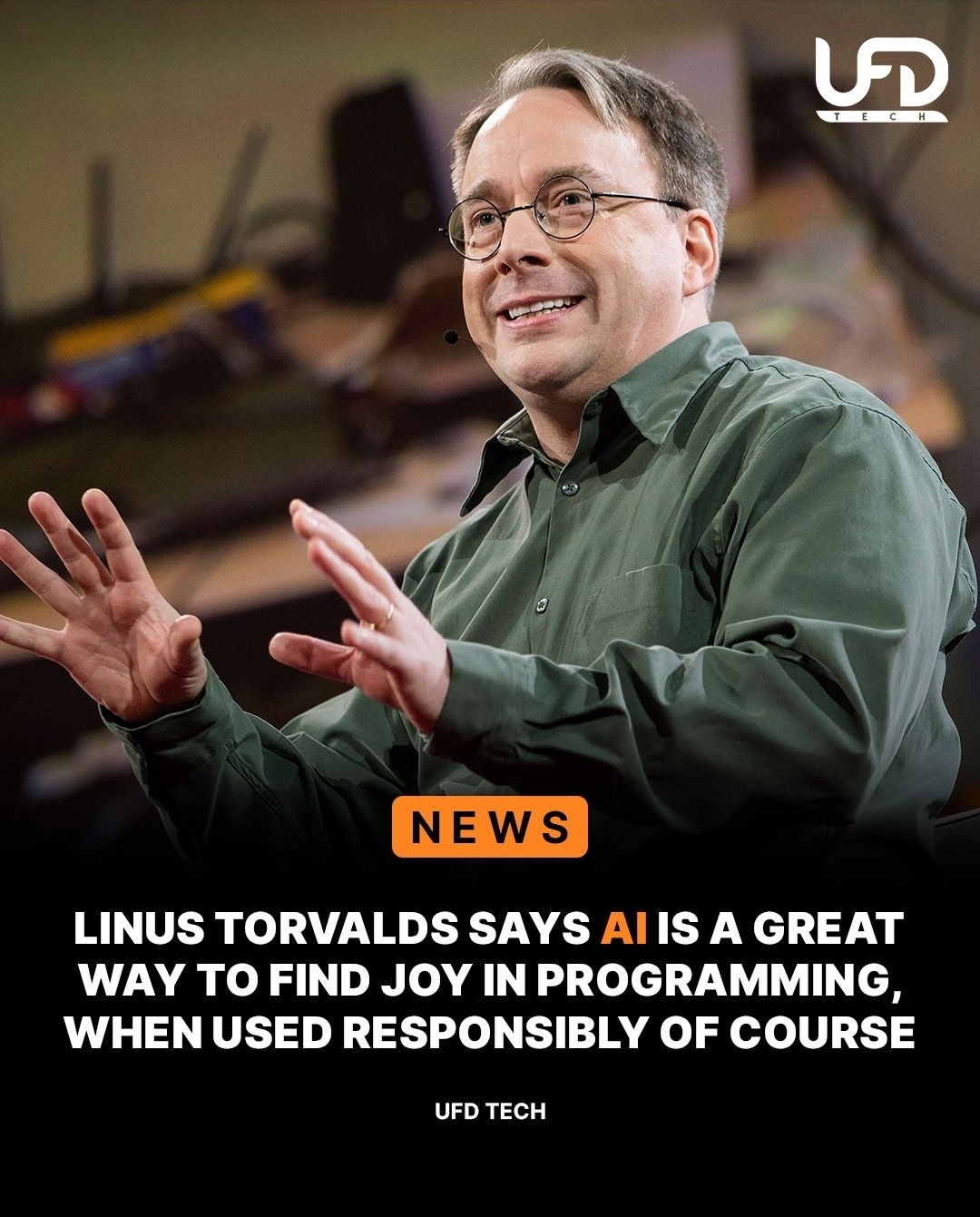
    Linus Torvalds says AI is a great way to find joy in programming, when used responsibly
     

    I have to start this specifying and expanding on what I refer when I say that I'm dyscalculic:

    1. I have both types of developmental dyscalculia.
    2. The functional type of dyscalculia I have is the intermediate dyscalculia; citing the dyscalculia definition page in Edubloxtutor, it's the «inability to work with symbols and numbers, especially when abstract signs (like √, ×, <, >) or large figures are involved. This type often overlaps with conditions like dyspraxia or dyslexia.» I don't have dyslexia though, but idk about the dyspraxia.
    3. I have the lexical and operational forms of dyscalculia. As per Edubloxtutor:
      • Lexical dyscalculia: This subtype refers to difficulties in reading and recognizing mathematical symbols, such as digits or operation signs. Students with this subtype may misread symbols (e.g., confusing a “6” with an “8” or “+” with “×”), which interferes with both understanding and solving problems.
        • I don't have so many difficulties with digits, only when they're either too big or too small, or if they have too many decimals.
      • Operational dyscalculia: Even when students understand the symbols and concepts involved, they may still struggle to carry out the steps of arithmetic operations (like borrowing or carrying in subtraction and addition). Operational dyscalculia reflects a breakdown in the ability to perform calculations in a logical and sequential manner.
    1. My cognitive subtype is the Memory Dyscalculia: «Weaknesses in both working memory and long-term memory, particularly in recalling arithmetic facts, procedures, or sequences.»
    2. I also struggle with ADHD and autism, as well as bipolar disorder, so these four things interact.
    3. I'm confident in that I'm actually really strong in formal logic, although only in natural language, because in symbolic formal logic I'm horrible (and that is to be expected, tho, because I struggle with abstract symbols in general); curiously, or perhaps predictably, and maybe I'm that good in logic because I'm that bad in maths.

    So, what I would like to know is, are there any programming languages (or maybe some libraries) that, despite being (or making these not-so-dyscalculic-friendly languages) accesible and not too math-centered (I want to avoid them as much as possible) and with a friendly learning curve, don't sacrifice that much performance, efficiency, lightweightness, security and all that?

    I'm particularly obsessed with performance, lightweightness and efficiency because I have a PC that, despite being actually decent (screenshot below), I constantly do hardware-intensive things and I love ricing, customizing and having powerful and featureful tools, but most of them are just so bloated (i.e. most Zettelstaken-style outliners are or written with Electron [or even Tauri], or too bare-bones, and I want both featurefulness AND efficiency, functionality AND lightweightness [I hate Suckless btw]).


    Also, I need to know, what are the best tutorials (if they're in Spanish, better, because I only understand well the written English, I struggle with spoken English), courses (same here) and resources in general to learn programming that are dyscalculia-friendly (better if they're explicitly tagged or categorized as such)?

    I feel really alienated because most of them do assume that you're idk, Ramanujan, or something like him, at least from my perspective and lived experience, and I'd really love to be able to program my own tools and to be able to contribute to projects I like with features I'd love to see there, and to fork some tainted projects and make an untainted version, etc.


    TL;DR:

    I have developmental dyscalculia (both functional and cognitive subtypes): intermediate functional (struggles with abstract symbols and large numbers), lexical (misreads math symbols, especially with many decimals or extreme sizes), operational (can't execute sequential arithmetic steps), and memory-based (poor working/long-term recall of arithmetic facts and procedures). I also have ADHD, autism, and bipolar disorder, which all interact. I'm strong in natural-language logic but weak in symbolic logic (expected, given my symbol difficulties).

    What I'm asking:

    1. Languages/libraries: Which programming languages or libraries are not math-heavy, have a gentle learning curve, and still deliver good performance, efficiency, and lightweightness? I want to avoid Electron/Tauri bloat and Suckless bare-bones; I want both featureful and efficient.
    2. Learning resources: What tutorials, courses, or resources exist that are explicitly dyscalculia-friendly (or at least don't assume strong number sense)? Spanish is strongly preferred; written English is fine, spoken English is not.

    Goal: Build my own tools, contribute features to projects I like, and fork/fix projects that are tainted by AI.


    PS: I mean tainted as per OpenSlopware definitions


    To frame this precisely: do you think that distinctions between cis-homosexuality/bisexuality/heterosexuality, trans-homosexuality/bisexuality/heterosexuality, and other gender-specific or gender-exclusive sexual orientation labels are necessary, or should we keep it minimal, or even abolish labels completely?

    And just to make everything clear, I have to disclose that I'm NOT part of the queer community, though I try to be as allied as humanly possible (I have three trans friends [two gay trans males, one lesbian trans female], one demi-pansexual genderfluid friend, etc., and I support and help all of them in everything I can). So, precisely because of this, I want to learn and know more about your ideas, feelings, experiences, philosophies, and beliefs. As I know the queer community isn't a monolith, I want to hear as many voices as possible so I can form more well-founded and well-informed opinions, questions, and actions. I equally support your rights and oppose all reactionary conservatives.

    That said, and back to the question that opens this post as its title, I ask this because I've noticed that it is (or could be) a problem in queer discourse, semantics, and semiotics, and I want to know how different people try to solve it.

    For example, I have mixed feelings because, on the one hand, I think that creating more specific labels could help both as a recognition of the different experiences and identities that constitute the queer spectrum, and in making communication clearer, respectful, clever, and less prone to errors, misunderstandings, misinterpretations, or conflicts (for example, I only like cisgender women, and I'm a cisgender male, but if I say that I'm heterosexual, I feel that it's not clear if I like cis women, or if I like trans women, or if I instead like both kinds of women, without further explanation that's not always possible, or a more specific term, and that could lead to a conflict of expectations). But at the same time, on the other hand, it feels like it over-compartmentalizes and over-atomizes something that's not completely discrete (although it's also not completely continuous), and can lead to division, or even to other kinds of exclusion and discrimination both inside the community and outside it.

    I know this is not an easy problem, so what are your thoughts on this?

    Please, keep this respectful, civil, and on-topic. To all the moderators of this space, I kindly ask you in advance that if this results in a conflict or a fight, please lock it.

    Love and peace.


    I think it would be really cool, don't you think the same?

    Like, using Iroh + INS for a fully descentralized, uncensorable, undeletable, non-redundant, fast, secure, private, efficient, directionable CAS, then binding that to ActivityPub —or even better, ActivityPods—, so you can register to the instances that are archiving what is more interesting to you and subscribe to the archivists and topics you prefer.

    Wouldn't be cool? Or do you think it's not as good as it seems to me?

    Edit: I mean, archiving the Web, like Wayback Machine (with a similar UX) but descentralized and 100% FLOSS.


    The title says it all. Basically, a truly free alternative to r/SomebodyMakeThis that is not on Reddit (or should I say Reshit? 😎), to basically connect people who have time, and/or money, and/or skills (but no ideas of what to do with them) with people who have ideas and perhaps theoretical knowledge (but not time, and/or money, and/or skills).

    I'm very good (I think) at programming theory, as well as broader computer science theory... But in practice I can barely make a (ugly and clunky) "Hello world" program in Python, and I have some pretty interesting and good (or at least I think so) ideas about software that would be really good if made (apps/programs, extensions, plugins and scripts for existing software, frameworks, libraries, algorithms, etc.).

    Is there something like this on the Threadiverse? And if so, could you give me the abbreviated identifiers/handles of some of those communities? That is, your !community@instance.tld. I thank you in advance.

    view more: next ›