It's shows up on mine.
I can't find a setting to disable alt text, either, so I'm not sure what would be preventing it from showing for you. Have you tried tapping on the image?
It's shows up on mine.
I can't find a setting to disable alt text, either, so I'm not sure what would be preventing it from showing for you. Have you tried tapping on the image?
Oh dang, streaming from my PC was one of the main reasons why I jumped for the Frame after having skipped all the other brands.
TinyWebGallery?
If you're talking about remote access specifically, I use tiers.
"Public" is open, but goes through crowdsec and anubis, and is on a DMZ network. This is my website, blog, Fediverse, etc.
"Private" is either secured with mtls or wireguard. This is stuff that's only for me or family, like media or home assistant.
"Sensitive" is wireguard only. This is infrastructure management, Paperless, etc.
Rsync.
You could leave the drive plugged in and schedule a daily/hourly sync, or you could have the system trigger a sync whenever you plug the drive in.
I'd mount it as a second storage location in Steam, then, within Steam, use the storage option to move the files over to the main library. That will ensure that they all get moved properly and reduce any potential issues.
That's exactly the use case for "tunnels": allowing public, incoming connections behind CGNAT.
Wireguard requires a public IP on at least one side of the connection and only allows private access. If you want to host a blog or website AND you're behind CGNAT, then a "tunnel" service is a very easy solution.
Edit: my previous blog post on the topic: https://blog.k3can.us/posts/2025/feb/2025-02-21_cloudflarefort/
Late to the party, but I have a second PBS instance that's at another family member's house.
Sounds like you're fairly invested in this, so why not reach out to the maintainer? It shouldn't be difficult for them to offer a signed hash.
...But keep in mind that most images are built using base images and various other dependencies, which could all also be compromised. It might be better to eliminate docker entirely.
I grabbed a used Lenovo Tiny I5 6500 with 16GB around the same time for $32 (even included the PSU). Now it looks like you can't even get just the RAM for that price.
I also bought a new Sapphire RX 6800 that year $399. It looks like the used ones are selling for around $500.
This was recently posted on Reddit and might be helpful.
https://www.reddit.com/r/openwrt/comments/1vwq1ey/google_nest_wifi_router_h2d_board_mistral_qcs404/
I use mTLS for Home Assistant and Navidrome.
It's very secure, the only limiting factor is that the client apps need to support them (or you use a PWA).
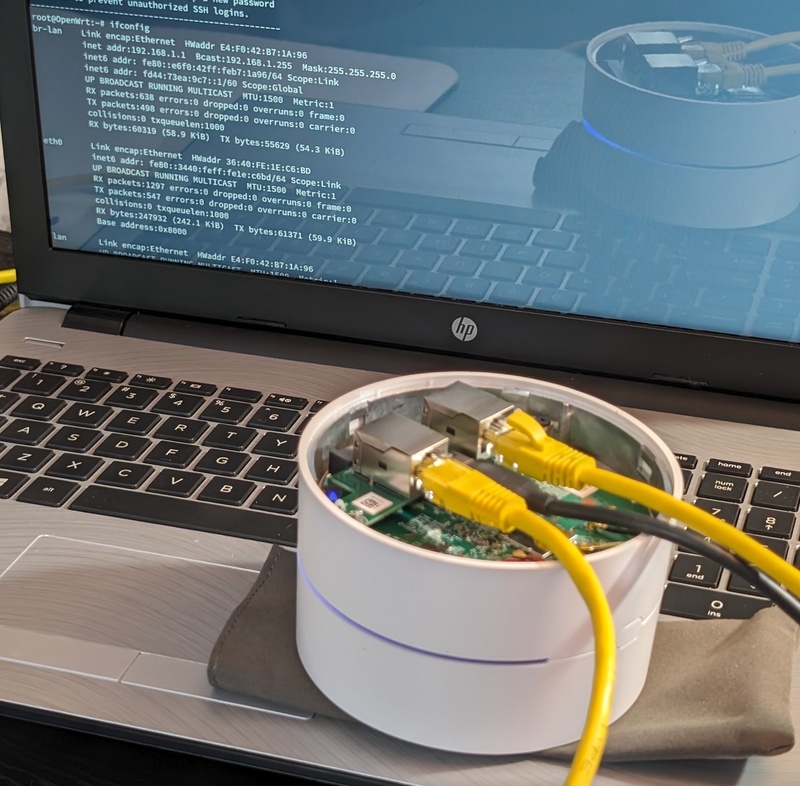
Someone on another Lemmy instance raised the question of whether an old wifi router could make a usable server of some sort, specifically a decade-old Google AC-1304. Since I happened to have a couple hanging around, I decided to give it a try.
I wrote a little about my experience in my blog but to summarize, I thought it would be fun to se if I could run a GoToSocial instance entirely on the router. It has an ARMv7 processor, 4GB of storage, and 512MB of RAM, so it falls a smidge short of the recommended minimum specs, but I figured that I might be able to get by if I kept the instance simple.
Surprisingly, GTS seemed to run fine after some basic configuration tweaks. The biggest issue I encountered was actually with ffmpeg, rather than GTS itself. The only GTS build available for ARMv7 is a nowasm build, meaning that it's missing the built-in media handling components, and instead relies on ffmpeg being proveded by the host system. The version of ffmpeg that ships with the OS I'm using (OpenWRT) didn't have the needed codecs to create webp files, which GTS requires when dealing with media. Using the OpenWRT SDK, I tried to build an ffmpeg package with the correct codecs, but it still failed to properly convert files to webp. My goal was just to run GTS, though, so I that digging deeper into ffmpeg felt like a tangent I didn't want to pursue.
But I digress. The instance is now online and running (though without media), and I created a simple bot account, named Gale, who will post a random fact about wifi and networking each day.
Feel free to give 'em a follow in your favorite Mastodon client at @gale@gts-googlewifi.k3can.us or you can view past toots here
Just wanted to share!